Up next in 10


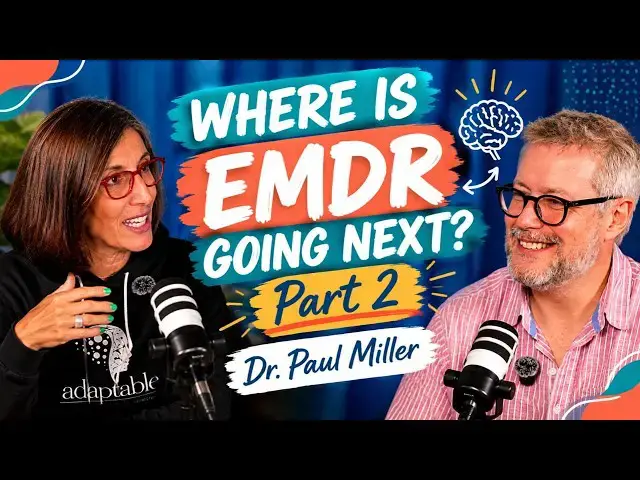
Welcome to Adaptable | Behavior Explained! This is recorded at the EMDRIA conference, Kelly talks with Paul Miller about clinical wisdom, developing perspectives, and questions shaping the future of EMDR therapy.
I'm Kelly O'Horo, Attachment based EMDR Therapist, EMDRIA Consultant, and Advanced Trainer. I'm a mom of 5, Nonna of 5, wife, and a healer. I have the honor of spending my workdays walking along side people while they brave their healing journeys. I try to live with the generous assumption that we're all doing the best we can with what we know. Therapists are teachers for the "life stuff" and "emotional vocabulary" that may not have been learned due to gaps in our care givers capabilities. In the last 15 years I've learned that people are freaking amazing, resilient, and inspiring. Most importantly, we are hardwired for connection and for healing!
I hope to bring an authentic, compassionate, and unpolished approach while we explore a variety of topics such as parenting, marriage, relationships, dating, trauma, attachment, adoption, depression, addiction, anxiety, and love! There's a why for all behaviors and an explanation that makes perfect sense as emotion is at the root of it all.
-- Links --
https://linktr.ee/kellyohorolpc
https://youtu.be/rLnARKekvgo
https://www.emdria.org/find-an-emdr-therapist/
Show More Show Less View Video Transcript
0:06
Hi everyone, I'm Kelly O'Horo and this
0:09
is Adaptable Behavior Explained. Welcome
0:12
back to Adaptable. I'm so excited to
0:14
have you here. We're live at Andrea with
0:16
therapists who are eager to learn more
0:19
innovative ways that we can help others.
0:21
And as you all know, I'm have this
0:23
series where I'm lucky enough to
0:24
interview awesome, amazing people that
0:27
are contributing to uh exciting ways to
0:31
improve the way that we help our clients
0:33
heal. And we've got Paul Miller
0:35
returning for an episode two because we
0:37
didn't even get into some of the really
0:39
awesome stuff that he's been doing. And
0:42
first of all, thank you for the last bit
0:44
of the of the show. And if you didn't
0:45
see episode one, please tune in to that
0:48
uh with Paul Miller. uh you have to see
0:50
it to get the gist of what we're talking
0:52
about, but we're going to continue the
0:53
conversation and uh you've been
0:55
interested in psych psychedelic
0:57
research. What sparked that curiosity
0:59
for you and tell me where you're at with
1:00
that part of your work.
1:02
>> Okay. Yeah. Thanks. I mean, it's been a
1:04
fantastic part there there's there's
1:06
loads I guess for much of I mean I've
1:09
been doing what I've been doing for 30
1:10
years and so a part of that 30 years
1:12
journey has been a journey with my own
1:15
trauma history. And so part of that I
1:18
think I was reaching a stage where it
1:20
used to be that around this sort of age
1:23
and stage many psychiatrists could
1:25
retire and and I was pretty to be honest
1:28
I I really was pretty burnt out. So I
1:30
started a course well started course
1:33
with IP and that was looking at really
1:35
the the MAPS MDMA training. We then did
1:40
training around ketamine and we did
1:41
training on psilocybin. And so I was
1:44
very blessed to have people in my circle
1:46
of influence and stuff who were very um
1:50
skilled had long legacy with regards to
1:52
journaling with psychedelics and I could
1:55
go busy with them and experience
1:58
psychedelics in the legal sort of safe
2:00
and accessible and I realize I'm very
2:03
privileged for that. But it it really
2:05
made a huge difference for me because it
2:06
meant that stuff that I hadn't been able
2:09
to really journey with in my apartment
2:12
experiences traumatic death of an older
2:15
sister um uh when I was 11. She was 18.
2:19
She died in a motorbike accident coming
2:21
back from her honeymoon. Um very
2:24
traumatic family dissolution following
2:26
that. Um mother's abandonment of the
2:29
family really. And although again it's
2:33
possible to understand these traumas,
2:35
understanding doesn't take away
2:36
everything. It's a good hand. And so I
2:40
think but there was always a part of me
2:41
that um I felt still wasn't quite being
2:45
reached. And so with to really
2:48
>> and you had done EMDR before? Yeah, I've
2:51
been very blessed to be able to access
2:53
EMDR and done that and I felt I had done
2:56
a lot of healing around it as well and
2:58
found like I guess the way Francine
3:00
always put it it was I'd reached an
3:02
adaptive plate so like I was at the
3:03
train station I felt comfortable with
3:05
that and I' done a bit of exploring
3:07
>> but I was always open to the need to do
3:11
more exploring to do I think after 30
3:14
years of saying expertise there was a
3:17
sense of really the limitations medicine
3:20
that we had and um
3:24
SSRI are are becoming very effective. I
3:26
think they're often overused in the
3:29
absence of the provision of
3:31
psychotherrapeutic endeavor. And so the
3:34
the beauty of this wonderful group that
3:36
I was working with then who was very
3:39
experienced in the psychedelic space had
3:42
been approached to do some psychedelic
3:45
research in Northern Ireland and he
3:47
didn't have capacity so he passed it to
3:48
me. So I was very blessed to have this
3:51
wonderful opportunity. We made an
3:52
amazing team um with a group called uh
3:56
transcend therapeutics and so their
3:58
medicine not really heard of by a lot of
4:01
people but is methodone or MDMC. So it's
4:03
a it's an analog of um MDNA
4:08
really some some distinct aspects to it.
4:10
we refer to it as a rapidly acting
4:12
neuroplast. So it's broadly speaking in
4:15
a pathogen similar
4:17
uh you know but similar to that
4:20
psychedelic space and so for me my first
4:23
journey then with experiential stuff was
4:26
with psilocybin and so a high psilocybin
4:29
experience for me was just really
4:32
transformative and so a bit like it was
4:35
the first time really that took me back
4:37
to my very similar experience with
4:39
training back in 1997
4:42
of doing I'm thinking like is this just
4:46
you know the the technical term we use
4:48
is this just
4:50
and uh you think yeah is this just like
4:54
overselling here you know but yet the
4:57
EMDR and then seeing and seeing how
4:58
people genius was really pretty
5:00
transformational and then I was
5:02
confronted by this group of individuals
5:05
who were doing amazing healing work done
5:07
amazing personal healing work and
5:09
journeying um and using psychedelic
5:12
medicine is very respectful way and
5:16
uh think got to treat this with you know
5:20
the seriousness that it has. I became
5:23
very familiar as an academic then with
5:25
looking at the literature around it and
5:28
um but the experience over them was
5:31
something
5:32
and so then we had the the really
5:34
wonderful opportunity results are now
5:36
published so with transcend and met with
5:39
them and seeing officers and police
5:41
officers out that sort of that
5:45
population that I've known and worked
5:46
with for 25 years to see them utterly
5:51
in medicine and we had an open label um
5:54
to start with so we knew they were
5:57
getting it and I knew they were getting
5:58
it and it honestly such a wonderful
6:00
medicine signals around pain for people
6:04
that you know also the top of the
6:05
research we've done we're just about to
6:06
move into phase three and uh that was
6:10
super exciting and I think it it has
6:12
amazing pros so we got to look at all
6:15
the psychedelics really and uh so
6:17
mushrooms being the first MDMA methone
6:21
Um but there there's lots more work like
6:24
Sasha Shogun's work and other other
6:28
options that are coming in the we look
6:32
at the history but MMA when it was first
6:34
introduced was known as emp
6:38
sense of being able to many police
6:40
officers military traumatized
6:42
individuals the thing is it can trust
6:44
the person I'm sitting and so a medicine
6:47
that that helps the person do something
6:49
that we want to do helps build a therapy
6:52
retainer. The psychiatrist Tom Burns
6:55
who's a rehabilitation psychiatrist
6:56
wrote a wonderful book called um
6:58
psychiatry are necessary shadow and
7:01
within it one of the things that he says
7:03
more or less I'm probably not entirely
7:05
quoting him exactly but I've always
7:07
remembered it as he talked about mental
7:10
illness has a common thread. It happens
7:13
in the space between people and so that
7:17
sense of if we're going to work on that
7:18
material that really need to be and so
7:21
the therapist is a really important part
7:23
of it. Tim Berry obviously famously
7:26
talked about set mindset and setting the
7:29
environment where we do things. Um but
7:31
my clinical team we also feel that we
7:34
need to add sitter because the sitter
7:37
brings a a dynamic modifiable changeable
7:41
um energetic force and so Harry Bergen
7:45
and I have long talked about and believe
7:47
that we set up and create an energetic
7:50
diad and we're doing that within the MDR
7:54
and especially when we're doing work
7:56
with complex cases when we're working
7:58
with schizophrenia
7:59
of all sorts.
8:01
Um actually the most important thing is
8:03
still doing the basics well doing you
8:06
know doing the making of the therapeutic
8:09
lines and I see the psych many of the
8:11
psychedelics help
8:12
>> yeah that energetic container it's
8:14
really important that we're wired for
8:15
that.
8:16
>> So the psychedelic work I think to me
8:19
it's obviously the focus at the moment
8:21
is with regards to FDA licensing for
8:25
these different medicines. there's a
8:26
reciprocity within MH in Europe and I
8:30
think we're going to have these things
8:31
certainly by 2030 we'll be able to play
8:34
it'll be that long
8:35
>> I don't think it will be I I think we're
8:37
probably looking at well NMAS is
8:39
resubmitted
8:41
um and so potentially you know that
8:44
could come to quite quickly we're in
8:45
2026 maybe we're looking at 2027 for
8:49
some sort of ruling let's hope it is in
8:52
favor um my understanding is that the MH
8:55
in Europe then has a reciprocity
8:58
agreement that they will follow suit
9:01
with FDA within 18 months unless they
9:05
need to oppose it rationale for that. I
9:08
hope they don't. Um I think I have two
9:11
hopes for the future. I think that these
9:14
medicine used we need to do some
9:18
specific research and looking at the
9:19
medicines and how we use everything. Um
9:23
and I have colleagues that I'm looking
9:25
at with some of that stuff and really
9:27
wonderful collaborators joining Rose
9:30
who's written an excellent book on um
9:33
psychedelic EMDR therapy um with her
9:36
colleague who's never forget
9:39
and then but also one of my supervises
9:41
who's been working with the hummingbird
9:43
church um and looking at their sacrament
9:48
is Iaska so looking at Iawaska but doing
9:52
G10 prior to that was a preparation and
9:54
engine test was a part of integration.
9:57
So there's lots of really super
9:58
interesting work that's out there. I
10:00
think the legislative getting things
10:02
accredited sort of muddies of water at
10:04
the minute because for me the most
10:06
exciting thing as an academic and a
10:07
commission is beginning to look at what
10:11
you do what's the therapeutic stuff.
10:13
Okay, you you've made it legal, so off.
10:16
Um, but I think there's lots of stuff.
10:18
Certainly,
10:19
I'm hearing an increasing number of
10:21
people are journeying
10:23
bases and like the reality is with the
10:25
right wisdom. Some people are not
10:27
allowed. They're looking at systems that
10:28
can't cope and they're just going to
10:30
pick on their own like, you know, that's
10:33
what we're seeing now. And I'm not going
10:35
to go tell you to do that. It's not
10:37
legal. And let's work on the things that
10:39
are now available thanks to that
10:40
experience you had.
10:41
>> Yeah. It's not something that we even,
10:43
you know, I don't see myself as someone
10:45
who is there as the the arbiter or the
10:47
the social policeman, but but what we're
10:49
seeing increasingly is people coming to
10:51
us, they're saying like, I, you know,
10:53
I've had to wait for a long time. I've
10:54
tried multiple medications. If we look
10:56
at the STARD research,
10:58
>> by the time you get to your third
11:00
medication, um, your likelihood of of
11:03
responding to acid is 11%. Now it it's
11:08
not quite as simple as that because
11:09
whenever some of the research was
11:10
explored and looked at there is a group
11:12
that do much better than that on the
11:14
third medication. Um but what start what
11:17
whenever they look at the start data and
11:19
they pared it out there is a group of
11:20
people who are failing to respond and I
11:23
actually select serotone reuptake
11:25
inhibitors and combinations um actually
11:27
will make people worse. So I have
11:29
colleagues and and mentors like for
11:31
example Ken Gilman in Australia and Ken
11:34
is really championing the the reuse of
11:37
of monoimoxides inhibitors and they they
11:40
truly wonderful medications. Again I'm
11:43
intrigued because some of the the down
11:46
channel signals of those and Ken writes
11:48
really elegantly in his website uh which
11:50
is psychotropical. P S Y C H O T G R P I
11:55
C A L psychotropical.com
11:58
but if you search for Ken Gilman but
12:01
really good information about these kind
12:03
of cases and I think there's a lot of
12:05
stuff which comes up they're not
12:06
suitable
12:08
but a lot of it's just market and then
12:10
they get priced out of things too that's
12:13
changing people are increasingly well
12:15
informed about their own health and what
12:17
they would like to try but I think the
12:19
the role that we're seeing with me
12:22
increasing the potential growth within
12:24
the brain and the brain tropic factor
12:27
receptors etc and things. I think all
12:29
these are very interesting areas to look
12:31
at. um the sense of ego to the solution
12:34
uh the sense of the fundamental
12:36
interconnectedness of everything as
12:38
Douglas Adams said and the uh in terms
12:42
of his work uh when he wrote about the
12:45
the fiction of the tech he wrote about
12:47
one of the favorite books is the long
12:49
dark tea time of the soul but he talked
12:52
about the fundamental interconnectedness
12:54
of things and we're seeing that with the
12:56
psychedelics sense of dissonance sense
12:58
of belonging one of the things of people
13:01
traumatized is that sense of isolation
13:03
and so not that there's an interview we
13:07
can see on YouTube with with Carl Young
13:10
and he's asked the question do you
13:11
believe with God and Y's answer is no I
13:15
don't believe
13:19
and I think whenever we begin to look at
13:20
that my own journey the mystical
13:23
tradition of of faith Christianity
13:27
exploring that connection with the
13:29
divine journey set in essence and
13:34
um for me the divine I think I've be
13:38
talking about my experience in different
13:40
phases of my career first being what was
13:43
like from my surgical career still quite
13:46
interventional
13:47
um very early stage of physician surgeon
13:51
but moving to psychiatry then I was like
13:53
okay so we can be interventional about
13:55
EMDR and the different things we do I
13:57
can give medications but moving then to
14:00
the sense that we can't always be
14:02
intervention. We can't bring the end
14:04
>> right
14:04
>> and we talk about Hav
14:10
is not certain that everything will turn
14:11
out well. We can't guarantee that we
14:14
can't bring meaning to a person's
14:15
journey. But I think really after 30
14:18
years the place I find myself now both
14:20
with my own journey of mental health and
14:22
wellbeing but also the journey I've made
14:24
with people very complex and we're
14:26
seeing it within our ketamine service
14:29
within the psychedelic stuff is
14:32
much more for us to be invited to be um
14:36
people who accompany and so to be with a
14:38
person that often doesn't mean we're
14:41
taking away the trauma but we we're
14:43
accompases
14:45
are wonderful I I think it's interesting
14:47
the world of psychiatrists have faced
14:48
the psychedelic stuff within uh you know
14:53
the people who are still looking at
14:55
electrical propulsive therapy and stuff
14:57
the first second page of their document
14:59
around psychedelics is always
15:01
pharmarmacology I can't help but feel to
15:03
some degree that whilst it's a worthy
15:07
misses the point in terms of questions
15:10
that we really ought to be engaging with
15:12
psychiatrists and professions I'm a
15:15
shame
15:16
ask the questions of what is it? Who is
15:21
what is the mind that knows this thing
15:23
or searches for this thing? Is there
15:26
something greater than us? Um we look at
15:30
the work of people like Paul and the
15:32
ground of all being he refers to you
15:35
know how people experience spirit and I
15:38
think these medications as Stan R has
15:40
said we've all specific psychic
15:43
amplifiers. The risk is they cannot
15:46
apply bad stuff to there is the
15:48
potential for harm. We see this with
15:50
many people doing this on the ground and
15:53
like as I've said to people before one
15:54
of my patients said to me I've taken my
15:56
body weight in MDMA over decades and it
15:59
hasn't made me a better person or or
16:01
better with it like it you know it
16:03
really screwed up his life and so the
16:06
reality is it's very important that we
16:08
create that space between us and we
16:12
create the healthy psych spiritual
16:14
communities that help people and that we
16:17
are honest about the potential harm that
16:19
they can the potential restrictions um
16:23
that people have as far as accessing
16:26
people and it's challenging these you
16:28
know many of these things can end very
16:30
expensive
16:32
and so I think we've got to look at that
16:34
I would like our legislators and society
16:37
to begin to look at these medicines and
16:40
also think we ought not to restrict
16:43
these medicines and for many years I've
16:45
been as rights and
16:47
rights of enlightenment knowing the
16:50
meeting and connecting with the divine
16:53
as you know it choose to define it and I
16:56
think with all of those things as we
17:00
we
17:01
wisdom around that and we also need to
17:04
not make mental health and wellbeing
17:06
something that people are limited to
17:09
what tools they have because they
17:11
haven't chosen or aren't willing to take
17:14
a specific oh I'm sick I'm broken I've
17:16
got depressed depression I've got this
17:19
thing called schizophrenia or I've got
17:20
this thing called PTSD.
17:23
I think there are lots of people who
17:24
come and say I just don't appropriate or
17:27
you know I want to just add a little bit
17:29
deeper and I want to you know there's a
17:30
bit that I can't quite scratch it and I
17:32
think there's a way to do that. So I
17:34
think there's a maturity
17:35
>> assisted psychotherapy and we went
17:37
through the training as a team and you
17:39
know the the baseline measurements of
17:41
what we should be referring out and my
17:44
personal philosophy was if you can
17:46
afford it and you are not a
17:47
contraindicated person we should let you
17:50
do this cuz it's so cheap and like just
17:52
the opening and the space that happens
17:54
in just that medicine and that's the
17:56
only one that you know is currently
17:58
>> I think we got to move
17:59
>> off label for no we've got to move away
18:02
from We in my opinion agree with you.
18:04
We've got to move away from the medical
18:06
paternalism
18:06
>> right
18:07
>> and any sense that we control
18:10
um what people feel that they want to do
18:13
as a part of their journey of
18:14
self-nowledge and of knowledge around
18:17
>> why does it why does there have to be a
18:18
problem before we can find solutions. I
18:20
I think we should it's a really you know
18:22
I've seen that work in across my 30-year
18:24
career in unhelpful ways that you have
18:27
new services that would be set up but
18:29
this is a service for personality
18:30
disorder and so people who have complex
18:33
PTSD suddenly need to get it label of
18:36
personality disorder acts as a service
18:38
great but try getting rid of the label
18:41
then not so good and so you know we need
18:44
to look at this and I think be more
18:46
mature about a way forward and I think
18:49
psych pschiatry probably needs to find
18:52
its soul again and uh I think that's
18:54
going to be a challenge for many people.
18:56
Um but I think that there's a
18:58
requirement for that that we we ought
19:00
not require people to exclude or move
19:03
away from the soul whenever the
19:05
psychospiritual has been such a part of
19:07
what we've been doing as a profession in
19:10
terms of mental health for a very long
19:11
time and if we look at the indigenous
19:13
heaters in the movie for example Phil
19:15
Bours's movie Crazy Wise and we begin to
19:18
look at you know his discussion of what
19:21
we saw for example his work with the
19:23
Dalai Lama shaman
19:25
>> and then we begin to look the people
19:26
that we as a society label as you know
19:30
schizophrenic or psychotic. Um so you
19:34
see these are the same things and but
19:36
the label that we give them becomes very
19:38
different and outcomes are are
19:39
predicated and related to that.
19:41
>> I think it foos us as professionals and
19:43
people to look at
19:46
>> yeah needing to slap something on that
19:49
is a negative impact in so many other
19:51
areas of their life just so that they
19:52
can become better in those same areas.
19:55
It's just it's it's counterintuitive to
19:57
just overall wellness.
19:59
>> It is. And I think we can begin to look
20:00
at things in terms of like the work I've
20:02
done with Professor Derek Farrell and
20:04
and Sunonny Bravetto with first
20:06
responders and early interventions using
20:08
ASAP uh which is a modified version of
20:11
GTA that we we developed for first
20:13
responders with with the land super
20:15
permission. Alan has built wonderfully
20:17
on it. the but again the article he
20:20
published um jointly looking at GTAP and
20:23
stuff because it's so highly scripted
20:25
it'll always be conceived to be uh um
20:28
self
20:30
but again we want to be able to hold the
20:32
space correctly and so we need to that
20:34
space needs to have the right energy
20:36
>> placed into it so I think we as
20:38
therapists first of all I think need to
20:40
have a humility about that
20:43
when I worked with Kenneth Candler in
20:46
regards to his work in the genetics of
20:48
schizophrenia the phenomenology of
20:50
schizophrenia etc within DSM5 or DSM3R
20:54
was becoming DSM4 he would talk about
20:58
the danger of epistic hubris that I know
21:01
it all this is the answer people just
21:03
need to understand this I understand and
21:05
so I think it's we should always
21:07
encourage questions and we should always
21:09
encourage exploration and I think yes
21:12
okay it is important that our
21:14
legislators and regulators regulate
21:16
these very powerful
21:18
And at the same time, they've been
21:19
available to mankind, humankind for
21:24
millennia and used, you know,
21:26
[laughter and clears throat] we look at
21:27
the indigenous wisdom of the Shepivo
21:29
people and the work with mushrooms and
21:32
second mushrooms are right across the
21:35
world. Um, we look at the the amazing
21:37
work of the people like Paul Stannis and
21:41
they challenge us and they invite us to
21:43
be able to look at these medicines and
21:44
see what role do they have. I don't
21:46
think we ought to predicate their
21:48
availability to people who are in so
21:51
much according to us sick,
21:54
>> right?
21:55
>> So fascinating and there's so much more
21:58
to learn and so little of the brain that
22:00
we fully understand and the pathways
22:03
that open because of these medicines.
22:05
And we talked a little bit last night
22:07
about my own personal bias. I was a kid
22:09
with the, you know, the 80s where DARE
22:11
and drugs are bad and don't cook your
22:13
brain, all of these things. It just
22:15
does, you know, and it's like it's been
22:16
such a metamorphosis for me to recognize
22:19
the openings that can that can occur and
22:22
the healing that can happen as a result
22:23
of these powerful medicines. And I think
22:26
about like even the MDMA studies and and
22:28
some of these clients that you've just
22:30
worked for so long to build those
22:32
connective pathways that are just about
22:34
I'm safe and we're okay and you can
22:36
trust me. Absolutely.
22:37
>> Cuz there was nothing and we were
22:38
starting from no pathways. And it's like
22:40
if we could fast forward just that
22:43
piece, how quickly we could move and and
22:45
they're losing so much of their life
22:47
over the weight.
22:48
>> If you have never felt safe, [laughter]
22:51
I can tell you about the the networks
22:54
and the mirror neurons. I can tell you
22:56
about the parts of the brain. Oh yeah,
22:58
we're like we're working on this. But
23:00
again one of my supervises I think it
23:02
was talked about it in terms of if we
23:04
think about our smartome
23:06
>> that um the area of the brain that deals
23:08
with affect regulation and adult the
23:10
dorsal prefrontal cortex this is the
23:13
area that deals with attachment you so
23:16
the unattached or disregulated attached
23:19
individual
23:21
becomes a disregulated adult who is
23:23
unable to regulate their emotions and I
23:25
think the amazing thing has been that
23:27
when we look at the work people like
23:28
Robin Khart Harris talks well about this
23:30
with his reeba small mall and he uses
23:32
the example of if we take the example of
23:35
a you know a snow field and I've been
23:37
skiing from my hut down into the village
23:39
to get provisions but I've been skiing
23:41
the same route every day there's a rut
23:43
in the snow and the problem is that rut
23:45
takes me underneath the train I bang my
23:47
head in the branch every time I go down
23:49
and the psychedelics are like a fresh
23:52
fall of snow choose a different route I
23:55
don't have to ski on that tree where I
23:57
bang my head and So it begins in a very
24:01
experiential way. First of all, the the
24:05
[laughter]
24:06
pathogens and the rapid acting
24:07
neuroplast methylone and MMA that it's
24:12
not a cognitive thing that people are
24:14
engaging with. They feel it much as Jung
24:17
talked about don't believe in God. They
24:18
don't need to believe in the therapeutic
24:20
process.
24:21
>> They experience it. They know it from
24:24
firsthand. And I think there's a beauty
24:26
of that. Um there's a responsibility for
24:28
that because I can choose to ski under
24:30
the tree by their head and some people
24:32
do that. Um,
24:34
>> you had mentioned that last night about,
24:36
you know, like if someone with more
24:37
narcissistic traits
24:39
>> does the treatments and they're not
24:41
necessarily open to seeing that side of
24:44
themsel that it can backfire and
24:46
>> yeah, I think that I mean the the
24:48
research literature in the field would
24:49
talk about that. Stan calls them
24:52
non-specific psychic amplifiers and so
24:54
they can amplify the negative and the
24:56
person who is unwilling to to look at
24:59
themselves through a lens of love and
25:01
see themselves potentially differently
25:03
>> or lacks the capacity to do so. the re
25:06
the dangers they just reinforce that
25:08
>> right
25:08
>> and so you know in a sense we can't
25:11
scream how do we decide right
25:12
>> yeah yeah exactly and I think you know
25:14
we're not the moral arbiter of that but
25:16
we have to be as much as possible saying
25:18
to people this is perhaps not the wisest
25:20
thing for you to do I'll provide people
25:23
to do that
25:24
>> I think the importance for that is that
25:25
there certainly we would have seen my
25:28
work with schizophrenia and psychosis
25:29
that people would have had lots of ideas
25:31
oh if you engage with the voices you
25:33
engage with delusional system you don't
25:34
challenge that that that is damaging.
25:37
That's a myth that's out there and it's
25:38
wrong. The studies have shown that
25:40
that's not what people find and we move
25:44
towards the adaptive resolution and
25:47
always working towards a balance which
25:50
is dynamic. It's not a static thing, you
25:52
know, and and Francine, I think as she
25:55
pulled together and defined the adaptive
25:58
information processing with with Roger
26:00
Solomon, the beauty of that was it
26:02
recognizes that dynamism and I think I'm
26:05
really encouraged and I want to
26:07
encourage people to increasingly
26:09
um look at the role for EMDR within the
26:12
psychedelic space because I think it's
26:14
really important. I think the other
26:16
thing which is again we're quite we're
26:18
bit further away from it yet but you
26:21
know I was encouraged to again by
26:24
Francine and Jim Kn and we had that
26:26
conversation on a uh sort of we patch of
26:29
grass having lunch out outside the the
26:32
conference center in Philadelphia and we
26:34
began to look at treating you know why
26:36
not is this not relevant for all
26:38
schizophrenia or all psychosis
26:39
>> right
26:40
>> and when I indeed looked at that that
26:42
that's what I found clinically and then
26:45
the Dutch have really advanced that
26:46
research which was great and and I think
26:50
it's been very powerful to do that. I
26:51
think I hear in a similar way a
26:53
prohibition to working with psychosis
26:55
and schizophrenia within the psychedelic
26:58
space and I understand the need for us
27:00
to be careful about that
27:03
>> but I'm just constantly interested in
27:06
>> I can see you being you know a bit of an
27:07
envelope pusher on these topics and I'm
27:09
thinking these people if they're so sick
27:12
then what are we risking if there's an
27:14
opportunity for them to heal why are we
27:16
being so
27:17
>> cautious when they're not living in a
27:20
full space of human experience that is
27:23
integrated or at least aware of the
27:25
potential of some integration and and
27:27
the relationships that suffer as a
27:28
result is so much loneliness and chronic
27:30
pain. I think that's really important
27:32
because I think this is what we came to
27:34
in the work that I did with colleagues
27:36
like um professor Martin Sinclair and
27:39
others whenever we looked at the
27:40
perinatal space and then again Mara
27:43
Tesarstein now really teaches
27:44
wonderfully on this whole area and of
27:46
course I've got to mention Phyllis Kl
27:49
and her work and and her husband uh
27:52
again together in the whole peral space
27:55
because there was an understandable
27:56
place where Francine wanted to say like
27:58
we've got to be aware of pregnancy and
28:00
such thing, but it wasn't predicated on
28:04
data,
28:04
>> right? And we're still answering this
28:07
question every single time. And it's
28:09
like, Mara and I talked about that
28:11
earlier today. Like, please, we have to
28:14
scream this everywhere.
28:15
>> We do. And and the challenge is that we
28:17
got to bear in mind that doing nothing
28:19
is not a neutral act.
28:21
>> Oh, say that again.
28:23
>> Doing nothing is not a neutral act.
28:25
>> I love that. Yeah. You know, so
28:27
important. So I think I I am intrigued
28:31
let's call it at the minute that many of
28:33
the individuals that I've known and
28:35
worked with within who would have given
28:38
and have had diagnoses of psychosis that
28:41
creating that loving container has
28:43
helped me to be able to hold them and to
28:45
work through this stuff and I can only
28:48
see how again some of the psychedelics
28:51
psycholytic dose of academy for example
28:54
wrote on breer and his work has been
28:56
fantastic around that I encourage
28:57
encourage everybody to to look at his
28:59
work. I love his most recent book where
29:01
he's talking and inviting people to look
29:03
back again at the the important of the
29:05
relational and again uh Mark Dwarkin's
29:09
book a mentor to me in terms of EMDR and
29:11
the relational imperative. um these are
29:14
really important active agents that we
29:16
consider it and I think doing the basics
29:18
well with the more complex cases is
29:21
super important and I do feel that the
29:24
deeply symbolic as I see it language of
29:27
the person experiences psychotic state
29:30
that we remember right back to the time
29:32
of Oregon when he coined the term but
29:34
we've got to remember the term was
29:36
coined as the schizophrenia it was
29:39
plural so there is a range and I think
29:41
there probably are some people who are
29:43
very organically driven. We poorly
29:44
understand it at times and they're not
29:47
going to be amenable to
29:48
psychotherrapeutic endeavor but we have
29:50
a person a therapist who's skilled and
29:53
who can judge am I able to engage with
29:57
this person is this person able to
29:59
engage and so I think some of the fears
30:01
we have
30:01
>> we be friend with everyone in there and
30:03
if possible
30:04
>> maybe there is potential and change
30:07
>> I think there could be potential
30:09
>> wonderful we need to do the research
30:11
>> yeah right always but what a what an
30:13
exciting exciting time and what a
30:15
blessing for me to get to talk to you
30:16
today and man it just makes me know how
30:20
much I don't know the more I speak with
30:22
people today I just am like well it's
30:24
nice that I'm brand new and even though
30:26
I've been doing it 15 years you know
30:28
it's just fascinating to hear that and
30:30
it's so exciting
30:31
>> it's important because I think the thing
30:32
is
30:33
>> the humility I think is the is what what
30:35
I'm hoping everybody who gets to watch
30:36
this feels you know it's just like
30:38
>> it's it's really really important and
30:40
like one of the things I'll leave you
30:42
with then is who when we Look at the
30:44
work again, comedy, you know, films,
30:47
movies, books and stuff and the
30:49
mythopoetics of it often teaches us
30:51
things that we in our very serious state
30:53
sometimes forget. And so when we look at
30:56
the the work the last work written by um
31:00
Douglas Adams was a book and also a
31:03
computer game uh called Starship
31:05
Titanic.
31:06
>> Okay.
31:07
>> Yeah. And um it had at the center of it
31:11
a a game that you had to solve to get
31:13
the code for opening a safe. And in
31:15
those days, this is years ago now, back
31:17
in the '9s, and there was like a list
31:20
discussion thing you had. That was
31:22
pretty tough to solve, but the solution
31:24
to the to the vault to open the vault
31:27
was nobody likes a smartass. [laughter]
31:31
And and I think it was it was just so
31:35
him, you know, and and it was also like
31:37
and nobody trusts a smartass,
31:39
>> you know, people I think dangerous as
31:41
therapists and certainly I was guilty of
31:43
this as a younger therapist, you know,
31:45
it's like we feel like I have to have
31:46
all the answers and Nobody
31:49
does.
31:49
>> Nobody does.
31:50
>> And we shouldn't trust people who have
31:51
all the answers because they don't. The
31:53
one thing we can be sure of is that they
31:55
do not because the the the whole thing
31:57
is it's about meeting the person where
31:59
they are. And if I can't fully know you,
32:02
how can I fully have the answer?
32:04
>> You know, that just never made sense to
32:06
me.
32:06
>> Always just ends up with curiosity is
32:08
the next step. And
32:09
>> absolutely
32:10
>> approaching with that curiosity and
32:11
compassion is really the only answer in
32:14
any of those defensive stances.
32:15
Otherwise, we've lost before we've
32:17
begun.
32:18
>> We have and I think that's why it's
32:19
important that we also do our own
32:21
healing. And I think in the psychedelic
32:22
space as with the ENTR as well, I think
32:25
>> there's such an important part of it
32:27
which becomes an apprenticeship. And so
32:29
it's not just a book learning. It's not
32:31
just getting right certificate.
32:33
>> It is an experiential do your own work.
32:36
>> Yeah.
32:36
>> Because if you do wish we were requiring
32:38
it, I will tell you. I think we should
32:41
too. I know that I was chiming in when
32:42
we were revamping the approved
32:44
consultant
32:45
>> rules like this should be a part of it.
32:47
like we must count x amount of
32:49
therapeutic hours in this space in order
32:51
to kind of clean up our own side of the
32:52
street.
32:52
>> Totally. And I say to people, you know,
32:54
if [snorts] you're looking for a
32:55
therapist, okay, look at their
32:57
credentials and stuff. Fine. But I think
32:59
the most important thing you do is you
33:01
say, you talk to them, you say, are you
33:03
doing your work? How are you doing your
33:05
work?
33:06
>> What things have you done to do your
33:07
work? Do you continue to do your work?
33:08
How do you find your blind spots? I
33:10
know. I'm like and if they say you work
33:12
with somebody no if they if they say
33:14
it's none of your business or that's not
33:15
an appropriate question next [laughter]
33:18
>> that's a quick that's a quick tell.
33:20
Yeah. Like we're going to find someone
33:21
who. So thank you so much for spending
33:23
time for coming back for being so
33:25
flexible today. You are just dynamite
33:27
and I'm so excited to continue to follow
33:29
your work and thank you so much for
33:30
bringing us that book.
33:31
>> No problem. Also a pleasure to talk with
33:32
you. Kelly
33:33
>> what I take away from this conversation
33:34
is the importance of curiosity of
33:36
compassion. Whether we're talking about
33:38
trauma, whether we're talking about
33:40
psychosis, EMDR, or these other exciting
33:42
emerging therapies, progress happens
33:45
when we're willing to ask better
33:46
questions and remain open to the new
33:48
possibilities and not be limited by our
33:51
biases and our fears. And perhaps even
33:53
more importantly, this conversation
33:55
reminds us that behind every diagnosis
33:58
is a human being with a story, with a
34:00
reason, with a history. So, thank you so
34:03
much for sharing your wisdom and your
34:05
experience and your vision with us. I
34:07
feel like so incredibly lucky to get to
34:09
be sitting here with you. Um to everyone
34:10
listening, thank you for spending time
34:12
with us. If you've enjoyed today's
34:14
episode, please subscribe. Share this
34:16
with a colleague. He's brilliant. You
34:18
already know it because you watched it.
34:19
Let's make sure he's more seen. And for
34:21
everyone else, thanks for tuning in.
34:24
Until we meet again, don't forget to
34:25
lead with love. It'll never steer you
34:27
wrong.
34:29
>> I don't shake
34:32
this. tough and want to hate this.
34:35
[music]
People & Society