Up next in 10


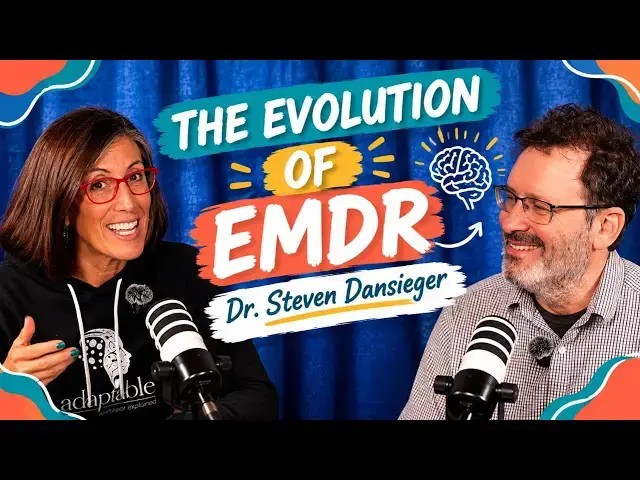
Welcome to Adaptable | Behavior Explained! This episode features Dr. Steven Dansieger in an EMDR Difference Makers interview recorded at the EMDRIA conference. Kelly and Steven explore creativity, innovation, and how EMDR therapy continues to evolve.
I'm Kelly O'Horo, Attachment based EMDR Therapist, EMDRIA Consultant, and Advanced Trainer. I'm a mom of 5, Nonna of 5, wife, and a healer. I have the honor of spending my workdays walking along side people while they brave their healing journeys. I try to live with the generous assumption that we're all doing the best we can with what we know. Therapists are teachers for the "life stuff" and "emotional vocabulary" that may not have been learned due to gaps in our care givers capabilities. In the last 15 years I've learned that people are freaking amazing, resilient, and inspiring. Most importantly, we are hardwired for connection and for healing!
I hope to bring an authentic, compassionate, and unpolished approach while we explore a variety of topics such as parenting, marriage, relationships, dating, trauma, attachment, adoption, depression, addiction, anxiety, and love! There's a why for all behaviors and an explanation that makes perfect sense as emotion is at the root of it all.
-- Links --
https://linktr.ee/kellyohorolpc
https://youtu.be/rLnARKekvgo
https://www.emdria.org/find-an-emdr-therapist/
Show More Show Less View Video Transcript
0:06
Hi everyone. I'm Kelly O'Horo.
0:09
And this is Adaptable, Behavior
0:11
Explained. Hello everyone and welcome to
0:13
a special live edition of Adaptable.
0:15
We're here at Emdria today, surrounded
0:17
by clinicians and educators and
0:19
innovators who are constantly exploring
0:22
new ways to help people heal from
0:24
trauma. And one of the exciting things
0:27
about our field is that it continues to
0:28
evolve. We're learning more about the
0:30
nervous system, more about resilience,
0:33
and more about the practice that helps
0:35
people move from surviving to truly
0:37
living and thriving. Today's
0:40
conversation sits at the intersection of
0:42
several powerful approaches: EMDR,
0:45
mindfulness, contemplative practice,
0:47
addiction recovery, and clinician
0:49
well-being. Our guest has built a career
0:52
exploring how these worlds can inform
0:54
one another in meaningful and practical
0:56
ways. I've got Dr. Steven Dansiger. He
0:59
is a licensed therapist, an EMDR
1:01
trainer, author, and the creator of the
1:04
META protocol. I can't wait to hear more
1:06
about that. An approach that integrates
1:09
EMDR therapy with mindfulness and
1:11
contemplative practices. His work has
1:14
helped clinicians deepen their own
1:15
healing while expanding how they think
1:18
about trauma treatment, recovery, and
1:20
the therapeutic relationship. Steve,
1:22
welcome to Adaptable and to Emdria.
1:25
Thank you so much for being here.
1:27
Um,
1:28
I'm really excited because getting to
1:30
talk to you earlier and we're going to
1:31
show a clip of of his latest invention.
1:34
So, I'm really excited after getting to
1:36
try that and we'll we'll go with more
1:38
into that about the work that you are
1:40
doing and the innovations that you have
1:44
spent the last several years refining.
1:46
But, I want to start with the META
1:48
protocol because that's how I first
1:50
discovered you and then later found out
1:51
you have so many more things in your bag
1:53
of tricks.
1:54
Is that okay?
1:55
>> Yeah, absolutely.
1:55
>> Okay, cool. So, for someone who's never
1:58
encountered it before, let's start with
2:00
the basics. What is the meta protocol
2:02
and what problem was it originally
2:05
designed to solve?
2:07
>> So, it's the mindfulness and EMDR
2:09
treatment template for agencies.
2:12
>> Okay.
2:13
>> And the idea was the problem was that I
2:16
saw at agencies that people were not
2:17
speaking the same language and they were
2:20
treating
2:20
>> Like public behavioral health agencies.
2:23
>> Uh any kind of agency.
2:24
>> Okay.
2:25
>> It could be private, it could be a
2:25
rehab, it could be private.
2:27
>> All right.
2:27
>> You know, any any where where there's
2:29
folks who are all working together
2:31
>> Okay.
2:31
>> on a project of wellness and health.
2:34
>> All right.
2:35
>> And so, I wanted everyone to be
2:38
able to see EMDR as a complete
2:40
psychotherapy and EMDR as something that
2:43
could be the guiding psychotherapy of an
2:46
agency.
2:47
>> Right.
2:47
>> As an adjunct.
2:49
>> Sure.
2:49
>> Everything else could be surrounding
2:52
EMDR.
2:52
>> Right.
2:53
>> And then also mindfulness. So, that
2:56
mindfulness would be the guiding
2:57
principle behind
2:59
the agency
3:01
And so, one of the major problems that I
3:03
saw, too, was that there's very little
3:05
training for non-clinicians.
3:08
So, meta protocol was designed to train
3:10
everybody from the person cutting the
3:12
grass
3:13
to the person cleaning the food
3:14
>> Wow.
3:15
>> to
3:16
everyone.
3:17
>> Okay.
3:17
>> Admissions.
3:18
>> I love no outliers.
3:20
>> Yeah.
3:20
>> Everyone gets to understand
3:21
>> Everybody gets a
3:22
training in trauma-focused care.
3:24
>> Okay.
3:25
>> Yeah.
3:25
>> And that probably helps with like
3:27
psychological safety from the first
3:28
phone call.
3:29
>> Yeah, that's 100% about
3:32
that, you know, from the very first
3:35
interaction.
3:36
>> Right.
3:36
>> It could even be an intervention.
3:38
>> Sure.
3:39
>> You know, any anywhere along the chain
3:41
of folks
3:42
um
3:43
care.
3:44
>> Okay. And so often are people that do
3:46
start with that first interaction don't
3:49
have the have any background or training
3:52
to deal with
3:54
what people call in to get help for.
3:56
>> Yes.
3:57
>> And so I I could imagine, you know, that
4:00
from the get, if that's not done well,
4:03
it starts to pave the way for safety in
4:05
the entire experience of getting help.
4:07
>> Yes. And you see it you can see it with
4:09
clinicians, too.
4:10
>> Right.
4:11
>> Not that clinicians are getting off on
4:12
the wrong foot.
4:13
>> Sure.
4:14
>> You know, coming out of school or during
4:16
>> I mean, sometimes.
4:17
>> Sometimes.
4:18
>> For sure.
4:18
>> Um but they could also So you see how,
4:21
you know, with developing a common
4:22
language and the
4:23
>> Right.
4:24
>> Okay.
4:25
on you know, mindfulness, and on
4:27
trauma-focused care, and on EMDR as
4:31
something that can drive the train.
4:33
>> Very, very cool. So your work brings
4:35
together two traditions that might seem
4:38
very different at first glance. What
4:41
drew you to Buddhist practice and EMDR
4:45
in the same room?
4:46
>> So it starts with me actually getting
4:49
into recovery myself. I had a bad drug
4:51
and alcohol problem. I was a different
4:53
person. And when I was 26, I
4:57
came into recovery.
4:58
And I was
4:59
>> Good for you.
4:59
>> Congratulations.
5:00
>> Thank you.
5:00
>> That's no small feat.
5:01
>> It's been 37 years. So anyone wants to
5:04
do the math.
5:07
>> Everybody's googling your age.
5:09
>> [laughter]
5:09
>> Um they don't have to anymore.
5:11
>> Right.
5:12
>> So uh 4 months into recovery,
5:15
a new best friend of mine in recovery
5:18
invited me to an AA retreat at a
5:20
Buddhist monastery.
5:21
>> Okay.
5:22
>> And so I went to the Buddhist monastery
5:24
and
5:25
you had the option of hanging out with
5:26
the monks.
5:27
>> Okay.
5:27
>> That was the option.
5:29
And I decided to hang out and got my
5:30
first meditation lesson.
5:32
Which was the instructions were sit
5:36
down, shut up, don't move.
5:39
You know, that's all I got.
5:40
And they rang a bell.
5:42
And they didn't ring a bell again for 45
5:44
minutes.
5:45
So in the beginning
5:48
the first 1 minute, 2 minutes, it was
5:49
like I want to leave the room.
5:52
>> I totally did a similar experience where
5:54
we went to a meditation retreat and I
5:56
was like, I will be a very good student
5:57
and I will sit here and do the rules and
5:59
I didn't get it until I
6:01
>> Yeah,
6:02
>> [laughter]
6:03
>> then about 2 3 minutes later, I was
6:05
like, wait.
6:06
>> Right.
6:07
>> Yeah.
6:07
>> Right.
6:08
>> And then the meditation became
6:11
the rest of the 45 minutes was, ring the
6:13
effing bell,
6:15
>> In your head.
6:15
>> In my head.
6:16
>> Yeah.
6:16
>> And then they rang the bell
6:19
and I got up and I felt better and I was
6:22
like, let's do that again.
6:24
And so I
6:24
>> That fast it affected you?
6:26
>> It that fast.
6:27
>> Okay.
6:28
>> There's something about monks and the
6:30
nuns and
6:31
you know, the 1600 people.
6:33
>> Their resonance.
6:34
Also.
6:35
>> Yes.
6:36
>> Yeah.
6:36
>> So
6:37
>> Very cool. That's such an awesome
6:40
and what an what an important
6:42
recognition to just being embodied
6:45
with recovery and no longer running.
6:47
Like we can do it. You can be here.
6:49
>> Yes, be here.
6:50
>> Right now. And you don't have to go
6:52
anywhere and what a great thing to have
6:54
that be part of that recovery program. I
6:56
love to hear that.
6:57
Mindfulness has become incredibly
6:59
popular over the last decade at least in
7:02
western culture. Unfortunately, we're a
7:04
little late to the game, but many would
7:06
argue it's also been
7:08
heavily commercialized along the way.
7:11
What gets lost when mindfulness is
7:13
stripped down to a wellness app or
7:16
reduced to a quick self-help guide for
7:18
you?
7:18
>> Well, some people have called it
7:20
McMindfulness and it never goes that
7:22
way. And I don't I don't have that dim a
7:25
view of it.
7:26
>> Okay.
7:27
>> I find that
7:28
any place that just can start
7:31
can start with a start.
7:32
>> Sure, I love that.
7:34
I love that.
7:35
>> Folks being able to get into the stream
7:37
of things and think and hopefully they
7:39
discover, you know, deeper relations
7:41
because it is a way of life.
7:43
>> Yeah. That's a practice. Yeah.
7:46
I um
7:47
will have clients that they downloaded
7:49
this app or that app for to do their
7:51
meditation and it's guided and all of
7:53
that sort of stuff and I kind of think
7:56
of it a little bit like training wheels.
7:58
While we're learning to not be focusing
8:00
on work while we're trying to be quiet,
8:02
there's that is a nice guide {slash}
8:04
distraction. But then when we can just
8:06
sit in whatever it is the absence of
8:08
something, that's really the skill that
8:11
can evolve you.
8:14
>> I felt very lucky I was trained first in
8:15
Zen meditation, which is totally silent.
8:18
>> Yeah.
8:18
>> So I actually when I first went to a
8:20
guided meditation retreat,
8:22
I was like, "Dude, can you please stop
8:23
talking? I'm trying to meditate." Right.
8:25
But um
8:28
>> Especially for the people who want to
8:30
get it right or don't understand what it
8:32
is that we're doing.
8:33
You know, they need the cognitive
8:35
explanation to better
8:37
buy in maybe or be less anxious about
8:39
the process. So I I think it's really
8:41
cool. You often speak about mindfulness
8:43
as more than a skill or an intervention.
8:45
How does having a genuine contemplative
8:48
foundation
8:50
uh change what happens in trauma
8:51
treatment?
8:52
>> Yeah, so I have found that someone comes
8:55
in to my office
8:56
already built in
8:59
this
9:00
and what therapy is said
9:02
>> Well, they know how to be in their
9:03
bodies, so that's a good start.
9:05
>> Exactly. And they know what I mean when
9:06
I say, "What are you noticing?"
9:09
They know what I mean.
9:10
>> Exactly.
9:11
Wait, what's that like? Like the fan or
9:15
>> [clears throat]
9:15
>> What am I supposed to be noticing?
9:18
>> Right.
9:18
>> Right.
9:19
>> So someone who has that practice, they
9:20
don't
9:22
>> Notices just what we do.
9:24
Right. And there isn't an opinion of
9:26
that.
9:26
>> Yeah.
9:28
>> Yeah, that's cool. Something that I
9:30
appreciate I appreciate about your work
9:32
is that you talk just as much about
9:34
clinician's practice and not just about
9:37
the client's healing. So, why does the
9:40
therapist's own mindfulness or
9:42
contemplative practice matter so much to
9:44
you?
9:44
>> Well, I think that 90% of what we do as
9:47
practitioners is our presence.
9:50
And so, if we're going to have presence,
9:52
we need to be embodied. And you know how
9:54
to get embodied when when you could use
9:57
>> Sure.
10:00
Sure.
10:02
Yeah, and if only it was required in
10:04
school.
10:06
>> It would be a good thing.
10:07
>> It would be a really useful thing.
10:10
Right. Especially when they talk about
10:12
in in all modalities of care, the
10:15
greatest predictor of outcomes is the
10:16
relationship and the connection. So, we
10:19
know that, but like how do you know in
10:21
your own body
10:23
where you are in relationship to the
10:25
client if you're not also connected to
10:27
self.
10:28
It's a gap, for sure.
10:30
>> Well, when I do the EMDR basic training,
10:32
we do mindfulness exercises throughout
10:34
the training.
10:35
And really, I find it amazing, you know,
10:37
a lot of folks are like, "I haven't done
10:39
that
10:40
in like x amount of time."
10:42
And it's just
10:43
it's hard to develop a practice. For
10:45
sure.
10:47
>> Right.
10:50
Right.
10:50
>> But
10:51
my original teacher, my original Zen
10:53
teacher, used to say that it looks like
10:55
it's a solitary practice, but it's
10:57
actually not.
10:59
And the energy that you get from the
11:01
>> Sure.
11:01
>> people bring to sit down and shut up.
11:03
>> Right. Right.
11:05
>> helps to sit down, shut up, develop and
11:06
I love that.
11:08
>> You've also done extensive work with
11:10
addiction and recovery. What does your
11:12
approach offer people in recovery that
11:14
traditional treatment models sometimes
11:16
miss?
11:17
>> So, on the mindfulness / Buddhist side,
11:21
um
11:22
four noble truths of the historical
11:24
Buddha, which are basically about
11:27
addiction in a lot of ways. That life is
11:29
suffering.
11:30
>> Mhm.
11:30
>> And suffering
11:31
>> Right.
11:32
>> or the other
11:34
the other translation of the word dukkha
11:36
suffering is unsatisfactoriness.
11:40
>> [laughter]
11:41
>> Like the traffic on the 405, you know,
11:42
like that.
11:43
>> Unsatisfactoriness.
11:44
>> Unsatisfactoriness. Like [laughter] I'm
11:45
not satisfied with this.
11:46
>> Right.
11:47
>> And that the cause of that, second
11:48
truth, the cause of that is craving,
11:51
clinging, and aversion.
11:52
>> Mhm.
11:53
>> Which are, you know, craving and
11:54
clinging and aversion.
11:56
>> attachment, yeah, attachment.
11:57
Yeah.
11:59
What's the cessation? Sure.
12:01
>> And then
12:03
the third truth is that there is a cure,
12:05
there is a cure
12:06
for
12:07
suffering, unsatisfactoriness.
12:09
It's not
12:11
ending your pain in life.
12:14
>> Right.
12:14
>> But it's ending the craving, clinging,
12:16
and
12:18
aversion.
12:18
>> Wonderful, right?
12:19
>> And so then the fourth truth is the
12:22
eightfold path, which is the
12:23
prescription.
12:25
And so
12:27
it takes
12:28
it takes some practice.
12:30
And then you can
12:31
live in a cool, peaceful way.
12:36
>> If only all recovery programs
12:40
understood.
12:41
>> So I ran a Buddhist treatment program.
12:44
>> Okay.
12:46
>> It's amazing to me that you could just
12:48
plug it all in
12:50
just just like that and go.
12:51
>> Mhm.
12:52
>> And have that be again
12:54
>> Who's meant to hurt
12:55
>> certain
12:56
>> places
12:57
>> and Moses was specifically for this
12:59
model.
13:00
And in the Indian every single clinician
13:01
was trained
13:03
Everyone was doing Indian therapy.
13:06
>> Mhm.
13:06
>> Such a brother
13:08
>> I think I agree.
13:10
>> It's so special.
13:14
It's really hard to
13:16
words and
13:17
inside of a conversation.
13:21
amongst half
13:24
>> Right.
13:26
>> And so
13:26
I think
13:29
>> Right.
13:35
>> I need to get a list of these places
13:37
because I am a fan of them specifically
13:40
and if they existed it would be my top
13:42
choice. Because that's the that's the
13:44
gap. Yeah, I don't I I I haven't known
13:47
of places that are so committed to doing
13:49
what works
13:51
so thoroughly the way you're talking
13:53
about this. Because that's
13:55
probably not the case.
13:57
Maybe efforts to job group
13:59
I don't know, but I definitely need to
14:01
get some things from you at the end of
14:03
this for that just as an adjunct benefit
14:10
over the last
14:11
I mean it's going so fast for several
14:13
years and as someone who's deeply
14:15
involved with both EMDR and mindfulness
14:17
communities, what do you make of where
14:19
trauma field is heading right now?
14:21
>> I think it's heading in a good direction
14:23
because it's becoming more
14:26
effective in its treatment.
14:30
understanding of the trauma
14:36
We're growing.
14:37
>> Right.
14:37
>> We're growing our understanding of the
14:38
brain. We're growing our understanding
14:39
of the nervous system.
14:49
>> Right. Just like nervous system
14:51
regulation is becoming commonplace
14:53
language.
14:54
Which is so nice cuz then we're not
14:56
fighting
14:57
just the semantics of neurobiology.
15:00
You know, it's just like a known thing.
15:02
Which is so lovely. Even in even in what
15:05
all your professional
15:07
you know, professionals that practice
15:09
that don't necessarily have a bottom up
15:10
training.
15:11
I'm noticing they're at least speaking
15:13
more in our biological language. Which
15:16
is great finally to have the extensive
15:19
biological understanding more so
15:21
than just we can reframe and thought
15:24
stuff and
15:26
>> [laughter]
15:26
>> you know, all the things that we learned
15:28
in school, at least that's what I
15:31
This doesn't work.
15:32
That's not how we learn.
15:35
Why would anybody come here if that just
15:37
worked?
15:38
You know. For sure. So, many of the the
15:40
clinicians attending MDIA are carrying
15:42
full case loads, supporting clients
15:45
through incredibly challenging
15:46
circumstances, and they're managing
15:48
their own lives at the same time.
15:51
For a clinician who feels burned out,
15:53
disconnected, or removed from reasons
15:56
they originally entered into this
15:57
profession, what would you want them to
15:59
do?
16:05
>> Get help and talk to us.
16:07
>> Right.
16:07
>> Surround yourself with people. Surround
16:09
yourself with people who
16:14
>> Wouldn't we all be so lucky?
16:16
Yeah. Yeah, I know. I I think that's
16:17
wonderful. So, let's talk a little bit
16:20
about your more recent innovations
16:22
because, um,
16:24
I think that in line with we are
16:26
broadening and things are becoming even
16:28
more interesting and creative on how we
16:30
can reach people and
16:33
help them move from such constant and
16:35
chronic dysregulated states to a place
16:38
of presence and healing. Talk to us
16:40
about your recent invention.
16:42
>> So, I didn't invent it myself.
16:44
I did design one of the innovations in
16:48
motion.
16:49
It was invented by a drummer who wanted
16:52
to use it in a live show all the time.
16:54
>> Okay.
16:54
>> And out of that came a pair of shoes
16:57
that were Bluetooth
16:59
speaker technology.
17:00
>> Okay.
17:00
>> And
17:02
you get a full immersion with the whole
17:05
live experience
17:05
>> Okay.
17:06
>> of music.
17:07
>> All right.
17:07
>> And so, I brought them into my therapy
17:09
practice because I wanted to use them to
17:12
help regulate my clients. And one of my
17:15
clients was like, "Oh, gross. No I'm
17:17
wearing that shoe." So, what's going on?
17:19
And so
17:20
>> It's just an insert.
17:22
>> So, now now it's an insert.
17:25
And shoot, then because my clients
17:28
didn't want to share a shoe
17:30
share shoes,
17:32
uh had the engineers develop these
17:33
pedestals so that you could put your
17:35
feet on without taking your shoes off
17:37
and get the same sensation.
17:39
And so that allowed us to have a
17:40
hygienic version
17:42
of the shoe.
17:43
And we boiled down the shoe to an
17:46
insole.
17:47
So, that could go in
17:48
any shoe.
17:49
>> It's amazing.
17:50
>> And
17:51
you can get that same full immersion
17:53
experience. And the pedestals are also
17:55
for people doing bilateral stimulation.
17:58
>> Wow.
17:59
So, as an EMDR therapist, how do you
18:02
incorporate the pedestal bilaterals or
18:05
like what phases do you use them in? How
18:07
would it look if I was going to use
18:09
those?
18:10
>> So, the music itself, I use it in phase
18:14
one and two.
18:15
>> Okay.
18:15
>> For regulation.
18:16
>> All right.
18:17
>> And use it in phase seven to close down
18:19
session.
18:19
>> Okay.
18:20
>> And
18:21
>> So, like in lieu of arm state, we're
18:22
using these babies on.
18:23
>> Exactly.
18:23
>> Awesome. And you And take advantage of
18:25
like the physical capacities we have to
18:28
down-regulate our our body just
18:30
somatically.
18:31
>> Yes.
18:32
>> Okay.
18:33
>> And then, you know, with the insoles,
18:35
the client can actually also do the same
18:38
for themselves.
18:38
>> Wow.
18:39
>> Yeah,
18:40
between sessions.
18:41
>> That's so fun.
18:43
I wonder if it would be distracting if
18:45
you were wearing them somewhere and you
18:46
just like clicked on your shoes. I guess
18:48
only if anyone knew.
18:50
Although, it'd be a really interesting
18:51
conversation, I'm sure, for someone like
18:54
me.
18:54
>> Yeah, I mean, I I used to I used to
18:56
watch people on the street and be like,
18:58
"What the is that?"
18:59
>> Okay.
19:00
So fun. I could see if you were like
19:03
test anxiety or she Some of those things
19:06
like the state change and just it's in
19:07
your shoe and you just turn it on.
19:11
I could see it for first responders,
19:13
too. Like after a call, they could just
19:15
turn cuz they could go in their
19:17
and they could just turn it on and just
19:18
roll with shift state so that they got
19:20
that cortisol break.
19:22
>> That's amazing. What an awesome tool.
19:24
>> Yeah.
19:25
Yeah, because when you're calm and
19:26
measured, you make your own state and
19:28
everything.
19:28
You're not activated. You're
19:30
>> That's amazing. Wow, you must be so
19:32
proud of yourself for coming up with
19:34
such a cool thing.
19:35
>> Really I'm just excited. Yeah. Excited
19:38
that I got brought into the cause.
19:39
>> Sure.
19:41
>> Co-founder of the company.
19:42
>> Good for you, man.
19:44
I hope that so many people,
19:47
you know, get to use this and benefit
19:49
from it. I can I can definitely see
19:51
where practices should have this. You
19:53
know, not everybody gets to use it all
19:55
the time everywhere, but
19:57
you've got the one that just works and
19:59
everything else seems to struggle with.
20:01
What a gift at the end. We have massage
20:03
chairs in our practice, so
20:04
you know, so at the end of a hard
20:06
session they can go and do that. So,
20:08
that's way better than the whole brain
20:10
thing.
20:11
>> [laughter]
20:11
>> You know, this would be nice. You could
20:12
just set it up by a chair or whatever.
20:16
>> That's really cool.
20:18
>> Thank you so much for sharing this with
20:20
me and with us and for everybody at
20:22
Emdria.
20:23
>> What an awesome opportunity. I feel
20:24
really lucky that I get to talk to
20:26
people about all of their great ideas.
20:28
>> And help spread more innovative,
20:29
exciting ideas to
20:31
the public and to therapists so that
20:33
they can make the world lift and help
20:35
the people heal a little bit better. So,
20:37
thank you really a lot for being here
20:39
today.
20:40
I appreciate it. So, um one of the
20:42
themes that stands out from this
20:44
conversation is that healing isn't just
20:46
about techniques, it's about presence
20:48
and awareness, um connection, and our
20:51
willingness to engage fully both
20:54
professionally and personally in our own
20:56
growth so that we can hold that healing
20:59
for our clients in the way that you
21:00
described. And so, for those of us here
21:02
at Emdria, that's a powerful reminder to
21:04
me. Therapeutic tools that we use do
21:07
matter, but the quality of our presence
21:09
matters the most. And so, I just really
21:12
thank you for sharing your insights,
21:14
your experiences, and the work that you
21:15
do, the impact that you've made on
21:18
addiction recovery, and for your meta
21:20
protocol, and this pedesool,
21:23
awesome tool for bilateral stimulation.
21:25
I just How fun to be in this space right
21:28
now and getting to see all the different
21:30
ways that we can be creative. So, thank
21:32
you again. And so, if you enjoyed this
21:34
conversation, then please subscribe to
21:36
our show, leave a review, or share this
21:38
with someone that you think could
21:39
benefit. You know, colleagues are always
21:40
looking for new ideas, so let's spread
21:42
this new stuff around so that we can get
21:45
great ideas into the hands of our
21:46
healers. And until next time, don't
21:49
forget to lead with love. It'll never
21:51
steer you wrong.
21:53
>> [music]
22:01
[music]
22:09
[music]
Health Education & Medical Training
People & Society
Counseling Services