Up next in 10


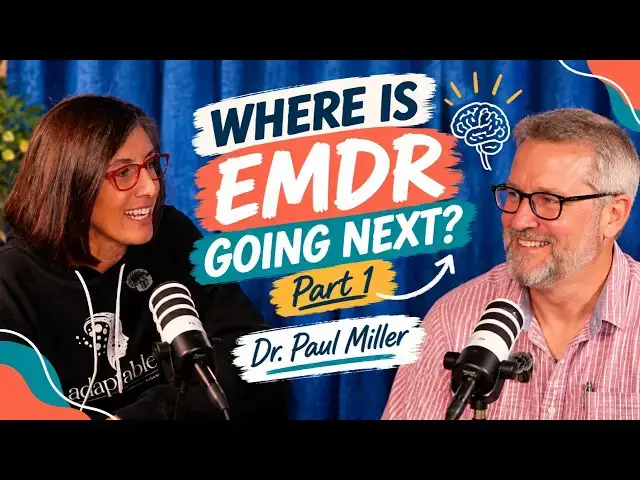
Welcome to Adaptable | Behavior Explained! This episode is recorded at the EMDRIA conference, Kelly talks with Paul Miller about clinical wisdom, developing perspectives, and questions shaping the future of EMDR therapy.
I'm Kelly O'Horo, Attachment based EMDR Therapist, EMDRIA Consultant, and Advanced Trainer. I'm a mom of 5, Nonna of 5, wife, and a healer. I have the honor of spending my workdays walking along side people while they brave their healing journeys. I try to live with the generous assumption that we're all doing the best we can with what we know. Therapists are teachers for the "life stuff" and "emotional vocabulary" that may not have been learned due to gaps in our care givers capabilities. In the last 15 years I've learned that people are freaking amazing, resilient, and inspiring. Most importantly, we are hardwired for connection and for healing!
I hope to bring an authentic, compassionate, and unpolished approach while we explore a variety of topics such as parenting, marriage, relationships, dating, trauma, attachment, adoption, depression, addiction, anxiety, and love! There's a why for all behaviors and an explanation that makes perfect sense as emotion is at the root of it all.
-- Links --
https://linktr.ee/kellyohorolpc
https://youtu.be/rLnARKekvgo
https://www.emdria.org/find-an-emdr-therapist/
Show More Show Less View Video Transcript
0:06
Hi everyone, I'm Kelly O'Horo and this
0:09
is Adaptable Behavior Explained. Welcome
0:12
back to Adaptable, the show where we
0:14
explore healing, resilience, and
0:16
innovative approaches to transforming
0:18
mental health care around the world. I'm
0:20
your host, Kelly O'Hurro, and I'm
0:21
especially excited today because we are
0:23
live at Embria, where we are surrounded
0:26
by therapists who are exploring
0:27
innovative ways in which they can help
0:30
others heal. And we are very fortunate
0:33
to have with us our guest today who has
0:35
spent his career asking questions many
0:37
people once thought were off limits.
0:39
What if psychosis isn't just something
0:41
to manage, but something we can better
0:43
understand through the lens of trauma?
0:45
What if the symptoms that we see are
0:47
adaptations to overwhelming experiences
0:50
rather than simply evidence of illness?
0:52
And what does the future hold as EMDR
0:55
and neuroscience and even psychedelic
0:58
research continue to evolve? Today's
1:00
guest has been helping clinicians
1:02
explore these questions for decades. Dr.
1:04
Paul Miller is a psychiatrist. He is an
1:07
EMDR consultant and trainer and the
1:09
founder of Miraabilis. Did I say that
1:11
right?
1:11
>> Morabis. Parabolis Health Institute and
1:15
author of BBMDR therapy for
1:16
schizophrenia and other psychosis. His
1:19
work has helped expand our understanding
1:21
of trauma complex mental health
1:23
conditions and what's possible in
1:25
treatment when we look beyond
1:26
traditional models. Paul, welcome to
1:28
Adept. Thank you so much for being here.
1:31
It is such a pleasure to have you and
1:33
what the audience didn't get to
1:34
experience is last evening. We spent
1:36
time learning about one another and
1:39
sharing stories and whatever you see and
1:42
the approachability of him is 100%
1:44
authentic. And one of the things that I
1:47
appreciate most about your work is your
1:49
willingness to stay curious. Uh
1:51
throughout your career, you've explored
1:53
areas that many clinicians are hesitant
1:56
to touch, talk about, whether it's
1:58
psychosis or severe mental illness,
2:00
complex trauma, which we all have to
2:02
deal with, and more recently emerging
2:04
conversations around psychedelic
2:06
assisted therapy. So, I'd love to start
2:09
at the beginning of that. When you look
2:12
back, what first pulled you toward
2:14
working with drama and psychosis?
2:16
>> Those are sort of like I guess two
2:17
questions. So um what drew me first I
2:20
think into drama.
2:23
>> I think first of all was my my own
2:25
personal life experience. So uh I was
2:28
born in 1971 whenever what we refer to
2:31
in Northern Ireland as the troubles. Um
2:34
the troubles being really that that uh
2:36
period of uh internet violence between
2:40
um the different communities in Northern
2:42
Ireland. um often framed as sort of
2:45
religiously motivated but really it's
2:47
was more tribalism. Uh people belonging
2:50
to different communities that happened
2:54
in regards to wrongdoing and separation
2:57
and uh sadly then there were individuals
3:00
who took those disagreements and uh
3:03
weaponized them. So I I was born into
3:06
that um that environment where uh people
3:10
uh being involved in bombs, people being
3:12
shot
3:14
um was a daily occurrence. I use every
3:16
night
3:19
and
3:20
>> sense of safety is just not amazing.
3:22
>> Yeah. And as a as a kid though to be
3:24
honest like I I had a great childhood in
3:26
many regards and uh that was just
3:30
um so in a sense I guess some of that
3:33
was many individuals were born in their
3:36
breath and when we began we would say
3:39
now I'm an ident
3:42
peace building as well in Northern
3:44
Ireland and he always reminds me that
3:46
really we're not a postconlict society
3:49
people do refer to this as that but
3:52
actually we're uh we're still a
3:54
community of communities uh emerging
3:57
from continent and so there is still you
4:00
know a very good amount of risk so I
4:02
guess there's that personal legacy
4:04
growing up in Northern Ireland um and
4:07
then my mother was a psychiatric nurse
4:11
and uh so I think that always made me
4:15
interested in the mind and sort of how
4:17
that was working and and then our family
4:21
then experience mentioned some personal
4:22
traumas. So I had my twin her sister
4:26
Margaret only 7 years old and she sadly
4:30
was to die
4:32
coming back when she was 18.
4:35
Um so that was uh that really devastated
4:38
the family and then my my parents um
4:41
ended up divorcing me a year after
4:45
my mother left the family and so yeah
4:49
things were like you know they were
4:51
challenging things I think but there's a
4:54
lot of that I still saw resilience of so
4:57
even in the research we had look at um
5:00
the adverse childhood experiences
5:02
um uh some research, but we then also
5:06
see Nar's work on the benevolence
5:08
childhood experiences and we see that
5:10
there's a great point that that then can
5:13
bring uh resilience and such.
5:17
I think a lot of that was a lot that I
5:19
didn't receive and the environment that
5:21
I grew up with um
5:25
created a greater resilience within me
5:28
and initially I trained so I trained as
5:30
a doctor uh initially I started to go
5:33
down a pathway with regards to surgery
5:36
but very quickly when I was working in
5:38
uh ER the interest was still very much
5:42
about the impact that these physical
5:44
traumas were having on the minds of
5:45
these indiv individuals and we also have
5:47
people coming in um suicidal self
5:50
harming or just very very disregulated
5:53
including psychology and so I thought
5:57
yeah I must scratch statics if I need to
5:59
scratch the so I went uh went to
6:02
psychiatry then training and really just
6:05
fell in love with it my first mentor was
6:07
a man called Peter and Peter worked in
6:11
the latter hospital in Belfast and we
6:14
would have had in three or four of the
6:16
patients around that hospital. Um across
6:20
the period of the worst of the troubles,
6:22
one third
6:25
injured were in those three rough areas
6:28
of the hospital serve.
6:30
>> Wow. So it was like today's show the
6:32
pit. It sounds like it's like not really
6:35
going to be that way every day. It
6:37
sounds like that area would have been
6:38
similar. Yeah, it was really tough and
6:41
um for those communities and I think you
6:43
know what what we saw was that uh sadly
6:46
the terrorists and organizations
6:50
where they would espouse some crime or
6:52
clan or something often
6:55
violence on their own.
6:59
So that was uh that was something that
7:01
was very sad to see the impact that this
7:04
was having. Um and uh I did a lot of my
7:08
training around the Mic Hospital and um
7:12
part of that sort of really two pathways
7:14
that I am taking. The first part took me
7:17
in quite a traditional um medical model
7:21
and
7:23
uh actually then involved in psychiatric
7:26
genetic epidemiology working with
7:28
professor Ken Kandler. So Ken at that
7:31
stage was over from the Virginia
7:33
Commonwealth University and was on her
7:36
undertaking
7:37
and Irish schizophrenia triad. So we
7:41
were collecting that individual for
7:45
schizophrenia. At that point it was
7:47
really the toughest definition. Uh
7:50
professor Keer believed that per outcome
7:53
schizophffective disorder and
7:54
schizophrenia were the same thing.
7:57
genetic dispute and indeed the genetics
7:59
that we we collected when I was a small
8:01
part of that collection team uh the the
8:05
team Virginia homes went on to identify
8:07
first generation
8:10
now sadly that wasn't really translated
8:12
into any per se but these were important
8:16
questions to be asked and understand
8:19
what individuals experiencing what it's
8:23
this thing
8:25
so I find that intriguing because it was
8:27
unlike when I was in say for example
8:32
surgery somebody fell down a set of
8:34
stairs you had a set of X-rays you
8:37
didn't see it right
8:38
>> and medical was like that and so that
8:40
that intrig
8:46
I think I've always been very attracted
8:49
to women and so within medicine we had
8:53
sort of that supreme
8:56
was to see my mother within psychiatry
8:59
and felt drawn to
9:02
Julie came as a lead psychiatry and
9:04
adult and so at that point near the
9:08
start of my career we were to have the
9:10
drugs for dementia and so we finally had
9:13
some intervention work
9:17
then another mentor Karen actually not
9:20
related to Dr. Michael Karan invited me
9:22
to the very first um EMGR training on
9:26
the island of Ireland and that I trained
9:28
back in 1987
9:31
and really the thing about it was uh
9:36
because of the practical element there
9:38
was a bit of like this all too good to
9:40
be true but once we experienced the
9:43
facts to experience uh dropmanship
9:48
was quite dramatic and uh so I was
9:52
pretty convinced with that big push The
9:54
academic department that students was
9:57
very much a micro chapters the previous
10:04
theory of mental illness. So looking
10:06
into serotonin
10:09
adrenaline or epinephrine or epinephrine
10:12
looking at all these different things
10:14
increasing the time and a lot of the um
10:18
the way that the large pharmaceutical
10:21
companies work.
10:23
EPM
10:25
there is always a model
10:30
within a system
10:32
that's without even thinking of the
10:34
possibility of consciousness and what is
10:37
consciousness and what does that mean
10:39
and um so a lot of things got as we
10:42
often do simplify
10:46
alliances so it's not that that was
10:47
wrong but I think um what we find is
10:52
challenging
10:53
therapy. Um, cognitive behavioral
10:56
therapy was on the ascendancy. Nobody
10:58
had really heard of the MDR. So, it was
10:59
just the the weird thing that all
11:03
but I saw people change. I'm so glad
11:05
they had on the one hand
11:11
of being on some combination.
11:16
um certain things like quality, the use
11:19
of the legacy belt ticket and other
11:23
eyes. Um when I got started in super
11:27
just been introduced
11:30
um I think my baby was spirit one of the
11:33
first psychotics.
11:36
So it was a very very interesting time.
11:38
was a sense of hopefulness but I think
11:42
as the years have gone along I guess
11:45
sort of free of my professional journey
11:47
is how
11:50
I think a nicely coming from a general
11:53
medical as a surgical stress training
11:57
that I started very early stage
12:00
I came with a sense of okay what's the
12:01
intervention you know what is Kelly
12:06
>> it's great to know about Yeah. So, so
12:09
the camp, you know, sort of when we're
12:11
young, we have heard very enthusiastic
12:12
way to do something. So, that
12:16
to be honest, the MDR was something too
12:25
slowly do something. So, I think that
12:27
was a very important piece. And I think
12:29
I do see sometimes people seem to go
12:32
through their own personal therapy
12:33
journey and stuff. There can be a sense
12:35
of oh I did that and that was really bad
12:38
and I need to negate that in some way
12:41
but I think it was a nice
12:44
long period I think that it was really
12:46
engaged with
12:47
>> was there was there a client or an early
12:50
experience that changed the way you
12:53
understood mental illness
12:56
the impression really in terms of
12:59
patients
13:01
got for me was the patient
13:03
I refer to as
13:07
the god of beginning to end
13:10
because to a certain degree I gone to
13:13
Royal College of Psychiatrist
13:16
and you know Bruce I just picked up a
13:19
book that was innovative treatment of
13:21
schizophrenia by Paul Mos and uh really
13:26
and I've said this to Paul many times
13:28
I've had the pleasure of teaching
13:30
talking platforms like but it it
13:33
introduced the concept here. I was doing
13:35
this research on the world
13:46
and
13:49
he was talking about the trauma model
13:54
what we currently know as schizophrenia.
13:58
Um
13:59
we invited me to the rap ministry.
14:04
So when he returned, it was always the
14:10
city
14:11
and at the time
14:15
he himself was convinced by Clark who
14:18
was working with him. Um he was in the
14:21
middle of the height of this course
14:25
and the interesting thing was that the
14:28
model was presented
14:30
like that the schizophrenians was a
14:32
modern day interpretation
14:35
of what had been rather
14:41
he said he was not interpreting
14:43
the the
14:46
Andrew Muskovitz is really developing
14:49
this that we see that the correspondence
14:52
between employe
14:55
and that was very challenging certain
14:59
models that existed around schizophrenia
15:02
psychosis. Um there was a revealing
15:08
pain within existed that time which was
15:11
what I call traum
15:15
that I find intriguing and they knew but
15:18
it didn't
15:20
but it just didn't take
15:25
that and some of it is socially
15:26
political
15:28
and politics behind why I mean some
15:31
people would sort of joke about you
15:33
didn't know in a sense you had uh Kani
15:36
who was sort of a rather unpopular
15:39
acidic Frenchman and uh you had Sigman
15:43
Floyd who was a popular party cookie
15:46
addict and so it's a bit of the cultural
15:48
personality
15:51
very understandably
15:56
get further with that so I think it's
15:58
important to look at the history of some
15:59
of these things and we hear things as to
16:03
pray everything.
16:11
It's not always
16:13
so. So, I think that encouraged me to
16:15
begin to
16:18
decency. So, I set up practice as well.
16:22
It just gave me more latitude for I
16:25
think and surrounded. So I met the child
16:31
and
16:32
had
16:35
met all the criteria that we were still
16:37
collecting genetic material being
16:40
sampled as far as selling.
16:44
So I knew that this guy definitely met
16:46
the criteria. He was on all sort of
16:49
correct treatment modalities
16:52
psychologically speaking. Uh he was
16:55
still I think psychotic except now many
16:58
times greater weight um ill physically
17:01
unhealthy
17:03
um and uh you know on his way to
17:05
metabolic dysregulation
17:08
and
17:10
we began talking and so he began talking
17:13
about he had this troll and so he did an
17:17
interesting history of people of course
17:20
many of us myself included have our
17:23
experience we necessarily immediately
17:25
think that that was traumatic. It's just
17:28
our life. It's just it's just our life.
17:31
And so I remember Jana saying to me, we
17:33
were talking about his family of origin.
17:35
He said, "Well, you know, it's a bit
17:37
difficult, you know, good old uh Scott
17:41
term that there was a bit of bars and
17:43
barging between his parents.
17:47
>> Sounds like a pretty mild way to talk
17:49
about kind of war in your house." Well,
17:51
it was [laughter] a very Yeah, that's
17:52
you're absolutely right. So, we're doing
17:55
some processing then and uh it turns out
17:58
that what he was calling Margie Bar was
18:00
on one occasion um his mother had tried
18:03
to shoot his father um with his personal
18:06
protection weapon and on another tried
18:08
to steal so you know something like this
18:11
is too far wasn't too far off is exactly
18:14
right. But the key thing was I began to
18:17
see so yes we could work the target
18:21
we could but then also consider
18:25
we can connect the effects that we can
18:28
get to
18:32
market
18:44
because I didn't hit the right amount of
18:46
people because I didn't it didn't even
18:50
look
18:51
and I remember having a conversation
18:53
with Francis
19:08
actually
19:11
so I think when we look at the spectrum
19:14
more
19:16
schizophrenia
19:25
and that was rejected. But I think what
19:28
that really taught me
19:32
increasingly as I was coming on Facebook
19:37
I of course
19:40
disorders
19:43
and
19:45
seeing the question asking Paul
19:50
say is it is it
19:53
is it something different
19:57
Well, exactly. And I actually think of
20:00
all the time they are.
20:04
So I find increasingly that there was
20:06
this when we was a single one of my
20:10
colleagues
20:13
as with some students
20:16
research
20:20
services.
20:24
What would you what do you wish more
20:26
therapist understood about this?
20:30
>> There's a couple of things. So there's a
20:31
few old messages which I think still
20:33
persist. So one of them is um you want
20:36
not to pollute the person uh or that you
20:40
believe that they're
20:43
uh is real
20:46
and uh so that's why we see within
20:50
therapy and so a lot of
20:53
disclosure
20:56
um so regardless for example he believed
21:00
that his thoughts were pulled by his
21:02
head on speech
21:04
around the top
21:06
there. Slang
21:09
and so now we go straight to how likely
21:12
is that that seems
21:16
ahead how how likely is it that there is
21:20
a voice
21:23
and I think for me what I realized was
21:27
that
21:28
it's all
21:30
so if I start to say to you well you're
21:35
like really upset would you tell me
21:36
you're upset
21:37
the world is speaking to you and telling
21:39
you that you know it's going to come to
21:41
them. So that's not
21:45
what you need to create. This person
21:49
this person
21:51
this person probably
21:53
just
21:57
once we start to treat this phenomen
22:13
person stops rolling in without
22:15
disability.
22:17
And so college book
22:22
with the adults that experience
22:25
and more a sense of looking and saying
22:27
well we're treating here
22:32
what we
22:36
call
22:39
here and uh as the Dutch went on to show
22:42
in their great research that um
22:47
Well, I guess
22:49
the doctor
22:51
again has always been a wonderful
22:53
community that you know of great support
22:57
with them on my own business and uh so I
23:00
began to reach out and and find some
23:02
colleagues who have been a Japanese
23:03
colleague working on some they sadly
23:07
passed away
23:10
um but then further work
23:14
actually
23:17
work with
23:22
the other person without
23:30
individuals and they started comparing
23:32
them to that.
23:35
So the icon very simple four albums. The
23:38
first one is what you're talking
23:44
say oh I appreciate my girlfriend
23:49
>> and probably not argue.
23:52
>> No exactly. So so then there's a target
23:57
we could just talk about the more
23:59
standard.
24:03
Um phase two is where we take in those
24:06
uh alphabet bridges and we follow those
24:09
bridges backwards and forwards and and
24:11
telling trainees. It's like you know
24:13
it's like where's the out you know you
24:15
fall down the stairs in the yard. What
24:17
do you ask where's it? Just cuz you have
24:19
a sore neck, that doesn't mean that they
24:21
were stolen before
24:26
the number of ladies
24:29
were really
24:40
small.
24:42
And so beginning to look at there was
24:44
there was some work carried out in
24:46
Northern Ireland looking at the work in
24:50
regards to risk levels
24:54
and
24:57
so similar at that stage
25:02
I guess that sort of sort of
25:06
you had um so Martin Dor was one of the
25:09
lead authors on this piece and what
25:11
Martin said, "Well, you have three
25:14
significant traumas between the age of
25:16
18 to 18 that your risk of a pathology
25:19
level increased from public by uh 18
25:24
times.
25:26
If you have five levels, it was
25:29
increased by
25:32
>> there's no shot getting out of it."
25:34
And then I wonder what the research on
25:36
like triple three before years old,
25:40
>> you know, because I think that
25:42
developmental lecture
25:44
>> completely your sense of self and who I
25:46
am to the world.
25:46
>> Yeah, I think that's something.
25:49
Yeah, I became much more aware and and I
25:51
think you know as we uh because I think
25:54
the first thing coming in is beginning
25:57
to see and be very
26:05
um so the work of people like Sam Haro
26:11
has his the people
26:13
that the it's his ruined his lived
26:17
experiences
26:19
is something which gets more by
26:26
I think this program
26:30
whenever it's articulated by what you
26:32
saw it's clear that people can't be able
26:36
to talk to people about and they could
26:38
say oh wow this makes sense and I was
26:42
always very struck
26:46
the boy used to It was general that they
26:49
knew purveyors
26:52
and
26:54
used to think a lot about that in terms
26:56
of our teachers and therapists and there
27:00
was a a politician news that last
27:03
president back in the first president
27:10
and saying hope is not a certainty that
27:13
everything will turn out well. whatever
27:16
it is the sense that no matter how it
27:18
turns out that it will happen
27:22
and I looked up
27:25
I couldn't remember I can show you
27:26
somebody to do this any better um what I
27:30
can do to you bring that was the second
27:33
the second piece I think
27:36
life was
27:39
starting to see bring even things you
27:43
know that seem weird or desperate But
27:46
actually they have origins and roots a
27:49
lot of the time and one of my colleagues
27:52
Katie and Sh
27:56
and one of the things that I love
28:00
haven't seen him don't think he's here
28:02
but Katie's brilliant and like one of
28:04
the things
28:06
when we think about drawing yes we have
28:08
our sort of DSM criteria
28:11
and that's important but I do think we
28:14
can
28:15
ability to her definition says trauma is
28:18
any threat for not
28:22
the quote I tell my
28:25
digest
28:28
>> you know it's just fair helplessness to
28:29
help someone else is worse than
28:31
helplessness to help myself I have so
28:33
many little she
28:37
by her love
28:38
>> no she's absolutely fantastic mind and I
28:41
think the lovely thing there is Um, I
28:45
think he can be accused of have been
28:48
accused of, oh, he sees trauma
28:50
everywhere and don't take that as a
28:53
criticism.
28:54
>> I'm like, well, because it is and he's
28:55
got eyes, [laughter]
28:57
>> right?
28:57
>> The thing is that there are there are
28:59
modalities.
29:01
Is it the whole explanation? No, I don't
29:03
think so. But I think it is an important
29:05
one and I think it has utility and so I
29:08
think whenever we begin to then follow
29:10
the out
29:15
again once you identify
29:24
that I wanted to try and say that is or
29:26
is not power and so
29:30
following through with that I was then
29:32
to assert see for myself
29:38
complex
29:40
maybe
29:43
that the reality is that they are on
29:45
staff I thought I think then I began to
29:49
look at you know what are the other
29:51
pieces that then are covered with that
29:52
person doesn't tell you they can't find
29:54
it with an effect and so I came to them
29:58
parts work and I was introduced to the
30:01
walk into my um park
30:06
and then began to make footwork at Pal
30:09
and talk to Cedra and she told me that
30:13
had been in sand.
30:16
So I was very very interested in that
30:17
and so we then began to look at what if
30:19
we treat the voices or prophecies of
30:23
dysfunction like memory networks
30:24
traumatic memories and so what if we
30:26
just talk to them maybe that was engaged
30:29
in doing that within looking at how
30:32
geotensive bilateral stimulation
30:35
increase
30:37
so then that was developable area then
30:40
of looking at how work parts
30:44
and I think there's lots options, but
30:46
there's a real history of that. That's
30:48
that's what works on. But fantastic to
30:51
see how when you respect the heart voice
30:56
that didn't trans
31:01
voice,
31:04
you know what I say to people
31:05
tolerating,
31:10
you don't go, okay, that's really busy.
31:11
I'll just I'll just wait over here. Oh,
31:14
they ramp it up. So, it's exactly what
31:17
that's true. Um, I'm just going to care
31:19
what I think we can look at. We can ask
31:22
ourselves about phenomenologically
31:25
are these voices
31:29
partner
31:30
and I think that's been really good
31:32
because there parts there's a system
31:36
and research is not shown.
31:40
>> Passion and love is always the answer.
31:43
It doesn't even matter how bananas it
31:45
seems.
31:45
>> Yeah. No, no, that that is right because
31:48
if if you know saying to a person um you
31:51
know who's coming and they believe they
31:53
have some horrible body dysmorphia
31:56
uh have been sent to me surgeon says
32:00
they were not really unless they have a
32:02
letter. Um and you know they think their
32:05
audience is telling that they're crazy.
32:07
And so my question is do you think you
32:09
really not
32:12
really obvious terribly actually the
32:15
most question which is at the level is a
32:19
sense
32:22
There's always hope for
32:26
beyond that scene. I think that way
32:36
we get to know. So we left a group of
32:41
like didn't really fit into any pillars
32:43
that we couldn't identify the history or
32:45
intake. been finding bridges and there
32:49
were parts of DVDs of conversation and
32:52
so that left sort of the the script
32:57
and I've been trained and supported by
32:59
Mark
33:03
and so Mark was very much about releases
33:07
and the importance of that but also came
33:09
from
33:11
I thought that's
33:14
a big complex psychotic experience
33:17
delusion belief system thoughts were
33:19
pulled out of his head and everybody
33:21
gets seen up the strings away but it was
33:26
almost like so overwhelmed by the way
33:27
things you say well that's the worst
33:30
part of that
33:32
and just how do you feel and think about
33:35
that experience you're blowing the lawn
33:37
everybody can see your thoughts you're
33:39
trying to get rid of the thought bubbles
33:41
and and that's where I really was
33:43
reminded about the addage
33:47
and so on would say that like it's a
33:50
really complex target
33:55
isn't that but as long as you can bring
33:58
the person in that pandic
34:07
>> I am so dumbfounded by how haven't I
34:11
heard one and until
34:14
>> go talk to the police So, well, I just,
34:16
you know, it's funny because Barry's
34:17
like, "You need to meet him." And I'm
34:19
just like,
34:20
>> "Well, tell me more." You know, and he's
34:22
like, "You're going to love him, you
34:23
know, and he was totally right." And he
34:26
does know me. And so, he was spot on.
34:28
I'm just so grateful to have challenge
34:30
you. And because of this awesome, really
34:34
amazing topic and time that we have,
34:37
we're going to do a a second show. Is
34:39
that okay?
34:40
>> Oh, boy. Yes.
34:41
>> Awesome. Awesome. It's hard for an Irish
34:43
man to be short.
34:45
>> You know what? When people are worth
34:47
listening to, you should listen to them.
34:48
[laughter]
34:49
So, thank you so much for tuning in live
34:52
from Andrea. We are so lucky to have had
34:53
Paul Miller. We've got his book here.
34:55
You should definitely pick it up if you
34:57
haven't. I cannot wait to dig into this.
34:59
Uh I didn't have a chance to read it
35:01
before, so it's on my absolute short
35:03
list of of ones to get to. And um if you
35:07
found this helpful, please share it with
35:08
someone that you know. If you're someone
35:10
that works with complex cases, please
35:12
make sure that you dig into this because
35:14
we don't have to stop. We can find ways
35:16
to reach compassionately and lovingly
35:19
the parts that are screaming for our
35:21
attention. And I think that you gave us
35:22
an artful way to look at that and to
35:24
talk about that and and there's a lot of
35:26
other ways to frame it, but not
35:27
everybody makes it so approachable and
35:29
understandable. So, thank you for making
35:31
that a really uh digestible way to to
35:34
discuss this topic. And um please share
35:36
this with colleagues who could benefit.
35:38
We need more good support in the world
35:40
of healing. And if you liked it, give us
35:43
a like. And until next time, don't
35:45
forget to leave a love. It'll never
35:47
steer you.
35:54
>> [music]
People & Society