Up next in 10

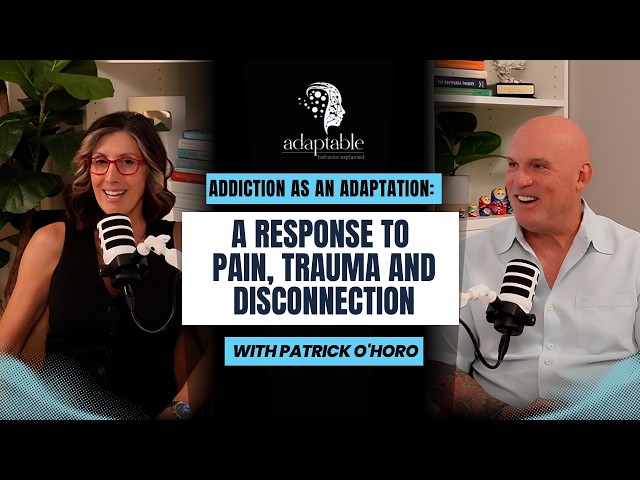
Addiction as an Adaptation: A Response to Pain, Trauma and Disconnection with Patrick O'Horo
Jun 11, 2026

Welcome to Adaptable | Behavior Explained! This episode goes over addiction as an adaptation to pain, trauma, and disconnection rather than a moral failing or lack of willpower with Patrick O’Horo. We explore addiction not as something rooted in weakness or purely a disease model, but as a response the nervous system develops to cope with unresolved trauma and emotional pain. This perspective can shift how we understand both behavior and healing.
I'm Kelly O'Horo, Attachment based EMDR Therapist, EMDRIA Consultant, and Advanced Trainer. I'm a mom of 5, Nonna of 5, wife, and a healer. I have the honor of spending my workdays walking along side people while they brave their healing journeys. I try to live with the generous assumption that we're all doing the best we can with what we know. Therapists are teachers for the "life stuff" and "emotional vocabulary" that may not have been learned due to gaps in our care givers capabilities. In the last 15 years I've learned that people are freaking amazing, resilient, and inspiring. Most importantly, we are hardwired for connection and for healing!
I hope to bring an authentic, compassionate, and unpolished approach while we explore a variety of topics such as parenting, marriage, relationships, dating, trauma, attachment, adoption, depression, addiction, anxiety, and love! There's a why for all behaviors and an explanation that makes perfect sense as emotion is at the root of it all.
-- Links --
https://linktr.ee/kellyohorolpc
https://youtu.be/rLnARKekvgo
https://www.emdria.org/find-an-emdr-therapist/
Show More Show Less View Video Transcript
0:06
Hi everyone, I'm Kelly O'Horo and this
0:09
is Adaptable Behavior Explained. Welcome
0:12
back to Adaptable. As you know, this is
0:14
the podcast where we slow things down
0:16
and we get curious about behavior and we
0:18
talk about why we do what we do, not
0:20
just how to fix it. Today's episode is a
0:22
really important one because we're
0:24
talking about addiction, but not in the
0:26
way that it's usually discussed. not as
0:28
a moral failing, not as a lack of
0:30
willpower, and not strictly through a
0:32
medical or a disease-based lens. And
0:34
this might be pretty unpopular for some
0:36
people, but I urge you to hang in there
0:38
and stay with us because it might be
0:40
surprising because instead we're going
0:41
to talk about addiction as an
0:43
adaptation, a response to pain, trauma,
0:46
and disconnection. And I could not think
0:48
of a better person to have this
0:50
conversation with with than my guest
0:52
today, Patrick O'Horo. He is a licensed
0:55
associate counselor and an EMDR
0:58
therapist. And Patrick works with trauma
1:01
and attachment wounds and other ways the
1:03
nervous system learns to survive
1:05
overwhelming experiences. He also brings
1:08
a lot of personal experience and a
1:10
compassionate perspective to this
1:12
conversation about addiction and it's
1:15
really aligned with the work of Gabbor
1:17
Mate and how he understands adaptation
1:20
and trauma and this as a survival
1:23
outcome that becomes a problem but it's
1:25
not usually the first problem. And so
1:28
Patrick, I'd love you to talk to me and
1:31
us after you give us a little background
1:33
on why this topic matters to you a
1:35
little bit about this concept today.
1:37
>> Sure. Thanks for giving me an
1:38
opportunity to talk about it. Uh it
1:40
might be an interesting one. I can
1:41
already kind of notice it coming in. Uh
1:43
history.
1:44
>> Yeah. Um
1:45
>> thanks for your courage.
1:46
>> Yeah. So uh I'll start by saying I don't
1:50
identify as an addict. And even to say
1:55
uh that is extremely powerful. My
1:58
history as born into a super
2:00
dysfunctional family. I know we've had
2:02
past episodes where we've talked about
2:03
some of that stuff, but my father
2:05
rightly so identified as an alcoholic.
2:08
He was an extremely abusive alcoholic.
2:11
In the 70s when my mother who also had
2:15
her own mental health challenges was
2:18
trying to become free from that abuse,
2:22
she found Alanon and I think it likely
2:26
saved her. I I grew up with a suicidal
2:28
mom and she did not end up committing.
2:30
Right. It was largely I think uh
2:32
beneficial into giving her a supportive
2:35
environment where
2:38
she could learn to stand up for herself,
2:40
have boundaries, seek treatment and
2:42
things like that. And Alanon became a
2:44
very very big part of her life for
2:47
probably 60 years. And as someone who
2:50
loves an addict,
2:52
that gave her a support system to
2:54
understand that those behaviors in him
2:56
were not about her, which probably
2:59
helped her to feel less isolated and
3:00
things like that.
3:01
>> Um, I think isolated, but to also have
3:04
uh community, right? She grew up in an
3:06
environment where you didn't talk
3:08
>> about what was going on in the family.
3:11
And so I think there's one, you know,
3:13
whenever you have a forum where you can
3:15
share the good, the bad, and the ugly,
3:17
right? I think it's very helpful to go
3:19
in and be able to say, you know, I'm
3:21
being abused or this is how someone is
3:23
behaving and have other people just go
3:25
like, yeah, that's not good. And then,
3:27
you know, that there's some type of
3:28
framework for for support.
3:30
I mean primarily like you know the term
3:33
codependency came from Alanon in a way
3:36
to describe how people that live around
3:39
people typically identified as addicts
3:42
right or abusers learn to walk on
3:44
eggshells and learn to change their own
3:46
behaviors and learn how to manage the
3:48
feelings and outcomes for other people
3:50
to create safety right so if we stem
3:52
back from that she was learning how to
3:54
not be codependent how to not be a
3:56
victim and all of that and I was just a
3:57
boy I I bring this up though to say that
4:00
I was in Alat
4:02
at like 8 years old. I was learning 12
4:05
steps from an Alanon perspective in the
4:08
language of little children and then I
4:10
went into Alatene and I remember her
4:12
dragging us to conference and I think in
4:14
her perspective it was trying to give
4:17
support to this new emerging family
4:20
system that's like free of addiction.
4:24
The challenge for me was it's kind of
4:27
like once you see it, you can't unsee
4:29
it. And so my mom began to see
4:32
everything through the lens of
4:35
addiction,
4:37
addictive behavior
4:39
and how to a protective lens for her.
4:42
So, as I go into pre-teens, and this
4:45
will kind of circle back when we talk
4:47
about, you know, the environments that
4:49
that addiction or addictive propensities
4:52
kind of emerge, uh, was that I I would
4:55
say I had given the environment that I
4:57
lived in, the neighborhoods I lived in,
4:58
the background that I had, you know, the
5:01
uh, experimentation with like marijuana
5:03
or or drinking or, you know, monkey see
5:05
monkey do, what does my what does my
5:07
father do? and and and
5:10
uh I quickly was labeled an addict way
5:13
before like any
5:15
>> remind me how young you were when that
5:17
label came toward you.
5:19
>> Yeah. So I mean and granted right this
5:22
is a spectrum
5:23
>> right
5:24
>> at 10 years old I was smoking a pack of
5:27
cigarettes a day. I'll never forget when
5:29
you told me that and our son was 10 and
5:32
I was like
5:34
>> what the was your parents doing
5:36
because you told me you said my mom said
5:39
just don't take your dad's and make sure
5:42
you go outside.
5:42
>> Well, my dad So my dad was don't take
5:45
dad's cuz those are his smokes.
5:47
>> My mom was just smoke outside. I'm
5:49
allergic
5:50
>> at 10.
5:51
>> So you know even 10 years old even prior
5:53
to 10, right? I, you know, it was very
5:56
common to get sent to the store with a
5:59
note from my grandma. You know, I can
6:01
remember probably seven or eight years
6:02
old getting sent to the store with a
6:04
note from her to pick up smokes and they
6:07
would just hand me the cigarettes and I
6:09
would bring them back. And so
6:10
eventually, right, everybody smokes and
6:12
you know, pretty soon you're out with
6:13
with the friends and everybody's coping
6:15
a smoke. And what I realized is all of
6:18
my friends were getting in trouble for
6:19
smoking and I was just told to smoke
6:22
outside. And so I was, you know, it was
6:26
safe. And so when we think about coping
6:28
with anxiety, stress, things like that,
6:31
you know, medicating right off the bat.
6:33
And then we think about the circles that
6:35
you're in when you're the one that can
6:38
freely have a pack of smokes. You know,
6:40
they sold for a buck a piece in the '
6:42
70s, right? That was a lot of money or a
6:45
quarter, you know, to your friends. And
6:46
so, you know, you start being kind of in
6:48
those circles. So there's experiment.
6:50
You know, there was always alcohol
6:53
around. My father thought it was a badge
6:55
of honor. I remember the first time he
6:57
got me drunk was probably age nine at my
7:00
sister's wedding.
7:02
>> Notice the words. The first time my
7:04
father got me drunk.
7:05
>> That my father got me drunk cuz it was
7:07
it was funny. Right. So when you grow up
7:09
in these environments and then you learn
7:11
that you see people coping or just you
7:14
know what would be normal even if
7:17
atypical behavior in a family system.
7:20
monkey see monkey do. you just start
7:21
kind of doing that and then so you know
7:24
then it started being experimentation
7:26
with marijuana of course drinking um I'm
7:29
not saying that any of that was healthy
7:31
>> right
7:31
>> but based on the level of supervision
7:33
and what was going on in society
7:35
>> lack thereof
7:36
>> right it was it wasn't a problem until
7:39
through how my mother manifested
7:42
behavior when she came up against normal
7:46
teenage broken household a very
7:49
traumatized young man with no guidance
7:52
and those problems, she was very quick
7:55
to label those addictive behaviors. So,
7:58
as opposed to being somebody that she
8:00
was trying to help with Alanon and all
8:02
of this stuff,
8:03
>> now that the abuser was out of the
8:05
house, I was the identified abuser and
8:08
therefore an addict. So, even though I
8:11
had never had cigarette smoking aside,
8:14
uh I'd never had any legal trouble
8:18
trouble at school. I'd never been caught
8:21
with drugs. I I She'd never even seen me
8:24
with drugs. When I was 14, uh I was
8:28
removed. She had sent me to go live with
8:31
my very abusive father. She was trying
8:33
to restart her life. And that didn't end
8:37
very well. My own medicating increased a
8:40
lot to deal with the constant abuse of
8:42
living in that house. And eventually I
8:44
was removed by law enforcement and put
8:47
back into her custody, which really
8:49
didn't fit into her schema of what her
8:51
new life was like. And so then any
8:54
behavioral stuff that came up for me, it
8:56
must be because I'm secretly a drug
8:59
addict or an alcoholic. And so one day I
9:02
was put in the car and I was told we
9:04
were going to visit a relative who was
9:06
in the hospital and we walked in and we
9:09
went up to somebody met us in the lobby
9:11
and we got in the elevator and we get up
9:13
to whatever floor we're on and we come
9:15
out and they're like, "Hey, this is your
9:17
new home. You're you're actually I got
9:19
tricked into this like rehab."
9:21
>> And uh and that started a cycle. It's
9:23
kind of like when you when you hear
9:24
about
9:25
>> people putting ch you know somebody in
9:27
jail and it becomes like a warrior
9:29
academy. you just put me in like drug
9:31
addict academy like you know this was
9:34
kind of West Hollywood
9:36
>> and so you know the kids that were in
9:38
there with me they were runaways street
9:41
urchins you know they'd had all of these
9:42
legal problems and I was just a kid from
9:45
the suburb who
9:46
>> there wasn't even any evidence of that
9:48
had smoked some weed or drank and so um
9:52
so that was really really rough I I say
9:55
all of this and that you know there's
9:56
there's multiple periods that was just
9:58
the start of this journey
10:00
until you know for the next few years
10:02
till I got uh to adult age
10:04
>> right
10:04
>> of being identified as an addict. So
10:08
whether you know I left that program and
10:10
went into an intensive outpatient you
10:12
know even when I was in rehab we went to
10:13
7 to nine meetings a week I won't unpack
10:16
my entire history with this right there
10:18
was uh several years of in and out of
10:22
rehab facilities programs
10:25
mothermandated treatment uh group homes
10:29
foster care
10:30
>> and I remember you told me at the
10:32
beginning of our relationship that when
10:35
I was getting so pro theapy and going to
10:37
therapy and all of those things. You had
10:39
a really negative bias towards therapy
10:42
because as a young child, you learned
10:45
just say what you need to say to get you
10:47
to the next point and become an
10:49
excellent, you know, kid in recovery. So
10:52
that you said all the right things and
10:54
your words, I think, were something to
10:55
the tune of, I know exactly what I need
10:57
to say so that I can move out and be
10:59
done with it. And so therapy is not
11:01
going to work for me. I remember you
11:02
said that. Well, you said a couple
11:03
interesting things there. And I'll
11:05
circle back to the word recovery. I
11:07
think that that's a really loaded
11:09
>> question.
11:10
>> If you're participating in a program
11:13
>> versus being in recovery, that's like
11:15
saying if you're falling and you haven't
11:18
quite stopped moving, you're in fall
11:20
recovery. I don't think like recovery is
11:22
like fall is complete. I'm getting back
11:24
up. I'm brushing myself off. But that
11:26
aside, you know, going into these
11:29
programs and having been so well-versed
11:32
in all, allatenon,
11:35
all of this stuff, you know that there's
11:38
a language, but then you realize that
11:40
the lens is being applied to you. And so
11:43
I remember in the first facility, you
11:46
know, now I'm lost. I'm outcast from my
11:48
family. I'm locked up in a in a
11:51
hospital.
11:52
And you know, we would have meetings and
11:55
we would have group and you weren't
11:57
going to progress through the program
11:59
unless you admitted to what your
12:00
addiction was.
12:01
>> Mhm.
12:02
>> You know, so I started identifying as an
12:05
alcoholic or I started identifying as a
12:07
drug user. And then eventually it was
12:09
like, oh, you can go to a meeting and
12:10
you can get a chip and everybody's proud
12:11
of you when you get 30 days. I'm like,
12:13
how am I not going to get 30 days? I'm
12:15
locked up in a hospital. I can't even
12:16
like get dessert,
12:17
>> right? So then you get the chip and you
12:19
know that your identity becomes really
12:21
wrapped up in this addiction. So the way
12:23
people see you
12:25
>> is somehow tied to the label that you're
12:27
given or you you acquire, right? That
12:31
you you assign to. That's one of the
12:33
things that I struggle most as a trauma
12:35
specialist is you know we are uncoupling
12:38
negative beliefs that get maladaptively
12:40
encoded like I am bad I am this I am an
12:44
alcoholic I am and it doesn't leave room
12:47
for the learning I struggle with said
12:49
behavior is so much healthier and that's
12:52
one of the issues that I struggle with
12:53
related to just the Allenon programs in
12:56
general and don't get me wrong they are
12:59
so good for so many things and for so
13:01
many people and especially those without
13:04
resources who can get into therapy to
13:06
work on the trauma and all of those
13:08
other things. It is definitely better
13:10
and on honestly the consequences even of
13:13
white knuckling abstinence
13:16
tend to be better for families and
13:18
people's lives than continued said, you
13:21
know, destructive overuse or abuse where
13:24
jobs are lost and relationships are lost
13:26
and all of those things. So please make
13:27
no mistake that I'm I'm not saying these
13:30
things are bad, but we're just trying to
13:31
make sure you understand an additional
13:33
perspective. So say more about that.
13:36
>> Yeah, I'll comment a couple things. I
13:37
think there there is the, you know, the
13:40
diagnosis
13:41
of, you know, any any type of chemical
13:44
abuse,
13:45
>> right?
13:46
>> And how that shows up biologically and
13:48
chemically in your body versus the
13:50
labeling of behavior.
13:52
>> Um, we see that even with clinical
13:54
diagnosis, right? How many times have
13:55
you had a new client come in and they
13:57
say, "Oh, I'm bipolar." And, you know,
13:59
it's not, okay, let me build from there.
14:01
It's like, you know, help me understand,
14:03
you know, why is it that you identify as
14:05
someone that meets the criteria of
14:07
bipolar? And often times, especially
14:09
like bipolar 2, it's like trauma,
14:11
trauma, trauma, trauma, trauma.
14:12
>> And we don't even agree with that.
14:13
>> So, we don't even need to do that,
14:15
right? So, it's like what's the value of
14:16
a label or a diagnosis? So when I think
14:19
when it comes to drug addiction, alcohol
14:21
abuse, things like that, uh or even, you
14:24
know, non-chemically addictive
14:25
behaviors, sex addiction, I I did my
14:27
internship at a place where, you know,
14:29
they were very they were all seesats and
14:31
everybody was focused on, you know, uh
14:34
sex addiction and I just I've always
14:36
struggled primarily because of my own
14:39
history of this label
14:41
>> and I remember when
14:43
>> you know I was in 12step, not as an
14:46
alatene Alat type, but as the identified
14:51
>> uh alcoholic drug abuser,
14:54
>> you know, the the 12step book is like
14:56
you are you're defective, right?
14:59
>> You were born defective. You have a
15:01
disease.
15:02
>> It's in your brain and there's no
15:03
getting rid of it.
15:04
>> And it's in your spirit and your soul
15:06
and all you can do is try to walk a
15:09
better path.
15:09
>> Like I am someone with, you know, a
15:12
brain tumor.
15:13
>> Yeah. And while I respect the 12step
15:15
community and I'm glad that there's a a
15:17
community where people that are
15:18
struggling
15:19
>> whether whether it's whether it's,
15:21
>> you know, actual addictions or
15:24
behavioral propensities or they just
15:26
don't have a social system that
15:29
understands what they've been through or
15:31
how to heal or how to get resources.
15:34
The identification that we are
15:37
inherently defective just does not
15:40
resonate with me at all.
15:42
>> Mhm. And so, you know, even going back
15:44
into my own history and sitting there
15:45
and saying, you know, in order to be
15:47
accepted in this community, I had to
15:48
stand up and say, "Hi, my name is
15:49
Patrick. I'm a drug addict."
15:51
>> And it took me a long time to to drop
15:55
those labels. You know, I I grew up. I
15:58
went into the military. I had a very
16:00
long productive career where, you know,
16:02
alcohol and drugs were not really part
16:03
of my life. And I remember as I I got
16:06
out and you know just
16:09
sharing you know full transparency even
16:11
when I started looking at dealing with
16:13
my own nervous system my own will uh
16:15
window of tolerance dealing with
16:17
unwinding a very complex post-traumatic
16:21
stress response in my nervous system
16:24
>> and I started using things like
16:25
cannabis. It was a really really hot
16:28
button in our household, right? Because
16:31
you know this being able to pull up a
16:32
book and a page and go if you're doing
16:34
this you are an ex
16:36
>> and me sitting there and saying
16:38
>> it's that or a bullet in my mouth. Like
16:40
I I I cannot survive,
16:45
>> right?
16:46
>> And so it it was very touchy, right?
16:48
I've done a lot of
16:49
>> extra learning on addiction and I
16:51
understand, you know, the chemical side
16:53
of of GABA and dopamine and serotonin
16:55
and and all of that. And I think opioids
16:57
and um classifications of drugs,
16:59
>> bodoazipines, right, are are their own
17:02
different animal and how they
17:04
>> jack into our our feelings of pain,
17:06
>> right?
17:07
>> But I, you know, I prefer now to think
17:09
of
17:11
addictive like behaviors, whether those
17:13
are chemical or behavioral, as being a
17:16
symptom of addressing pain,
17:19
>> not of pleasure.
17:20
>> Totally. I agree. And and I'm going to
17:21
just kind of circle back to something
17:23
that you said, you know, in those early
17:25
days when you started using, you know,
17:27
substance in that way. I was early in my
17:30
counseling program and it didn't include
17:32
this lens of trauma and that's a little
17:34
bit new in fact. And so, you know, I
17:37
would say Gabbor mate would argue that
17:39
it is not new for him. But as far as
17:41
making this commonplace knowledge for
17:43
mental health professionals, it is still
17:45
not generally approved of a non-medical
17:48
model and more of a symptom of addiction
17:51
or a symptom of trauma model. And so,
17:53
it's just really like turning an
17:55
aircraft carrier around. And so, I was
17:57
very much the rules say, if this then
18:00
that. And so I was having a lot of
18:02
internal conflict around my values of
18:05
being with someone who used substances
18:07
in what I thought was a way that was a
18:10
misused situation. And obviously over
18:12
time that has been part of the picture,
18:14
you know, because it's keeping that
18:15
balance. But I would also I would also
18:18
argue that in those programs where it
18:22
becomes so black and white, someone who
18:25
is healing from their trauma ends up
18:28
almost pushing back, maybe even further
18:30
back on use or misuse because of the
18:34
historical labels and because of the
18:36
needing to own your sacred ground around
18:38
the truth of not being in a specific
18:40
identity. And I think that's a I think
18:42
that's a thing, too. And I think it does
18:44
a disservice to those who are trying to
18:46
get better
18:47
>> in in some ways.
18:48
>> There's a I'm very visual. So, as you're
18:50
talking and and I'm checking in with my
18:52
own nervous system,
18:54
>> uh, for lack of a better analogy,
18:56
sometimes that feels like a parachute to
18:58
somebody who's falling, who has no
19:00
ground underneath them,
19:01
>> right?
19:02
>> When their nervous system is in a panic
19:04
state or something like that. And I'm
19:06
seeing uh an Inside Out, you know, and
19:09
they're all all the emotions are falling
19:10
out of the sky and and fear pulls a
19:13
parachute and they're like, "You have a
19:14
parachute?" And he's like, "You don't."
19:16
>> Right? So, when you look at somebody who
19:18
has who has evolved and adapted in an
19:23
environment of suffering, how do they
19:27
how do they titrate
19:28
>> and how do they get a reprieve from the
19:29
suffering when it's a nervous system
19:31
issue? Yeah.
19:32
>> And largely, you know, society induced
19:35
too. to the environment that they're in.
19:37
Right? So, I know, you know, one of the
19:38
things we wanted to, you know, in
19:40
addition to like Gabbor's work around,
19:42
you know, not looking at the behavior as
19:44
a pleasure- seeeking behavior,
19:47
>> but as an uh as addressing pain, as a
19:49
relief circuit.
19:50
>> And I want to say, I think, you know,
19:53
we're going to address this in more
19:55
detail in our next episode. So, what
19:58
more about your personal story do you
20:00
think is really important that we know
20:01
from this show? and then we'll jump into
20:04
kind of more the research side of things
20:06
and how we address it and not so much
20:08
like the recovery of but just continuing
20:11
to bring your personal experience from
20:14
your life into a more clinical view.
20:17
What do you think
20:19
see and hear from you?
20:20
>> I I'll qualify it in that I've never
20:22
struggled with an opioid addiction. Uh
20:25
you know I've never struggled with a
20:27
substance that
20:28
>> had any level addiction. you have no
20:32
stimulants or or no
20:33
>> aside from cigarettes.
20:34
>> No withdrawal. Well, and but that's an
20:36
interesting, you know, if you think of
20:37
that, I'll even talk about cigarettes,
20:39
right? Smoking a pack a day at 10,
20:42
>> that was in my system. And
20:43
>> how does a nervous system learn
20:45
something different? And how does the
20:46
brain
20:48
right side when that's what they are the
20:51
brain is growing in the most important
20:53
years of development with a stimulant
20:55
constantly being pumped into the brain
20:56
like what a mess. So, I I smoked heavily
21:00
until
21:01
uh I joined the Navy. I you know,
21:03
obviously I got a break during boot
21:04
camp. We weren't allowed to smoke. The
21:06
first thing I did out of boot camp was
21:08
buy a pack of cigarettes as I headed to
21:09
the airport to go to the unknown. And as
21:12
I reflect back, like any period of
21:14
uncertainty or imbalance or instability,
21:16
right, nicotine was the thing. And then
21:18
within the military, it's also really
21:20
social. oftent times the only time you
21:23
can like bust out of detail or do
21:25
something like that is to go get a smoke
21:27
break.
21:27
>> Mhm.
21:28
>> So I remember when uh I was shipboard
21:30
and when they started to really uh
21:33
titrate down, you know, just we used to
21:35
be able to smoke everywhere. Like you'd
21:36
be in your bunk smoking and um
21:38
>> I remember when we toured the ship of
21:40
Nicks and you were like we could smoke
21:42
in all these places and I thought I'd be
21:44
keen to jump overboard if I had to work
21:46
in a room that was full of cigarette
21:48
smoke.
21:48
>> Yeah. But I mean it's just you know come
21:50
coming up from you know this was
21:52
probably in the '9s where you know the
21:54
Navy started saying no you got to go
21:56
smoke outside right there's a there's a
21:58
designated section and they're really
21:59
trying to reduce just the the smoking in
22:02
general
22:02
>> the exposure for
22:03
>> Yeah. And then education, right? So at
22:05
some point, right, somebody was smart
22:07
enough to go, you really that's probably
22:09
not so healthy for you, even though
22:10
you've been doing it, you know, really
22:12
for your whole life. And having, you
22:15
know, wanting to not smoke and I would,
22:16
so I would take breaks. I would try to
22:18
quit smoking like many people do, uh,
22:20
whether it was for money or health or
22:22
whatever. And then in times of stress,
22:25
right, the smoking would come back. So
22:26
it's either I I can connect with these
22:29
people who are also smoking or I can
22:32
just kind of manage my own nervous
22:34
system. And then I remember, you know,
22:35
was my early 30s when I met you. And at
22:38
the time I I wasn't smoking as in a very
22:41
kind of big health kick and I'd been
22:43
kind of right sizing my life. And so I
22:45
didn't have I wouldn't say I wasn't
22:47
stressed, but you know, I wasn't kind of
22:48
seeking. It was good because you were
22:50
just a hard antismoker. And then I
22:54
remember when when I did start smoking
22:56
weed, moved to Europe for a little while
22:58
and I started smoking and it was very
23:00
very stressful time
23:02
>> and you were just like you are not the
23:04
person like I would have never married
23:06
you if I knew you were going to smoke
23:08
>> and so that's when you know my own
23:10
desires to not smoke when I think about
23:12
it from an addictive perspective now
23:14
it's causing a problem in my life
23:16
>> and how do I manage that and how much
23:18
conflict did we have around that
23:20
>> and it wasn't really until my father got
23:23
the cancer diagnosis. It was just a
23:25
switch. I was like, I'll never smoke
23:27
again. And and even it's not even hard.
23:29
Like it's just it's disgusting to me
23:32
now. My body, right, just reacts to
23:34
that. Not that I have a judgment about
23:36
it, but that my body just says, you
23:38
know, no. Hey,
23:39
>> it became it became personally relevant
23:41
and important enough for you to make
23:43
that decision.
23:44
>> Yeah. And that's with a chemical
23:45
stimulant, right? So, and I've seen, you
23:48
know, other times where, um, you know, I
23:50
had I had a pretty severe motorcycle
23:53
accident, right? And I was on opioids
23:55
for a while, and I could tell I got to a
23:57
point where I realized that the
24:00
withdrawal symptom would cause pain,
24:02
>> right, to make you take how that works,
24:05
>> right? And so, that's where I have a lot
24:07
of compassion for for people that
24:09
struggle with opioid addiction because
24:11
it's not
24:11
>> it started pharmaceutically. It gets so
24:13
judged, right, that or fentinels, right?
24:15
That it gets so judged that you know you
24:18
were pleasure seeking and you got
24:20
trapped. That's what we were all told,
24:22
right? Like if you do this drug, it's
24:24
going to get its hooks in you. But
24:25
there's been a lot of studies if you
24:27
look at like uh Vietnam veterans, right?
24:29
They were doing a lot of opioids,
24:31
>> right?
24:31
>> And there was a huge fear that all these
24:33
vets were going to come back and we're
24:35
going to have this massive opioid
24:36
crisis. And so many of them when they
24:38
got out of the environment that they
24:39
were having to cope with, you know, it
24:41
was actually a pretty small percentage
24:43
that actually continued
24:45
>> um to be able to, you know, and then you
24:47
look at the environment that they came
24:48
back into, right? Were they being
24:49
accepted? Were their families or were
24:51
people spitting on them? Were they
24:52
outcasts? You know, what was the
24:54
environment that they went into?
24:56
>> And so for me, what was really eye
24:58
opening was when I learned of the rat
25:01
park experiments.
25:03
>> So I'm gonna have you pause right there.
25:06
because we're going to dig into that in
25:08
our next episode so deeply. So, thank
25:10
you so much for joining me for this
25:13
conversation. I feel like we could do
25:14
this for 5 hours. This topic is so
25:16
fraught with so many different angles
25:18
and perspectives and commonly lacking in
25:22
research and awareness and knowledge.
25:23
And I just really value the personal
25:26
side of things that you can bring to the
25:27
conversation that so few really informed
25:31
therapists can bring from that personal
25:33
side of things as well as the experience
25:35
and working with and treating clients
25:37
who struggle with some of these things.
25:38
So, thank you so much for being here. I
25:41
so appreciate that. For those of you who
25:43
tuned in, I think that you've got way
25:46
more to come. So, I hope you tune in
25:47
next week for our follow-up episode
25:49
related to this. And we have an
25:52
additional episode after that about
25:54
recovery and how to heal and the things
25:56
that we can do to address these issues.
25:58
So if you found this episode helpful or
26:01
useful, please please subscribe, like,
26:04
share, do all the things that help
26:05
improve our algorithm, which helps this
26:07
content reach people who really need it
26:09
the most. And thank you so much for
26:11
tuning in. And until we meet again and
26:13
Patrick, thank you so much for being
26:15
here. I appreciate it.
26:16
>> Pleasure.
26:17
>> Until we meet again, don't forget to
26:19
lead with love. It'll never steer you
26:20
wrong.
#People & Society