Up next in 10


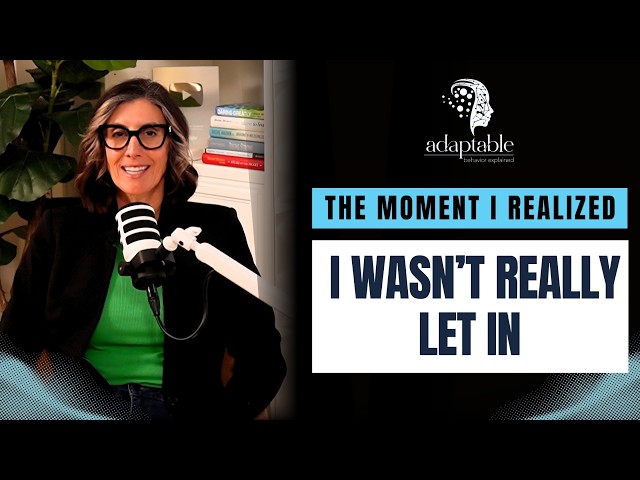
Welcome to Adaptable | Behavior Explained! This episode explores the painful moment of realizing you felt emotionally close to someone who never fully let you in. We unpack emotional unavailability, attachment patterns, and why this kind of distance can feel so confusing and heartbreaking.
I'm Kelly O'Horo, Attachment based EMDR Therapist, EMDRIA Consultant, and Advanced Trainer. I'm a mom of 5, Nonna of 5, wife, and a healer. I have the honor of spending my workdays walking along side people while they brave their healing journeys. I try to live with the generous assumption that we're all doing the best we can with what we know. Therapists are teachers for the "life stuff" and "emotional vocabulary" that may not have been learned due to gaps in our care givers capabilities. In the last 15 years I've learned that people are freaking amazing, resilient, and inspiring. Most importantly, we are hardwired for connection and for healing!
I hope to bring an authentic, compassionate, and unpolished approach while we explore a variety of topics such as parenting, marriage, relationships, dating, trauma, attachment, adoption, depression, addiction, anxiety, and love! There's a why for all behaviors and an explanation that makes perfect sense as emotion is at the root of it all.
-- Links --
https://linktr.ee/kellyohorolpc
https://youtu.be/rLnARKekvgo
https://www.emdria.org/find-an-emdr-therapist/
Show More Show Less View Video Transcript
0:06
Hi everyone, I'm Kelly O'Horo and this
0:09
is Adaptable Behavior Explained. Welcome
0:12
back to Adaptable. I'm Kelly and this is
0:14
a space where we slow things down and we
0:17
talk honestly about relationships, how
0:19
they form and how they fracture and how
0:22
we adapt when things don't feel the way
0:24
that we thought that they did. Today's
0:26
episode comes from a dynamic that I see
0:29
constantly both personally and
0:31
professionally. And yet, we really don't
0:33
talk about this out loud. And so, I want
0:36
to ask you something. Have you ever had
0:38
a friend that you spent a lot of time
0:40
with? You trusted them. You texted them
0:42
regularly. You show up for each other.
0:45
You maybe even thought, "This is like
0:47
one of my people." And then one day
0:49
something casually comes up and
0:51
sometimes even months later and you find
0:53
out that they were going through
0:54
something that was a big deal, enormous,
0:57
something you can't believe you spent
0:58
time with them during that phase and
1:00
they didn't even let you know. Maybe
1:02
those are things like a miscarriage, uh
1:05
a divorce, um or maybe some other
1:08
personal dynamic they're going through
1:09
financially or with their work and you
1:12
had no idea yet you spent a lot of time
1:14
with them. And this wasn't because you
1:17
weren't available. It wasn't because you
1:18
didn't respond and it's not because you
1:20
wouldn't have cared, but because they
1:22
never told you. And when you hear that,
1:26
something drops in your body. It's
1:27
almost like pain. And because that pain
1:31
isn't just about what they went through,
1:32
it's about you weren't part of it. You
1:34
weren't allowed to be let in. You
1:36
weren't considered someone that was
1:38
trusted to be there for them. So, we're
1:41
going to talk a little bit about why
1:42
this hurts so much and what makes this
1:45
kind of experience so painful is that it
1:48
kind of forces us to confront something
1:49
that's pretty uncomfortable. Closeness
1:51
isn't always about just the time that we
1:54
spend with somebody. It's about shared
1:56
vulnerability. And when you realize that
1:59
vulnerability wasn't mutual, it can be
2:02
pretty destabilizing and pretty
2:03
upsetting. You start to replay the
2:06
relationships in your head. Did I
2:08
misunderstand? Maybe I didn't matter to
2:10
them the way that they matter to me. Was
2:13
I more invested than they were? Was I
2:15
not safe enough? Did I do something to
2:17
compromise or betray them? And even if
2:20
you intellectually know that that's not
2:22
the case or it's not that simple, it's
2:24
still really it hurts. It stings and
2:26
it's emotional. And so, usually when we
2:30
come to this crossroads, there's some
2:32
grief that we have to lean into. And
2:34
it's a specific kind of grief that comes
2:36
with this. It's like the grief of the
2:39
intimacy that you thought that you had
2:41
and the version of the relationship
2:43
where you were emotionally living inside
2:46
this shared experience that you thought
2:47
that you had this we that was your
2:51
understanding of the relationship and it
2:53
turns out that this is a one-sided
2:55
thing. This grief is confusing because
2:58
it doesn't signify that anything bad or
3:00
notable happened. There was no blowup.
3:03
There was no discussion about it. no
3:05
betrayal or nothing dramatic that ends
3:07
it. It's just this weird quiet
3:09
realization that something wasn't what
3:12
you thought that it was. And those are,
3:14
I think, sometimes the hardest losses to
3:16
process because your experience or place
3:20
in the relationship was perhaps not
3:22
mutual or not what you thought it was.
3:25
And a lot of that ends up being based on
3:28
assumptions that we make. And so, let's
3:30
talk a little bit about what's happening
3:31
on the other side. And part of why I
3:35
want to slow us down and widen this lens
3:37
based on adaptation because while this
3:40
experience is really deeply personal and
3:42
often painful, very often it has nothing
3:45
to do with you at all. Many people don't
3:48
withhold because they don't value
3:50
connection rather they withhold because
3:52
there's shame and it's running the show.
3:54
And shame is our most inhibitory
3:56
emotion. It shuts us down more than any
3:58
other feeling does. And there might be
4:01
shame around, you know, their body,
4:03
around their emotions, around their
4:05
perception of failure, about whatever it
4:07
is that they're dealing with. They might
4:09
have a belief that they should be able
4:11
to handle things on their own and that
4:13
by needing somebody else or sharing
4:15
their messy skeletons from their own
4:17
closet, they're somehow inadequate. And
4:21
so shame operates in a lot of cases
4:23
related to this. And the other story
4:26
that people make up who maybe withhold
4:28
is that maybe this is so much to bring
4:30
to someone. I don't want to be a burden.
4:32
They have so much on their plate. They
4:34
already have so much going on. Or if I
4:37
share this, maybe they'll judge me or
4:38
they'll see me differently. Or maybe
4:40
they'll pity me and I somehow feel a bit
4:43
responsible for it and I don't want to
4:45
deal with that. So instead of them
4:47
reaching outward, they pull inward. And
4:49
from the outside, on your side, that
4:51
silence can look like distance, getting
4:53
ghosted, it can feel like lack of trust.
4:56
But when internally for them, it's often
4:58
some version of self-p protection. And
5:01
now, I know we talk on this show a lot
5:03
about attachment patterns. And one of
5:05
them having incredible emotional
5:07
self-reliance as part of that
5:09
adaptation, but for many people, this
5:11
pattern is really rooted in in an
5:13
avoidant attachment pattern, which stems
5:15
from childhood trauma. Avoid an
5:18
attachment isn't about not wanting a
5:19
relationship. It's about not trusting
5:21
that relationships will be there when
5:23
things get really hard. Often these
5:25
people learned early that needing
5:27
somebody else led to disappointment or
5:30
sometimes even conflict or judgment or
5:34
being shamed for needing things. And
5:36
then that vulnerability that they had as
5:38
children wasn't met with care or
5:40
compassion or love um or mattering. And
5:43
that reliance on someone else felt too
5:46
risky. So they then adapt to not need
5:48
anybody. And that adaptation, although
5:52
beneficial at the time to try to
5:54
protect, it ends up creating a lot of
5:56
distance in relationships as people grow
5:58
up that perhaps they don't want. Those
6:01
people become emotionally
6:02
self-sufficient. They learn how to
6:04
survive privately. I've got it. Um, I'll
6:07
go it alone. Um, and they told
6:09
themselves, I don't need to lean on
6:11
others. I can handle this. And the thing
6:13
about that is is unfortunately socially
6:16
we often admire that on the surface. We
6:19
think they've got their together.
6:20
We think that they're incredibly
6:22
independent and autonomous. And they
6:24
seem strong. They seem capable. And we
6:28
call it things like independence or
6:30
autonomous or self-reliant or resilient.
6:33
But that independence can quickly block
6:35
the very intimacy that we all crave as
6:38
humans. We are attachment beings that
6:40
are hardwired for connection. And so
6:42
someone who ends up in an avoidant
6:45
attachment pattern in these
6:46
relationships ends up being more lonely
6:49
than they need to be by way of the story
6:52
they tell themselves that they're
6:54
protected. And so there's a painful
6:56
paradox that happens in this
6:58
relationship. It's where the dynamic
7:00
turns into the problem. And it's pretty
7:02
tragic. So for these people in trying to
7:05
keep themselves safe, avoidantly
7:07
attached people often create the outcome
7:10
that they fear the most because when
7:12
someone doesn't share their inner world,
7:15
end up having their hard circumstances
7:17
faced by themselves, uh when they don't
7:19
allow emotional reliance on others be
7:22
part of their circle of support. They
7:25
don't risk being fully known and so they
7:27
feel unseen and unknown. And then that
7:30
person eventually feels shut out. They
7:34
feel unneeded. They feel emotionally
7:36
alone in a relationship. And over time
7:38
they pull back. And it's not out of
7:41
punishment but out of self-preservation.
7:43
And then the avoidant person sees this
7:46
as see people always leave. So it's a
7:49
self-fulfilling prophecy. You're trying
7:51
to be in relationship with somebody um
7:54
who does share with you and you don't
7:55
share back. they get tired of being in a
7:58
one-way relationship and they don't end
8:00
up feeling like it's mutual or mutually
8:03
beneficial. And so without realizing
8:05
that um the leaving came from never
8:08
being let in all the way, not because
8:10
there was anything wrong with you
8:12
inherently um in the avoidant style. So
8:16
let's talk about if you're the one
8:17
that's being kept out of the
8:18
relationship. And if you're listening
8:20
and you're thinking that this happens to
8:22
me or it's happened to me, I want to
8:24
make sure you hear this part. That
8:26
there's nothing wrong with you for
8:28
wanting depth. There's nothing wrong
8:29
with you for assuming closeness means
8:32
openness. And just because you are
8:34
someone who has felt safe and has built
8:36
trust doesn't mean you're someone who
8:38
overshares. Cuz there's nothing wrong
8:39
with you for wanting to be in mutually
8:42
beneficial vulnerable relationships.
8:45
Especially when there's been what you
8:47
thought to be trust built in small
8:49
moments over time and it makes a lot of
8:51
sense that when someone doesn't share
8:54
back with you or let you in that you
8:55
feel hurt and you didn't imagine the
8:58
connection and you didn't ex you know
9:00
you didn't think that it was um real
9:02
when it wasn't. You just experienced it
9:04
differently than they did. And part of
9:06
the maturity in relationships is
9:08
learning that mutual investment matters
9:10
more than our perceived closeness. So,
9:13
we end up asking ourselves like,"What
9:16
kind of emotional reciprocity do I need
9:18
in friendships? What does being in a
9:21
true friendship look like? Is it just
9:23
that I'm there for others or is it that
9:24
they will let me in and that they will
9:27
be there for me? Am I consistently the
9:30
one that's offering the depth while
9:31
receiving pretty surface level access to
9:34
people? Uh, what boundaries protect my
9:36
own emotional energy without hardening
9:38
my heart?" Right? I don't want to end up
9:40
as someone who's all iced out because
9:43
I'm afraid to share because I'm
9:45
reluctant to trust that it won't be
9:47
received. So, you don't need to shame
9:49
yourself for being open. Openness is
9:51
actually a strength. And there's no, you
9:53
know, the thing about vulnerability is
9:55
it's the risk of uncertainty and
9:58
emotional exposure. Again, there's no
9:59
guarantee that when we're vulnerable,
10:01
people are going to uh return that
10:03
vulnerability in a way that's healthy.
10:05
So, just know that that's pretty normal.
10:09
If you're the one that keeps things in,
10:10
you're the one in the more protected
10:12
stance in the relationship. And if
10:14
you're listening and realizing this, I
10:16
might be the one who doesn't share, this
10:19
isn't a call out. This is an invitation.
10:21
This is for you to get introspective
10:23
about how your adaptation could
10:26
negatively impacting your own desired
10:28
outcome strategically. And so, it's an
10:31
invitation for you to explore like what
10:33
feelings are unsafe about being fully
10:36
known. Um, what did you have to survive
10:39
by handling things that were hard when
10:41
you were young alone? And where did you
10:44
learn that needing others wasn't an
10:46
option? Because people simply were not
10:48
going to show up for you when you needed
10:49
that. You don't have to suddenly tell
10:52
everyone everything. That's not the
10:53
goal. And people don't automatically
10:55
deserve your trust and vulnerability
10:57
just because you know them or spend time
10:59
with them. The goal is noticing whether
11:01
your self-p protection is costing you
11:04
the connection that you really deeply
11:05
want. And naming the truth of that
11:08
pattern is the first step. And honestly,
11:11
oftentimes people don't even really know
11:13
that they're co-creating this pattern of
11:15
disconnection. And one of the most
11:17
healing things that we can do in these
11:19
relationships is name it, talk about it,
11:21
have compassion, have some self
11:24
understanding, some insight, and be able
11:26
to to express yourself. So sometimes
11:29
you're going to need to look at yourself
11:31
and think, I realize that I need more
11:34
emotional openness in my friendships. I
11:37
might need to say if I'm the one that's
11:38
being shut out, I care about you, but I
11:40
also notice that I feel shut out. I know
11:43
that I had a friend who I deeply thought
11:46
we were very connected. And after a
11:48
moment like this where she actually had
11:50
a pet that died and her pet was
11:52
everything to her and she didn't even
11:54
tell me and it was like weeks before I
11:56
knew that I was so shocked and I was
12:00
hurt and I was betrayed because I was
12:01
like what kind of friendship is this
12:03
that you know I see you many many times
12:05
a day and you didn't even think that you
12:07
could share that with me. It just felt
12:09
so strange to me. So, you know, I want
12:12
to be able to say like I want connection
12:14
that includes the hard parts, not just
12:16
the good ones. And I want to be one of
12:18
your people like you are one of my
12:20
people. And that way it doesn't come
12:22
across as an accusation, but it's
12:24
clarity about what you need, what you
12:26
feel, and what you hope to gain by being
12:28
in the relationship. And this clarity
12:30
allows us to adapt rather than like
12:32
silently resent or just slowly pull away
12:35
and disappear. So, this episode isn't
12:38
about labeling anyone as good or bad or
12:40
healthy or unhealthy. It's about just
12:42
helping us better understand patterns
12:44
that exist in relationships and
12:46
sometimes those big moments that happen
12:49
that we don't fully understand. It's
12:52
about understanding those invisible
12:54
dynamics that shape our connection and
12:56
our trust and our vulnerability. And
12:59
sometimes relationships end not because
13:01
anyone did something wrong, but because
13:03
that intimacy was being defined
13:05
differently on each side. And so that's
13:08
where it does require a little bit of
13:10
vulnerability to talk about it. And
13:12
notice that um it's an act of emotional
13:16
maturity or lack thereof. And so if this
13:20
episode resonated with you, please
13:22
subscribe to Adaptable or leave a
13:24
comment for us and tell us about an
13:25
example where this might have happened
13:27
in your story. Or maybe if you know of
13:29
someone where this is this has come up,
13:32
share the show with them so they better
13:33
understand what was going on in the
13:37
person, the other person's side of
13:38
things perhaps. Uh these conversations
13:41
deepen our relationship. they deepen our
13:44
awareness and connection um as long as
13:46
we're willing to let them. So, thank you
13:48
so much for tuning in. If this is
13:50
something that you're experiencing or
13:52
have experienced, you're not alone. I
13:54
too have gone through this a few times
13:56
personally and it is painful. And so,
13:58
thank you for tuning in. I hope that
14:00
this helped. And until next time, don't
14:02
forget to lead with love. It'll never
14:04
steer you wrong.
#People & Society