Up next in 10


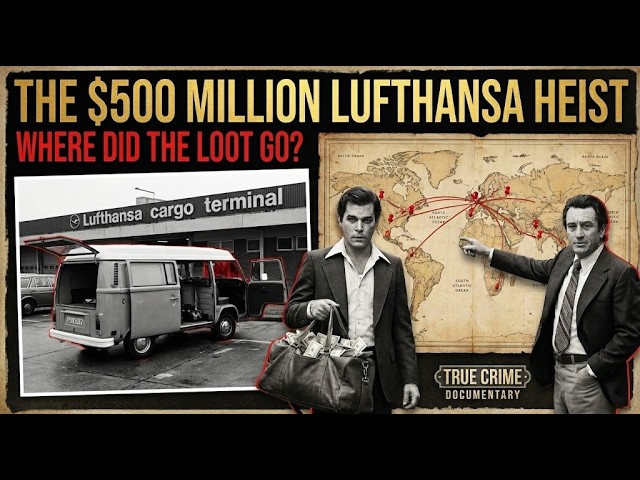
December 11, 1978. In 63 minutes, a crew of men walked out of JFK Airport with the equivalent of $500 million in untraceable cash and jewels.
It was the largest cash robbery in American history, but the crime was only the beginning. Within months, the bodies of the thieves started appearing across New York, and the money itself vanished into the underworld, never to be seen again.
But where did it go? From Lucchese family vaults to offshore accounts in the Bahamas, and the dark theory that the money was simply buried with the men who stole it, this is the investigation into the ghost of the Lufthansa Heist.
This is the untold story of the night the system failed and the money that never came back.
No textbook covers the calculated elimination campaign Jimmy Burke launched to protect his share.
Some secrets are worth more than life itself.
⚠️ HISTORICAL DISCLAIMER: This documentary reconstructs events from historical records, court documents, oral histories, and investigative journalism. Some dialogue and scenes are dramatized based on documented accounts. Sources listed below.
📚 Sources & Further Reading:
→ Wiseguy (Nicholas Pileggi)
→ The Lufthansa Heist (Henry Hill & Daniel Simone)
→ FBI Case Files: Lufthansa Cargo Robbery (JFK Airport 1978)
→ The Lucchese Family: A History of Crime (Court Records)
→ The Pizza Connection Investigation (Italian-American Task Force)
🏷️ Hashtags:
#TrueCrime #MafiaHistory #Documentary #LufthansaHeist #JimmyBurke #HenryHill #UnsolvedMystery
-~-~~-~~~-~~-~--~-~~-~~~-~~-~--~-~~-~~~-~~-~-
🕵️♂️ Global Mafia Universe - https://www.youtube.com/@GlobalMafiaUniverse?sub_confirmation=1
-~-~~-~~~-~~-~--~-~~-~~~-~~-~--~-~~-~~~-~~-~-
⚠️ Content Disclaimer
This video is created solely for educational and informational purposes.
We do not glorify, promote, or encourage any kind of criminal behavior or illegal activity.
All visuals, audio, and materials in this video are either:
✔️ AI-generated, or
✔️ Sourced from royalty-free platforms under valid licenses.
Some images, characters, and scenes have been created using artificial intelligence and are not depictions of real people or events.
No copyrighted material belonging to others has been used without permission.
❤️ Support the Channel
If you enjoy learning about true crime stories, history, and real-life mysteries, please:
✔️ Like the video
✔️ Subscribe to the channel
✔️ Share your thoughts in the comments
Your support helps us continue producing valuable and well-researched content!
🔧 Tools I Use to Grow This Channel
I personally use vidIQ to optimize my videos, find trending keywords, and grow faster on YouTube.
👉 Try it for free and experience the difference.
💼 Contact & Copyright Notice
If you believe any part of this video infringes on your rights, please contact me directly via YouTube.
I fully respect copyright laws and will respond promptly and professionally.
-~-~~-~~~-~~-~--~-~~-~~~-~~-~--~-~~-~~~-~~-~-
-
Show More Show Less View Video Transcript
0:08
December 11th, 1978.
0:11
3:15 in the morning. JFK International
0:15
Airport, Queens, New York. A black Ford
0:18
van pulled up to the Lufthansa cargo
0:20
building, building 261. The men inside
0:24
wore dark clothing. Some had ski masks,
0:28
others had badges of fake ones, but
0:30
convincing enough at 3:00 in the
0:32
morning. They moved fast, knew the
0:35
layout, knew which doors, knew which
0:37
guards worked, which posts, knew the
0:40
vault schedule down to the minute.
0:42
Within 63 minutes, they were gone. And
0:45
with them went approximately [music]
0:47
$5 million in unmarked American currency
0:51
and $875,000
0:53
in jewelry. At the time, it was the
0:57
largest cash robbery in American
0:59
history. Adjusted to today's value, that
1:02
Hall sits somewhere north of $500
1:05
million,
1:06
half a billion in one night. This
1:09
documentary is based on court records,
1:12
FBI case files, witness testimony, and
1:16
decades of investigative reporting. Some
1:20
conversations have been recreated based
1:22
on documented accounts where the record
1:25
goes silent. We've used informed
1:28
interpretation.
1:30
The events, however, are real. Here's
1:33
what makes the Lthansa heist different
1:35
from every other major robbery in
1:37
American history. The money was never
1:40
found. Not a single traceable bill
1:43
recovered. Not one diamond identified in
1:46
a porn shop or [music] a safety deposit
1:49
box. Not one numbered bearer bond
1:52
flagged at a bank. $500 million
1:56
vanished. Over the next several years,
1:59
the FBI would build cases, turn
2:01
witnesses, flip informants. They would
2:04
eventually identify the crew. They would
2:07
eventually understand how the job was
2:09
planned and executed. But the money
2:12
itself remained a ghost. It entered the
2:15
underworld on that December morning and
2:17
never resurfaced. The question isn't
2:20
really who did it. We know that now.
2:23
Henry Hill told us. The courts confirmed
2:26
parts of it. The bodies confirmed the
2:29
rest. The real question, the one that
2:32
investigators and journalists and
2:34
amateur detectives have chewed on for
2:37
over four decades, is simpler and harder
2:40
at the same time. Where did the money
2:43
go? There are three major theories. Each
2:46
one has evidence. Each one has problems.
2:49
And each one tells you something
2:51
different about how organized crime
2:53
actually works when the stakes are this
2:56
high. But before we get to the theories,
2:59
you need to understand the job itself
3:02
because the way the heist was planned
3:04
[music] contains the first clues about
3:06
where the money ended up. The inside man
3:09
was Louis Wernern Wransa
3:14
cargo agent. He'd worked at the terminal
3:17
for years, knew the vault, knew the
3:19
routines, knew the security gaps. He
3:23
also had a gambling problem that had put
3:25
him roughly $20,000 in debt to
3:29
bookmakers connected to the Luis LE
3:32
crime family. That's how it started. Not
3:36
with a criminal mastermind plotting in
3:38
some back room with a cargo worker who
3:41
couldn't cover his bets. Wernern fed the
3:44
information to a book maker named Martin
3:47
Kugman. [music] Krugman brought it to
3:50
the man who could actually put a crew
3:52
together, James Burke. Jimmy Burke,
3:55
sometimes called Jimmy the Gent, though
3:58
there was nothing gentle about him.
4:00
Burke was a Luis associate, not a made
4:03
man. His Irish heritage prevented that,
4:06
but deeply embedded in the family's
4:08
operations. He ran a crew out of
4:10
Robert's Lounge, a bar in Ozone Park,
4:14
Queens. [music] The bar was
4:15
unremarkable. wood paneling, pool table,
4:19
cold beer, the kind of place you'd walk
4:22
past without a second look. Behind it,
4:25
Burke orchestrated hijackings, lone
4:28
sharking, and cargo theft across the
4:31
airport corridor. He was, according to
4:34
investigators at the time, one of the
4:36
most prolific thieves operating out of
4:39
JFK. Burke assembled the team. The
4:42
number varies depending on who's telling
4:45
the story. [music] Henry Hill later said
4:47
it was roughly 11 men. The FBI estimated
4:51
between 6 and 10 [music] actually
4:54
entered the building. What's agreed upon
4:56
is that the crew was a mix. Luke's
5:00
associates, independent thieves Burke
5:03
trusted and a few muscle guys brought in
5:06
specifically for the job. Tommy de
5:08
Simone was among them. Angelo Seep,
5:12
Louie Cafora, Parnell Edwards, Paulo
5:16
Liecastry, an alleged Sicilian scent,
5:19
according to some accounts, to observe
5:22
on behalf of interests overseas. The
5:25
presence of Lie Castry is one of the
5:27
earliest hints that the money's
5:29
destination might not have been entirely
5:31
domestic. The job itself went almost
5:35
perfectly. Almost. The crew [music]
5:38
entered the cargo building using
5:40
Wernern's information. They subdued the
5:42
guards. There were reports of pistol
5:45
whipping threats. A guard forced at
5:48
gunpoint to disable an alarm system.
5:51
[music] They reached the vault. They
5:53
loaded the cash and jewelry into the
5:55
van. One error. The plan called for them
5:58
to also take a shipment of gold. They
6:01
couldn't move it. Too heavy. The
6:04
logistics hadn't been worked out. Some
6:06
accounts say the gold was in a separate
6:08
section they couldn't access in time.
6:11
Others say they simply underestimated
6:14
[music] the weight. Either way, they
6:16
left precious metals behind and drove
6:18
into the Queen's night with bags of cash
6:21
and jewels. Burke had given the crew
6:24
strict instructions beforehand.
6:26
According to Henry Hill's later
6:28
testimony, the rules were clear. No big
6:31
purchases, no new cars, no flashy
6:34
jewelry, no attention, lay low, wait for
6:38
the heat to die down. The money would be
6:41
distributed in stages. [music]
6:44
Within weeks, those rules were broken.
6:47
One crew member's wife showed up at a
6:49
Christmas party wearing a new fur coat
6:52
and a diamond necklace. Another bought a
6:54
Cadillac in cash. A third started
6:58
picking up restaurant tabs that were
7:00
triple his known income. Burke noticed.
7:04
Everybody noticed. The FBI noticed, too.
7:07
And this is where the story splits from
7:10
heist into something darker. Because
7:12
what followed wasn't a distribution of
7:15
wealth. It was an elimination campaign.
7:18
Between January 1979 and the spring of
7:21
1980, the men connected to the Lufthansa
7:25
heist began dying one by one, sometimes
7:29
two at a time. Martin Krugman, the book
7:32
maker who' brought the tip to Burke,
7:35
disappeared in January 79. His body was
7:38
never found. Parnell Edwards shot. His
7:42
body found in a trailer in Flatlands,
7:45
Brooklyn. Richard Eaton, a money mover
7:48
connected to Burke, found frozen in a
7:51
refrigerated truck, stabbed multiple
7:53
times. Louie and Joanna Khora, both
7:57
shot, found in the trunk of Louis Buick
8:00
in a parking lot near the Brooklyn
8:02
waterfront. Theresa Ferrara, an
8:05
associate who'd handled some of the
8:06
jewels, found dismembered on a beach.
8:09
Angelo Seep, shot in his apartment.
8:12
Tommy de Simone, disappeared. never
8:16
found. His death was likely sanctioned
8:19
by the Gambino family for unrelated
8:22
reasons, [music]
8:23
the murder of Billy Bats, but the timing
8:26
aligned with the Lu Thansa [music]
8:29
cleanup. In total, estimates range from
8:32
8 to 12 people connected to the heist
8:34
who were killed in the months and years
8:36
that followed. some directly by Burke or
8:40
on his orders, others through related
8:42
but distinct mob [music] politics. The
8:45
official interpretation, the one the FBI
8:49
built its case around, [music] the one
8:51
Henry Hill confirmed, was that Burke was
8:54
eliminating anyone who could tie him to
8:56
the robbery. Loose ends. People who
8:59
talked too much, spent too visibly, or
9:02
simply knew too much. But there's a
9:04
secondary interpretation that feeds
9:07
directly into the question of the money.
9:10
What if the murders weren't just about
9:12
silence? What if they were also about
9:15
consolidation?
9:16
Every person killed was a person who was
9:19
owed a share of the take. And every
9:22
share that didn't get paid [music]
9:24
was a share that stayed with whoever
9:26
controlled the main pool. That thought
9:29
leads us to the theories. Theory one,
9:32
the Luki's vault theory. This is the
9:35
most straightforward explanation, and
9:37
for [music] a long time, it was the one
9:39
most investigators leaned toward. The
9:42
idea is simple. Burke, working under the
9:46
authority of Paul Vario, his Luki's
9:49
captain, delivered the bulk of the money
9:51
up the chain. The Luis family absorbed
9:54
it into their existing financial
9:57
infrastructure.
9:58
From there, it was distributed to family
10:01
leadership, invested in legitimate
10:04
businesses, used to fund lone sharking
10:07
operations, or simply stored. The
10:10
evidence supporting this theory is
10:12
largely circumstantial [music]
10:14
but substantial. Burke was a Luis
10:17
earner. Everything he did required a
10:20
kickback to Vario. A score this size,
10:23
the biggest in American history, would
10:26
have demanded immediate tribute to the
10:28
family boss. According to the customs of
10:31
the organization, the families cut on a
10:34
score like this could range anywhere
10:36
from 40 to 60%. [music] Henry Hill
10:40
testified that Vario was informed of the
10:43
heist in advance and had given his
10:46
blessing. That blessing came with
10:48
expectations.
10:50
Hill also stated that Burke was under
10:53
enormous pressure from the family to
10:55
deliver the tribute quickly and
10:58
completely. Some investigators [music]
11:00
believed the cash was moved to locations
11:03
in New Jersey and Long Island controlled
11:06
by Luis's operations,
11:08
safe houses, construction company
11:11
offices, even a funeral home that had
11:14
long served as a front for family
11:16
business. The theory is that the money
11:19
was broken up into manageable sums, tens
11:22
of thousands, not millions, and filtered
11:26
into the economy through dozens of small
11:29
channels over a period of years. Court
11:32
documents from later prosecutions
11:35
reference unexplained cash flows in the
11:38
late 70s and early 80s that some
11:41
analysts have attempted to link to the
11:43
Lufthansera proceeds. None of those
11:46
links were ever proven conclusively in
11:48
court. The problems with this theory are
11:51
notable. If the Luki's family absorbed
11:54
the money through normal channels, some
11:57
trace should have surfaced. The FBI had
12:01
informants inside the family. They had
12:04
wire taps. They were actively monitoring
12:06
Lui's finances through the early8s as
12:10
part of the broader commission case. And
12:12
yet nothing definitively tied any
12:14
recovered funds to the Lufthansa
12:17
shipment. The cash was unmarked, yes,
12:20
[music]
12:20
but 875,000
12:22
in jewelry is harder to hide. Diamonds
12:26
have characteristics.
12:28
Stones can be identified, graded,
12:31
matched to shipping manifests. Lanca and
12:34
its insurers provided detailed
12:37
descriptions of the jewelry to law
12:40
enforcement. Not one piece was ever
12:43
identified in circulation. Supporters of
12:46
this theory [music] argue that the Luis
12:48
family simply had the discipline and
12:51
infrastructure to absorb the hall
12:53
without leaving fingerprints. That the
12:56
absence of evidence is itself evidence
12:58
of competence. Critics call that
13:01
convenient and they point to the second
13:03
theory. Theory two, the offshore
13:07
laundering theory. This theory gained
13:09
traction in the late 80s and '9s as
13:13
investigators developed a better
13:15
understanding of how organized crime
13:18
moved money internationally during that
13:21
>> [music]
13:21
>> era. The premise is that the bulk of the
13:24
Luansa cash was moved offshore
13:27
relatively quickly within weeks or
13:30
months of the heist through a network of
13:33
intermediaries
13:34
connected to both American organized
13:37
crime and international [music]
13:39
financial operators. In the late 1970s,
13:43
the infrastructure for this kind of
13:45
movement existed but was less regulated
13:49
than it would later become. The Bank
13:51
Secrecy Act of 1970 required [music]
13:54
reporting of transactions over $10,000,
13:58
but enforcement was inconsistent.
14:01
Structuring, breaking large amounts into
14:04
smaller deposits to avoid reporting
14:07
thresholds, was not yet a federal crime.
14:10
That wouldn't happen until 1986.
14:13
The theory suggests several possible
14:16
routes. cash couriers to the Bahamas or
14:19
the Cayman Islands where banking secrecy
14:22
laws were robust. Transfers through
14:26
Canadian financial institutions that had
14:29
looser oversight or movement through
14:31
European banks possibly in Switzerland
14:35
or Luxembourg facilitated by contacts in
14:38
the Sicilian mafia who maintained
14:41
established channels for heroine money.
14:44
This is where Paulo Lcastri becomes
14:47
significant again. [music] Liecastri's
14:50
presence on the heist crew has never
14:52
been fully explained. He was not a
14:55
regular Burke associate. He was
14:57
Sicilian. According to some accounts, he
15:01
was connected to the Bontate Bone Tah
15:04
family in Palamo, which at that time was
15:07
deeply involved in the transatlantic
15:09
heroine trade and had wellestablished
15:12
money laundering roots between the
15:15
United States [music] and Europe. Some
15:17
investigators have theorized that Lie
15:20
Castre's role was not as a thief but as
15:23
a representative there to ensure that a
15:26
portion of the proceeds was earmarked
15:28
for Sicilian interests. [music]
15:30
If accurate, this would mean the money
15:33
didn't stay in Queens, it crossed
15:35
oceans. The supporting evidence is thin
15:39
but intriguing. In the early 80s,
15:42
Italian authorities investigating the
15:45
pizza connection, a massive heroine
15:48
trafficking network that linked Sicilian
15:50
mafia families to American distribution
15:53
points, many of them pizza parlors,
15:57
identified financial flows between New
16:00
[music] York and Palamo that predated
16:02
the known heroine transactions.
16:06
Some investigators informally speculated
16:09
that Luansa money might have been among
16:12
the earliest funds moved through those
16:15
channels. No formal connection was ever
16:18
established. The pizza connection trial,
16:21
which concluded in 1987,
16:24
produced thousands of pages of [music]
16:27
financial records, but none that
16:30
definitively linked back to the JFK
16:33
heist. The jewelry question is partially
16:36
addressed by this theory. Uncut diamonds
16:39
and high value stones could be moved
16:42
internationally with relative ease. A
16:45
courier with stones sewn into a coat
16:47
lining could pass through customs
16:50
without triggering any alarm. Once in
16:53
Antworp or Tel Aviv, the world's two
16:56
dominant diamond markets. stones could
16:59
be recut, regraded, and sold with no
17:02
trace to their origin. According to
17:05
certain accounts from investigators who
17:08
worked the case in the 1980s,
17:11
there were unconfirmed reports of
17:13
Lufthanser profile stones appearing in
17:17
the Antworp market in late 1979.
17:21
Unconfirmed is the key word. The
17:24
descriptions matched, but matching is
17:27
not identification. And by the time
17:30
anyone thought to look seriously, the
17:32
stones, if they were the stones, had
17:35
been recut and resold multiple times.
17:38
The offshore theory has appealed because
17:41
it explains the total absence of
17:43
recovery. If the money left the country,
17:46
then domestic surveillance, informance,
17:48
[music]
17:49
and financial monitoring would all come
17:52
up empty, which is exactly what
17:55
happened. The weakness of this theory is
17:58
its complexity. Burke was a street level
18:01
operator, brilliant at what he did, but
18:04
what he did was hijackings and cargo
18:07
theft. The kind of international
18:10
financial maneuvering described in this
18:12
theory [music] requires a level of
18:14
sophistication and trust network that
18:17
Burke may not have possessed unless he
18:20
didn't need to possess it. Unless the
18:22
Luis family or their Sicilian
18:25
connections handled that part, in which
18:28
case theories one and two start to
18:31
overlap, which brings us to theory
18:34
three. Theory three, the dispersal
18:37
theory. Some people call it the chaos
18:39
theory. This is the least dramatic
18:42
explanation and in some ways the most
18:44
believable. The idea is that there was
18:47
no master plan for the money, no vault,
18:50
no offshore account, no Sicilian
18:53
pipeline. The heist was planned
18:55
meticulously, but the aftermath was not.
18:59
The money was divided quickly and
19:01
chaotically among the crew, their
19:03
associates, and their families. Some was
19:06
spent immediately. Some was hidden in
19:08
walls, buried in yards, stuffed in
19:12
safety deposit boxes under false names.
19:15
Some was gambled away. Some was used to
19:18
pay debts. Some was simply lost. And
19:22
then the killings started and whatever
19:24
organizational structure existed for the
19:27
money collapsed entirely. Think about it
19:30
from a practical standpoint. 11 men,
19:34
give or take, pulled the job. Each
19:36
expected a share. Burke owed a cut to
19:39
Vario. Vario owed a cut up the chain.
19:42
There were expenses, vehicles, weapons,
19:45
the safe house where they divided the
19:47
take. There were debts. Wernern's
19:49
gambling debts had started the whole
19:51
thing and others in the crew had their
19:53
own obligations.
19:55
If you start [music] subtracting from 5
19:57
million, it goes faster than you'd
19:59
think. Burke's cut, Vario's cut, the
20:03
boss's cut. Expenses, debts. Now divide
20:07
what's left among six to 10 crew
20:10
members. Each man's share might have
20:12
been between $1 and $250,000.
20:16
Significant money. Absolutely
20:19
lifechanging in 1978, [music]
20:22
but not the kind of sum that requires an
20:25
offshore banking network to hide.
20:28
$100,000 in cash fits in a shoe box. You
20:32
can bury a shoe box. You can put it
20:34
behind a wall. You can give it to your
20:36
mother. And if you die before you tell
20:39
anyone where it is, it stays there,
20:42
maybe forever. The dispersal [music]
20:44
theory suggests that much of the Lthansa
20:47
money suffered exactly this fate. Small
20:51
sums hidden by individuals who were then
20:53
murdered before they could retrieve or
20:56
spend them. cash that degraded in damp
20:59
basement. Jewelry that was sold
21:01
peacemeal to local fences [music] for
21:03
pennies on the dollar, then resold and
21:06
resold until prudence was untraceable.
21:10
Henry Hill himself supports a version of
21:13
this theory. In his various accounts,
21:16
and Hill told this story many times with
21:19
varying details over many years, he
21:22
described a chaotic aftermath. Money
21:25
distributed in paper bags at Robert's
21:28
Lounge. Arguments over shares.
21:31
Suspicion. Paranoia. Hill has said that
21:34
Burke held back a large portion, the
21:37
family tax plus his own cut, and
21:40
distributed the rest unevenly based on
21:43
role and trust. Some guys got 50,000.
21:47
Some got more. Some got promises that
21:50
were never honored. And then the
21:52
spending started. And then the killing
21:54
started and whatever wasn't spent or
21:57
killed over was simply scattered to the
22:00
wind. There's a melancholy to this
22:02
theory. $500 million in today's money.
22:06
And the idea is that it just dissipated.
22:10
No grand conspiracy, no hidden vault,
22:14
just human greed and human stupidity and
22:17
human mortality doing what they always
22:19
do. The evidence for dispersal [music]
22:22
is mostly negative evidence. The absence
22:25
of any large recovery, the absence of
22:29
any organized financial trail, [music]
22:32
the absence of any single person who
22:34
seemed to benefit disproportionately
22:36
over time. If someone had received and
22:39
kept a major portion, their [music]
22:41
lifestyle would eventually reflect it.
22:44
Nobody's did. Not in a way that was ever
22:47
identified. There is one exception that
22:50
complicates every theory and it's worth
22:53
addressing. In 2013,
22:57
decades after the heist, federal
22:59
investigators executed a search on a
23:02
property in Queens connected to Vincent
23:05
Assaro ISA,
23:08
a Banano family captain who had been
23:10
linked to the Luansa robbery through
23:13
informant testimony. Assaro was
23:16
eventually tried in 2015 on charges
23:20
related to the heist and other crimes.
23:23
During the investigation, authorities
23:26
recovered no luans money from Asarrow's
23:29
property. However, Assaro's involvement,
23:33
a Banano family member participating in
23:37
what was understood to be a Luis
23:39
operation, raises questions about how
23:42
widely the heists proceeds were shared
23:45
among New York's crime families, if
23:48
Banano members were involved. Were
23:51
Gambino interests represented, too? Were
23:54
their obligations paid to the commission
23:56
itself? [music] If the money was
23:59
distributed across multiple families,
24:02
the dispersal theory gains strength. The
24:05
total is diluted across a much larger
24:07
pool of recipients and the individual
24:10
amounts become small enough to hide
24:13
easily. Assaro was acquitted in 2015.
24:18
His defense argued that the government's
24:21
case relied heavily on the testimony of
24:24
cooperating witnesses whose credibility
24:27
was questionable. The acquitt means we
24:30
need to be careful about treating his
24:32
involvement as established fact. The
24:35
jury was not convinced. So three
24:38
theories, Lucy's vaults, offshore
24:41
laundering, chaotic dispersal. Each has
24:45
logic. Each has gaps. There are
24:48
investigators, retired FBI agents who
24:51
worked the [music] case who believe the
24:53
answer is some combination of all three.
24:57
That Vario and the Luis leadership took
25:00
a significant cut and absorbed it
25:02
domestically. That a portion was moved
25:05
overseas through Sicilian channels and
25:09
that the remainder was scattered among
25:11
crew members who spent it, hid it or
25:14
died with it. This composite theory is
25:17
less satisfying [music]
25:19
than any single explanation. It doesn't
25:21
have the neatness of a hidden vault or
25:24
the intrigue of international [music]
25:26
laundering or even the dark poetry of
25:29
money lost to murder and time. But real
25:32
life rarely offers neat answers,
25:35
especially in this world. One retired
25:39
agent, his name was Steve Carbone, who
25:42
supervised the Lufthanser investigation
25:45
for years, said something in an
25:48
interview that stayed with investigators
25:51
long after. He said the money was
25:53
probably in 50 different places by the
25:55
end of 1979.
25:58
Some of those places are known, some
26:00
aren't, some of those places don't exist
26:03
anymore. Buildings torn down. Lots paved
26:07
over. People dead who were the only ones
26:09
who knew. $500 million in the ground, in
26:13
the walls, in bank [music] accounts
26:16
under names nobody remembers. Scattered
26:19
across two continents. Spent on fur
26:21
coats and Cadillacs that rusted out 30
26:24
years ago. paid to men who used it to
26:27
fund other crimes that funded other
26:30
crimes in a [music] chain that
26:32
eventually becomes untraceable. The
26:35
Lufthansera heist is remembered as the
26:38
greatest cash robbery in American
26:40
history. Good fellas immortalized it.
26:43
[music] Henry Hill made it famous. Jimmy
26:46
Burke became a legend because of it. But
26:49
the money itself has no legend. It has
26:52
no story. It was there and then it was
26:54
gone. And the men who took it were dead
26:57
or imprisoned or both. And nobody was
27:00
left to say where it went. Louis Wernern
27:03
was the only person ever convicted for
27:05
the Luansa heist. The inside man, the
27:09
cargo worker with the gambling debts. He
27:12
received a 15-year sentence. He served
27:15
his time and was released. His share of
27:18
the money, if he received one, was never
27:21
identified. Burke died in prison in
27:24
1996.
27:26
Cancer. He was never convicted of the
27:28
Lufthansa robbery itself, though he was
27:31
serving time for the murder of Richard
27:34
Eaton, one of the men killed in the
27:37
aftermath. He never told anyone where
27:39
the money was, or if he did, that person
27:43
never talked [music] either. Henry Hill
27:45
died in 2012. He'd spent 30 years in
27:49
witness protection, giving interviews,
27:52
writing books, making the rounds on
27:54
television. He claimed he received a
27:57
relatively small share, somewhere around
28:00
[music]
28:00
$50,000,
28:02
and that Burke kept the lion's share.
28:05
Whether that's true or simply what Hill
28:07
wanted people to believe is impossible
28:10
to verify now. Paul Vario died in prison
28:14
in 1988.
28:16
heart failure. He took whatever he knew
28:18
with him. The cargo terminal at JFK
28:22
still operates. Building 261 was
28:25
eventually renovated. The vault was
28:28
upgraded. New security protocols were
28:31
implemented. None of that matters to
28:34
this story. What matters is what left
28:37
that building in a black Ford van in the
28:40
early hours of a December morning and
28:43
where it went after it disappeared into
28:45
the streets of Queens. Some money gets
28:48
recovered. Some money gets traced. Some
28:51
money gets taxed, laundered, seized,
28:54
returned, reinvested. That's what
28:56
happens to money in the system. This
28:59
money left the system and the system
29:01
never got it back. The file on the Lansa
29:05
heist remains technically open. The FBI
29:08
has never formally closed it. There is
29:11
no statute of limitations on the
29:13
underlying charges, [music] but every
29:16
significant figure connected to the case
29:18
is now dead. Every lead has been run
29:21
down, documented, and filed. $500
29:25
million somewhere. Nowhere. Subscribe if
29:29
you want to hear what happened next. The
29:31
Lthansa heist didn't end at JFK. Its
29:35
consequences rippled through the Luis
29:37
family, accelerated the fall of Paul
29:40
Vario, [music] and helped trigger the
29:42
biggest wave of mob informants in
29:44
American history. That story is coming.
29:48
Don't miss it. The file remains open.
29:51
The questions remain unanswered.
Arts & Entertainment
Law & Government
News
People & Society