Up next in 10



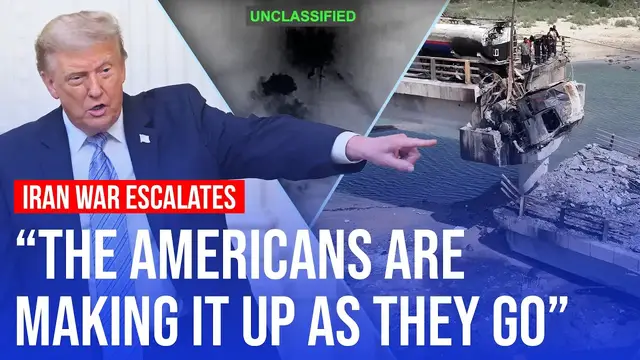
The US has launched further strikes on Iran after Donald Trump declared that the contested Strait of Hormuz was open to all ship traffic except for the gulf state. Iran state media has also accused the US of targeting civilian infrastructure during its most recent attacks. The White House has denied this, instead citing that strikes were carried out 'exclusively on military targets, including military logistics infrastructure'. Matthew Wright is joined by Middle East expert Jane Kinninmont and Rachel Johnson is joined by Dr David Wearing to react to the escalation. Listen to the full show on the all-new LBC App: https://app.af.lbc.co.uk/btnc/thenewlbcapp #matthewwright #racheljohnson #iran #donaldtrump #trump #iranwar #middleeast #straitofhormuz #LBC LBC is the home of live debate around news and current affairs in the UK. Join in the conversation and listen at https://www.lbc.co.uk/ Sign up to LBC’s weekly newsletter here: https://l-bc.co/signup
Show More Show Less View Video Transcript
0:00
The US military said it launched a seventh consecutive night of strikes against Iran on Friday night
0:05
as fighting escalated over the strait. In the past week, we've had Donald Trump talking about putting charges on boats using, on ships using the strait
0:15
And then Iran saying that they were the ones that would be doing that. They were the true guardians of the strait
0:21
And so it goes on. Iran, for its part, has responded to the US strikes by targeting Bahrain, Kuwait, Jordan, Oman and Qatar
0:29
and what I find interesting there is Qatar has been one of the mediators between the US and Iran
0:34
and they've been mostly spared from Iranian retaliation to date. I'm joined by Jane Kinnamont, a Middle East specialist and chief executive of the United Nations Association UK
0:44
Nice to see you this morning, Jane. What do you make of the situation now in Iran and the Strait of Hamuz at the end of this past week
0:53
Good morning, Matthew. Well, you've described well there what's been happening And on top of that, really, it's very messy and it's very risky
1:01
Now, it is one month since the US and Iran signed this so-called memorandum of understanding
1:10
as kind of skeleton agreement that set a basis for having talks
1:16
And the idea was that they were supposed to then spend two months having talks
1:20
to come up with a more comprehensive and more stable agreement. But one month in, those talks now are not happening and both sides are violating the agreement
1:32
So there is obviously a concern that it could completely break down. Now, I suppose the optimistic case is that for people who want diplomacy and an end to war
1:42
is that the kind of basic fundamentals of that agreement, you know, both sides still have an interest in them
1:51
But the worry is that these are two countries that have disliked and misunderstood each other since the Iranian revolution in 1979
2:01
You know, a pretty long time ago. It goes back to that. Long before that, I mean, the CIA and the UK deposed a democratically elected president of Iran back in the late 1940s, early 1950s
2:12
Well, this is important, too, that there is a very deep mistrust that does have longer historical roots
2:20
But the current political leadership and the system in Iran was formed out of this 1979 revolution where the whole idea of it was to resist the West, to be anti-Western
2:33
And, you know, that's partly about political Islam, but it was also a kind of third worldist revolution
2:40
And in a way the Iranian leadership has had a kind of ideological comeback since it was attacked by the US and Israel last year and this year
2:52
You know, for many in Iran, the revolution has really become kind of morally bankrupt
2:58
You know, it's quite a long time now since 1979. Most Iranians don't directly remember it
3:03
And they are living in a system, you know, where the economy is mismanaged and ordinary people are fairly repressed in their lives
3:12
But it does seem that since being attacked by the US, the Iranian regime has been able to posture much more than it is the kind of global defender against imperial arrogance, etc
3:24
And they really want to show that they're winning. And the US, of course, really wants to show that it's not losing
3:31
So while there is some way forward to find a common interest and not continue the fighting
3:40
there's a huge amount of arrogance, belligerence, unpredictability and potential for misunderstanding
3:47
that might mean that even if an agreement is in the interest of both countries, it doesn't get reached
3:54
That's just brilliant, isn't it? Even if an agreement is in the interest of both countries, it might still not be reached
3:59
the one thing and unfortunately we don't have time to talk about it but i'm just going to throw it out there for the listeners i think the real winners of the war so far are the oil traders
4:06
aren't they i mean the price of oil goes up in a predictable fashion when trump talks of peace
4:11
and the price of oil uh sorry the price of when it looks like trouble and the price of oil comes
4:15
down when trump talks about peace it's uh you can't lose if you trade in oil at the moment it
4:19
strikes me you've listened to sort of cast their minds back to about a month ago a memorandum of
4:25
understanding was agreed between the US and Iran and that supposedly formalized the kind of informal
4:32
ceasefire that held since April and which brought to an end this sort of six weeks of really intense
4:40
hostilities between Israel and the US on the one hand and Iran on the other. Well that memorandum
4:45
of understanding, I don't want to say it wasn't worth the paper it was printed on. Go on, it's
4:50
clearly true what was the understanding there seems to have been no understanding and no memo
4:56
yeah there's a lack of understanding because there's a lack of clarity um the language is
5:03
really really vague um there's particular provisions about reopening the strait of
5:08
hormones which as i'm sure you and your audience are well aware is a really really important um
5:14
sort of trade artery for which a huge amount of the world's energy flows and a huge amount of
5:18
other important commodities and goods, shutting that straight down as a disaster for the world
5:24
economy The key passage in the memorandum of understanding provided for that straight to be reopened but it was completely vague And the Iranians have interpreted the key passage Clause 5 as being one where they control the strait
5:42
and it's down to them who comes through. And that's the exact opposite of what the Americans want
5:46
And, of course, if this was competently drafted, as opposed to being, you know
5:50
negotiated by Trump's son-in-laws, for example, then we might have had some more clarity
5:55
and less room for competing interpretations. The Iranians don't want to lose control of the Strait of Hormuz
6:02
because for them this is a better deterrent than a nuclear weapon. They've discovered that they can shut the Strait down pretty cheaply
6:10
and prevail over the United States in a war by virtue of being able to use that weapon
6:17
And so they're not going to give it up lightly. The Americans want them to give it up and that's effectively why hostilities have broken out again
6:25
over the last six days. And as you mentioned in your question, I mean, this is escalating sharply and you've got attacks on civilian infrastructure from both sides
6:36
So it's getting really dangerous, unfortunately. Both sides meaning? Well, the Iranians are hitting civilian infrastructure in place
6:44
In Kuwait, they hit a desalination plant. Kuwait doesn't have much fresh water
6:49
They rely on desalination plants for their drinking water. So if you hit a desalination plant, that's really serious
6:55
And meanwhile, Trump is hitting bridges, roads, ports. So this is what happens when escalation, you know
7:04
when two sides in a conflict get into an escalatory spiral. Trump makes big threats, hits bigger targets
7:12
Uranians do likewise. Neither want to back down. And it can end up somewhere pretty ugly until someone decides to de-escalate
7:20
You mentioned the attack on the desalination plant in Kuwait. Is there any likelihood or risk that Iran could escalate and hit, you know, when Dubai Airport was closed right at the beginning of hostilities
7:33
Do you see it widening as well as escalating? Of course. I mean, they've hit other US allies in the region over the last six days
7:43
and you can expect any sort of escalation that Trump engages in
7:50
the Iranians will be really keen to show that they can match
7:55
They want to show the Americans, however hard you hit us, we will hit you and your allies back even harder
8:01
So you may as well come back to the negotiating table or you may as well accede to our demands
8:08
It's a good idea not to start a war, which is what Trump and Netanyahu did
8:12
and they can't get out of it. That's the last two questions I was going to ask you
8:16
The first one was I was puzzled when Donald Trump thought it was clever to say that the US would control the Strait of Hormuz and impose a tariff and fees on traffic I thought that was crazy If he didn want Iran to do
8:30
something like that, why is he suggesting it? And second, what, if any, is the likely off-ramp
8:35
for the US-Israel on Iran as things stand? I mean, this thing about Trump imposing fees on
8:45
going for the straightforward moves, I mean, you're right to highlight that. On the one hand
8:49
you can't spend, like, weeks saying that the Iranians have no right to impose tolls on the
8:55
straightforward moves and then decide you're going to do that. And if you're going to do that
9:00
it's even more ridiculous to then change your mind 24 hours later. And it's a sign that the
9:04
Americans are making this up as they go along. It's that they've been floundering from the moment
9:09
they started this war. And in terms of off-ramps, it's going to get to the point where the pain is too much
9:17
for one side or the other. I mean, what basically happened at the beginning of April
9:21
was that Trump realised this wasn't working and he wanted to get out of it
9:26
He had buyer's remorse. And what he hoped for, I suppose, he always hopes for a capitulation
9:34
He thinks he throws his weight around and the other side capitulates. and he can't really comprehend why the Iranians won't capitulate
9:41
And presumably he's going to get frustrated again in a few days or a few weeks' time
9:45
and there'll be another attempt to reach some sort of modus vivendi
9:51
But I'm afraid, I think this is going to just drag on sporadically for months
9:57
It's really difficult to see how the two sides get out of this. And it just underlines the fact that the war should never have been started to begin with
10:04
And the Iranians will never surrender. It's extremely unlikely. I mean, my ogy would be the Houthis in Yemen
10:14
The Saudis pulverised Houthi-controlled parts of Yemen for seven years, and the Houthis are stronger than ever
10:21
I mean, you look at Iran, the Americans hit them with virtually everything short of nukes
10:27
and Trump effectively threatened to nuke them. And they're still there. You know, this is the reality, this sort of coercive bombing
10:35
this sort of attempt to pulverize people into submission. Nine times out of ten it doesn't work
10:41
So it's one option... And we've seen the result of that. Yeah, thank you. Just, is one option for Trump just simply to leave the theatre of Iran
10:49
and to just pretend nothing happened and just create a drama somewhere else, Greenland, Cuba, you know
10:55
somewhere else and just divert the world's attention to that? A sensible American president
11:02
A, would never have started this war, obviously. Yeah, of course. If they had, and they were in a situation now
11:07
they would do what's called declaring victory and leaving
#news