Up next in 10



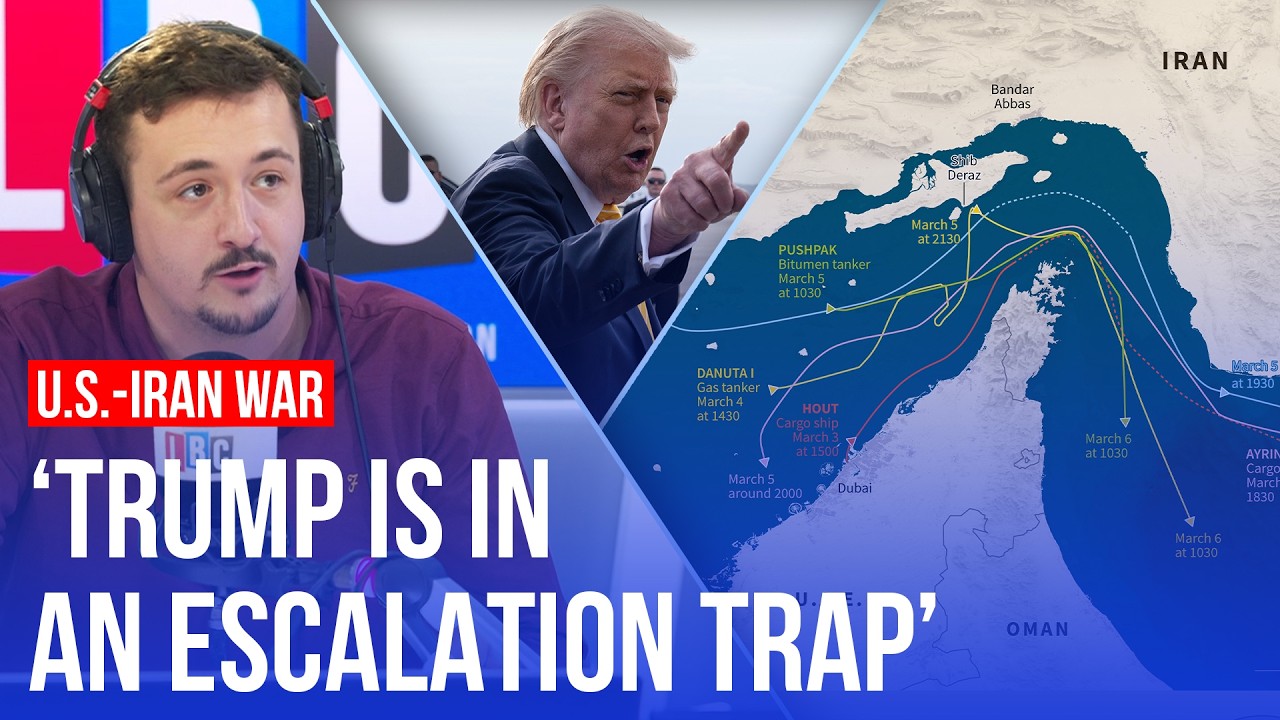
As tensions rise in the Strait of Hormuz, conflicting claims from the US and Iran highlight a deeper issue: both sides may be stuck in an “escalation trap”. Ross Harrison, Senior Fellow at the Middle East Institute and author of "Decoding Iran’s Foreign Policy", joins Henry Riley and to explain why neither side can easily back down. Will this war cost Trump the midterms? Listen to the full show on the all-new LBC App: https://app.af.lbc.co.uk/btnc/thenewlbcapp #henryriley #middleeast #trump #donaldtrump #iran #iranwar #straitofhormuz #uspolitics #news #usnews #politics #LBC LBC is the home of live debate around news and current affairs in the UK. Join in the conversation and listen at https://www.lbc.co.uk/ Sign up to LBC’s weekly newsletter here: https://l-bc.co/signup
Show More Show Less View Video Transcript
0:00
as you've been hearing in the LBC News bulletins
0:03
When it comes to the Strait of Hormuz, conflicting reports. Two US-flagged merchant vessels are reported to have sailed through the Strait of Hormuz
0:11
according to Central Command. President Trump saying the US military would begin helping vessels
0:17
as he said, I think it was yesterday, who were stranded in the shipping channel
0:23
Tehran insisting that these claims were baseless and entirely false. Let's speak with Ross Harrison, who's Senior Fellow at the Middle East Institute and author of the new book, Decoding Iran's Foreign Policy
0:34
Ross, thank you for joining us. You're very welcome. As usual with these sort of issues with the Strait of Hormuz, it depends who you listen to
0:44
But Iran and the USA are completely conflicting things with regards to those two ships
0:50
Yeah, it's not unusual, Henry, for this to happen. I think what we're seeing here is that Donald Trump is in what we call an escalation trap in that he can't really achieve the objectives that he wants, which is capitulation on the part of the Iranians by escalating
1:05
And he can't de-escalate lest he admit defeat or some kind of falling short of his war objective
1:13
So what you're seeing is you're seeing him instead of waging strong kinetic actions, strong escalation
1:22
you're seeing him sort of a minor kind of soft escalation, which is agreeing to escort ships, claiming it's a humanitarian objective
1:29
And the Iranians, on the other hand, have very little to lose or they have less to lose
1:36
I'll restate it. They have less to lose by escalating the de-escalating. So if they escalate, they claim they attack the ship, the ships
1:43
If they escalate, then they've reestablished deterrence. If they de then they are weakening themselves when they get to the negotiating table So each party is kind of caught in their own sort of trap in a way with very very different incentives And that what you seeing And what we hope for Henry is that this will ultimately lead to both parties de and then move back to the negotiating
2:04
table. But that's not what we're seeing today. And is there any prospect of, of course, we have
2:08
the talks in Pakistan that were cancelled and J.D. Vance didn't end up going to, which was widely
2:14
reported at the time. Is there any dates for a sort of future negotiation or third party
2:19
conversation? No, if there is a date, Henry, it's opaque to us. We don't certainly know what it is
2:26
I don't think there is a date. I know that the Pakistanis are talking to the Americans and they're
2:31
talking to the Iranians. But in terms of actually creating some kind of a critical mass or pathway
2:36
towards the negotiating table, no, I think it's the opposite. I think you're seeing negotiations
2:41
take place, by the way, but they happen to be taking place in the Strait of Hormuz, with each party trying to best the other
2:48
so that when they get to the negotiating table, they're in a strengthened position. So right now they're negotiating using military means
2:55
and hopefully that will ultimately lead to some kind of a de-escalation
3:00
that will take them back to the table. But right now we don't see it. What do you imagine the US will be willing to compromise on
3:06
and the same with the Iranian side in perhaps what was mooted at the first round of negotiations
3:11
Well, I think for the Americans, what's important, or at least for Donald Trump, what's important is that he's able to claim that he got some kind of a concession on the nuclear issue that is better than the JCPOA, the deal that he walked away from, the one that was negotiated in 2015 by Barack Obama
3:31
So he can claim that. And if the Strait of Hormuz is open, those are the two main things that he's given up on, I think, on the fact that the leadership is going to change in Iran
3:40
He's basically focusing on opening up the strait. And we have to remind your viewers the strait was open before the war started This was a consequence of the war and getting a better deal than he had before On the Iranian side it very clear what the Iranians want or what the Iranians need They
3:56
need to survive and they need to have re-established deterrence, Henry, because during the last war
4:04
last year, almost a year ago, June, at the end of that war, when the United States and Israel
4:10
attacked Iran's nuclear sites. At the end of the war, Iran believed it had lost deterrence
4:16
And it knew, in fact, I talked to President President Pashishkian at the time about this
4:20
He knew that a follow-on war would occur. He didn't know when. So he kind of knew that this
4:26
war that we're in now would occur. So I think what's important to them, since they knew
4:32
why did they know the war was going to come? Because they knew they had lost deterrence. So for the Iranians, the key is recreating deterrence so that Israel and the United States have a disincentive to do this again
4:43
And so what they're willing to do is do whatever it takes to get out of this war, but maintain deterrence and maintain at least their right to enrich uranium and get some kind of an economic lifeline, some kind of economic, whether that's in the form of tolls through the straightforward moves or unfreezing of assets or some kind of sanction relief
5:03
those are the things that are important is there a convergence i think there is whether donald trump
5:09
can give up his his his goal of capitulation on the part of the iranians which is not going to
5:15
happen as long as he can be flexible and do that there's probably a deal to be had but um if he's
5:21
if he's basically going back to the same old playbook that took him into this war and has
5:26
kept him and has kept him in this war not having achieved his objectives then who knows what's the
5:33
future. And the domestic pressure of the pocketbooks, as you'd say in America, of voters
5:40
You got important midterm elections of course coming up in just a few months time And I mean we having a very live conversation in this country about you know fertilizer for example and obviously the
5:50
the cost of um of of petrol and diesel for people to put in their cars um how much is that because he
5:58
i remember during the election when i was in um washington and other states it was all about the
6:02
price of eggs and it was all about the price of groceries now with that increasing over in the
6:07
States as it is here. Is the pressure starting to turn some of his supporters against him
6:12
President Trump? Or what's the sort of state of play? Donald Trump said, with the lead up to the 2016 election, that he could kill somebody on
6:21
Main Street, and his supporters would still support him. So I think there's always a group
6:26
of people. Maybe it's a third of the electorate, maybe it's 25% of the electorate, it's a smaller
6:30
portion than it was before. We'll support him no matter what. So we have to accept that
6:36
The question, Henry, I think, is how impervious is he to domestic political considerations
6:42
What you heard about the price of eggs was occurring in the lead up to the 2024 election, right
6:48
When he had something to lose. Now, yeah, I mean, whether he really cares about his Republican Party, whether he cares about the Senate or the House turning, we don't know
7:00
A normal president would feel the pressure, the pressure that you just alluded to, and that would be baked into his decision making, presumably, on how to proceed with this war
7:14
but I would not, you know, it's not clear to me that he is that responsive
7:21
to the traditional bread and butter issues and political pressure that we would be seeing heading to a midterm with any president but Donald Trump
7:31
It's just not clear to me at this point. Thank you, Ross. Appreciated. Ross Harrison is Senior Fellow at the Middle East Institute
7:37
author of the new book, Decoding Iran's Foreign Policy
#news