Up next in 10



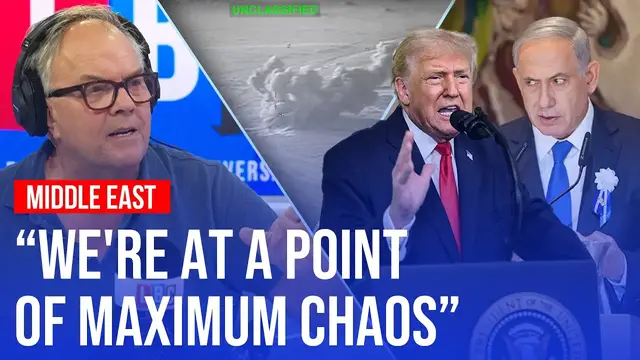
The United States and Saudi Arabia have struck a deal on nuclear energy amid the Iran war. This comes as Trump told Saudi Arabia that 'it's time' to normalise ties with Israel. It is understood that the deal will allow Saudi Arabia to develop a civilian programme with appropriate safeguards. The agreement could earn the US billions of dollars and will allow its companies to produce enriched uranium as fuel for reactors. Israel is heavily opposed to the deal - which it argues could result in the kingdom developing a nuclear weapon. Listen to the full show on the all-new LBC App: https://app.af.lbc.co.uk/btnc/thenewlbcapp #mattfrei #iranwar #middleeast #israel #netanyahu #trump #saudiarabia #LBC LBC is the home of live debate around news and current affairs in the UK. Join in the conversation and listen at https://www.lbc.co.uk/ Sign up to LBC’s weekly newsletter here: https://l-bc.co/signup
Show More Show Less View Video Transcript
0:00
Now, the war in the Middle East, the one that was started by Donald Trump and Israel on the 28th of February
0:06
may make your eyes glaze over because the ceasefire has been broken, yes
0:10
but it seems to be kind of a little, I mean, the fighting is sort of on again, off again
0:15
The price of oil has shot up again to $100 a barrel. But we seem to be able to tolerate a huge degree of chaos, insecurity and volatility as a result of this war
0:26
But I wonder whether that is just too complacent and too dangerous, because what's happened in the last week, you know, I think is quite significant
0:34
And there are a couple of developments I want to point to. One is that the Saudis have been hit by the Iranians or rather American bases in Saudi Arabia have been hit
0:42
There are four American deaths of servicemen altogether in the last week
0:48
This has, of course, caused Donald Trump to come back with an even more robust response after 30 nights of bombing against Iran
0:55
the Saudis also face the Houthis trying to close the Bab del Mandab Strait on the Red Sea which
1:02
means that their escape route for their oil has been effectively closed off this means that if
1:08
this continues the only way they can get their oil out is through the Suez C which is not
1:12
nearly as efficient it involves a one-month journey around the Horn of Africa to get the oil
1:17
to its Asian markets so there's some really potentially you know difficult things here
1:23
And then you've got this extraordinary deal that the Americans announced and then retracted from to some extent in the middle of the week where they said we will allow Saudi Arabia to develop a nuclear, civilian nuclear capacity, which involves a small degree of enrichment of uranium
1:41
We will allow them to do that while we're also bombing Iran for doing exactly the same
1:47
You know, the Iranians say they don't want a nuclear weapon. The Saudis have not been given that right either
1:52
But the potential suddenly arose on the horizon of a kind of nuclear arms race between the Sunni superpower and the Shia superpower in the Middle East, as if you needed more trouble
2:01
So how dangerous is this moment, you know, and what can be done about it
2:06
Let's first of all speak to Liz Sly. She's a veteran journalist in the Middle East, former Washington Post bureau chief in Beirut and a global affairs correspondent
2:14
And also Alan Pinkas, Israeli diplomat who served as Israel's Consul General in New York
2:19
foreign policy advisor to the former Prime Minister Ehud Barak and Shimon Peres
2:23
Welcome to you both. Lislay, let's first of all start with you. How would you see this week in the context of some pretty miserable weeks and months this year
2:32
Yes, I would say good luck to anybody trying to figure this out
2:36
Anybody in the Middle East, anybody who's an expert, anybody who's covered this all their life
2:41
as I have it. I mean, we're dealing with two completely unfathomable countries
2:48
In Iran, we don't even know if their supreme leader is alive, but he issues this mysterious statement
2:55
who knows who's writing them every now and then, and that's the only way you can possibly glean
2:59
what the Iranians are thinking. It's completely sealed off. There's almost no media coverage
3:04
In America, in the form of Donald Trump, I mean, you can't take anything he says at face value
3:11
We don't know whether that's a fiendish strategy or whether he's making it up as he goes along
3:17
But over and over, we've seen a situation, as with the MOU, where he says there's a deal
3:22
Then he discovers he doesn't like the deal. So he goes back on it. And now this week with Saudi Arabia there a deal with the Saudis to let them develop this nuclear energy But then he says oh no there another bit of this deal that I hadn thought of but obviously the Israelis thought of it because they didn like this deal either
3:41
never mind the Iranians. They've got to join the Abraham Accords, which is really out of question for Saudi Arabia
3:47
And explain to us why that's out of the question. It's really because of what's happened in Gaza and even before what happened in Gaza
3:56
But the Saudis are like the guardian of the holy places there. the architects of the only Middle East plan that was ever taken seriously by anybody for a long time
4:06
certainly since 2002, they would face massive domestic opposition if they were to agree to any peace with Israel that did not include a settlement with the Palestinians
4:18
And there's no chance of that at the moment. Well, let's turn to you, Alan Pinkas. There is no chance of that at the moment, is there
4:24
I mean, the two-state solution, as far as I can tell, is off the table. and even the Israeli elections in October is not going to resurrect it
4:32
You're absolutely right. But let me start, Matt, with saying that I could not have said it better than Liz did
4:38
in terms of understanding where everyone is involved. Back to your remark or question
4:45
No, the election is not about the Palestinian issue, unfortunately. Look, we were focused on Gaza, then we were focused on Iran
4:55
then we were focused on Lebanon. then Gaza again, then Iran again
5:00
And everyone is conveniently forgetting or living in denial over what's going on in the West Bank
5:05
And that pertains directly to what you just said, and I think correctly in terms of the two-state solution
5:15
But here's the thing, and I'm not some kind of a rosy philosopher
5:19
Far from it, Matt. Here's the thing. You can make a solid argument that the two-state solution
5:26
is off the table because it is not feasible, it is not viable, it is not implementable
5:31
The two sides aren't ready to make the hard decisions that need to be made in order to
5:36
facilitate such a model. On the other hand, there is no better model. At one point, both sides
5:45
after bleeding each other to death for another year, I mean, you can count this in bodies rather
5:51
than in time, which is pretty tragic, a tragic thing to say. But at some point, everyone is going
5:57
to go back to the two-state model. Now, the model may not be an immediate Palestinian state
6:03
established immediately alongside Israel, according to the 4th of June 1967 borders
6:09
etc., etc. But there are other modalities that ensure the two-state solution can work. Do I see
6:17
happening in the near future? No. What worries me, Liz, is that we seem to be at a point of
6:24
maximum chaos. I mean, the Middle East was never unchaotic, but the chaos that has been created by
6:30
October the 7th, Israel's response to October the 7th, the unpredictability of Trump's
6:39
government changing his mind every five minutes, the war of choice that has gone badly wrong
6:45
in Iran, the fact that the Saudis have been sucked into this, the fact that we might get
6:50
another reversion of the war between the Saudis and the Houthis in Yemen. I mean
6:53
there are all these moving bits here in this kaleidoscope of chaos that I fear could get
7:01
much worse out of hand than it already has. Yes, I wouldn't describe it as maximum chaos
7:07
because I don think we seen what maximum chaos could look like yet And that of course is the huge worry You got so many moving parts It very difficult to line them all up together
7:17
But you've got other moving parts that could yet move and make things even worse
7:21
For instance, I mean, carrying out the threat to start hitting critical infrastructure
7:29
You could have people dying of thirst all over the Middle East because it's a place that's already chronically short of water
7:35
both in Iran and in the Gulf. You could have Syria ignite
7:41
You could have Lebanon's kind of calm at the moment. The West Bank could get much, much worse
7:48
Could Egypt get sucked into it? Egypt could get sucked into it if you have all these other chaotic things going on all at the same time
7:58
I mean, Egypt proved itself very capable of staying out of it
8:02
But if you have a real economic crisis in the world, such as you mentioned at the beginning, we so far seem to have tolerated this hundred dollar oil quite well
8:12
But economists last week were saying, hey, now it's going to go to 200. We still don't know where all of that will lead
8:18
But yes, it could get much worse. And of course, you could have chaos in Iran and people streaming, migration, refugees, war in Iran
8:27
I mean, so much worse could happen. It's odd, isn't it, Liz? Because on one hand, and Alan
8:31
we have these worst-case scenarios that they sound pretty miserable on a Saturday morning
8:37
but these things are all entirely plausible, given what's happened in the past already
8:41
And at the same time, they're so complicated and so misery-inducing that we're almost sort of shying away from them
8:49
There's a level of tolerance for this chaos that is also remarkable. I just wonder, Alan
8:53
whether the real problem in all this at the end of the day is that as things seem to be spiralling
8:58
more and more out of control, partly because of America, were lacking any hint of any honest
9:03
broker that could try and put some kind of settlement on this. And of course, that is
9:08
crucial when it comes to the West Bank, you know, and the Gaza Strip. The Americans have never been
9:13
honest brokers on this particular subject, as they were in Northern Ireland, for instance
9:17
You know, they simply aren't. It doesn't look as if they will be. And therefore, this mess will
9:22
just continue. I think you're absolutely right. But since the three of us are playing around and
9:26
toying with nightmare scenarios, I would take Egypt out of the equation and add Turkey
9:32
if you really want anarchy into all this. Right. And how would that work? That perhaps, Matt, is for a different conversation
9:39
Yes, I think, you know, I always prided myself, so to speak, as criticizing both Israelis and
9:46
Palestinians for constantly and perpetually blaming America for their lack of leadership
9:52
their lack of will, their lack of resolve. But here I have to retract on my own criticism and say this chaos is American
10:02
The fact that there is no American power broker, the fact that America essentially under Trump, under Trump abdicated
10:11
And it's not as if they made they didn't make mistakes in the past
10:16
They did. But under Trump, they have abdicated their role as an arbiter
10:20
They have abdicated their role as a go-between, as a mediator, as someone who compels or coerces sides into some kind of an agreement
10:32
In fact, no one contributes to the anarchy that both you and Liz talked about more than Donald Trump since February
10:42
In fact since 2025 So yeah if you look at the American experience with the Palestinian conflict the last major at least goodwilled if not major involvement in intermediation that the
10:58
Americans made was in 2014. That's 12 years ago. That was when Secretary of State John Kerry
11:07
met, was sent here to somehow try and relaunch or reignite a peace process
11:16
Ever since then, there has been absolutely nothing. And, you know, you asked Liz before on why the Saudis cannot join the Abraham Accords
11:27
Because the Abraham Accords, aside from being a very nice and attractive arms deal for the U.S.
11:34
The Abraham Accords contained a major chapter on the Palestinian issue. The Saudis, without a major progress on the Palestinian issue, cannot join the Abraham Accords
11:46
So we're basically back to square one. The U.S. not only not being involved, but actively sowing anarchy, chaos and uncertainty
11:55
I fear that we haven't seen the end of this process. So finally, to both of you, you first, Alan
12:00
Do you think this will get worse before it might get better? I don't know. I go back to what Liz said, and I think very smartly at the very outset
12:09
We're talking about two unpredictable, very erratic, not necessarily subject to our rational thinking regimes
12:16
One in Iran, we don't know what the communications or the power and communications system in the Iranian leadership is now
12:26
And one is Trump, who, you know, who oscillates between like a wild, unpredictable pendulum between unconditional surrender and annihilation
12:37
Yes, it could get worse because Trump is a guy who seems to be only interested in optics and appearance and how it reflects on him rather than geopolitical interests
12:51
So he could escalate this quickly, and then the Iranians escalate this in retaliation
12:59
And Liz, just very quickly, I mean, erratic Trump, but also irascible Mohammed bin Salman, the Saudi ruler
13:05
I mean, let's put his character into the mix as well. Yes, I mean, if we put his character into the mix, he's actually become a lot less irascible and erratic and unpredictable in recent years
13:18
than he was when he, for example, murdered my friend and colleague Jamal Khashoggi
13:23
And he's been playing things quite wisely for a while. We don't know where this new escalation
13:29
with the Houthis is going to go because there was an airstrike last week
13:34
It could really spiral out of control. But if I had to make any kind of bet
13:39
under any circumstances on what might happen next, I would say it's neither going to escalate
13:43
to this massive chaos that we've got, Nor is it ever going to nor is it going to be sold for as long as Trump is in power
13:50
The Iranians cannot do a deal with Trump because they cannot trust him
13:55
He's let them down too many times before and they murdered. He murdered their supreme leader
14:00
So this continues like we've seen it till 2028. How the world economy survives that
14:06
I don't know how everybody else survives it. I don't know. As the great Russian author said, Dostoevsky, the tragedy is that we get used to it
14:13
So we might just bubble along with this, shuffle along with this degree of uncertainty, you know, and ballistic ballet and oil prices at $100 a barrel for the foreseeable future
#news