Up next in 10



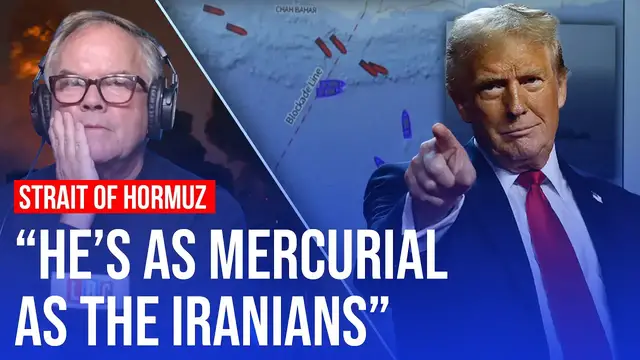
Matt Frei is joined by Iran expert Ali Ansari as Iran proposes a deal to reopen the Strait of Hormuz within seven days if the US meets its conditions.
Speaking to reporters at the United Nations in New York on Friday, Mr Araghchi said if the necessary conditions are met, "the Strait can be reopened".
He said a "normal" maritime passage could be restored in as little as seven days, but added: "The choice now rests with the United States."
Listen to the full show on the all-new LBC App: https://app.af.lbc.co.uk/btnc/thenewlbcapp
#mattfrei #donaldtrump #trump #iran #iranwar #straitofhormuz #politics #LBC
LBC is the home of live debate around news and current affairs in the UK.
Join in the conversation and listen at https://www.lbc.co.uk/
Sign up to LBC's weekly newsletter here: https://l-bc.co/signup
Show More Show Less View Video Transcript
0:00
The last time a US president rushed out to Andrews Air Force Base to greet a visiting leader at the bottom of the stairs on the red carpet
0:10
which is what he did with Xi Jinping a few days ago, was in 1962
0:16
It was President Kennedy greeting Harold Macmillan, the British Prime Minister, who was arriving then
0:21
Well, that ain't happening anymore. So there we go. Things have changed. The world has changed
0:26
Now, one of the things that was remarkable about this week is that we saw two sides of Donald Trump
0:30
We saw Donald Trump, the very gracious host, falling over his Chinese guest with all the stuff that we've just been talking about and that clip that we heard earlier on
0:39
But we also saw Trump at the United Nations, a body that he loves to hate, with his rather bullying side talking about Iran
0:47
Listen to this. But I have a big decision to make. Will a deal be made with Iran that lets them rebuild and create a far greater country than it ever was before
1:02
Maybe one of the greatest in the Middle East or even the world
1:06
Or do I annihilate the Islamic Republic? Annihilate the Islamic Republic. Well, he said that before, although at the moment it seems to be that they're doing more damage to him
1:17
than he's doing to them after the initial stages of the war. So there is this deal that the Iranians have offered, which we talked about earlier very briefly, to open the Strait of Hormuz within seven days
1:28
But that deal has attached to it all the other conditions that the Americans haven't liked in the past
1:32
And I think Trump has only, as has just now, actually said the deal's off. He doesn't like it. This is according to The Wall Street Journal
1:38
So where does this leave the all-important Strait of Hormuz? And we care deeply about that bit of geography because whatever happens there doesn't stay there
1:45
It'll affect the budget in our country on the 28th of October
1:50
It has already affected the fiscal headroom that the chancellor has at his disposal
1:55
You know, everything and the obvious stuff, of course, of filling your car with petrol
2:00
All of it will depend on what happens there. Let's speak to Ali Ansari, as we often do on Mattiz Iran
2:05
He's the professor of Iranian history at the University of St. Andrews. Where are we now with the Strait of Hormuz and, you know, the Iran-U.S. war
2:13
Trump wants to open the Strait, but not at any price. the iranians have offered to open it but if they want conditions attached i mean are we just going
2:21
to carry on with the stalemate well it looks at the moment as if i mean since we last spoke i have
2:27
to say i think there's been a certain shift a certain uh a tilt in the balance and clearly
2:33
there is some oil now coming out of the straits i mean the the the the the u fleet is is actually managing to shepherd a number of tankers out and and the amount coming out out is probably more substantial than we generally recognise I know there are problems with diesel by the way
2:47
As a driver of a diesel car, I know this is going to be an immensely difficult time for me
2:51
but I think on a general sort of more level, the balance has sort of tended to shift
2:56
and the Iranians are also aware that in some ways they've lost the initiative on this
3:00
I mean, this is what's quite interesting, is that they are coming over with proposals, and the proposals are really a rehash of the old, obviously, the memorandum
3:08
which Trump isn't particularly interested in now because he thinks that that balance has shifted somewhat
3:14
We do have, obviously, what's going on in the Bab al-Mandeb as well, but that's, you know, complicating matters
3:19
but still it's not having quite the effect that people thought it would have
3:23
So not yet anyway, so we have to wait and see. So I think at the moment, what for me is most interesting
3:29
is that both sides, to some extent, are saying they are happy to have a deal
3:32
the iranians are coming over with the deal the question is is what the terms of that deal or that
3:36
negotiation would be and i think the terms as they were say four to six weeks ago are no longer
3:41
going to be sufficient for the americans because that that balance has shifted and i should say by
3:45
the way that the iranians are suffering a great deal i mean i think you have to be aware of that
3:48
the the balance there is is is more is more complex than i think we're seeing from our perspective
3:53
over here i was going to ask you about that because of course the one thing we don't talk
3:58
enough about is the fact that the americans have also imposed a counter-blockade that makes it very
4:03
difficult for iran to export its own oil or indeed to get the goods that it needs including medicines
4:08
etc etc how bad is the state of the iranian economy which was already very bad at the beginning of
4:13
this year so one of the a number of the details are now coming out for instance and iranian
4:19
economists and other officials are remarkably open and discussing the problems that they're facing
4:23
they're now reckoning that the economy has shrunk over the last six months by 10 percent i mean
4:27
it's difficult to comprehend that you know in terms of what we are also facing i mean that there
4:33
are there are problems in iran that are immense and you know they are dependent on imports and you
4:38
know we talk about medicines and stuff but it's basic foodstuffs actually that the issue i mean
4:42
it's their inability to actually import the basic foodstuffs that they need there are some in iran
4:46
that think that they're sort of self-sufficient they're not they're far from self-sufficient they
4:51
have a population of 92 million it needs to be fed it needs to be you know it needs to be supported
4:56
on many different levels. And I mean, of course, what you're seeing is the blockade is working
5:00
And they are also saying themselves, I mean, this is the interesting thing, there's a lot of commentary on Iranian television
5:05
and others about why the memorandum collapsed in the first place. And they're starting to criticise
5:10
some of their own officials, including members of the Revolutionary Guard Corps
5:13
for having basically attacked that shipping, which gave Trump the excuse he needed
5:18
not that he particularly probably needed a huge amount of excuse to basically come out of that memorandum So they criticising themselves pretty heavily and i do think that we need to pay a bit more attention to what you know what they saying inside the country the troubles that they coping with and the real polarization
5:33
of opinion that's that that is in iran i don't know if you noticed but i think a couple of weeks
5:37
ago we had this rather a surreal moment where there was a women's marathon taking place in
5:42
which many women sort of ran without any veiling at the same time as the basij women were holding
5:47
their own rally at the other part of the city with guns and kalashnikovs and fully veiled and i mean
5:52
these two sort of events took place and were an excellent sort of um metaphor in a sense for the
5:59
for the real disparity and and sort of views going on in iran at the moment
6:03
including in the in the circles of power so i wonder to what extent the the hard the hard
6:10
liners who basically you know in the past seem to be kind of calling the shots here and and and
6:14
setting the tune to what extent are they now losing power and more moderates like the president
6:20
or the foreign minister you know have you know able to kind of say well listen we've got to end
6:25
this thing at some stage uh but you know straits of humus is fine we'll be able to get something
6:30
out of it but ultimately we've got to feed our own people or we're going to have another revolution on our hands well i think there is a there is a real tussle going on there and one of the
6:37
clearest indications of the problems is that hassan rohani the old sort of let's say
6:44
more moderate uh president previous who was the chap who came in with the jcpa of course uh has
6:50
and rahani's house has been sort of like uh surrounded by hardliners all criticizing and
6:54
wanting him to be impeached or prosecuted or something or other and that's always to me a
6:58
good indication of the tensions that exist within iranian society that they're now targeting you
7:03
know people who they think would be key to the making of a deal you know i mean and and and these
7:08
individuals uh i think like pezeshkehan and others are particularly anxious that you know there are
7:14
these two clocks going on we we look at the western clock and obviously we feel it uh but there is a
7:19
clock going on in iran too and they had always calculated from this fact that trump would be
7:24
basically beholden to the midterm elections and trump of course answered that very clearly at the
7:29
un and basically said i don't care you know and uh i'm happy to send this out and you know i'll
7:33
outlast you i mean that was that was the thing i mean he played that he played it back quite well
7:37
I mean, the problem the Iranians have is they're facing a president who's as mercurial as they are in that sense
7:42
completely unreliable, completely unpredictable. Nobody knows what he's up to. They're used to Western interlocutors who play by the rules, and Trump obviously doesn't
7:51
So there's a problem, and we find it very problematic. I mean, you and I, you know, we find it very frustrating
7:58
You know spare a thought for the Iranians who have been used to sort of dealing with Westerners who will sort of play by the rule book and now are finding that it just simply not working that way So they having to sort of recalibrate how they handling things And this is why I think this offer has come out This is why I think they tried to do this at the UN to sort of
8:14
seize back that sort of moral high ground again and say, look, we can offer this deal. But I think
8:19
obviously the deal that they're offering at the moment is not something that Trump in his current
8:23
position is really interested in taking. He wants a little bit more now. Had they been a bit more
8:28
Had they not interfered or hit those Atari ships earlier, something may have developed
8:35
I don't want to be too optimistic about that. But something may have developed in the right direction for us
8:42
Well, timing is everything, isn't it? Even in diplomacy, you've got to pick your moment and know your own strength
8:48
How do you think this will end then? I mean, I know things are shifting all the time and there's a lot of known unknowns and unknown unknowns, as Donald Rumsfeld used to say
8:55
How do you think this ends? And could at the end of the day, there be a light in the tunnel that says, you know what, we will get some kind of pressure from the streets
9:05
We'll get back to where we were at the beginning of the year with the Iranians rising up against the regime and wanting something better
9:12
Because that discussion has gone completely by the wayside. It has. Yeah, it has. I think, again, it's very difficult to sort of assess how these things
9:21
I mean, I talk to a lot of ysts who look at the economic data much better than I do
9:25
And even they're slightly sort of perplexed about how things might unfold. But my sense is, is that you will eventually, you know, they will come to some sort of arrangement
9:35
The alternative for them, you know, if, and this is the question
9:40
if the Americans have managed to establish a degree of control over the strait
9:44
that allows oil and other, you know, assets to come out while maintaining the blockade against Iran
9:51
then the Americans now have the initiative. And if the Americans have the initiative, the Iranians are going to get weaker every day we go forward
9:58
And sooner or later, therefore, they will have to come to some sort of agreement or face exactly what you say, a sort of a collapse of the economy at home
10:06
And, of course, a number of people are saying the economy is teetering on that. But I mean, some economists are saying to me it's already basically in a freefall if you look at the currency, if you look at inflation and other things
10:16
But, of course, the question is, is when that psychology, when they decide
10:21
and that the problem for the hardliners in Iran is the pain has been so great for their people
10:27
that they need to come out of this with a victory, with a palpable victory
10:31
I mean, you can't say to people, the promised land is round the corner, the desert is rather long
10:36
but, you know, we'll get to the promised land. But they're not delivered the promised land. I mean, basically they say
10:40
well, we've compromised with Trump. So this will be very difficult for them to come to terms with
10:44
I mean, it will be very difficult for them to come to terms with. But the alternatives for them may be much, much more serious
#news