Up next in 10



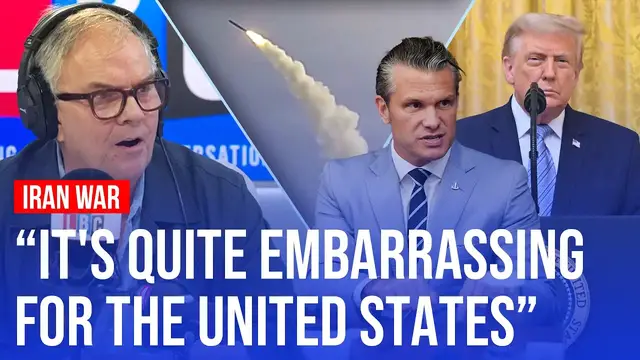
The US has used up "virtually all" of its stockpile of long-range missiles during the war with Iran, forcing the Pentagon to rely more on "more risky" missions if the conflict continues.
The depletion means the Pentagon will have to rely more on piloted bombing missions if Donald Trump keeps up his war on Iran, which is deemed more risky.
The war was only initially believed to last a short while but appears to have no end in sight following repeated failed talks.
Listen to the full show on the all-new LBC App: https://app.af.lbc.co.uk/btnc/thenewlbcapp
#mattfrei #trump #petehegseth #war #iran #LBC
LBC is the home of live debate around news and current affairs in the UK.
Join in the conversation and listen at https://www.lbc.co.uk/
Sign up to LBC's weekly newsletter here: https://l-bc.co/signup
Show More Show Less View Video Transcript
0:00
There is a feeling amongst intelligence experts and military experts that America is simply
0:05
running out of the kind of weapons it needs in order to continue fighting its so far failed
0:10
war against Iran. This comes at a very awkward time because America always has to have enough of this
0:16
stuff in case there should be an incursion by China into Taiwan, in case the Russia war
0:21
were to spread. And we'll discuss that as well in the coming hour. So running out of weapons at the moment is not a good idea, especially when the Iran wars
0:28
hit the buffers. And you could argue that it is now the rump Iranian regime that was supposed to have been obliterated by Trump in the first few weeks of this war of choice that is really calling the shots in terms of timing and settlement
0:41
That is quite embarrassing for the United States. So let's speak to Professor Ali Ansari, Professor of Iranian History at the University of St. Andrews
0:49
Ali, it's good to have you back on the program. Morning. So first of all, America running out of weapons
0:54
I mean, they denied officially, but we know that there was this row between the Pentagon, the Secretary of War, as he likes to be called, Pete Hexeth, and the President around weapon supplies
1:06
It is plausible, is it not? And what does that mean for America's ability to continue making plausible threats when it comes to the annihilation of the Iranian regime
1:17
Well, I think it certainly is plausible, and it's also a sad indication of a lack of planning going forward
1:23
because, I mean, clearly the US economy could start producing a lot more
1:26
but they haven't really, they don't seem to be prepared for it
1:30
So it does remove from them the ability, I suppose, to provide a plausible threat to the Iranians
1:38
Although I have to say, I think we've reached that stage now where they're sort of running out of the military option per se
1:45
We're moving into that sort of economic sort of strangulation mode. But even that is a bit of a two-way street at the moment
1:51
It's a question of who's going to blink first. And at the moment, it seems to be that Trump will probably blink first
1:56
But also the threats issued by Trump an issue around just the other day I think at the beginning of the week he said they be hit harder than anyone been hit since World War II I mean it a bit like a burglar alarm going off all the time You begin to ignore it It is And I mean I remember saying to some American colleagues with as they
2:12
said, alarming British understatement that Trump lacked message discipline. And I mean, I think
2:16
this is the sort of the problem is that, you know, they're calling his bluff and they've
2:21
and the irony or the paradox is, of course, is that they, if they do keep calling his bluff
2:26
there's a risk that actually at one stage he will snap. And this is the problem
2:30
I mean, you've got to have a credible threat, but a credible threat means, you know, not, you know
2:35
to paraphrase Teddy Roosevelt, you know, do carry a big stick, but, you know, speak softly
2:40
Trump is actually doing the opposite, and it doesn't really work. And, I mean, this is the problem
2:44
I mean, he's, you know, he's shouting loud, but he doesn't seem to have that stick anymore
2:48
to do the sort of things that he might want to do. And it's really a reflection, as the Iranians themselves have said, actually
2:54
I find some of the Iranian ysis, if you dig deep enough for it, is actually pretty good
2:59
I mean, they basically said that the reason we've done so well is because the Americans failed to plan
3:04
And it is going to be one of the big questions going forward, is why the sort of forward planning that would have been necessary for an operation of this nature
3:13
does not seem to have been done. And I suspect Hexeth will come in for some pretty heavy criticism in the months ahead
3:19
Yeah, and some of that may be starting already. I mean, you know, you can accuse the Iranian regime of all sorts of things, and we certainly have on this program and you have as well
3:27
But the point is that if you live in a state of siege from the time of your revolution
3:32
and you've already conducted one very long war against your next door neighbor, Iraq, you are prepared for this kind of stuff
3:39
You do go through the scenarios. And I think that point is just missed by this administration in Washington
3:44
Well, I mean, again, I sort of think that that also slightly ignores the fact that we've
3:51
been through 47 years. And I mean, things change. I mean, it's not that the revolutionary fervor that we had in the 1980s certainly doesn't
3:59
exist in that sort of same level. I mean if you look at popular opinion in Iran it very much disillusioned with the states I was thinking more in terms of their feeling that they threatened by the United States So they ran through the scenario of the Strait of Hormuz over and over again and then lo and behold it actually happens
4:13
Yes, absolutely. I know. I mean, certainly the regime, the regime hardliners will have thought through it
4:18
But, you know, I can tell you that the Americans are also well aware of the Strait of Hormuz. I mean, the problem here is, I mean, we went through umpteen, I remember
4:24
going through umpteen sort of war game sessions, in a sense, with Americans and Europeans and others
4:28
and the Strait were always a feature of that. So, you know, some of us sitting aside here are a little bit baffled
4:33
that a preparation was not made for that. I remember when I was in Washington during the Iraq war
4:37
I talked to Colin Powell, who was then Secretary of State, and it wasn't being heard by then Dick Cheney
4:42
these people are all dead now, and Donald Rumsfeld, who was then Secretary of Defence, and he told me, off the record, but I can say this
4:49
because they're all resting in peace, as it were, I've got a drawer full of plans for the occupation of Iraq
4:55
and they've all been ignored by the White House. They just weren't interested in the detail. because they thought it would be done and dusted very quickly
5:01
And the same mistake has been made again. Are the Iranians, who were handed a bit of a gift in the Memorandum of Understanding
5:09
which was then bombed to smithereens and now may be back on the cards, are the Iranians in danger of overplaying their hand
5:15
because they think that they've managed to defeat the Goliaths? And this is the key question
5:20
I mean, actually, at the moment, one of the problems that the regime itself faces
5:25
is that they're now going to be fighting over the spoils. and in fighting over the spoils
5:29
they'll probably get into some sort of fairly intense internal fighting. So this is going to be interesting
5:34
I mean, I think the irony is that the regime itself may be at its weakest, actually
5:39
while it's busy sort of trying to work out who's going to get the benefit of what they've achieved. And I think that problem of overplaying their hand is a very real one
5:47
certainly in being able to sort of push their sort of, quote, humiliation of the United States
5:52
to such an extent that the Americans perceive this not as an attack on Trump
5:56
which a lot of them can handle in a sense. I mean, they're not fussed whether Trump looks a bit stupid out of this
6:01
but they will get a bit irritated if the United States itself comes in for a bit of a pounding And I think that the problem I mean the Iranians have to play quite a delicate diplomatic hand And I have to say you know history shows a sort of rather mixed achievement on this regard Now you putting it mildly So just to be clear this new memorandum of
6:21
understanding, which may be signed, you know, imminently, allows for the Strait of Amrhus to
6:27
be open. And for 60 days, the Iranians will not charge a toll or a tax or a service fee
6:33
you know or bakshis call it what you like okay yeah but but essentially they have established
6:38
in their own minds and perhaps also in reality going forward that the strait will become a
6:44
toll gate now that for them is a massive massive boost financially politically in terms of you know
6:50
power projection it's it's crucial isn't it well i mean i first of all the memorandum of understanding
6:56
as we say it's basically just a a revisit of what was meant to have been done the first time around
7:01
Which is essentially, I mean, the agreement, as far as I can see, what the Americans really understand it by is we lift the blockade, you lift the, you know, you open the straits
7:09
Now, you're quite right that the Iranians are seeing this great sort of bonanza coming through after 60 days
7:15
The question mark is, is how many people will really be able to, will actually adhere to it
7:21
And one of the blocks that we have here, of course, is that Lords of London have actually said that if anyone pays a toll, they waive their insurance
7:27
So the fact is we're in a slight sort of problem here that presumably the Trump administration will then say that those sanctions will be lifted to allow the toll to be paid
7:38
But the Americans will have to also play that quite delicately because they won't want to be seen to be basically funding Iran
7:46
I mean, at the moment, the way the Iranians think about it, you know, 5% to 7% on every commercial ship going through
7:51
It's an enormous amount of money. Well, they're going to make no money from oil, you know, if they can export it. Exactly
7:58
And I can't see it actually being sustainable in the long run. I mean, I can see something happening in the interim while Trump basically gets through
8:05
his midterms, but I have to say I think he's already lost those anyway. But it's not something that I think is sustainable in the medium to long term
#news