Up next in 10



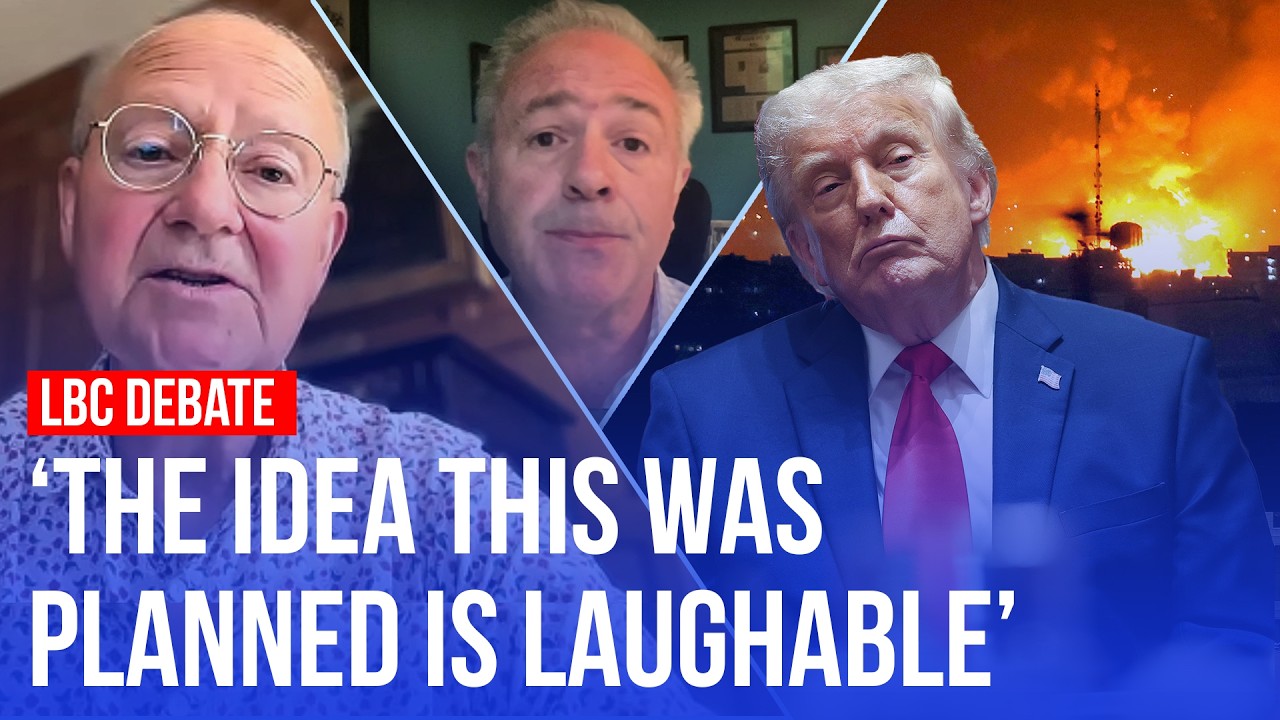
Matt Frei is joined by Edward Luce, US National Editor at the Financial Times, and Professor Gwythian Prins, former adviser to NATO and member of the Chief of the Defence Staff’s Strategy Advisory Panel, for a debate on Trump, Putin and Iran. The debate gets heated as parallels between Russia’s war in Ukraine and US policy in the Middle East are drawn. Listen to the full show on the all-new LBC App: https://app.af.lbc.co.uk/btnc/thenewlbcapp #mattfrei #donaldtrump #LBC #trump #usnews #uspolitics LBC is the home of live debate around news and current affairs in the UK. Join in the conversation and listen at https://www.lbc.co.uk/ Sign up to LBC’s weekly newsletter here: https://l-bc.co/signup
Show More Show Less View Video Transcript
0:00
Well, we've got, I think, a situation, a really close parallel between two presidents, Putin and Trump
0:07
Each starting was that they, based on assumptions that they would win within days
0:14
even Western intelligence agencies agreed with Putin's expectation that Kiev would fall within a week and Ukraine would fold
0:23
And if you recall, the then Biden administration offered Zelensky a plane out and he said
0:29
send me bullets, not a plane. And then, of course, Trump on the 28th of February. Again
0:35
the ogy here being very, very tight of based on expectations that this would be over within a
0:43
few days. You decapitate the leadership of Iran. You would bomb its missile production capacity and
0:50
its mobile launchers and its navy to smithereens. And it would submit within days. Both expectations
0:57
false based on our wishful thinking. And in each case, they are now really on the back foot against far, far weaker powers
1:10
although Ukraine relative to Russia is stronger than Iran is relative to the United States
1:16
But both have innovated on the battlefield to produce these drones and these interceptors
1:26
and to create the ability to basically block much, much more powerful, much, much more expensive systems
1:39
In Iran's case, they now have the whip hand over the Strait of Hormuz
1:44
and the ability to strike the soft underbelly of America's allies in the Gulf
1:51
their oil production facilities, etc. In Ukraine's case, it can reach a thousand kilometers with its missiles into Russia and directly threaten the May Day parade, for example, earlier this month with a fraction of the resources
2:09
And this is sort of revolutionized warfare. You use the David and Goliath ogy
2:14
I think that's what what links these two situations. These two theaters of war are linked in other ways
2:21
But the most salient link is that much weaker powers can bring a colossus low through really cheap sort of revolutionized economics of warfare, which is namely drone innovation
2:38
Which is extraordinary. And that's what everyone's talking about. But I just wonder whether, Professor Prince, I wonder if the original sin of the, you know, the powers that started the wars of choice, whether it's Putin's Russia or Trump's America, was a lack of imagination about what happens at the receiving end of their weaponry
2:57
And then even though the Iranian regime for instance is incredibly unpopular inside Iran if you attack them in the way that America and Israel did you bring out something in that regime that allows them to cling on and use all their imagination their strategic and tactical imagination to make it work for them Well
3:18
thank you very much, Matt, for inviting me on. I've listened with great attention to your
3:23
introduction and to what Mr. Luce has just said. I think you're both dead wrong, as a matter of fact
3:29
Each of you has made a... I love a debate. Go on. Well, it's just a fact. I mean, each of you has made a heroic assumption, which I think is incorrect. Your incorrect assumption is that there isn't a plan in the mind of the Americans. I think there's very clearly a plan. But you do not see that plan by listening to words. You only see that plan by looking at deeds and what people do
3:54
Remember, words are weapons in a three-mode war, which is what we are now fighting, with Krink, who is the enemy of the free world
4:03
That is China, Russia, Iran and North Korea. And it's three-mode because it's hot and it's grey and it's cold
4:11
And in grey warfare, you are always using words as weapons. So you make an assumption, a heroic assumption, which I think is not sustainable in fact
4:20
that the Americans have not had a plan, they do not have a plan
4:24
and they do not know what they're doing. I think that that is all completely... Was the closure of the Strait of Hormuz part of the plan
4:30
If you go to the United States Naval War College in Newport, Rhode Island
4:35
one of the very first war games that naval officers in the United States Navy practice
4:40
is the Straits of Hormuz. I mean, the person who... I mean, I know that
4:45
but do you think that that is what Trump was banking on when he started the war
4:49
That they would close? No, with due respect. And in any case, the war didn't start on the 28th of February. This war started on the 26th of October 2024. It's the third phase of a carefully planned war, which has a very clear strategic objective. And that objective is to remove the Shia theocracy currently ruling Iran stroke Persia
5:13
Now, that cannot be done with bombs. Nobody's stupid enough to think that you can bomb your way to a change of regime or that requires boots on the ground, all these other lazy tropes that are produced
5:26
So there is a plan. You can see it's clearly there. You know, we know who made it. It wasn't Mr. Trump. It's men who people don't by and large know about
5:38
Let's bring in Edward Luce then, who's shaking his head at the moment. I'm not sure if you can see him, but he is
5:43
Edward, what's your response to what Professor Prins just had to say? Naturally, I disagree with the professor
5:48
I mean, I'm quite close to the situation here with observing Trump
5:54
I haven't even spoken to him four or five times since Operation Epic Fury began
6:01
And there is no plan in his head. So the professor might be referring to Pentagon plans and indeed Israeli plans
6:08
for regime change in Iran. But Trump's goal of end goal for this war
6:14
keeps changing. Originally it was regime change Then it was nuclear getting rid of the nuclear materials Then it became opening the Strait of Hormuz and various other along the way
6:28
a various gamut of options, all of which he's run through. The notion that there is a plan that began in 2024 and that is now being executed is completely laughable
6:43
I mean, I don't know anybody, including supporters of this war here, a very small but vocal section of Washington, D.C
6:53
Nobody believes that Trump has got a clear end goal in his head because he keeps changing what that end goal is
7:00
So I haven't actually, you know, I've been interacting with this administration, with people on Capitol Hill, of course, with people at the renamed Department of War from before this war and during this war
7:12
and this is the first time since the war's begun that i've heard such an account it's it's pure
7:18
sort of fantasy it's this is how interesting you think that what you have done uh mr luce is to
7:26
fall directly into the trap in gray warfare which is to believe the words that you are hearing
7:31
as i said including from the commander-in-chief as i said at the beginning each person has a role
7:37
to play you will perhaps i'm sure you both will be familiar with what is known as the madman theory
7:42
of the presidency. It was articulated by Henry Kissinger. And the madman theory has two requirements
7:48
of the commander in chief. First, to be utterly unpredictable. And secondly, as a result of being
7:55
unpredictable, to be terrifying. Now, this was brought to perfection by President Reagan, by the
8:01
way. But Trump has done extremely well with this. Now, whether he has gone over the edge at this
8:08
point, I'm not claiming to have a crystal ball. But I can make for you, and I'm interested that
8:13
it's the first time you've heard this ysis, because if you talk to people like me, it is by
8:17
no means an uncommon ysis. Mr. Trump played that role extremely well in phase two, which was
8:25
Operation Rising Lion, which was last year in the 12-day war last June. He has done the same here
8:31
It is, of course, a joint Israel and American plan, but it is actively supported by other parts of the shadow of Abraham's court
8:43
It's very interesting, if I may just make this point, because your listeners probably know this, that just in the last couple of days, frustration with the president in not getting on with the kinetic, the hot conclusion of this phase was expressed from Saudi Arabia
9:03
The Saudis said, finish this war, get rid of the Ayatollahs, or else there may have to be geopolitical consequences
9:11
where we, the Saudis, will cease to be aligned with the free world and with the West
9:17
And we will have to create a different alignment to deal with our problem, which is with Turkey
9:24
Now this is the real world I respectfully observe I too interact with the same sorts of people that Mr Luce interacts with It just perhaps that I spent rather longer dealing with military strategy And by the way to correct your introduction there is no longer a strategy advisory panel to the Chief of Defence Staff
9:41
That was got rid of by Mr. Cameron. All right. OK, fair enough. I deeply apologise for that mistake
9:48
Edward, I mean, judging from what the professor had to say, the obvious question for me would be
9:54
you know, if that is the case, if the madman theory exists, where are the results? Where are
10:00
the achievements? Well, I don't accept the premise of this madman theory. It's a sort of hoary old
10:05
chestnut to, we have a term here in Washington, sane washing, attempting to project onto Trump
10:13
a genius sort of multiple dimension chess brain that simply doesn't exist. This is a blunder of
10:23
the first order. He thought the Iranians would fold within a few days. And he's been trapped in
10:29
a dilemma of his own creation ever since, to the extent which whenever this deal that he had a
10:36
situation or a meeting in the White House yesterday to discuss, whenever this deal comes through and
10:45
the outline looks like a 30 to 60 day ceasefire during which the strait gradually reopens
10:52
Iran gets some access to its frozen assets, $24 billion worth of frozen assets, in exchange for helping to demine the strait
11:01
And then they begin to talk over those 60 days about a nuclear deal
11:06
Whatever contours this framework for a deal takes, and whenever that happens in the coming days
11:12
the situation will begin in a far worse position than we were in on February the 27th
11:19
And again, you know, I mean, I'm talking every day to all the players here in Washington, D.C., and indeed to America's very frustrated allies who were not consulted about this prior to February 28th and have therefore been very reluctant to heed Trump's calls to back it
11:38
This is not some genius plan. And the professor, if I can't really sort of put it too euphemistically, does not have a clue what he's talking about
11:49
Okay. You have 10 seconds to respond to that, Professor. Being out comment doesn't really help
11:56
I do have a considerable clue about what I'm talking about. I would respectfully suggest that talking about fantasies
12:02
your account of the negotiation is actually fantasy. But as I end, let me just point to the category mistake in your original ysis
12:12
which is that you made an ogy between Ukraine and Iran. It's the wrong ogy
12:18
The correct ogy of disruption is between Ukraine and Israel. And Ukraine's role in the Middle Eastern war has been absolutely crucial to Ukraine in gaining new allies
12:31
Because as you know well, they gave freely counter-drone advice to the Gulf states
12:38
And in return for that free gift, they have gained strong diplomatic support
#news