Up next in 10



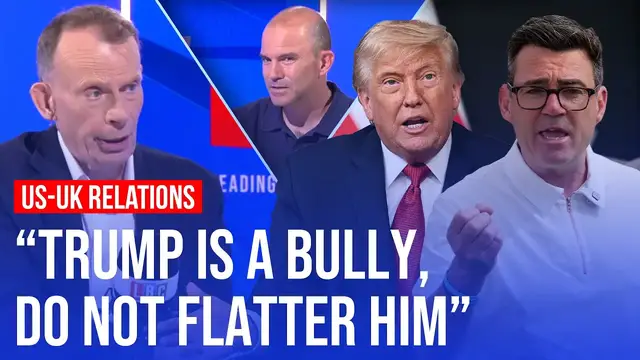
Andrew Marr is joined by Obama's former security adviser Ben Rhodes to discuss the war in Iran, Trump's 20-point plan for Gaza, and his advice for the next PM. Hillary Clinton has 'surprisingly' come out in favour of Trump's plan for Gaza, despite the fact that she is the President's most prominent critics. The former US secretary of state argues that it's the only realistic path towards reconstruction and stability in the region. Listen to the full show on the all-new LBC App: https://app.af.lbc.co.uk/btnc/thenewlbcapp #andrewmarr #iran #iranwar #donaldtrump #trump #ukpolitics #LBC LBC is the home of live debate around news and current affairs in the UK. Join in the conversation and listen at https://www.lbc.co.uk/ Sign up to LBC’s weekly newsletter here: https://l-bc.co/signup
Show More Show Less View Video Transcript
0:00
It's more like a surrender deal. It's more like the terms of victory for Iran, because measured against the objectives at the beginning of the war
0:09
I mean, you'll recall, actually, before the U.S. bombed Iran, there was a negotiation going on
0:13
And the U.S. terms in that negotiation were absolutely no nuclear program whatsoever, no ballistic missile program beyond a certain range, no Iranian support for proxies
0:22
The war was launched, and the kind of suggestion from Trump is that the Iranian people are going to rise up, the regime's going to fall
0:27
And now here we are in this memory of understanding. The regime is more entrenched in place
0:33
They are not abandoning at all their ballistic missile program or their support for proxies
0:38
And in fact, they're getting huge amounts of revenue before they even make any nuclear concessions
0:43
And this vast $300 billion offer, if and when Trump goes, presumably the Democrats or whoever have to pick this up and honor it
0:51
Yeah, and Democrats, unlike Donald Trump, have tended to kind of honor agreements because I actually think it's in the U.S. interest to not be so unpredictable that you tear up every agreement that the previous administration had
1:06
And it feels like that this is like some massive investment fund that will, you know, if it does go forward, will be kind of underway
1:13
So I will say that we get a lot of criticism for the Iran nuclear deal I worked on
1:18
$300 billion dwarfs any amount of revenue that Iran got. And that, frankly, revenue was unfrozen sanctions
1:24
That was Iran's own money. And it was nowhere near that amount. And Trump always said that your deal left Iran on the journey or on the road to a nuclear weapon
1:34
which I guess in theory was true eventually. But does this deal end that road or is it the same position
1:40
It's the exact same kind of deal. And our argument was, you know, the biggest restrictions in our deal were 10 years
1:45
And like a lot of arms control agreements, he renegotiated in 10 years. Trump, by tearing up the deal, accelerated the road
1:53
The nuclear stockpile they have now is because he left the deal. So this does not end their nuclear enrichment
1:57
And so, by definition, it does not end their program. You would have thought that to begin and then conduct a war and end it in a worse position than when you started would be a sort of reputation shredding moment
2:09
How has it gone down across the states? I actually think that in the decade that we've been dealing with Donald Trump
2:14
this has had the most negative impact on him, both because the war was such a calamity
2:21
but also because the gas prices that Americans are paying, the petrol prices that people are paying
2:28
kind of shattered the idea that he really cares about lowering prices. It also kind of shattered any sense that he is some more of invincibility around him
2:37
So if you look at his approval numbers in the United States They as low as 35 percent I do think that this war unlike a lot of things a lot of things don stick to Trump But I think that this has both had a political impact but it also kind of made people
2:51
think that, you know, this is getting a little too dangerous, a lot of hand
2:55
This is not a small thing. This isn't even like putting tariffs on the country. Like, this is spending tens of billions of dollars on a war that didn't make any sense
3:01
to people, that hurt a lot of Americans as well as people around the world, and left us
3:06
in weaker positions. I think he's a diminished president because of this
3:10
And in the greater sort of political argument going on across the states, what's going on on the Democrat side
3:15
Because, you know, this struggle against conservative nationalism or populist conservative nationalism, which you can see in the UK and Europe and the United States, the next phase is presumably some kind of revival of the Democrats
3:29
But it's hard to see who. It is wide open right now
3:32
There's no clear frontrunner for the next nomination, less so than at any time in my life since I went to work—well, actually, when I went to work for Barack Obama, Hillary Clinton was a clear frontrunner
3:43
So I think what you have is a generational shift happening. You know, there's no Hillary Clinton or Joe Biden waiting in the wings
3:49
The next person is going to be younger and different. And then I think the question is both left to center
3:56
Does the party move to a more progressive person like Alexander Ocasio-Cortez? Or do we embrace a more kind of centrist governor like a Josh Shapiro of Pennsylvania or Andy Beshear from Kentucky
4:06
And also kind of body language. How adversarial or confrontational are you
4:11
Like a Gavin Newsom is not particularly progressive, but he's very confrontational
4:15
I think at a minimum, Democrats want to see more fight in the person, whether they're left or center
4:22
They want to see someone who seems to get. The stakes are very high. And we don't want to see kind of generic politician
4:28
We want to see someone who's like more of a fighter, who's younger, who's doing things differently
4:33
And is there somebody you're beginning to get excited about, beginning to get behind? I'm not behind any one candidate
4:39
I will say for people who may not follow him, one person who's beginning to pique my interest in others in the United States is a guy named John Ossoff
4:45
who's a senator from Georgia. He's much younger. He's won in a state, Georgia, that Democrats had not traditionally won in
4:52
But importantly, he's kind of connecting the dots for people. He's telling this story
4:56
Democrats have had this kind of paralysis, and I feel this here in Britain too with the
5:00
Starmer government. Do we talk about kind of kitchen table issues, lowering prices, or do we talk about the threat
5:06
to democracy as if they're two separate things? And what Ossoff is doing is saying, no, no, it's one thing, because the kind of corruption
5:13
that we're seeing in our politics, the kind of, you know, power grab that we're seeing
5:17
from a small group of people with Trump at the top of it, but also these kind of tech companies Well that actually why you can afford health care That why you can afford prices that we need to fix the way politics works in order to fix the outcomes people want We are as you know very close to having a new prime minister in the UK at the moment
5:35
One of the things that any European leader has to confront is going to the White House and going to pay court to Trump, this very unpredictable, mercurial person, not knowing whether you're going to be warmly welcomed or, frankly, humiliated in front of the world's press
5:50
What advice would you give to Andy Byrne or any other new leader as you head towards Trump
5:56
Yeah, I would give this and I've given this advice directly to some European leaders
6:00
Do not try to flatter him. He's a bully. If you were on the schoolyard as a kid and you gave your lunch money to the bully, he comes back for more
6:09
That the leaders that stand up to Trump and that show toughness to Trump, he actually treats better
6:14
He actually respects more. Even now, if you look on the right wing in European politics
6:19
Georgia Maloney in Italy is having a great feud with him at the moment. He's having a great feud
6:24
I imagine that's probably helping her politically. I think people, you know, they know that Trump is unpredictable
6:29
They know that he might put tariffs on you. They want to see that your leader is standing up for your interests
6:35
that there's some nationalism. I mean, I'm a progressive, but there's a place for nationalism
6:39
and saying I don't want to be pushed around. And so whether it's Andy Burnham or someone else
6:42
My advice would be, you know, I think Keir Starmer like tried the kind of flattery and and he kept getting treated poorly
6:49
Right. I mean, I know that Ukraine, they were trying to keep Trump on board, but Trump's not on board on Ukraine
6:56
And so I actually think being firm is the advice I'd give. Ben, a moment ago you mentioned Hillary Clinton
7:03
She's made ruffled some feathers today with an article suggesting that Trump's plan for Gaza, the Board of Peace for Gaza, is the only game in town and everyone should get behind it
7:13
Were you surprised by that? I think, you know, she's been kind of pretty out of step with Democrats in Gaza for a long time
7:20
I was surprised because the Board of Peace is ridiculous. I mean, there's no money in it
7:25
And the idea that they're going to build, you know, high rises in Gaza when, you know, international journalists can't even get in seems absurd to me
7:33
So, you know, I think that I hate to say this, but like this is what I when I say, you know, do you fight and do you kind of take on this system and structure that is not working
7:44
The Board of Peace is just an ego stroke for Trump and frankly just looks like a kind of real estate investment for Jared Kushner
7:51
I don't think we should be accepting that as a premise because it's not going to lead to anything good
7:55
Let me come to your new book All We Say which is a look at American identity through a series of iconic speeches It not an anthology of speeches but it a single narrative about American identity And you argue that there are two competing kinds of American identity Just explain to people
8:14
Yeah, no, I was tracing, you know, the origin for it is I thought Obama and Trump kind of represented two different stories about what an American is
8:21
And if you go back to our founding, there have been kind of two stories in competition
8:26
One is a kind of exclusionary identity. We're essentially a white Christian nation, the inheritors of Western traditions
8:35
Other people can be in the United States, but they kind of have to subordinate themselves. J.D. Vance talks about this
8:40
You know, we have our own form of blood and soil nationalism versus a more progressive nationalism that says American identity is trying to live up to the Declaration of Independence, the idea that all are created equal
8:51
That's the movement for abolition. A separate kind of country from all the previous European ones
8:55
Yeah, because we didn't have a fixed identity at the beginning like European countries did
9:01
And actually, speeches from Frederick Douglass to Abraham Lincoln to Martin Luther King through Barack Obama have been a place where we use words to create what it means to be an American
9:11
You know, the I Have a Dream speech, which I write about, is this is a vision for multiracial democracy that we should aspire to
9:16
And I think one of the reasons our politics is so intense right now is what's on the table is not just kind of health care or even immigration policy
9:24
It's who is American and who gets to decide that question. So you might say that there is the closed America and there is the open America
9:32
Yes, yes. Are we heading back towards the open one, do you think? I think so
9:36
And I'd say, you know, even in a country like this is having similar debates about immigration
9:41
Being an open America does not necessarily mean that, like, you don't secure your border
9:45
But it does mean that you believe somebody who became a citizen five years ago is as American, as someone whose family's been here for generations in the United States, right
9:55
So, to me, open means everybody is equally American. There's no predominant, you know, ethnic or religious faction that dominates that equality is the objective in political rights
10:08
So, it's kind of the opposite of white nationalism. It is. And look, people on the other side of this question are making and are saying the quiet part out loud
10:17
There's a white nationalist movement in the United States right now. I would argue it's represented in the presidency of Donald Trump
10:25
And so I actually think, though, that I think Americans are beginning to get uncomfortable
10:29
Like, even if you take immigration, yes, there are huge concerns about the border
10:34
But once people started deporting your neighbor who's been there for 30 years, you saw in Minneapolis Americans say, wait a second, that's not what I voted for, even if I may have voted for Donald Trump
10:46
And so I think we're ripe for a return to a more inclusive American identity
news