Up next in 10



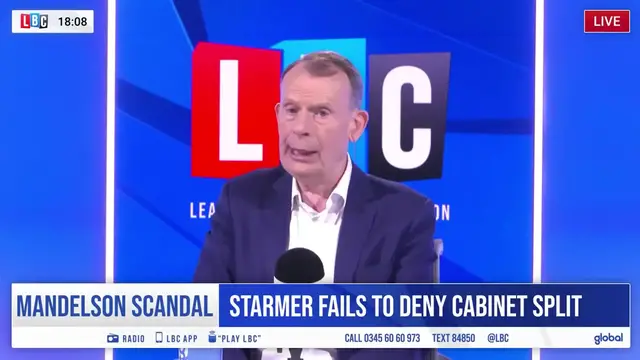
Andrew Marr is joined by David Satterfield, a former US diplomat and ambassador, to discuss the ongoing situation in Iran, and how it may affect us in the UK, and in particular Prime Minister Sir Keir Starmer. Inflation is likely to go up, and economic experts are projecting a recession arriving within the next two months, so life on these isles are very likely to get more and more difficult as the war and military action continues. Listen to the full show on the all-new LBC App: https://app.af.lbc.co.uk/btnc/thenewlbcapp #andrewmarr #politics #keirstarmer #donaldtrump #news #iran #trump #uspolitics #iranwar #LBC LBC is the home of live debate around news and current affairs in the UK. Join in the conversation and listen at https://www.lbc.co.uk/ Sign up to LBC’s weekly newsletter here: https://l-bc.co/signup
Show More Show Less View Video Transcript
0:00
Whoever leads this country over the next six months to a year
0:03
is going to be doing so in the face of the most hideous economic chaos
0:08
If the ball passes, it is the ultimate hospital pass. We have had 50 days of the Iran war
0:16
and the Strait of Hormuz remains a disaster area, with Iranian fighters storming three vessels
0:23
Trump saying US troops should shoot and kill Iranian mine-laying boats, and not a cheap of any peace talks
0:32
Result? The oil tankers on which the world depends are stuck and, according to the Pentagon, may be stuck for another six months
0:40
before all the mines can be cleared. The last few to get through the strait have now delivered their cargo
0:46
and the amount of oil still at sea is very limited. We aren't far away from global recession
0:52
and the IMF says Britain is particularly vulnerable. Now these shocks reverberate slowly
1:01
Inflation, giving up flights and holidays, more inflation, shortages. This is just starting
1:10
I don't know how long Keir Starmer is going to remain as Prime Minister. I do think that anyone replacing him in the next few months
1:17
is doomed to become even more unpopular even more quickly, walking straight into the kind of political nightmare zone
1:26
If I was a sneaky and truly ambitious cabinet minister, I'd say, do you know what, Keir
1:32
Give yourself another year. Let's hear next from David Satterfield, former U.S. diplomat, special envoy in the Middle East
1:38
I started by asking him to give an overview of what is actually going on in the Strait of Hormuz
1:45
It's a standoff. The president entered this conflict expecting a much shorter and much more decisive ending
1:52
in which a better-than-the-JCPOA, the 2015 nuclear deal, could be obtained from an Iran that responded immediately
2:01
to what was a massive air attack from Israel and the United States
2:06
But Iran's resilient. And the president did effect not regime change but leadership change The new leadership are all in the old Northern Ireland context hard men And if there is a division amongst them it is somewhat more
2:24
pragmatic hard men and those who want to hold a maximum line to the end. So the question now
2:30
facing the U.S., facing the globe, is who blinks first? Who offers a compromise outcome first
2:39
My betting is on Iran holding, because the Iranians believe, and there's some justice to it, they've got a capacity to absorb pain that is greater than that of the United States
2:51
They can wait this out. Their clock is a longer one than that of the U.S
2:56
And it doesn't seem to me there is an elegant way out for President Trump at the moment
3:02
Well, elegant is a matter of definition. Is there a way out? Sure there is
3:05
There are arrangements that can be made on the nuclear enrichment issue
3:11
That is, does Iran freeze for a period of time nuclear enrichment but hasn't acknowledged right to it in principle
3:18
Just doesn't do it. So there's a haggle to be done there. It's a haggle. It's the kinds of things that typically diplomats work over for months and months
3:26
But could you get a rough agreement more quickly? Yes, you could. Disposition of the 440 kilos of highly enriched uranium
3:34
That has to be accounted for, has to be taken out, or it has to be diluted in some agreed fashion by or with the IAEA's supervision
3:44
If you can resolve those two issues, Andrew, you can get to opening the strait
3:49
Because that is the crucial question. Who ultimately controls the strait? Iran is not prepared to let anybody else have that
3:55
Well, in the answer to your question lies the irony of all of this
4:01
This combat was started, ostensibly, to end an Iranian threat to acquire a nuclear weapon and with that weapon, threaten, impose its will, project power on the region and the world
4:13
Well, they don't have a nuclear weapon. But they've closed the strait and it cannot be kinetically reopened
4:22
Which is the more powerful threat? That a really big weapon the way you put it that way Let talk about the effect of using that weapon because a huge percentage of the normal traffic going through the strait is now completely stuck
4:34
A large proportion of the relevant oil tankers in the world are stuck
4:39
not moving anywhere. And week by week, the world is running out of oil
4:43
And it's not just oil. 12%, 13% of the world's maritime traffic goes through the strait
4:52
But it's not just hydrocarbons. That's 20% or so of the crude and a significant portion larger of gas
5:00
But it's also plastic precursors, 30% of the world's aluminium, 50% of the world's fertilizer feedstocks, and 30% of the world's helium
5:12
Sounds like that's unimportant. It is used in the manufacture of every semiconductor chip in the world, and it's irreplaceable
5:21
This is going to hit far bigger than the pump on the corner. So we're talking about the world economy
5:27
Yes, we are. Now, an awful lot of people listening to this so far, David, will think, hold on a second
5:30
This has been going on for some time, this war. I look around me, there's a little bit of an extra tick up in inflation
5:36
Petrol's a bit more expensive. But by and large, life carries on as before
5:41
Are they wrong? And if so, why are they wrong? They're not wrong looking about them now
5:46
The bigger shocks come when stockpiles of gasoline, petrol, stockpiles afloat of crude get to their destinations and are then exhausted
5:59
That's going to have the greater impact. We're still a few weeks away from that
6:04
I read that the very last tankers which got through the Strait of Hormuz before the war have now docked and unloaded their cargo
6:12
In the east, East Asia, Southeast Asia. That's correct. So, it's true, the shock has been significant, but it is not what it will be as the next few weeks roll on
6:25
Now, there is going to be a huge global reaction to what's going on, lots of pressure on America to find a way to reopen the strait and end this crisis
6:34
What about Israel? I be reductionist in my answer because it accurate President Trump will direct what Israel does or does not do with respect to Iran as he did when he brought about the ceasefire with Iran and then subsequently ended the Israeli
6:55
fighting with Lebanon. There is one other possible consequence, which is that Donald Trump decides to
7:01
escalate, because a lot of people here say if he really wants to reopen or try to reopen the strait
7:07
by force. The next thing he has to do is see some of the islands in the strait and possibly part of
7:12
the coast, the literal, boots on the ground and do that by force. Here's the problem with escalation
7:19
The U.S. military can do. That's not the issue. It's what does Iran do in response. It's what we
7:26
call escalation dominance in the trade. Iran has an ability to absorb the pain of the U.S. escalation
7:33
and then counter with its own escalation back again. Where? Against the Gulf, against civil infrastructure
7:41
and against further targets in the hydrocarbon sector. And it is very, very clear they have the military wherewithal
7:48
the ballistic missiles, the drones with which to do. Escalation by the U.S. is a trap that I fear will not lead to any positive resolution
7:57
Looking back, final question on the extraordinary events of the last 20, 30 years, including the COVID crisis
8:06
How does this measure? Are we facing something that could have as big an impact on daily life as that
8:12
Andrew, by every objective measure, this is the greatest energy shock the world has had already
8:21
Ever? Ever. It is greater than 73 and the Arab boycott, for those who remember that
8:27
because of the comprehensive dependence of the world on hydrocarbons and the derivatives of hydrocarbons
8:35
Well, there's a solemn thought to end on. And presumably it means for all those people wondering about whether they're going to fly off on their usual holiday destinations
8:43
you may have to rethink. Lufthansa Group has just ended some tens of thousands of Sure Hall flights because of fuel issues
8:51
David Hatterfield, thank you very much indeed for coming in and cheering us all up
8:55
Always want to be a ray of sunshine. Thank you, Andrew
#news