Up next in 10



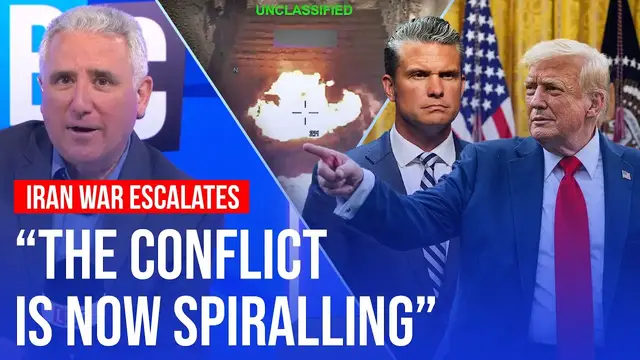
Simon Marks is joined by international law expert Tom Dannenbaum to react as the war in Iran escalates. This comes as Trump threatens to destroy Iranian a bridge or power plant for every ship targeted in the Strait of Hormuz. Iran’s Foreign Minister Abbas Araghchi responded to Trump’s comments on social media later Wednesday, noting the country’s “eye for an eye” military strategy. Listen to the full show on the all-new LBC App: https://app.af.lbc.co.uk/btnc/thenewlbcapp #simonmarks #iran #iranwar #trump #donaldtrump #petehegseth #whitehouse #LBC LBC is the home of live debate around news and current affairs in the UK. Join in the conversation and listen at https://www.lbc.co.uk/ Sign up to LBC’s weekly newsletter here: https://l-bc.co/signup
Show More Show Less View Video Transcript
0:00
President Trump has been making more threats today against Iran that themselves could pose
0:06
a challenge for the Burnham government. Taking to his social media feed, the president threatened once again to widen the conflict
0:14
that he has now notified Congress is once again a war against Iran
0:20
From this point forward, the president wrote, any time that the Islamic Republic of Iran
0:25
shoots at a ship in the Strait of Hormuz, whether it be by missile, rocket or drone
0:34
or any other device or weapon, the US will bomb or destroy a bridge or power plant
0:42
even those that are located in the Iranian capital, Tehran itself. Joining me now from Boston in Massachusetts, Tom Dannenbaum, Professor of Nuclear Security
0:53
at Stanford Law School, who was a co-author of an open letter from international law experts
1:01
raising concerns about war crimes in the Iran conflict. Professor Dannenbaum, thanks very much
1:07
for being with us here on LBC tonight. I would imagine your concerns about the possibility of
1:14
war crimes taking place in the Iran conflict are even more heightened this evening than they were
1:20
before that message that President Trump put out on his social media feed. Good evening to you from
1:25
London. Good evening. Well, that's absolutely correct. These threats are threats to engage
1:32
in violations of international humanitarian law. It is clear that any specific object is
1:38
presumptively civilian. Components of electrical infrastructure and specific bridges can become military objectives where those specific components or specific bridges make a contribution to
1:50
military action. But what President Trump is threatening here is not to target specific
1:56
components of electrical infrastructure or bridges that are making a contribution to military action
2:00
but to target that category as a class, a class which is presumptively civilian
2:07
in its totality. And so not only does this threaten specific violations of international
2:12
humanitarian law, it arguably entails a threat, the primary purpose of which is to spread terror
2:18
among the civilian population in Iran, which is itself a violation of international humanitarian
2:22
law at the level of the threat, regardless of what then follows
2:26
Can I just come to the specific power plants and bridges? Because we may end up in a situation
2:32
and we've already seen at least one bridge attacked, and the Pentagon claimed it was
2:36
a legitimate military target. I think that claim came from Central Command, in fact
2:40
I mean, we could end up in a situation where bridges and power plants are attacked by the
2:46
United States, and they then subsequently claim that they were military targets
2:51
That's one possibility that can't be ruled out, right? That's absolutely correct, but there is an additional safeguard here
2:58
So the first one is that you can target civilian objects and the specific target has to be a military objective But the second is even where it is a military objective an attack would be precluded if the civilian harm associated with or expected from attacking that specific objective would
3:14
be excessive in relation to the military advantage anticipated. And as attacks on these kinds of components of critical infrastructure expand the degree
3:25
of damage to civilians, whether it's through undermining electrical power to medical facilities
3:31
desalination or sanitation facilities, or to refrigeration for food, accelerates or gets
3:38
greater and therefore makes it less likely that that could plausibly comply with this requirement
3:43
of proportionality. And it's for precisely that reason that the International Criminal Court
3:48
issued arrest warrants for four senior Russian military commanders specifically for attacks on
3:53
Ukrainian electrical infrastructure. And they did that on two grounds. One, that some of these
3:58
were civilian objects. But the other was that even where those specific components were military
4:04
objectives, the effect on the civilian population was excessive. The attacks were disproportionate
4:09
and therefore they were war crimes that could underpin ICC arrest warrants for those four
4:14
Russian commanders. I'm glad you mentioned desalination plants, because there have been
4:18
Iranian attacks reported on desalination plants in neighbouring countries, allies of the United
4:26
States, some of them. And that puts the Iranians in the frame for facing accusations of war crimes
4:33
themselves, doesn't it? Absolutely. And desalination plants have a heightened status because
4:40
as I mentioned before, all objects are presumptively civilian until they make an effective contribution to military action. But there are certain kinds of objects termed in the
4:48
law, objects indispensable to survival, critical components of water infrastructure being precisely
4:54
such an object that have heightened protection such that the threshold at which they can become
4:59
military objectives is even higher. And there are clear reasons to believe that these are violations
5:04
of international humanitarian law as well. And in broader terms, the conflict appears not only
5:11
almost fully to have been reignited, but it now appears to be spiralling. I mean, there is no
5:17
indication that there's any negotiations meaningfully taking place, although we know some talks have continued to occur behind the scene. President Trump has publicly declared the
5:28
ceasefire, the memorandum of understanding, dead. The White House has notified Congress that the war
5:35
is back on. How bad do you think this situation is going to get, especially given the economic
5:42
impacts of the continued threat to the Strait of Hormuz on the new government here in the UK being
5:50
led by Andy Burnham, who, like Keir Starmer before him, desperately needs an economic break
5:56
The implications of this conflict beyond the specific theatre of war are profound
6:02
and they profound in multiple different directions There are the global economic impacts There are also the impacts on the transfer of fertilizer and the viability of food production including in countries that
6:14
could face severe food insecurity as a result of this. So the implications of this conflict are
6:20
severe and broad-based, and there is obviously an imperative to bring it to an end as soon as
6:26
possible. And one component that's relevant to what we were discussing earlier is the threat that
6:32
Trump made was in part a threat that if you violate international humanitarian law
6:36
we'll violate international humanitarian law back. That's known as a reprisal. And reprisals
6:41
are prohibited for two reasons. First, because it entails inflicting punishment on a civilian
6:46
population that isn't responsible for the initial violation. But secondly, because reprisals almost
6:52
inevitably lead to spirals of escalation because each side identifies the violations of the other
6:57
and is far less likely to identify its own violations. And so you get into these spirals of escalating violations
7:04
which is precisely why that's not a legal response to an illegal act by an adversary
7:10
And I was saying at the beginning of the hour, the beginning of our interview
7:15
that you were one of the co-authors of that open letter from international legal experts
7:19
who raised concerns about war crimes early in this conflict. Does it feel as though you're just kind of screaming into the void that you can write these letters, but they don't ultimately have any practical impact either on the American or the Iranian governments
7:39
We're certainly in a moment where the language of international law is being disparaged and where it's being ignored by some of the most powerful actors in the system
7:50
In response to that, I don't think that the correct reaction is to capitulate and say, OK, this is a domain of power. What use is invoking law in response here
8:02
I think law is the most powerful focal point around which to mobilise collectively in response to these kinds of acts and mobilise collectively across lines of political division, across lines of national division to say, these are the red lines to which we've all agreed
8:19
And these violations render the conduct of the party to the conflict that's engaged in them illegitimate and demand a collective response
8:27
And can I ask you finally, in legal terms, how much jeopardy might the UK find itself be facing if attacks on Iran by American fighter jets that are later deemed to have been war crimes originated from bases on UK soil
8:48
So there are mechanisms in international law, both at the level of state responsibility and at the level of individual responsibility, to hold actors accountable on a basis of complicity
9:02
That requires making a substantial contribution to the violation and at least knowing that that violation was going to occur as a result of that contribution And so the key question would be how profound is the contribution that the UK is making
9:17
or that specific individual officials within the UK are making? And how much did they know at the
9:22
time of making that contribution about the implications of that contribution and the
9:28
kinds of actions that were going to occur as a result? But there is precedent in international
9:33
law for holding persons accountable for their contributions to the violations of other actors
9:39
To take one concrete example, the former president of Liberia, Charles Taylor, was ultimately
9:43
convicted by the Special Court of Sierra Leone for contributions to the Revolutionary United
9:49
Front in that context, including, for example, providing arms and encouraging their activity
9:54
even though he wasn't held liable as a principal perpetrator of the crimes that they committed
9:58
So tonight here in London, do you think that Andy Burnham, the new prime minister, and Ed Miliband, who's out in Asia at the ASEAN summit, do you think they should be worried about maintaining the status quo
10:10
They should absolutely be engaging in a full legal review of the nature of UK contributions to US actions in this conflict and making a determination based on that legal ysis of what kinds of restrictions they need to place on US use of UK resources, including airbases
10:35
Professor Dannenbaum, I'm really grateful to you for joining the program tonight. That's Tom Dannenbaum, Professor of Law and Nuclear Security at Stanford Law School
10:43
one of the co-authors of an open letter from international law experts
10:47
that raised concerns about war crimes in the Iran conflict when that conflict got underway
10:54
There's more breaking news to report this evening. The U.S. Energy Department has announced that the United States and Saudi Arabia
11:01
have signed a nuclear cooperation agreement alongside an accompanying bilateral safeguards agreement
11:11
So some kind of nuclear cooperation agreement signed between the United States and Saudi Arabia
11:18
that will enable Saudi Arabia, it is reported, to develop a civilian nuclear program
11:26
Nuclear experts and former officials in Israel have warned that this agreement could lead to Saudi Arabia securing a nuclear weapon
11:37
And that is obviously within the region, given that the whole idea of fighting the war on Iran is to make sure that Iran can never get a nuclear weapon
11:49
going to raise all sorts of fresh questions about the direction of travel that President Donald Trump is on in this war on Iran
11:58
saying Iran must absolutely never, ever, ever get its hands on a nuclear weapon
12:02
But now the U.S. and Saudi Arabia signing an agreement, a nuclear cooperation agreement
12:09
that could lead to the Kingdom of Saudi Arabia developing a military nuclear program
news