Up next in 10



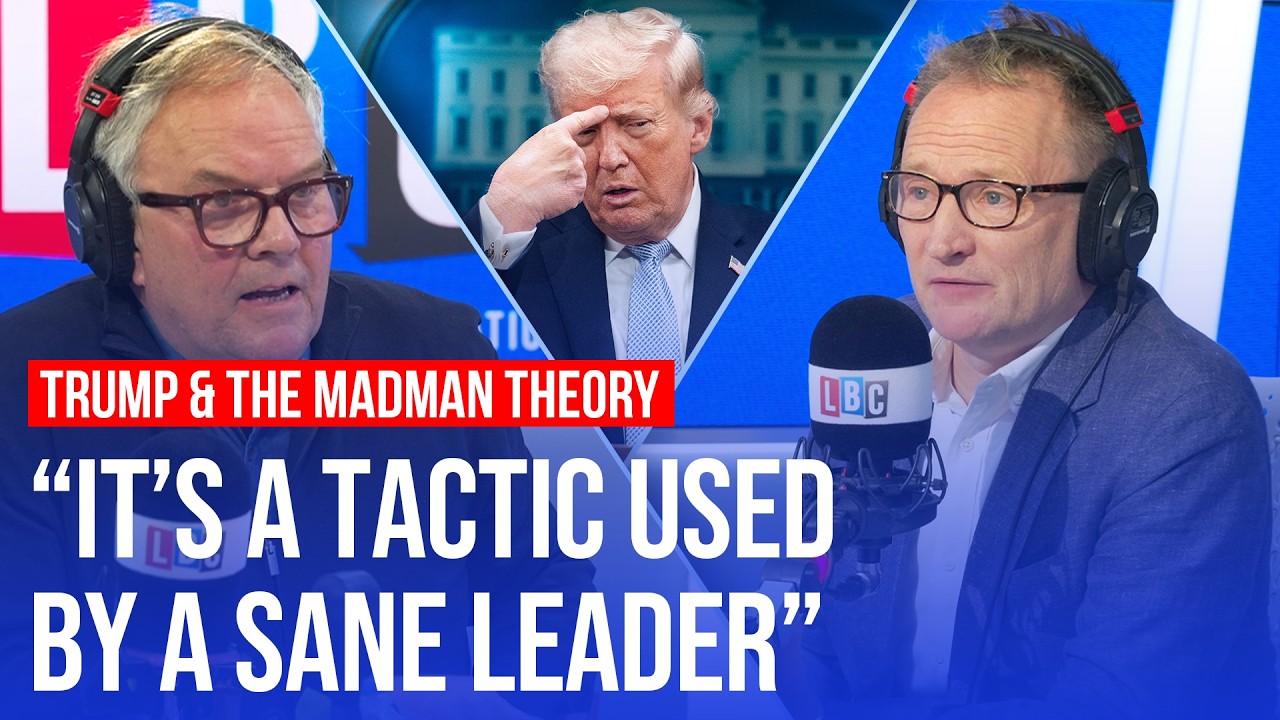
Matt Frei is joined by senior researcher James D Boys who specialises in the the Madman Theory and explains how Trump could be using the strategy in the Middle East. The premise of the Madman Theory was commonly associated with Richard Nixon's presidency and acted as an important pillar in his foreign policy. President Nixon's aim was to make leaders of hostile communist countries think he was irrational and volatile so they would avoid provoking the US in fear of an unprecedented response. This comes after months of 'erratic' and 'genocidal' threats from Trump, one of which he implied a 'whole civilisation will die tonight' in reference to Iran. Listen to the full show on the all-new LBC App: https://app.af.lbc.co.uk/btnc/thenewlbcapp #mattfrei #donaldtrump #trump #whitehouse #richardnixon #psychology #iran #middleeast #LBC LBC is the home of live debate around news and current affairs in the UK. Join in the conversation and listen at https://www.lbc.co.uk/ Sign up to LBC’s weekly newsletter here: https://l-bc.co/signup
Show More Show Less View Video Transcript
0:00
Some of the stuff that Trump has been saying in public, mainly on social media, that is frankly
0:04
to put it mildly, unpresidential. Dropping F-bombs, using, you know, describing friends and
0:09
allies as crazy. Then, of course, the one on Easter Sunday where he said, praise be to Allah
0:14
Then the really mad one about him appearing as Jesus Christ. No, no, I'm sorry, I wasn't Jesus
0:19
I was the healer in chief, which has launched a kind of a blizzard of memes on the internet
0:24
It's certainly entertaining, but is it mad? Well, we have to be very careful
0:28
and it's wonderful to be invited onto the show, so thank you for having me
0:32
I would remind everybody that in 1973, the American Psychiatric Association passed a ruling
0:40
known as the Goldwater Rule, in which it basically said it prohibits diagnosing
0:45
or speculating about the mental stability of any public figures from afar
0:50
And this was reaffirmed in 2017, and it was passed in the aftermath of Barry Goldwater's campaign
0:55
in 1964 when he was derided as being mad, when he was, frankly, nothing of the sort
1:01
Now, clearly Donald Trump gives his critics ammunition every single day. He clearly wakes up and thinks
1:06
how can I antagonise the left, academics, journalists, etc., etc.? And he seems to find a way of doing so every morning
1:14
And so if it's purposeful trolling, if he wants to get a rise out of us, out of half of America
1:20
then is he doing the right thing? Well, he's certainly doing an interesting thing. There's no doubt about it. And I think the fascinating thing about Donald Trump is he has never once, I think, demonstrated an interest in extending his level of support beyond his seeming base
1:36
And there's a lot of talk about where his opinion poll ratings are at the moment. And there's no doubt that they are languishing in the aftermath of the move into Iran
1:43
But again, if you look at his polling historically, you know, I've been lucky enough to be on this network many, many times
1:49
And we have the same questions about how can he win if his polling is only hovering in the high 30s
1:53
And yet time and time again, he wins. And I think you can see part of what we think of as the shy Tory vote in the UK manifesting itself there
2:02
I think polling networks often don't reach into the heartland of America and reach where his base is
2:09
he of course is not on any future ballots although his party are and those who wish to succeed him
2:16
will hope to be able to carry some sort of goodwill over on his coattails whether that's
2:21
jd vance or marco rubio let's talk about the madman theory when did it start and what is it
2:28
okay so the madman theory has an intellectual basis at harvard in the 1950s with the likes
2:34
of thomas schelling and daniel ellsberg and henry kissinger richard nixon believes that he has seen
2:38
Dwight D. Eisenhower implement it to get out of the Korean War
2:43
It shows up in fiction in a book called Failsafe that was written in the early 1960s which basically got lost in the avalanche that was Stanley Kubrick Doctor Strangelove but it a very
2:55
similar story. That's where the expression is utilised by a Kissinger-esque figure
3:00
Nixon then wants to use it as president with Kissinger to get out of the Vietnam War, and
3:05
we can look at the transcripts that have come out and the taping to hear Nixon and Kissinger
3:09
talking about some of the similar things that Donald Trump has talked about, using America's
3:13
military to take out the Vietnamese infrastructure, for example. And now I think we can see examples
3:19
of how Donald Trump, not with the same intellectual capacity behind this, but basically looking
3:24
at this and thinking, I like Kissinger, he was a strong man, this is how it worked, I
3:28
want to try something similar. But the theory is, I will do something, I will let the other side believe that I'm capable
3:34
of doing something so crazy that they will back down. Yeah, forgive me, you did ask me for a definition, so let me give you one. How about this? It
3:42
It is a tactic used as part of a wider strategy by a sane leader who feigns irrationality to convince an opponent that he will do something disproportionate in an attempt to get his own way without doing anything
3:55
And you only need to convince someone of a 1% chance of doing so for it to succeed
3:59
Okay. So many people would listen to that and say, well, in the case of Trump, they would take objection with the word feign, irrationality, because there's quite a lot of irrationality
4:08
I'm not saying craziness, but irrationality in the way that he veers from one extreme to the other
4:13
You know, one minute he's threatening hellacious destruction of an entire civilization
4:18
and then we've got a taco moment where he pulls out of something. So does that undermine any potential of the madman theory
4:25
The one thing we can rely on Trump to do at some stage is to pull back
4:28
So let me just be very candid here. Neither I nor my book are here to defend Donald Trump
4:33
It doesn't lionize nor demonize Donald Trump. but Milley seeks to explain this strategy and ask, does it apply here
4:40
However, the exact question you've asked me, you know, what about this
4:44
What about that? He's moving around all over the place. That's the whole point. You destabilise your opponent
4:49
You make it very clear that they don't know what you're going to do next. And he isn't going to tell you in the media, me as an academic, what he's going to do next
4:58
And that was very much part of his campaign logic. He believed, possibly correctly, that his predecessors, Biden and particularly Obama, were far too rational, that they told America's enemies, we're coming in, we're going to bomb at three in the morning, we're going to blow up an empty building
5:14
And so what's the point? Many people might remember the first season of the West Wing
5:18
And that was dramatized in the first season of that by Aaron Sorkin when President Bartlett talks about, I want a disproportionate response
5:25
And he talked out of it by his joint chiefs Well that was Aaron Sorkin speculating upon if it working in the case of Iran because the whole thing was supposed to be over within a couple of days after the literal decapitation of the supreme
5:43
leader. And eight weeks in, you know, we're still in this war. The Strait of Hormuz have been
5:48
weaponized in the way that people might have imagined, but have never actually experienced
5:53
And for the Iranian rump regime, just holding on and having a pulse is a form of victory
5:58
Well, it's possible. I suggest that there's 40 senior lead, ex-leaders in Iran who might
6:02
disagree with you if they were around to do so. The great challenge there, of course
6:06
is that what Donald Trump has not done is lay out a map to victory in a way that George W. Bush
6:13
might well have done when you were covering the White House back then, because he doesn't want to
6:18
say, this is what we're doing, this is the way that you can prevent us from doing so. And again
6:23
that is, if you look at Donald Trump, like him or loathe him, he has long held three distinct views
6:30
First of all, that America has been ripped off by its friends and its allies for decades
6:34
Secondly, that America's diplomats negotiate poorly and give the game away. And thirdly, that Iran poses an existential threat to the United States
6:44
You may have seen this. People have been talking about, well, is Donald Trump a time traveller? Because people are suddenly surprised that they've seen interviews from the 1980s with him
6:52
with Barbara Walters and Oprah Winfrey, saying what I've just said. this is not a secret but most people haven't taken the time to look into it and say oh yes
7:01
there is a track here to donald trump he's not crazy he's actually adhering to long-held beliefs
7:08
but the madman theory poses a threat which is if you look at how nixon implements it
7:13
it ultimately helps bring him down he goes after daniel ellsberg he was a key architect of the idea
7:21
in the abstract when he talks about the political use of madness
7:26
Ellsberg had been there at the birth of the Nixon presidency, and when he leaks the Pentagon Papers
7:32
it's Nixon's and the plumber's desire to go after him that begins the Watergate process
7:37
It's also the bombing of Cambodia, which was part of the madman theory
7:40
which posed one of the key articles of impeachment. So you can make an argument that not only did the madman theory
7:46
not work for Nixon, who in the world never believed was mad enough to do this
7:51
But it actually helped bring him down. Nixon, of course, Trump, of course, does not need a Kissinger figure
7:56
to go around the world and tell people that his president is mad because there's enough people, perhaps yourself included, I don't know
8:02
who think that he is. I'm sure many of the listeners think that. I don't think he's at all mad
8:07
But he's erratic, which is different. He is. But erratic is important in terms of preventing people to believe
8:11
that the madman theory will work. But I wonder if it works with your friends and allies
8:15
So, I mean, it's no secret that Iran poses an existential threat
8:20
especially to Israel but also to many of America allies and you could argue to America itself Would it not have been better to lay out a case you know and then say to the allies you know if you want to join us please do but if you don we understand
8:32
But lay out a case of how you think this war would proceed and do the same thing with your friends and allies in the Gulf
8:38
who also don't particularly like Iran over the water. I mean, the same man theory
8:44
Yeah, I like that. Maybe that's the next book. Thank you. I don't disagree with you
8:50
I'm not Donald Trump, And I think what Donald Trump has looked at is thought, how have we operated in the past
8:55
What have we done? Oh, we've told everybody we're coming in. We're making it very clear what's going to happen
8:59
And again, compare what's happened in Iran with what happened in Iraq
9:05
There was an attempt to decapitate the leadership there. Everybody woke up to the shock and awe, and they'd missed him
9:12
Say what you will about this operation. They succeeded where George W. Bush failed
9:16
and I think there was a deliberate attempt to build upon that and to move forward from that
9:22
Isn't the real truth here about Trump, it's not that he's, you know
9:26
the question isn't whether he's mad or he's sane, it's that he's quite unpredictable, yes
9:31
and that has its values or maybe not, but also he just gets bored very quickly
9:35
His attention span is limited. He doesn't do the homework. He doesn't do the homework before the war
9:40
He doesn't do the follow-up after the war and therefore he loses interest
9:44
And that, in a sense, is the worst outcome because there's a hell of a lot of unfinished business here
9:50
which these Israelis may want to go and clean up at some stage, which we may all have to deal with
9:54
especially when it comes to the Strait of Hormuz. And America can just say goodbye. We have a massive ocean between us
9:59
Yeah, I think that the White House is quite frankly surprised that the Europeans haven't gotten involved at this point
10:05
I honestly think that they believe that success would get success and that that would lead to Britain in particular becoming involved
10:12
But it wasn't successful, and they didn't ask us to get involved. They just posted it as a fait accompli
10:17
Yes. And then they insulted us. No, listen, listen. And again, I'm not here to defend Donald Trump at all
10:23
He clearly does stuff which appears to defy logic and norms of international behavior
10:28
But that, back to the book, is part of the whole concept of the madman theory
10:34
It's doing stuff that defies apparent logic in an attempt to get your opponents to do something which they would otherwise not do
10:41
And I think that very clearly we've seen Donald Trump use that against his allies, which, of course, Nixon would have never done with regard to threatening to withdraw from NATO
10:50
Just very briefly, is the madman strategy only ever employed by people who think they're actually losing
10:57
It's a desperate measure. No, not necessarily. But it's also only employed by sane people who can employ it very logically and feign it
11:05
and the mistake I think that's being misapplied, the madman theory, is that they believe it's a madman applying a madman theory
11:12
And you can believe that, but that is not what the madman theory ultimately is about
#news