Up next in 10



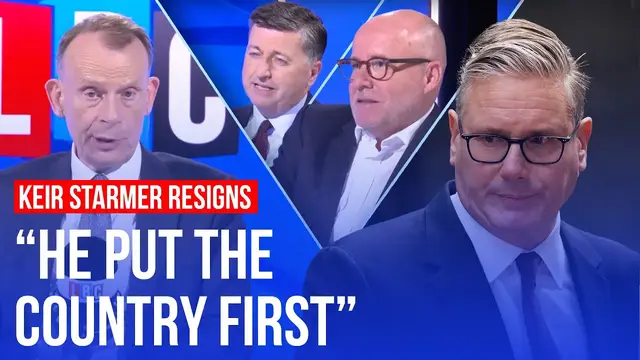
Some of Sir Keir Starmer's closest join Andrew Marr to give their say on his time as Prime Minister. 00:00 | Douglas Alexander Secretary of State for Scotland says 'history will be very generous to Starmer'. 07:07 | Lord Richard Hermer stresses how 'agonising' this decision has been for Starmer, and how he has conducted himself shows his 'decency and dignity'. Listen to the full show on the all-new LBC App: https://app.af.lbc.co.uk/btnc/thenewlbcapp #LordHermer #Andrewmarr #LBC #ukpolitics #generalelection #andyburnham #keirstarmer LBC is the home of live debate around news and current affairs in the UK. Join in the conversation and listen at https://www.lbc.co.uk/ Sign up to LBC’s weekly newsletter here: https://l-bc.co/signup
Show More Show Less View Video Transcript
0:00
First of all, your reaction both to what the Prime Minister said first thing this morning
0:04
and to how the PLP has greeted Andy Burnham. So I think in terms of Keir's statement, we saw Keir at his absolute best
0:13
I thought it was a statement of great dignity, grace and actually patriotism
0:19
And in that sense, in an era when politicians tend to have a bad name
0:23
I think it reflected very well on him. And it was a deeply human moment
0:28
and no Prime Minister leaves Downing Street without regret. It exacts a huge cost on your family and those closest to you
0:35
and I thought he very eloquently captured the significance of the moment
0:40
He's been deeply hated recently. Do you think he's going to be remembered much more kindly
0:45
I do. I think history will be very generous to him. Not simply because people too easily forget
0:51
what the Labour Party was like six years ago. I mean, he said that we were politically, effectively, morally, because of anti-Semitism and financially bankrupt
1:01
We had faced our worst defeat in many decades. And many people, and if I'm honest, myself included, doubted that in the course of a single parliament
1:09
he could do the work of Neil Kinnock, of John Smith, and indeed of Tony Blair in bringing us back to power
1:16
And yet we saw in July 24 a really emphatic Labour victory
1:20
So why did he go? Well, listen, I don't think... Which is the problem
1:24
I think in his remarks today, he made clear that he accepted a view that he would not fight and lead Labour into the next general election
1:34
I honestly don't think today is the day to litigate the character of the Prime Minister, his strengths or weaknesses
1:40
I thought you wrote a compelling and characteristically insightful article in the New Statesman last night
1:46
I've just heard what Neil's got to say as a serving member of the Cabinet. But my responsibility is to ensure that in terms of what comes next, we conduct ourselves with humility, with a degree of discipline and see this as a process of renewal
2:00
Which takes me directly to the obvious next question. Should there be a contest now? Would it be good for the Labour Party to have various people contending for the job
2:08
So I'm not convinced that a contest is actually in the best interests of either the country or indeed of the Labour Party
2:14
of course nominations will be opened formally on the 9th of July. It's for anyone who secures the 81
2:21
nominations from the PLP and a proportion of the constituency Labour parties to put themselves
2:25
forward. I was asked the question at lunchtime who I would be supporting and I answered honestly
2:31
in saying I'll be supporting Andy Burnham in that leadership contest and I'm not entirely convinced
2:36
that experienced political observers like you would regard any leadership contest as being a
2:42
cleansing, clarifying battle of ideas. It'll be a grubby auction, frankly. So, I mean, some people, lots of people are encouraging
2:49
for instance, Darren Jones to put his hat in the ring. Your advice would be, mate, don't
2:55
Ultimately, Darren will reach his own decision. As I say, I'm supporting Andy, and my sense is there is strong momentum building
3:02
behind Andy's candidacy, partly because of the triumphant victory in defeating Reform in Makerfield
3:08
partly because he's one of our most experienced political leaders given his time in the Manchester Mail team, never mind the time we serve together
3:14
in the Cabinet. So, listen, others will reach their own judgment, but my view is the coming
3:20
weeks are best spent preparing for what on any reckoning are going to be significant challenges One of his earliest and toughest calls is going to be who he makes as Chancellor of the Exchequer What in your view are the absolute key priorities for the Treasury going forward
3:36
So ultimately it's Andy's judgment in terms of who he wants to appoint as Chancellor
3:39
but what are the objective realities that any Chancellor would face? Firstly, really since the financial crisis of 2008, but certainly since 2010
3:48
we've endured a low growth, high inequality society. So how do you raise the trend rate of growth
3:55
That, I think, is going to be a common challenge, whoever is the Chancellor
4:00
What is the theory that informs that growth? A, we need to raise the productivity of the country
4:04
We're good at building innovative businesses, but we don't scale them effectively within the United Kingdom
4:10
Secondly, how do we recognise that in the private sector, incentives matter
4:15
So how do we liberate the animal spirits, not just in the financial services sector, but right across the economy
4:20
And thirdly, and very distinctively, I think Andy will bring a big focus on regional economic growth
4:26
To take just one example, if you look at the city that we both were born in, in Glasgow
4:30
it takes 58 weeks to get a planning application through in Glasgow. It takes 18 weeks in Manchester
4:37
We need a deep understanding of place-based economics to make sure that every region of the country can both contribute to and benefit
4:44
from what we need to drive forward, which is a higher trend rate of growth. Higher trend rate of growth
4:49
And at the same time, presumably protect Andy Burnham, given what he said in the past, from the bond markets
4:55
Well, listen, I think there's a basic truth here, which is the more credible you are, the more radical you can be
5:01
And in that sense, I think all of us who have both served in government
5:05
in the past and observed, frankly, the Horlicks made of it by Liz Trust
5:09
recognise that actually the need for fiscal discipline is the foundation of radicalism, not intention with radicalism
5:16
If you're credible and if they understand what you're doing, the bond markets will not cut you slack
5:21
but they'll understand it and they'll price accordingly. So I think there's a difference between asserting strength
5:26
and establishing credibility. And you're absolutely right. The bond markets want to understand not only what is the policy
5:32
but the thinking behind that policy. And in that sense, having worked so closely in the past
5:37
with Gordon Brown, it was very clear to me he saw a constant responsibility in articulating
5:42
not only an assertion of strength, but a willingness to explain why, if you like, strong economic
5:49
foundations were the foundation for everything else he was seeking to achieve. Final area, as it was with Neil Kinnock, should there be an early election? Lots of people
5:57
are saying this is the moment, you know, he's come in, he hasn't been elected, he wasn't elected in the general election, and therefore the country deserves another election
6:05
I don't believe that's necessary. Of course, there will be commentators and some in the
6:09
opposition who demand a general election. That's what oppositions do. The reality is we're a
6:12
parliamentary democracy in the United Kingdom. That mandate was won in July
6:16
of 2024 and I think in that sense we've seen a whole number of
6:20
precedents in recent years where there hasn't been a general election. I think our responsibility
6:24
is to double down and drive forward the change that people voted for in July
6:29
24. And I guess the final question is it's been a very
6:33
very tough time the last few years. Do you feel more optimistic
6:37
as a result of what's happened today? Honestly, I think one of Andy's great strengths is a facility to communicate hope
6:44
I think it was Napoleon who said the task of a leader is to establish reality and to offer hope And in that sense I think we all had a tutorial in reality in recent years in the United Kingdom People know that the condition of the country is really challenging
6:59
I think there is a key requirement on the next leader of the Labour Party, I hope it's Andy, to communicate a sense of hope and possibility
7:05
and I feel that sense this evening. I'd like to talk a little bit more about the Prime Minister
7:09
as an individual with somebody who is a genuinely close friend of his, the Attorney-General, Lord Richard Hermer
7:15
who gave me his reflections on this significant day. Well, I think we all would have witnessed this morning the decision. It must have been an agonizing decision for the prime minister. We also witnessed something else this morning, which tells us an awful lot about Keir Starmer, his decency, his dignity, the way he conducted himself this morning in making what I mean, can you imagine just how exquisitely painful that decision must have been for him
7:42
But the way he handled himself doing that tells us an awful lot about the human being as well as the prime minister
7:49
He clearly didn't want to take this decision. I mean, he talked about it a lot beforehand, saying he was going to fight on under all circumstances
7:56
But it's been widely said that the most important thing to understand in politics is how to count
8:01
In the end, was it simply the numbers against him that made this happen? Well, one of the many true things that Keir has said is that he came into politics to put country first
8:11
country above party. And I think he would have taken a view
8:15
that of course he could have fought a campaign from what are some advantage points
8:22
of being prime ministers to do so, but that it would be so damaging
8:26
to the party and thus to the country that again, putting country first
8:32
he made the decision that he did. Richard, you sound yourself a little ambiguous
8:36
Do you support what he did? Do you think he did the right thing? Yeah, look
8:39
I think having made a decision that any kind of campaign would have been deeply damaging to the country, I think he did make the right decision
8:51
He made the patriotic decision. He put country first. And I think he needs to be commended for that
8:56
One of the things he didn't talk about in that speech was what he'd got wrong
9:00
You know, there's no apologies, no explanation of why, after all these lists of achievements, he was where he was
9:06
I'd like to talk about that a little bit because it seems to me that among his many skills, there weren't very many classic political ones
9:13
He didn't enjoy political argument. He didn't enjoy the intrigue and the relationship building and the plotting that is an inevitable part of democratic politics
9:22
Do you think he came in, as you did, as it were, from the law into this new world, slightly unprepared for it
9:28
Look, I think that is somewhat of an unfair criticism, who someone who came in, became leader of the Labour Party, wrested control of the Labour Party from some people who, politics he did not share, won a general election in 24 at a point in which just a few years ago, people would have thought it was for the, you know, for the clouds winning that election
9:56
but he did it. So I think this kind of narrative about Keir, that he doesn't get politics
10:01
is not interested in politics, is demonstrably false. Now, what he is and how he is governed
10:07
is as a serious politician. So I think you could make the criticism of him that he hasn't
10:15
been interested in the stories about who up who down what going on inside the parliamentary Labour Party Perhaps you have to be a bit interested in those stories in the real world in terms of realpolitik Well look today may give us cause to reflect on that But I think what
10:32
it will also do is when we take the long view, Andrew, and we see what he has achieved both
10:38
domestically, not just making the Labour Party electable again. The list of things he talked
10:44
about child poverty and so on. Domestically, and I do want to talk about
10:50
what he's done internationally as well because I think that is extraordinary, but domestically what he has done
10:55
has laid the foundations within two years of a Labour government for creating
10:59
a far fairer society, breaking down huge structural inequalities. I mean, you raise one
11:05
which is lifting the two-child benefit cap, which was a horrendous policy
11:11
By lifting it... He was slightly forced into that, wasn't he? Well, no
11:15
I think what he said was consistent, which was he was going to do it when the economic circumstances permitted
11:20
So we didn't do it on day one. We did do it as soon as we possibly could for all the right reasons
11:25
It is going to lift more Trojan out of poverty than any other policy a post-war government has implemented
11:33
And that's just one of a kind of a whole range of domestic policies that we can look back at that are making this society fairer
11:39
So as we go with three years still to go to a general election, what care has provided for this government, for this country, the essential building blocks to going forward to keep making society fairer for all
11:53
You mentioned the international scene. It seems to me that in a sense, one of his biggest achievements was being a Trump whisperer, which wasn't always a kind of very elegant thing to have to do
12:02
You know, you had all sorts of twists and turns and you could never trust what Trump's going to say next
12:07
but with his most dangerous and mercurial figure in the White House
12:11
He coped with that. Yeah, I think he more than coped with that
12:14
I mean, look, I think for any politician, not least a Labour politician, there would have been this kind of temptation, what's called, you know
12:21
you probably used the phrase yourself, this love actually moment where you have this kind of cathartic moment where you kind of, you scream out loud
12:28
But that is not what this country needs by way of serious statecraft
12:33
And what Keir demonstrated was really serious statecraft. So when we came in, the status of this country on the international scene was at a particularly low ebb
12:43
We were no longer really thought of as a big player. That has radically changed because of Keir's leadership
12:50
He'd become a major figure on the international scene with huge advantage for this country
12:55
Looking forward, as we must know, what do you think of Burnham on the world stage
13:00
Do you think that he can do the same kind of things? Yeah, sure. I think he will come in
13:05
I think he will be able to build upon the work that Keir has established
13:09
He will be able to build upon the relationships that Keir has established. And do you think they will now be able to build a relationship between themselves in terms of a transition
13:17
Yeah, look, you saw that today on the steps. What a different speech Keir Starmer's was from Boris Johnson, from that kind of truculence that we saw on the steps of Number 10
13:26
Despite this must be the hardest day of his life. despite that it's words about it's words of solidarity it is an expression of an intent
13:37
to do everything that he can to support whoever it is that comes after him and that
13:41
that andrew is the true kirstama
news