Up next in 10



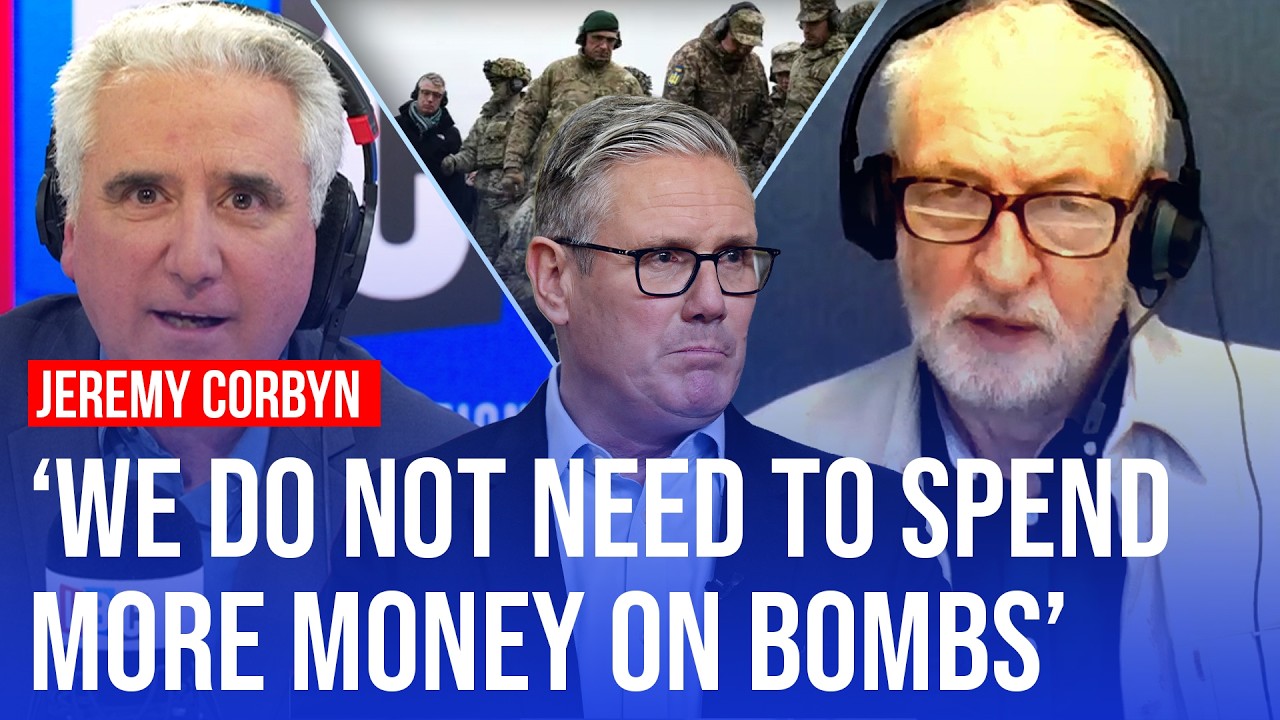
Sir Keir Starmer has rejected demands for welfare cuts to fund the armed forces, as he insisted he will fight on as Prime Minister despite more government resignations. Simon Marks speaks to Jeremy Corbyn, former Labour leader, as Keir Starmer faces accusations of ‘prioritising welfare over defence’ following key defence resignations. It follows the resignations of Defence Secretary John Healey and Armed Forces Minister Al Carns over the long-delayed defence investment plan. Listen to the full show on the all-new LBC App: https://app.af.lbc.co.uk/btnc/thenewlbcapp #simonmarks #jeremycorbyn #keirstarmer #politics #defence #funding #news #ukpolitics #TypeInTopic #LBC LBC is the home of live debate around news and current affairs in the UK. Join in the conversation and listen at https://www.lbc.co.uk/ Sign up to LBC’s weekly newsletter here: https://l-bc.co/signup
Show More Show Less View Video Transcript
0:00
Mr Corbyn, thank you so much for joining us on LBC this afternoon
0:04
I know that you've been stuck on the underground, which is why you were slightly delayed
0:08
which may be part of the argument for not spending money on defence
0:12
and keeping it at home to improve infrastructure and public service. I read to listeners earlier your post on X about this
0:21
We do not need to spend more money on bombs and bullets. We need to spend more money on housing schools and our NHS instead
0:27
a roof over your head, enough food to feed your children, a public health service you can rely on in your time of need
0:36
That is what real security means. But at a time of such volatility on the world stage
0:45
and at a time when we know that there are dangers to the United Kingdom posed, for example
0:52
by America's scaling back of its commitment to this country's defence, That's a hell of a gamble, isn't it
1:00
When I was coming over to my office, I walked past the very large weekly food bank
1:07
that's held not far away from my office. I also met a number of people that were rough sleeping
1:14
and I met a number of people around the station begging. That's normal in London today
1:19
That's normal in every one of our cities today. Youth unemployment up 5%
1:25
housing needs absolutely desperate and then cami badnot gets up in parliament wednesday and says
1:31
we're spending too much on welfare we need to spend more on warfare where is the agenda
1:37
most other european and north american governments an agenda about trying to bring about some kind of
1:46
detente or peace where were the efforts made to try and get a ceasefire in ukraine i'm not
1:51
unaware of what Russia has done in Ukraine. And I do not support Russia in Ukraine
1:57
But I want to see an end to that war. Because this war is being used as a motor
2:00
to increase arms expenditure all across Europe. And the consequences in every country are the same
2:10
Cuts in health, cuts in education, cuts in housing, rising poverty and rising unemployment
2:16
There's a choice. Are we going to pursue an agenda for peace and prosperity
2:20
or an agenda to build up for war. Exactly the same agenda is being followed in Russia
2:25
and other countries, we're spending more on arms and less on the needs of their people
2:31
Is it a good direction for the world? But can I challenge you and suggest that it's not necessarily an agenda
2:36
for building up to war It could be an agenda for strengthening our national defence because we know the Trump administration and the Americans simply no longer have our backs
2:52
The American trajectory now, you're right in a sense, I think that's what you mean, is to increase isolationism and go away from the idea of any kind of multilateral issues
3:05
I mean, that's the whole trajectory of Donald Trump. And so that means then the rest of the world have got to be realistic about what America's doing, which is, in fact, threatening the rest of the world to gain its natural resources
3:20
Is building up armaments for a putative war with somebody such a good idea at this time
3:27
Or is it actually going to lead to something bad? My question is, where's the investment in peace
3:33
Where's the investment in the UN? Where's the investment in overseas aid
3:37
Where's the investment in anti-poverty strategies in our own countries? That I find disturbing because if you look at the history of Europe, pre-First World War, there was a long buildup of an arms race which culminated in the massacres of the Western Front
3:54
Pre-20s and 30s, there was exactly the same kind of thing. Shouldn't we be thinking much more in terms of the real security of our planet
4:03
The real issues are surely environmental disaster, human inequality and increasing levels of poverty amongst the very poorest
4:12
When you say where's the agenda for investing in the UN, why would we bother
4:16
I mean, where's the proof that the UN has played a meaningful role, for example, in trying to negotiate peace between Russia and Ukraine
4:25
in terms of trying to bring about some kind of settlement in the Iran issue
4:29
And I'm not necessarily faulting the UN per se. I mean, the UN is a member organisation and it is absolutely captive to the permanent five Security Council arrangements that haven't been changed
4:41
It has, I mean, you would agree, surely, that the UN has failed miserably to live up to its responsibility to protect
4:50
which, of course, is that new sort of binding principle that is supposed to guide its operations
4:57
When I say funding of the UN, I also mean funding of the agency's World Food Programme and so on as well
5:02
which I'm sure you'd probably agree with putting more money in the World Food Programme. Yes, the UN has failed to do anything meaningful about Russia and Ukraine
5:11
The EU, likewise, the only people that seriously tried to do anything
5:15
to bring about a ceasefire have been the African Union and the Pope
5:20
And occasionally the Arab League has said stuff about it and President Lula Are we going to go on forever having a war in Ukraine And are we going on forever allowing our politics to be dominated by defence experts
5:35
that were all over the media for the past three days? A lot of those defence experts are actually bought and paid for by the arms industry
5:42
who are making a large amount of money out of all this. All these demands for increased arms expenditure, where are they coming from
5:49
Are they a popular demand of people on the doorstep all around this country
5:54
If so, I'm not hearing it. What they are coming from is those companies that will be making a great deal of money out of this increased expenditure
6:02
The New York Times had a front page lead this morning reporting that the United States now plans significantly to reduce the aircraft and warships it makes available for NATO operations in Europe
6:14
They're talking about cutting fighter jets from 150 to 100, reducing maritime reconnaissance aircraft from 26 to 15, and removing all eight aerial refuelling tanker jets it has previously made available to Europe
6:30
You know better than anyone that job number one for any British prime minister is protecting the country's national security
6:38
without that kind of umbrella protection, any government would have to be looking
6:45
at spending more money in this area, wouldn't it? Obviously, a government has to protect its people
6:50
but you also protect your people by your politics, by your diplomacy and by your relationships
6:56
Where are the attempts, I repeat this, where are the attempts to try to reduce the tensions
7:01
bring about a ceasefire and save life, save life of Ukrainian as well as Russian people
7:07
Are we just going to be witnesses to this carnage for another three years
7:12
What's your view about the MOD's threat reports that the Russian shadow fleet are increasingly probing the waters around the UK
7:22
Why should the country not be worried about that? I'd be interested to know what this shadow fleet is and what they're actually doing
7:30
There are arguments about the use of the Straits of Dover. The Straits of Dover are international water and can be used by anybody, providing they're not attacking either side
7:39
So if anybody turns up trying to actually attack the infrastructure of a country, then clearly they're in breach of international law and they are a threat
7:49
I do think there needs to be monitoring and surveillance. There has to be
7:53
And protests where appropriate against that. But try to develop some kind of intelligent relationship
8:00
Listen, I hate the war in Ukraine. I hate what's going on there. I hate the killing that's going on there
8:05
I want to see an end to it an end to it to save lives of everybody Can I ask you about two other issues before we let you go First of all I wanted to ask you about the split that has taken place in your party Where does that leave your party and where do you see it heading in the future
8:23
Well, our party has 60,000 members. We are setting up branches all over the country at the moment
8:28
We will have several hundred branches by the end of this year. We're planning a great deal of
8:34
activities. We supported and worked with and put up independent candidates in the local election
8:39
Fifty or sixty or so were elected to councils as a result of it. So, yes, there's the debate in the
8:45
party. Of course, there is. There's always debates in parties. But we're there organising in
8:49
communities, organising to deal with the housing crisis in Britain and the poverty crisis in Britain
8:56
And we're doing very well. So, are you committing in the next election to be running under a
9:00
your party banner um i've i'm a you part your party um it's my name now that i put it up as
9:06
that yes okay and the other thing i wanted to ask you about was the death of uh david hockney we're
9:12
going to talk about it at the very end of the program i mean this was someone who was born
9:16
into a revolutionary pacifist activist family and who really had pacifism and activism kind of
9:25
coursing through his veins and through his artistic work. And I wonder what your thoughts are today about Mr Hockney's contribution
9:32
to British society, but also to the world of art more broadly
9:37
I'm really pleased you brought it up because I do think we should always appreciate art
9:41
And there is an artist in all of us, there is inspiration in all of us, and I wish all our kids at school had real chance to learn music and art
9:48
Hockney, I think, was marvellous because he's what I would call sort of abstract with figurative in it
9:58
Figurative abstract. I love abstract art, but I'm just looking now. It's picked up my phone of Purple Road by David Hockney
10:05
At one level, it's a lovely picture of different coloured fields, almost sort of Picasso-like
10:12
And then it's got this rather weird purple road going uphill and down dale
10:16
not apparently going anywhere. You look at it and it makes you think
10:20
the beauty of our land, the beauty of our countryside, and the endless brilliance of human imagination
10:27
Let's thank David Hockney for what he did, the paintings he's given us, and let's make sure every school kid
10:32
gets to see the paintings of David Hockney. Fair to say that he wouldn't be backing
10:36
increased defence expenditure. I'm pretty sure that David and I would be very happy
10:40
to agree on many things, including that. So I'm sad he's gone
10:45
I want to thank his family and his life, for his life and what he gave to all of us
10:50
Jeremy Corbyn, thanks very much indeed for being with us on the programme this afternoon
#news