Up next in 10



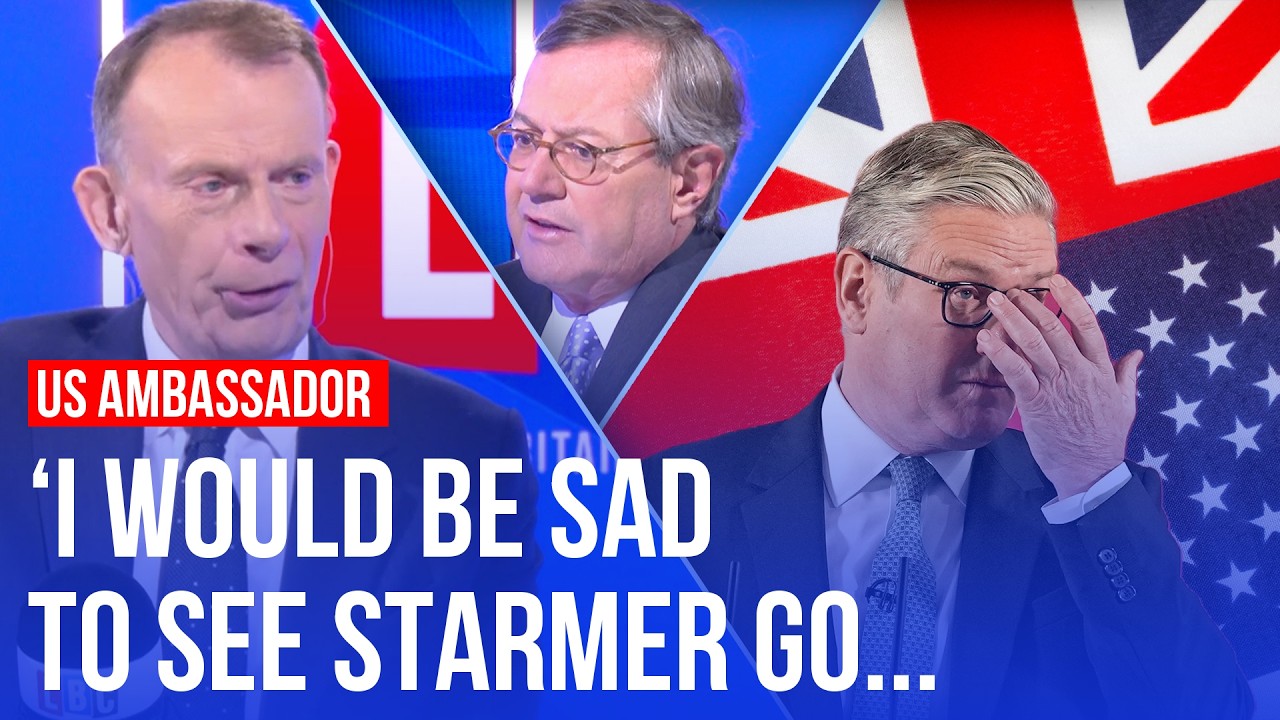
Andrew Marr speaks with US Ambassador Warren Stephens about a key problem for the special relationship, the shifting political landscape UK and what he thinks of Keir Starmer. With over 70 MPs and key ministers calling for Starmer's resignation, Andrew Marr puts the PM to ambassador Stephens. He says he would be 'sad to see him go' as despite their 'disagreements', Starmer is 'good and decent'. Andrew Marr also discusses President Trump's 'affection' for the royal family and the state of the US/UK 's special relationship. Listen to the full show on the all-new LBC App: https://app.af.lbc.co.uk/btnc/thenewlbcapp #andrewmarr #trump #usambassador #uspolitics #ukpolitics #LBC LBC is the home of live debate around news and current affairs in the UK. Join in the conversation and listen at https://www.lbc.co.uk/ Sign up to LBC’s weekly newsletter here: https://l-bc.co/signup
Show More Show Less View Video Transcript
0:00
I think the prime minister is constrained somewhat by the U.K. laws and in terms of certainly our military action and use of bases
0:13
And I think he followed followed those laws and it upset the president upset a lot of Americans because our air crews then had to fly 35 ish hours in the initial stages of the attack
0:28
But, you know, overall, I give the prime minister a lot of high grades for how he's dealt with Washington
0:36
How does he compare with the king as a kind of intermediary between our countries
0:40
Well, there's no comparing the prime minister to the king, but the king is your sovereign
0:48
And the president, frankly, loves the royal family, loves the king, loved the late queen
0:55
So it's, you know, the king, king's the king. King's the king
1:04
Early on in his relationship with President Trump, it seemed to be warmer
1:09
Trump described Keir Starmer as a friend. There seemed to be a genuine kind of relationship going on there
1:15
and it soured quite dramatically, partly over tariffs and partly over the Iran war
1:21
where the prime minister has said basically his greatest achievement is keeping Britain out of that war
1:26
How much has that stung in Washington? Well, as I was saying, I think, you know, it stung
1:33
We weren't asking for the UK to join us, but we were asking to use bases that are somewhat joint bases
1:42
And but, you know, the president, the president has has said some things that I think he is, you know, he felt very deeply
1:57
And and I know the prime minister feels the same way on the other side
2:02
We have very, very different political systems, of course. Looking from Washington, how do you think the president
2:08
What do you think the president will make of the sort of chaos that's going on here? It comes from a parliamentary system. It's a very different system. It's confusing even to us. How does it look to Washington
2:17
Well, I don't really know how it looks to Washington. I think the president has said in the past that he hopes the U.K. will change its immigration and energy policies
2:31
But I don't know if that will happen or not. Do you believe that the energy policies in particular are keeping Britain out of the AI revolution which is going to completely change the economies of all Western countries I think it going to hurt because data centers consume enormous amounts of power
2:49
and you have tremendous research that goes on in this country. So you have a lot of assets
2:56
But the ultimate, the data centers, as it relates to AI, need reliable power
3:05
and they need it as cheaply as they can get it. Is there a certain amount of American naivety about our situation, however
3:12
particularly around fracking, for instance? We are a much, much more densely populated country, a small archipelago
3:18
You've got Texas. It's very, very different here. No, I don't think we're being naive at all
3:23
I mean, we frack all over the country. We're fracking in Ohio. We're fracking in Pennsylvania
3:28
We frack around Fort Worth, Texas. You can do it. And I think I would hope the UK would do it, but I don't I don't think that's going to happen anytime soon
3:40
I must return to what's going on here now, if you don't mind, because we could be quite close to having another prime minister
3:46
Now, I know you want want to intervene in British politics at all. But what would it do to the special relationship to do to have a change of prime minister
3:54
You know, I think the special relationship goes on regardless of who our political leaders are
3:59
And I've seen that since I've been in this chair, the chair of the ambassador
4:05
And the day to day work between our companies, between our intelligence communities, between our militaries, it it goes on
4:16
And I think that will go on regardless of of what who the political leaders are
4:21
What about the instability aspect of it, though? We've had four prime ministers here in four years
4:26
Does that make it harder for Washington, for instance, to deal with the UK
4:30
I don't really think so. I think the policies don't really change that much, as long as the party in power is still in power
4:42
But certainly the ability to have personal relationships matters, and to the extent that there's frequent turnover
4:53
That's a problem. That's a problem. And what about the investment aspect of it? I know your background is in investment, and there's a certain amount of market turmoil going on today already. But how much do you think the political, fast political changes then affect the investment atmosphere, the investment climate, on which the UK partly depends
5:13
Markets don like uncertainty and to the extent there uncertainty in the market I haven looked at any of the financial markets today but I suspect that what going on is their uncertain as to what going to be the outcome
5:28
And markets don't like that. How much did the Peter Mandelson affair damage the U.K. in the eyes of Washington
5:37
You know, I don't really think it damaged the U.K. in the eyes of Washington
5:42
It's unfortunate that that has happened. But it probably did have an effect on our relationship because it then took a long time to get Mandelson's replacement in D.C
5:58
And that, again, has an effect because it's all personal relations. Yes. Let me just return to what we were talking about a moment ago, which is the energy issue
6:06
I know that you have been very keen to see a change in British energy policy and you've been talking to ministers
6:11
Have you seen any sign that there might be a change coming? No, not really
6:15
I think, but I do think there will be, well, there is a little bit
6:23
Let me back up. There is a little bit. I think certain people in the government would be open to some additional drilling in the North Sea
6:35
Exactly what that is, I'm not sure. Because of the crisis consequent on the Iran war
6:42
I think it actually started before that. The war probably has accelerated that thinking. I don't know that
6:54
But I think, you know, there are tremendous shale gas reserves on shore in the UK that could be safely drilled and produced
7:04
And it's a lot. It's a lot of shale gas that could significantly drive down energy costs in the UK
7:13
And if we did that, would that make it likely that American companies, particularly AI companies, would come and invest here
7:19
Make it more likely, for sure. I mean, what we're seeing in the U.S. is relatively cheap power, relatively cheap land
7:30
You don't have cheap land and they're big, but you do have great research
7:37
And, you know, if your energy costs are reasonable, I think I think American companies would be willing to come do that
7:44
Ambassador, let me ask you about one other issue, which I know has caused a lot of concern in the United States, which is the rise in anti-Semitic attacks and anti-Semitic expressions in the UK
7:54
Now you have a bit of that going on in your country as well but how concerned are you about the condition of British Jewry at the moment I worry about it a lot I think both in the U and the U the level of anti when it first came up in the U I was more aware of it there
8:16
I was quite surprised. And you wonder how did we get to this point
8:25
And it really seemed to start in the universities and the protests at the universities
8:30
How did we get to this point? And I'm not really sure, but we are, you know, at a point where I know the president, you know, the president has an appointed, confirmed person whose all he does is focus on anti-Semitism around the world
8:49
But particularly in Britain, do you think that we're doing enough? I think you're starting to do enough
8:53
I mean, I think these last attacks have galvanized the government. Prime Minister said it was going to be a whole of government approach, maybe even said a whole of society approach
9:07
But I can't remember that. I know it was a whole of government approach. And I think that's needed
9:13
There's just not that much. There's no reason for that. And inevitably, I come back to where we are now
9:19
A lot of people think the prime minister will be no longer in office by the end of this week
9:24
Would the president be sad to see him go? I think it would probably be who replaces him
9:30
I can tell you this. I'd be sad to see him go. I get along with him fine
9:34
We don't always agree, obviously. But I like him and I think he's a very good and decent man
9:43
And in terms of all the people listening to LBC who are feeling very down about Britain at the moment
9:48
very worried about the way we're going. You know, we don't relatively weak economy
9:53
confusing political leadership. Any words of advice? The UK is an incredibly strong company and the people are very strong. And I have no doubt
10:02
that they'll get this sorted out and get back to the way the people want it to be. And I think
10:11
the economy and this all seems to be related and it's not the energy, the economy
10:20
cost of living they're all related but you have in your power
10:28
the ability to do something different and I think you will. A glint of optimism on the horizon
10:35
Oh I think more than a glint You know, it's the UK's UK has been a shining light around the world for a long time
#news