Up next in 10



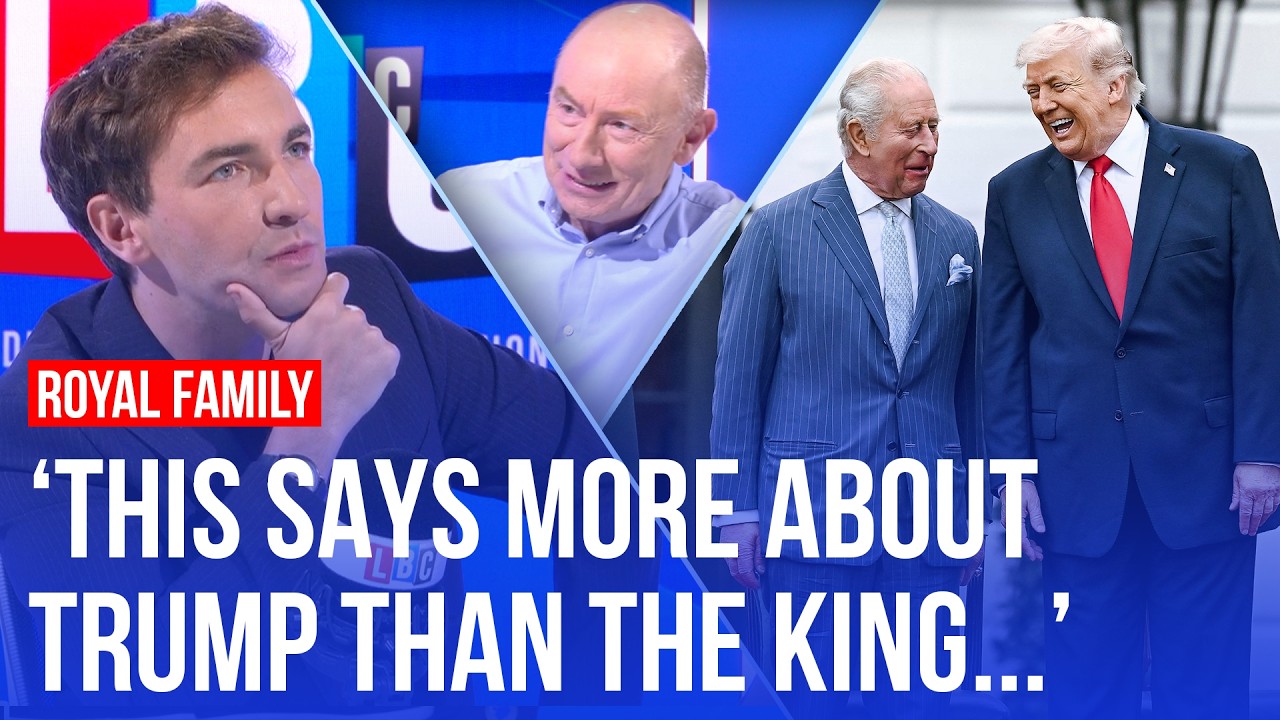
Lewis Goodall is joined by LBC's royal correspondent Peter Hunt, who gives his analysis on the recent royal state visit by King Charles and Queen Camilla to the United States. The King 'grasped in both hands' the 'risk and challenge' of the US state visit, but will not dwell on the perceived success of his trip, a senior palace aide has said. Ahead of the visit, Downing Street’s request was seen as a throw of the dice, with the King being sent to help repair the UK-US special relationship following repeated criticisms levelled by Donald Trump at Prime Minister Sir Keir Starmer over the war in Iran. Listen to the full show on the all-new LBC App: https://app.af.lbc.co.uk/btnc/thenewlbcapp #LewisGoodall #Royals #USA #Politics #DonaldTrump #Trump #King #KingCharles #News #WorldNews #RoyalFamily #LBC LBC is the home of live debate around news and current affairs in the UK. Join in the conversation and listen at https://www.lbc.co.uk/ Sign up to LBC’s weekly newsletter here: https://l-bc.co/signup
Show More Show Less View Video Transcript
0:00
Well, this has been a big week for the reign of Charles III
0:03
perhaps the week in which it has been written he stepped outside of his late mother's shadow
0:09
with that visit to Donald Trump's Washington, that much-praised speech on Capitol Hill to the Congress
0:16
where, among other things, he perhaps went further than almost any other Western leader
0:20
suddenly any democratically elected leader, and their criticism of Donald Trump, certainly much further than our own prime minister, has gone
0:27
Was it all it was cracked up to be, though? Peter Hunt is LBC Royal Correspondent, former BBC Royal Correspondent, of course
0:33
Peter, do you think that this was a week which will be looked back on as being important to Charles' reign
0:38
I mean, it is true, isn't it, to say that I find it hard to believe that the speech he gave to Congress
0:42
would have been the sort of speech that his late mother would have delivered. Yes, because not least she would have struggled with the jokes
0:48
I mean, you know, a man who's obsessed with the goons can deliver a good line
0:53
But the other thing to remember, of course, when you talk about jokes is people laugh uproariously at roars
0:58
even when they're not that funny. So, I mean, that is a context to remember. But the overarching thing is this was a very good week for Charles in terms of his legacy, because thus far his legacy had been problems, hadn't it
1:09
His legacy had Andrew Mountbatten-Windsor, which I'm sure we'll talk about, Harry and Meghan, the whole issue of transparency that people are calling about
1:15
But this was an opportunity for him because if you step back and look at him as Prince of Wales, all of those decades, all he had to do was be
1:22
And he struggled with just being. He wanted to do. So he did. But a lot of things he did ended up courting controversy because he was seen as a meddlesome prince or whatever
1:31
He just wanted to do and have an impact. And he had an impact in the States
1:35
And so from his perspective and from his legacy, it was a very good week because what you had were two billionaire heads of state who keep bees
1:45
I mean, that's the only thing they have in common. But somehow he managed to navigate that
1:49
I mean, I think royals often attract sycophants and President Trump is the latest sycophant to be attracted to the royals
1:56
And generally what Prince the King does with such people is, particularly if they're rich, is he uses them for their money, for his charitable causes
2:03
But whereas with Prince, with President Trump, he had an opportunity to say things, as you say, that others couldn't say
2:10
But of course there were two key words that he never uttered Indeed go on Geoffrey Epstein And that is despite the fact of course that the families of some of the survivors
2:21
and indeed some of the survivors themselves of Epstein, they were very keen to meet the king, weren't they
2:25
And the royal family, the Buckingham Palace were having none of it. I mean, in terms of Epstein, it's job done from the palace's perspective
2:31
because I read, on my way here, I read three articles on three main news websites
2:35
which were all ysis of the king's visit, and none of them mentioned the name Epstein
2:40
So, and pretty widespread acceptance of the palace argument that he couldn't, which I, the only paper I read or magazine that I read that said it was nonsense was Private Eye
2:51
I don't understand. I never understood that. They said it would somehow prejudice the ongoing legal inquiry
2:55
I don't accept that. He meets with people all the time. Why would it have done
2:59
And I always think with palace statements, the longer they are, the more you have a sense that they have concern
3:04
And so the comments they put out from spokespeople and sources became longer and longer
3:09
And buried within one of them was this phrase that the risk was small
3:14
So if the risk is small, then you make a calculation as to whether or not you should take that challenge
3:19
And, of course, as you say, what, you know, he has issued a public statement about the Epstein victims where he says they're in their thoughts and, you know, they are his priority
3:27
They're in their thoughts, just not their sight. Well, the Epstein victims in the state said what they wanted was a bit of symbolism
3:33
And that's what the royal family is about. They could have met. He could have expressed his sympathy. He could have listened. He didn't need to say anything. And from their perspective, they would have got what they wanted. And as one of the congresspeople who's been fighting for all of this said, it was a moral moment that he missed
3:48
And yet there has been almost no, as you say, no reference to that or any criticism really that they didn't do so
3:54
Despite the fact, as you say, they tend to these days since the ongoing imbroglio with Andrew Mountbatten-Windsor, every time they publish a statement, they're all very keen to different members of the family to reiterate how much these victims and survivors are in their thoughts
4:07
But I think if you step back from the way the institution has responded to the Epstein
4:13
and Andrew Mountbatten-Windsor, they've always done their bare minimum at each stage
4:17
Because, you know, they could, before he was arrested under this investigation about the
4:23
public offences they could have insisted publicly that he should go and testify in America but the king chose not to So their strategy all along has been to do the bare minimum to ensure that the focus is on the prince and not on the institution
4:38
But, of course, the other thing that hasn't had much coverage this week is the work of Gordon Brown and his article in The New Statesman
4:44
and his call for Andrew to be interviewed again by the police
4:49
and for a greater look to see as to whether these allegations of whether women were trafficked, A, to the UK
4:54
and B even more seriously through royal residences. And all of this then has an impact on the king and his institution
5:00
And there was a lot of commentary, I mean I see some even today, talking about this saying that this was a very high-stakes moment for the king
5:07
Was it very high-stakes? I mean there has been some achievement. We saw President Trump deciding to withdraw the tariffs didn't we on Scottish whiskey, for example
5:15
So something has manifested from it or been realised from it. But was it very high-stakes
5:19
What I think is always interesting is there's an arc to these sort of moments
5:24
aren't there and I think the art can sometimes be that there is an over exaggeration of the risk
5:29
before the event takes place and so you would have read articles a week or two ago which spoke about
5:35
how high stake how high risk you know could it fail for him or whatever then we get to the day
5:40
before where there's there's the shooting at that dinner with Trump where there's all this nonsense
5:44
about whether or not it would be called off which adds to that sort of tension when there was never
5:47
it was never likely that it would be called off and then you get to it I mean I suppose you know
5:51
because of the nature of President Trump, there is always a risk, isn't there, as to how he would react
5:58
But I thought what was very telling, and there's been a briefing in the last day or two by a senior person in the palace to people who followed the trip
6:06
And one of the phrases he used is he talked about the speech in Congress having observable facts
6:10
And I think that was the sort of the anchor for them, that in this world where facts are so contested
6:15
he insisted, he ensured that everything that he put into this speech was fact-based
6:19
But yes, there would have been risks as to how President Trump reacted. But I think the key thing they had in the bank was his constant praise of the institution and of the king
6:29
I mean, you do have to smile a bit because there's that account, isn't there, when he first met the king when he was Prince Charles, I think it was 2019
6:38
where Charles by Trump account bored and rigid by talking about the environment So I imagine that when they met privately he skated over that subject But that the truth isn it I mean for all of the praise and the speech was great and the king suddenly landed the jokes and clearly it was something that he wanted to say and he said it
6:53
But the truth is, in a weird way, the reason he can say it is precisely what is in a way the kind of one of the worst things about Trump
7:00
which is just Trump likes royalty, right? Trump fancies himself as royalty. This guy is not democratically elected
7:06
He's the king. He's royal. And so his bandwidth, his ability to be able to say things is greater than a democratic leader
7:13
It says more about Trump, frankly, than it does about the king. And that is and was the king's great Trump card
7:20
He told that joke about how his mum had a crush on Charles
7:25
I mean, they were pushing at an open door in terms of that
7:29
And then there was the masterful bit where they gave the bell from HMS Trump. I mean, everything had been very well thought through
7:34
And there's one other royal story in the papers today, which is we're told that the Prince of Wales, Prince William, pays some £7 million in income tax
7:42
We didn't know that before. Well, if that is the accurate figure, I mean, it's in the Sunday Times, which has been leading the charge in terms of looking at funding
7:49
And it's quite an important moment, really, because I think it does flow from the Andrew Bountbatten Windsor
7:53
And I think it flows from a growing desire for greater accountability and greater transparency when it comes to the royals
8:00
And actually, William has stepped back in terms of that transparency because his father, the king, when he was Prince of Wales, used to reveal what his tax was
8:08
And William doesn't. And William doesn't. And so reading the article in the Sunday Times this morning, clearly they have made a calculation that his income is around 23 million pounds, which he gets from the Duchy of Cornwall, which is what he inherited when he became Prince of Wales
8:21
If you apply a straight 45% tax to that, it's around 10 million. They've obviously lopped off some stuff for expenses and come up with a figure of 7 million
8:28
But it's yeah, whether it's completely accurate, I don't know, because William himself hasn't publicly stated, as his father did, what his tax is
8:36
But I think it is an important step in an institution that now that the as as the success of America fades
8:45
they will have to start focusing more and more on the impact and the adverse impact of Andrew Mountbatten Windsor on the institution
8:53
Peter Hunt there, LBC Royal correspondent with a measured assessment, I think it's to say
8:57
of His Majesty the King going to Washington
#news