Up next in 10



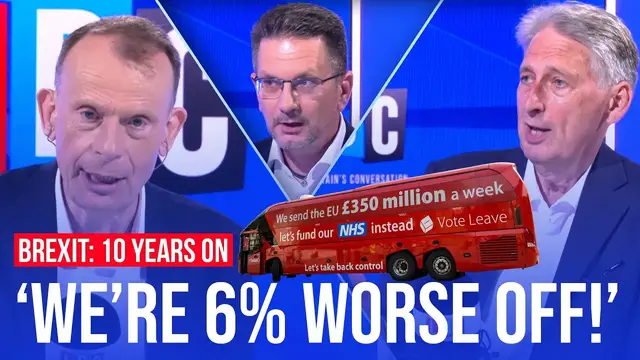
The Brexit Referendum dominated the public discourse for 18 months ten years ago, and yet still it rumbles on. On the anniversary of the vote, Andrew Marr is joined by experts from both sides of the debate. For Leave, Steve Baker, the former Conservative Brexit Minister, and for the Remain side of the argument, Philip Hammond, who was Chancellor of the Exchequer while the country attempted to navigate its exit from the EU. Listen to the full show on the all-new LBC App: https://app.af.lbc.co.uk/btnc/thenewlbcapp #andrewmarr #brexit #leave #remain #ukpolitics #politics #europe #eupolitics #europeanpolitics #LBC LBC is the home of live debate around news and current affairs in the UK. Join in the conversation and listen at https://www.lbc.co.uk/ Sign up to LBC’s weekly newsletter here: https://l-bc.co/signup
Show More Show Less View Video Transcript
0:00
It is ten years on exactly since the Brexit referendum
0:04
To commemorate the event, everybody is getting angry all over again. Looking around, I can see neither the vibrant, bubbling, unshackled Britain
0:13
the Brexiteers promised us, nor the devastated economic hellscape that Remainers predicted
0:19
What I can see is a country being inherited by Andy Burnham, which is caught between the unforgiving bond markets
0:25
and increasing political instability. So what, in the European conundrum, do the British politics look like for Prime Minister Burnham
0:33
First, the pro-hard Brexit former Tory backbencher Steve Baker. Steve, very good to have you on the show
0:40
Thank you. And you have been, as it were, re-litigating this or arguing about this with Remainers now for some time
0:46
I wish I wasn't. I mean, I wish we'd all moved on, but I'm afraid, yes, I've answered the question when I've been asked
0:51
Yeah. Now, before we get on to the cultural side of this or the argumentative side, just the data itself
0:59
You argue that actually, in terms of macroeconomics, Brexit hasn't really changed very much
1:04
Well, I try to rely on economists. So Dr Gerard Lyons has put out a paper from the Centre for Policy Studies, which I've got here
1:11
He predicted a kind of Nike swoosh, some damage. For example, if you export shellfish, it's been very difficult because of the rules on shellfish
1:18
So he predicted a Nike swoosh with some damage and then we'd be off. And actually, that is borne out
1:23
This is the GDP data from our world in data. Anyone can go onto the website and download it
1:28
Big story on here, if you index GDP to 2016, COVID, massive hit for everybody from COVID
1:34
The next big story is, yes, there is an outlying underperformer. It's Germany
1:39
The UK is right in the pack with between the middle. Yeah. So we've performed just like comparator EU countries
1:46
So I take the criticism very seriously. If I genuinely believe we'd cost the UK 8% of GDP doing this
1:52
I'd be sitting here in humility. I genuinely don't believe it. I think it's fanciful
1:57
The big story that isn't on this particular chart is if people add in the USA
2:01
the USA has really massively outperformed the European countries, and that's why I think we can do better
2:07
Not 8%, but the Bank of England report says that we've lost 6% of GDP
2:12
and it bases that on lots of data from companies they've been studying for a long time
2:18
Now, you know, the Bank of England, everybody has got a position, is partial up to a point
2:22
but it seems credible. That is quite a big loss. And that kind of loss to the economy could explain, for instance
2:29
the political instability that we've been living through since. Well, if it was true, and again, I don't want to, there is a problem
2:35
which hopefully will come to the cultural stuff. But the economist Julian Jessup has been very good at looking at each of these claims
2:40
as they've gone through. And each one of them he's taken apart. The Bank of England data relies on inputs and assumptions
2:47
which turn out to come apart quite easily under scrutiny. And I can go through his... I've got his explanation here
2:53
but I'd encourage people to search for Julian Jessup because each one of these claims is tricky to seriously stand up
3:01
partly because, whether it's surveys or modelling, it's still a forecast or an estimate
3:07
whereas if you look at the actual data of what has happened, You find the data is that we're performing in the middle of the pack with comparable EU countries
3:15
We should do better. Well, I was going to come to the do better then, because another way of looking at this is that the Brexit promise was that we would be deregulated and unshackled in a way that would allow us to grow
3:26
People said like Hong Kong. And it wasn't the truth that people wanted to be free from the EU
3:32
But at the same time they didn want that kind of radically different economy They wanted their welfare state They wanted their tax breaks they wanted life to carry on And in a sense Brexit Britain was not the radical change
3:45
that people like you hoped it would be. I think that's a fair summary
3:49
But I say first that the vote was about having democratic control
3:53
of political power. And that's why, despite the rail continuing, I still think it was right to come out
3:58
I used to be pro-EU for a long time, for all the reasons that people are pro-EU
4:02
It's nice to be able to travel freely, work freely, all those good things. It is nice. I like Europeans
4:07
You know, I was pro-federal Europe for a long time until I looked at how the EU actually worked
4:11
So I feel I've got some legitimacy in saying that that's what it was
4:15
first and foremost about. And then secondly, you know, I'm a classical liberal to libertarian
4:20
and I see a massive demographic time bomb, which is now, I think, the preeminent problem which all these politicians have
4:27
Andy Burnham and Gia Starmer. Demographics have overwhelmed the welfare state. Not enough young people
4:33
Not enough young people to sustain the welfare state model that's been long established
4:37
So I want to preserve older people having the benefits they need
4:41
If you're sort of 75 plus, you're not going back to work. We need to sort out funding social care, pensions
4:48
We have such large unfunded pension liabilities for the state pension and for public sector pensions
4:54
We need to absolutely go for growth. So look at the performance of the USA. we ought to at least be getting up to grow alongside the levels of the USA
5:03
We can only do that by regulating. Huge problems for the new Prime Minister, Andy Burnham
5:07
who is a kind of natural pro-European, but also says there is no going back
5:11
And he says that because there can't be another referendum, because we did ourselves so much damage
5:17
We were so angry with each other, we kind of ripped the fabric apart a bit
5:21
That's my biggest regret. I absolutely did not foresee what I now recognise as the behavioural science factors
5:27
because I've done a lot of work on behavioural science with Professor Paul Dolan, who, by the way, voted Remain
5:31
voted Labour. But he and I disagree about loads, but we agree that it ought to be possible to be tolerant by design
5:38
and Paul does great work on that. And it is possible for us to behave differently
5:44
I recognise, for example, we've all got a predisposition to find the evidence that suits our narrative
5:49
And I try to be really ruthless in going, what is the data and what does it say
5:54
And unfortunately, Paul's taught me, Most beliefs are not evidence-led. I think if there was a slogan for this programme, Steve
6:01
it would be agree disagreeably or be able to... Sorry, the other way around
6:05
No, that's the wrong word. Disagree agreeably is what I mean. Thank you very, very much indeed for coming in
6:11
Now let's hear from the man who was in charge of the country's finances in the immediate aftermath of our decision to leave the EU
6:17
the former Conservative Chancellor and Foreign Secretary, Lord Philip Hammond, who gave me his reaction to the fallout of Brexit ten years on
6:25
Well, I wish we hadn't done it. Obviously, I campaigned against leaving the European Union
6:32
And I did that because I felt that the British people would be worse off, less safe, less secure, less influential as a consequence
6:40
And I think all of those things have happened and the process is still underway
6:45
Because I'm one of those people who looks around and says, well, I don't quite see the absolute economic wasteland that we were threatened with
6:51
In other words, things haven't been so bad. And yet the Bank of England says we've lost six percent of GDP as a result
6:58
Both things are true. It was never going to be the case that the UK economy would collapse because we left the European Union
7:04
And I certainly never suggested that that would be the case. But it is the case that growth has been much slower than it otherwise would have been The Bank of England put a number on that I don think the process is over yet I think we still seeing attrition And it isn just about economics either It
7:23
about Britain's influence in the world, about our place within the European nations in terms of
7:30
security. And I think, to be fair, many of the people who did argue for Brexit imagined that we
7:36
would be leaving the European Union, going in our little boat on our own into a world that was
7:42
well-ordered with an American-led international order, with free trade, open markets, World Trade Organization and other international bodies functioning. None of that is now the case
7:54
They hadn't predicted Donald Trump. They hadn't predicted Donald Trump and all of the things
7:59
that we feared would happen have been made much worse by the fact that the world itself
8:04
has become a more difficult place to trade. We're now on the edge of yet another Prime Minister
8:10
walking into number 10. We've had extraordinary political instability since Brexit. Do you think the two things are connected
8:17
Well, I think they are connected, but not directly. I think the political instability
8:22
is because we've had stagnant economic growth. That stems ultimately from the global financial crisis
8:31
which is even earlier than the Brexit referendum. But it certainly has been exacerbated by the decision to leave the European Union
8:39
I think the challenge of grasping Britain's failure to grow as a political problem and meeting that challenge head on has been made much, much more difficult for governments of both persuasions by the fact of Brexit
8:54
I wouldn't try to ventriloquise Andy Burnham, but I get the strong impression that he thinks Brexit was a terrible mistake. In his vitals, he'd love to go back to the EU, but he also thinks that doing so via another referendum or another big national argument is just too much. We are too scarred by it, too traumatised by it, too divided by it to do it again
9:15
I completely agree. And I've been saying this ever since we left the European Union. First of all, the Europeans wouldn't have us back until they were absolutely sure that there was a national consensus in the UK. And that clearly isn't the case when the party leading in the polls is vehemently opposed to having anything to do with the European Union
9:37
I think closer and better relations with the EU are a real possibility once President Macron's term has expired next year
9:49
Much as I may like President Macron, I'm afraid he's never been a friend of Britain being a close partner of the EU
9:56
So I think there is a way to rebuild relations. I think Britain's obvious ability to contribute to Europe's new defence challenge is another way in which we can work more closely together
10:10
But I think the only chance of Britain ever rejoining the European Union is if the European Union itself were to change very radically
10:20
For example, were to split into a fast track to federalism and a much looser arrangement around that
10:28
Not impossible. Could be part of that looser arrangement. Not impossible. And you said earlier on that a lot of Brexiteers had failed to predict the future
10:36
We all failed to predict the future. But in that spirit, 10 years time, 20 years after the Brexit vote, do you think we will be in a worse situation as a result of it
10:45
Or we have healed and changed and gone in a new direction? So we will have healed But I think the options to us for that healing process are much more limited than even I might have forecast 10 years ago But I think the point is the damage is permanent as the Bank
11:04
of England is saying. We may start growing again, but we're growing from a lower base than we would
11:09
have had. So the British people are materially worse off than they would have been, and nothing
11:15
we do is going to recover that position. And have we seen the worst of it now
11:20
I think we probably have seen the worst of the Brexit effect. I think there is still a tail end
11:25
of that effect. I think there are some bright spots as well. I've just come from the City of
11:31
London. I thought that the damage to the City of London might have been worse than it was. I think
11:39
the tide is gently swinging back in London's favour among the European financial capitals
11:45
And I think there's really an opportunity for the new government when it's formed, if it wants to do
11:50
so, to focus on making sure that we let the pendulum swing back from the sort of extreme
11:57
regulatory approach that we took after the financial crisis to something a bit more business
12:02
friendly to allow that to happen. And beyond that, clearly, Andrew Burnham has to choose his
12:07
new chancellor before too long, and everyone says that growth will become his absolute
12:12
lodestar, the thing that he's really keen on. Is it possible to achieve greater growth
12:18
given the fiscal constraints, given the high level of taxation we already have
12:22
given the borrowing that we already have? Well, I think it is possible to achieve
12:26
faster economic growth. But the Labour Party in general, and the new prime minister in particular
12:32
will have to grasp the fact that our problems are constraints on the supply side of the economy
12:38
It isn't that we need to pump more money into the economy. It's that we need to relax regulations, planning rules, for example
12:47
We need to make it more attractive for people to work, whether we're talking about adults who are long-term out of work
12:55
or whether we're talking about people who are in work, but whether or not they want to do a bit more overtime
13:00
make the tax system more attractive to workers. All of these things will help to encourage the economy
13:08
I just talked about the city. Relaxing regulations to get the city back into the game
13:13
again, will help power the British economy. And is it essential, above all, that the new Chancellor
13:18
is able to reassure the bond markets? Yes, it is, because, and Andy Burnham will understand this
13:25
there's going to be nothing worse for him than coming into office and having a crisis within 48 hours
13:32
because the bond markets don't like his choice of chancellor or don't like his language around future fiscal direction
13:41
When you owe as much money as we do, unfortunately, you are not your master in your own house
13:49
And the markets will want to hear that the UK is going to continue to follow a sensible, I would call it a middle path
13:56
We are still borrowing and arguably we can't afford to be doing. So it's not the most extreme path that could be mapped out
14:03
But we need to continue to follow a middle path and we need to focus on growth because the best way of dealing with our debt crisis is to grow our way out of it
14:12
And the best way of dealing with our political crisis that we seem to have been in for a decade now is to get economic growth moving again
14:20
Because I can tell you this much about the British people. if they're seeing their wages rising every year
14:26
they're seeing their living standards rising, and they feel their kids are going to be better off than they were
14:31
then they'll be, broadly speaking, content with their lot
#news