Up next in 10



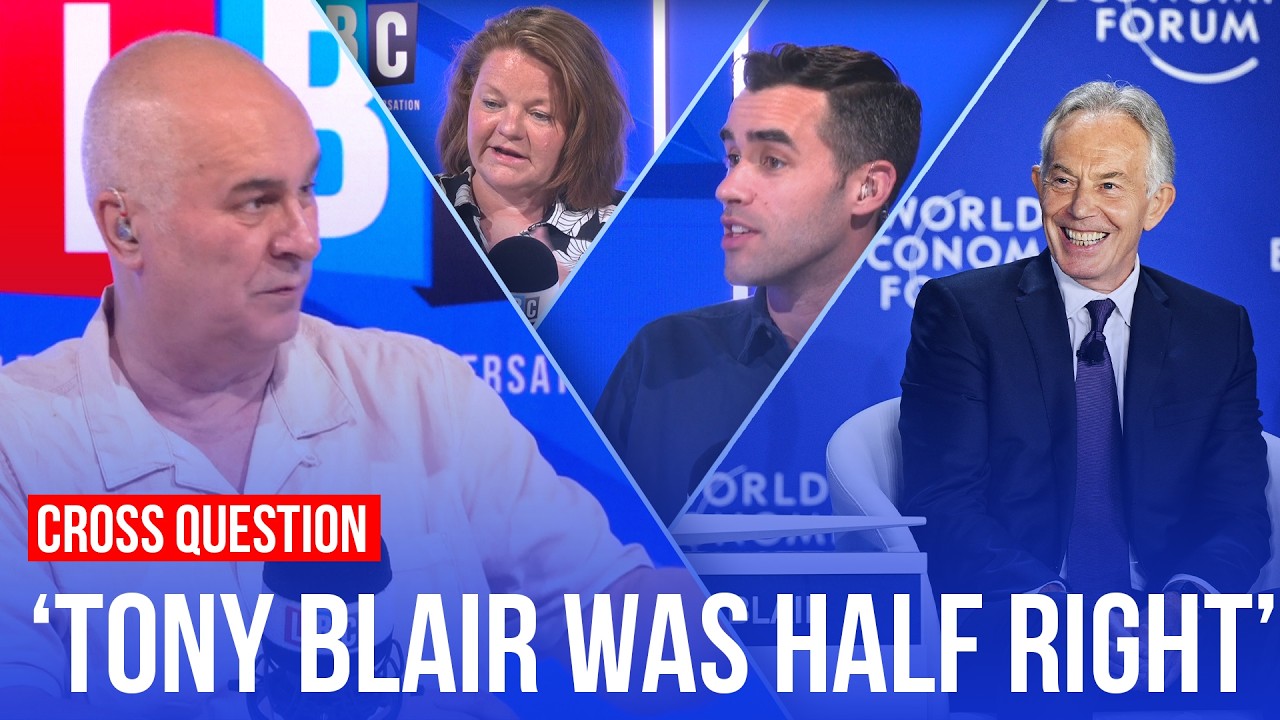
Tony Blair’s latest essay has reignited a debate over Labour’s future, the economy and Britain’s net zero strategy. Featuring Kirsty Buchanan, Alfie Stirling, Emma Revell and Richard Power-Sayeed, Iain Dale's Cross Question panel debate whether Blair is still relevant to modern politics, whether Labour has lost its “narrative”, and if Britain’s approach to energy and net zero is driving up bills. The discussion also turns to North Sea oil, fracking, living standards and whether Blair could ever return to frontline politics. Listen to the full show on the all-new LBC App: https://app.af.lbc.co.uk/btnc/thenewlbcapp #iaindale #tonyblair #keirstarmer #ukpolitics #uknews #debate #oil #energybills #netzero #climatechange #labour #labourparty #LBC LBC is the home of live debate around news and current affairs in the UK. Join in the conversation and listen at https://www.lbc.co.uk/ Sign up to LBC’s weekly newsletter here: https://l-bc.co/signup
Show More Show Less View Video Transcript
0:00
Charlie in Oxford. Hello, Charlie
0:02
Good evening, Ian. How are you? Good, thank you. What would you like to say? Yeah, so my question obviously is off the back of Tony Blair's publication. I'm just interested to know whether the panel feel that Tony Blair's right to suggest that Labour should align themselves with the sort of unclaimed radical centre, or is he just another ex-Prime Minister who, whilst respected by some, myself included, is now out of touch with the day-to-day challenges of the electorate
0:30
Good question. I mean, he's been out of power for 19 years, Richard Passe, but that doesn't mean to say that he isn't in touch with the modern world, does it
0:39
Not necessarily, but I'm afraid to say I don't think this was the most in touch essay he could possibly have written
0:47
He is desperate to be telling us the hard truths that the British state and British politics needs to hear
0:53
But I thought I thought it was just absolutely full of kind of easy, full solutions
0:58
I mean, the most kind of obvious thing was not talking about inequality as not just Burnham
1:03
This seems to be the narrative from the Labour Party. Oh, he didn't mention the word inequality
1:08
Therefore, it's 6,000 words that we can ignore. I think if you're not talking about something that most people think is pretty fundamental and most people are absolutely furious about
1:18
and most people think it's absolutely at the core of the upheaval and the anger that people in this country are feeling
1:27
then yeah actually you are out of touch and you're not giving us the solutions we need
1:32
because the point is if you ignore inequality if you ignore the power of billionaires
1:37
if you ignore the fact that there are some people in our country who own penthouses and yachts
1:42
and have money to spare to influence. I mean what an utter disgrace that we have a country where people can
1:47
own a yacht if they're really successful. And have money to spare to influence media and politics
1:54
whereas some people can't afford to pay monthly bills and can't afford to feed their kids properly
1:58
If you're not angry about that and if you're ignoring it, as Tony Blair is
2:02
then the fact is you don't have to worry about other things. You can pretend that there are false solutions, like, for instance, complaining about taxes going up
2:11
Yeah, sure, taxes are going up because the cost of servicing government debt has been going up since the financial crisis
2:17
And yet he says, oh, yeah, the solution is what, like cutting the welfare bill
2:21
Even Paul Johnson was screaming at him on Twitter today saying that's absolute nonsense
2:26
The proportion of the budget that's gone on welfare has hardly changed in eons
2:31
It's false solutions and it's kind of disingenuous. And I think that tells you everything about Tony Blair and where he is today
2:36
Kirsty Buchanan. I have long described myself as a radical centrist. So you will be unsurprised to learn that I looked at this and thought, what an awful lot of common sense
2:47
This man is talking. Can I just tackle the inequality issue first, which I've heard both Andy Burnham has said and now Wes Streeting has piled in in exactly the same point
2:58
Tony Blair didn't close the loop on this, but the prescription he was making and some of the solutions he was describing are in effect about tackling inequality
3:07
He talks about going further and faster on planning reform. Why? To build houses to make sure that people aren't locked out of the housing ladder and can't get the capital that they need to be able to invest in society
3:19
he talks about growth. Why does he talk about the importance of growth? Well, because from growth flows everything
3:25
tackling inequality, better public services. So the idea that he doesn't say the inequality word
3:30
and therefore it's not shot through in almost every paragraph of this article
3:36
I think is for the birds. The other thing I just wanted to say about it
3:39
is the big argument he's making here. And I have to be reading The Failed State at the moment
3:48
by Sam Friedman, a very good book, and I can highly recommend it. And it's the same sort of argument
3:53
It doesn't matter if you replace one prime minister with another prime minister, even if their comms is better
4:00
if your fundamentals of your system is wrong. And the argument he is making at the moment
4:04
is we have got huge structural challenges that we are not tackling
4:08
because we have a short-term political culture, dare I say it, a short-termism in kind of media
4:14
in the way it holds politicians to account too, And we're not making those fundamental changes. So you can swap out Keir Starmer with Andy Burnham. You can, you know, you can swap out the whole of the Labour government with another government until you start to fundamentally have a strategic vision for the big challenges that this country faces
4:32
We're just going to be playing, you know, round robin at the top with no real change
4:37
Do you not agree, though, Richard, that what Kirsty said there about the lack of vision, I mean, is endemic in this government, which is what Tony Blair was saying, that there's no sort of policy narrative. And they've got the worst of all was, but they have a prime minister, even if they had a policy narrative, it doesn't seem capable of communicating that to the electorate
4:56
I completely agree. There isn't a policy narrative. I think we perhaps talk about narratives a little bit too much in our political culture and maybe not just enough about policies
5:06
Well, I mean, it seems to me that it's all mostly narrative in his essay. Look, this government has increased public investment a bit. It's protected workers and renters a bit. It's not enough. It's not enough. And people are still very angry. And of course, the fact is that lots of the problems that we have can't be fixed quickly. Emma
5:29
I think what's interesting is, you know, the question refers to is Tony Blair out of touch with the electorate
5:35
It's a five and a half, 6,000 word essay that has been read by almost everybody that I've spoken to today
5:42
Listeners are ringing up and saying, you know, I liked this element. I didn't like that element
5:47
We're debating whether or not Tony Blair is still relevant. I can't think of many political leaders, never mind people who have run the country
5:55
who could write an essay of this length. And whether you agree with his prescriptions or not
5:59
and I don't agree with all of them, you can't argue that it's not a very coherent
6:04
persuasive vision for what Britain should be. But why is it people on the right who seem to welcome what he saying today rather than people on the left I think the Labour Party has real difficulty bringing itself to accept that Tony Blair is the most successful leader it ever had
6:22
He's the last person to win two general elections. David Cameron did, but had to go into coalition. It's not quite the same
6:29
He won three. Well, at least two. Somebody pointed out actually that Harold Wilson won four, but they were split up
6:36
Non-consecutive don't count. You know, he really is the last political leader we had who had not only the capacity, but the willingness to set out a narrative and govern over the long term
6:47
And I think that's what has led to a lot of the disruption, a lot of the confusion, a lot of the upset with how politics is now
6:53
It's very short term, as Kirstie said. It's very disrupted. We're going to have another change of leader probably over the summer, less than two years or just about two years after a general election
7:05
Tony Blair does, for a lot of people, mean a period of stability in British politics
7:10
even if you don't agree with anything he did then or said today
7:14
Alfie Sterling? I think Tony Blair was half right. I think that he was absolutely spot on that the big question facing this country is policy
7:23
not politics or personality. I think he was spot on that in the end governments and democracies get tested by
7:28
their ability to deliver in people's lives and make changes in people's lives
7:32
and not by how snazzy the comms are. But I think the bit he got wrong, and in the end fundamentally so
7:38
was the diagnosis. What is the big problem facing this country? And I don't buy that the number one problem
7:45
the reason why people are so frustrated now, why they're struggling so much now, is about a technological change that hasn't yet happened
7:51
That's not what has caused the last 10, 15 years of stagnating living standards
7:56
The problem we have now, yes, is inequality, but it's what does it actually mean in people's lives
8:01
People don't have enough income. to pay for the things that they need
8:04
And that's not just something now that's experienced by the very poorest, although it's most acute there
8:08
It's being felt right up the income distribution as well. I mean, look, just to..
8:13
But hasn't it always been that way? No, absolutely not. So on average, across a given 10-year period
8:18
people should expect their incomes to rise by about £8,000, £9,000, £10,000 a year
8:22
That's the average we've seen since modern records have begun. Since 2020, if you run the last five years
8:29
and look at the latest forecasts from the Office of Budget Responsibility, you have incomes going up by nothing
8:35
Flat. And that comes after the last decade, which saw barely anything
8:40
That's the problem. People are much better worse than that. You're ignoring the fact there was the world financial crash
8:45
Then since 2020, two years of that we've had COVID, which nobody seems to factor into any of the calculations
8:52
So I don't think anyone's ignoring it. We're just describing the consequences. And that is the policy challenge
8:56
that government has to face up to. I think the last government didn't face up to it
8:59
I think the current government is struggling to face up to it, and that's why they are each suffering from the same political turbulence as one another
9:06
And so when you talk about the political problem, it is the question of delivery in the current environment and the magnitude of our living standards and, yes, inequality problem
9:15
But when we talk about inequality, that feels abstract and left versus right. This is just a failure for people to see their lives get better, and that is why politicians are getting burned
9:23
Let's take a follow-up call from Kamal in Birmingham. Kamal, hi, what would you like to ask
9:29
Right, okay, so very simple question. I've met Keir Starmer in person, great guy. I personally think he's doing a good job. There's no way on earth I'd ever work for Burnham, Streeting or Rayner. I'm a big Blair fan. Is there any possibility that Blair could come back as PM
9:48
because I'm potentially a reform voter now. I voted for Labour previously
9:54
But if Blair was to come back, even as a backbencher, and was to come and put his hat forward
10:03
I would definitely vote for him and the Labour Party. And potentially, you know, Labour is going to lose the next election
10:09
Let's be honest about this. But if Blair was to come back, I would vote for him
10:13
And I personally think he could win, you know, Labour another landslide victory against
10:18
So you're somebody who's in the panel's opinion on that. So you're tempted by reform, but if Tony Blair stood as a Labour MP, you'd vote Labour
10:26
That is an interesting one. Right, let's go around the table. What do you think of that suggestion, that he might come back
10:32
I think it's fairly unlikely. And I think it's also important to remember that although Blair had these enormous electoral successes in terms of numbers of seats
10:43
It was actually under him, especially in 2005, when vote share in the Red Wall started to fall
10:50
because actually he wasn't that popular with exactly the kinds of people who have moved away from Labour gradually over a long time
10:57
He did have a majority of 66. Well, like I say, the seats obscured the fact that actually Labour was losing its vote share
11:06
And, you know, I hope I don't sound like I'm praising Ian Duncan Smith here, but the Tories didn't do quite
11:11
Free country. I'll get told off by my family when I go home
11:16
But, you know, the Tories didn't do as badly in 2005 as it might have seemed by that
11:22
And also, I don't know how old you were in 2005, but I remember it well because I stood in that election and it was Michael Howard that was leader of the Conservative Party
11:29
Oh, God, sorry, sorry, sorry. Not IDS. Poor, poor Michael. Are you thinking what we're thinking
11:35
Alfie. Well, I think we're doing exactly what Tony Blair said not to do, which is to speculate on the personality, on the individual
11:41
It was so much fun. Yeah, well, it's a good one, but we're not in a great situation for it
11:47
I don't know whether he'd come back. I think it's incredibly unlikely. I also don't think that's the important question
11:51
The important question is whoever forms a future government of any party
11:55
can they address the fundamental problem? The one lesson you learn by coming on this programme
11:59
is that the caller thinks it's an important question, so it is an important question
12:03
I think the important question is what do we do about the dire straits most families are living through at the moment
12:09
and I think that means a government... Most? Really? Yeah most Because on average incomes are flat So and around that you have more than that the median So you have a huge sway of the population seeing their real incomes no higher than they were 10 years ago That doesn mean to say that most families would describe their circumstances as dire
12:31
I think most families would say it's a dire situation if they have seen no progress in their living standards over a decade
12:39
I think that is a dire situation. Emma? I think Tony Blair's having too much fun not being on frontline politics
12:46
You know, he can still dip in and out when he wants to. He can write the essays, have the influence, like I said
12:51
everyone's talking about him today and he doesn't have to deal with the cut and thrust of Labour
12:55
Party, you know, policy or politics at Westminster. I also think the Labour Party wouldn't have him
13:00
because unfortunately they have a very difficult relationship with their most successful leader
13:04
ever. Kirstie? Labour Party couldn't afford him. I think it's probably the outshot of that one
13:13
Look, I have in my crazier moments and I wonder whether actually the next step forward
13:20
particularly if Burnham keeps on aggravating Tony Blair to get ever more involved in domestic politics again
13:27
It seems to me that there is a centre ground here which is almost completely being voided in the pursuit of votes to the left and to the right
13:37
and the shifting of the Overton window to a more kind of radical approach. And I wonder whether if you look at the kind of values inflections between, you know, the kind of old, what we used to call the Red Book
13:47
Red Book, Liberal Democrats. Orange Book. Orange Book, sorry. The kind of Blue Labour and the kind of David Gork
13:56
One Nation Crown of Tories. You know, I wonder whether you just create an entire kind of
14:02
on-marsh, radical-centrist new party funded by, and not spearheaded by Tony Blair
14:08
but funded by people like Amber Rudd, Tony Blair, to create with a really kind of charismatic leader
14:15
So basically a German Christian Democrat type party. Yeah, something like that that moves into this kind of increasingly vacated ground
14:21
and tries to get back to the kind of common good centre ground of politics
14:25
Well, Kamal, I hate to disappoint you, but all of our panel think that it's not going to happen
14:29
And I'll tell you another reason it's not going to happen, because Tony Blair, chat GPT, has just informed me, is 73 years old
14:36
You don't go back into Parliament. I'm sure somebody will come up with a suggestion of somebody
14:41
who over the last 200 years has gone back into Parliament at 73
14:45
but I think it's for the birds. James says, is Tony Blair right that the government's net zero policies are a fantasy
14:54
And he used the word quixotic as well, which was interpreted as calling Ed Miliband a quixotic fantasist
15:01
She's slightly overinterpreting what he said. But I mean, I thought it was quite interesting, his views on this, because he's always been seen as somebody who's fully in line with the climate change policy direction of the government
15:16
but he seems to have got a real problem with Ed Miliband. Alfie Sterling
15:20
I think it's very interesting for somebody who's so interested in existential future threats to then be so dismissive of climate change
15:28
I think it clearly is a really central issue facing us not just in the future
15:33
but right here in the present. And actually it intersects with the thing that people are experiencing
15:39
in all their lives right now in terms of the cost of energy. So our inability to have energy security at home through the retorts of renewable energy power that we have in this country has left us utterly exposed to global markets
15:55
And that is one of the reasons why the UK pays much higher energy prices than other countries, which is exerting a huge amount of pressure on families
16:04
And today, obviously, the energy price cap went up, back up to about £1,800 for a typical family
16:10
So I think climate change is not just up there as one of the main issues coming down the line, like technological change, which Tony Blair likes to talk about, but it is right here in the present
16:23
And it's the thing that is pinching on people's lives in a big way
16:27
Amber? I think the fixation with net zero above and beyond anything else is the problem
16:33
I think net zero in and of itself is fine. But I think, as Alfie points out, people are struggling with energy bills
16:38
maybe there are ways fracking North Sea oil, ways that we can improve our energy security at a time
16:45
when things like the conflict in Iran and not wishing to do too much or any trade with Russia
16:51
means that it's difficult to source oil and gas from across the world
16:55
We have domestic supply here. We could increase the security of that and help bring costs down
17:01
And Ed Miliband is fundamentally opposed to any conversation about that at all
17:06
I think that's what Tony Blair is referring to. We need to talk about the balance between decarbonisation, abundance, security when it comes to energy
17:14
I don't think you can pick one part of that triangle and go, this is the only one that matters
17:19
OK, Kirsty? I think I was part of the government that made the reaching net zero by 2050 a legally binding target
17:30
and I think obviously as a name that's fine but within that there are carbon budgets every year
17:37
and quite a lot of, every five years and quite a lot of flexibility about how you get there
17:42
It is bananas to me that when you get to net zero at 2050
17:46
25% of your oil and gas will still be used to still be part of the mix
17:51
and the only issue here is whether we choose to import it all
17:56
from somewhere else with all the kind of emissions and cost and volatility, you know
18:01
or that we use what we still have in the North Sea. Is it perfect? No
18:06
But use it to be able to help bring down our energy bills, keep us more resilient and be part of the energy mix
18:12
It baffles me, absolutely baffles me, why Ed Miliband is so resistant
18:17
not just to new licences, but even Rosebank and Jackdaw. Now, Jackdaw, I think, is the gas field
18:23
You could get that into people's homes within a year and help to bring their bills down
18:27
And it is bonkers not to get in the way of that. The other thing I don't understand about this is I read
18:33
to get into Westminster bubble politics for a minute which Tony Blair would not approve of I read all the time that Ed Miliband is increasingly being blamed by Starmer for orchestrating the kind of plot
18:45
and the internal coup against him. I don't understand now why he doesn't just take him and move him
18:51
If he's in end-of-days territory anyway, I'd move him out of the department
18:55
Because he doesn't have the political power to do so. What are they going to do to him that they're not already doing to him
19:00
He's in endgame anyway, so... It's being talked about as a future Chancellor
19:04
Richard? I thought that the section in Blair's essay on energy was one of the weakest, to be honest
19:11
He manages to get one thing right, which is the energy bills are too high and then it kind of goes down from there
19:16
The idea that the only real policy that was in there was maxing out the North Sea oil and gas
19:25
But everybody knows perfectly well, I'm disappointed to hear, not everyone here, but everyone outside of here knows perfectly well
19:31
that using North Sea oil and gas isn't going to help us with our bills
19:35
because North Sea oil and gas is priced at international levels. It literally cannot help us with our bills
19:41
Yes, it can because you sell it on the international markets and you get the tax take from it
19:45
So that's taxes. That's not our bills. It can be used to cut bills
19:51
Well, then you could use any taxes to cut bills. It's a meaningless statement
19:55
That's what government is all about. Then that's not the oil and gas helping you. It's just the taxes helping you
20:00
Taxes from oil and gas. So the tax take is absolutely pathetic. You talked about Jackdaw
20:05
Jackdaw is going to be tax negative. The Treasury has acknowledged that
20:09
We are going to lose out on taxes because of Jackdaw, because of how the tax is structured on it
20:15
It's absolutely bonkers. That's how generous the subsidy regime is for oil and gas
20:21
You know, you'd say, oh, maybe it could help us with employment. But if you lock communities into what is absolutely necessarily a dying industry
20:31
because the geology of the North Sea means that it's going to go downhill very quickly compared to Norway's
20:37
It means you're locking them out of being in the similar kinds of industries in clean tech where there actually would be future jobs
20:44
You go to Aberdeen and sell this message to the people of Aberdeen. This is not a dying industry and directly or indirectly 200,000 jobs rely on North Sea
20:53
So it's an interestingly dismissive attitude to such a large amount of jobs
20:58
And not only the jobs, but also those jobs that have transferable skills that when we continue to move towards a renewable industry, those jobs which are currently being lost because we're effectively mothballing and overlooking the North Sea and the opportunities it has
21:14
A lot of those jobs are now being lost to Africa, to Gulf states
21:19
They'll never come back again. We've lost all that talent and all that innovation
21:23
For what? To worship at the altar of Ed Miliband's net zero idolatry
21:28
And that's not because I'm a net zero sceptic. I support it. I support the aims of it
21:34
But not at the expense of 200,000 jobs and Britain's future. Those jobs, exactly the point is that they could be transferring into clean energy
21:43
Not that you don't have a smooth and managed transition between one and the other
21:47
That's exactly what you do if you invest in clean energy. But we all know perfectly well that if you are subsidising North Sea oil and gas to the extent that we are
21:57
then you're crowding out both private investment and indeed you're taking away from potential public investment
22:02
in the clean energy jobs that we want to be moving those people into. And, you know, you're perfectly entitled to disagree with me on this
22:09
but I think it's really unfair and a bit rude to describe me as being dismissive about those jobs
22:13
I'm describing a really serious problem for those communities, which is that they're being locked into an industry
22:18
So don't tell me I'm being dismissive. I've just got a different view on what's a good industrial policy
22:23
They're having their jobs taken away from them because somebody else is one man's net zero idolatry
22:28
You're talking about an industry which provides... Unite Union wants to keep those jobs. This is not a left-right issue at all
22:35
Unite is running a campaign for a smooth and orderly transition. This is not what we're going for. We're going hell-bent to move towards renewables without actually thinking about how you manage that properly
22:45
You take those transferable skills and you move them over time from one sector of North Sea to the other sector of North Sea, the future of North Sea
22:55
If you lose that now, it's never coming back again. If we max out on North Sea oil and gas, the absolute most that it could possibly benefit the GDP would be by a fraction of 1%
23:09
I'm not talking about GDP. I'm talking about jobs. By a fraction of 1%, like 0.1%
23:16
And that's if you completely ignore the way that it would crowd out investment into other sectors
23:22
And if you ignore the fact that, frankly, you got wrong earlier, that it's not going to help us with our bills
23:27
I do think I think it's important to emphasize this point about bills, which is where we started, because fracking and North Sea isn't going to address that
23:34
I mean, that is just true. And so we can then move around via tax and industrial strategy back into the economy
23:40
They are separate points to be contested. But the starting point that fracking and North Sea will lower bills is wrong
23:47
And it's just basic capitalism. If a company, these industries aren't nationalized, by the way, if anyone has noticed
23:52
If a company wants to make a profit, they sell on the global market and we pay the market price for those fuels
23:59
And if government wants to do something on prices, it doesn't need the few extra quid from the tax sheets from those industries to do that
24:06
It can choose to do that now. Emma? I just think that anyone who is sat at home thinking, God, this is a big jump in energy bills in July
24:16
like what's it going to be like come December, is thinking why are we not going hell for leather
24:21
on every conceivable energy source we have? Yes, that includes fracking. Yes, that includes the North Sea and solar and wind
24:28
and nuclear power stations. And we have not done enough to create a market in energy
24:33
We have subsidised, you talked about subsidising North Sea oil. We've subsidised renewables significant amounts
24:39
and they are still not able to stand on their own two feet because we have taxpayers' money propping them up
24:44
I think we need to row back from that, allow a proper energy market to develop
24:48
And if that does include fracking in North Sea along with solar panels, I think that's fine
#news