Up next in 10



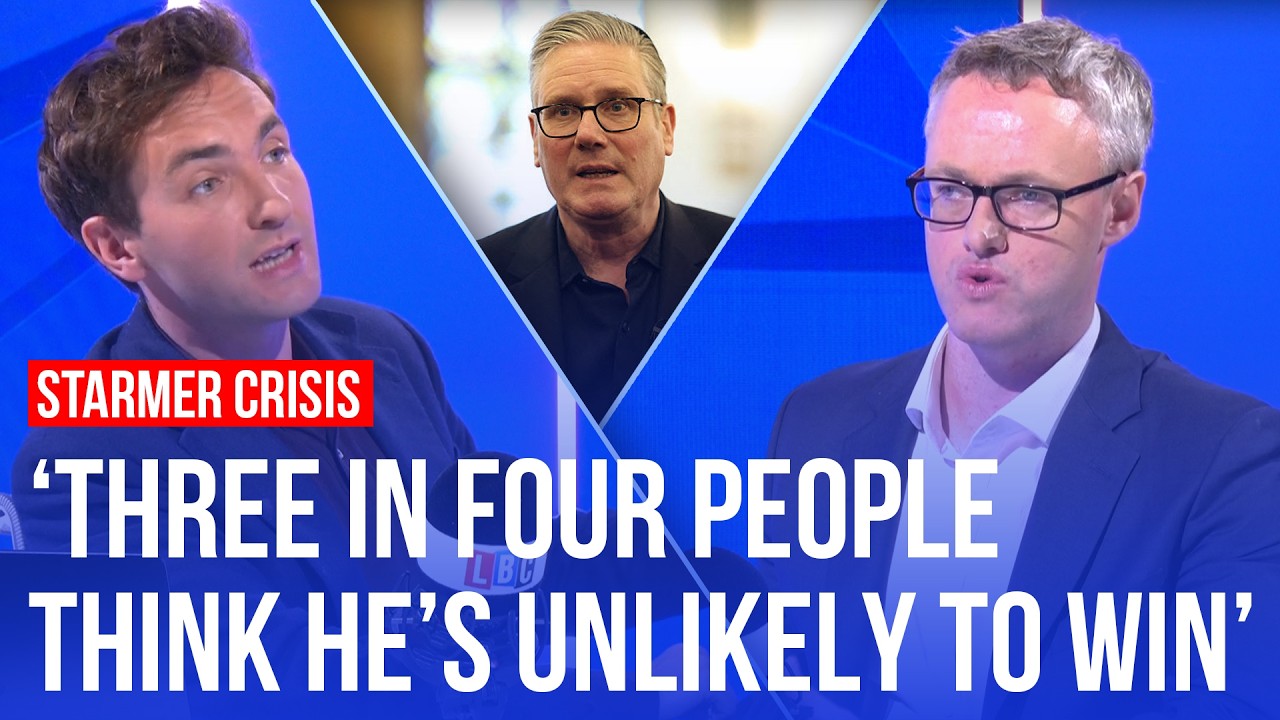
A new poll made by IPSOS, exclusively for LBC, suggests that Keir Starmer is becoming increasingly unpopular, with Labour trailing Reform and voters looking for solutions for the cost of living crisis. Could this reshape the next election? Keiran Pedley, Director of Politics at IPSOS, who carried out this polling with LBC, joins Lewis Goodall to discuss what this means for the Labour party and for the upcoming elections. Listen to the full show on the all-new LBC App: https://app.af.lbc.co.uk/btnc/thenewlbcapp #lewisgoodall #ukpolitics #politics #polling #elections #keirstarmer #starmer #reform #nigelfarage #farage #reformuk #andyburnham #angelarayner #labourparty #ukgovernment #generalelections #LBC LBC is the home of live debate around news and current affairs in the UK. Join in the conversation and listen at https://www.lbc.co.uk/ Sign up to LBC’s weekly newsletter here: https://l-bc.co/signup
Show More Show Less View Video Transcript
0:00
It is often said, I get this on Twitter quite a lot
0:02
and other social media platforms as well, by the Prime Minister's defenders
0:05
that he's far more popular than the media would allow and suggest that he is
0:10
Well, let's get a sense of that with Kieran Pedley, Director of Politics at Ipsos
0:14
who has carried out some exclusive polling on the Prime Minister and on Labour for LBC
0:20
Kieran, thanks so much for joining us this morning. What are the headlines from this polling
0:24
I think the starting point is that the Prime Minister's very unpopular. Six in ten have an unfavourable opinion towards him
0:30
Three quarters of the public think he's unlikely to win a future general election
0:34
But there is a crumb of comfort in there for the Prime Minister. When you force a binary choice between a Labour government led by Keir Starmer
0:41
even at this low ebb, and a reform UK government led by Nigel Farage
0:45
the public actually prefer a Labour government led by Starmer by a nine-point margin
0:49
Now, in reality, can you force the public to have that binary choice
0:53
That's another question. But there is some comfort for the prime minister, but very unpopular at the moment
0:58
And you can see why, therefore, I mean, the prime minister did it again in that Sunday Times interview that he did with Jock Lantz
1:05
that he is very keen to portray precisely that choice, isn't he
1:10
He's talking and has done now for 12 months or so about the idea that the choice at the next election will be between Labour and reform
1:17
And your polling sort of vindicates that approach. Yes, although there are political headwinds that the prime minister is grappling with
1:23
There's a lot of talk about Peter Mandelson, of course, but this week Ipsos data shows that economic optimism
1:28
is the lowest it's ever been under Ipsos. It goes back 48 years, nearly half a century
1:33
So 78% expect the economy to get worse in the next year
1:37
And when we ask voters in England, what they're voting on at these upcoming local elections
1:41
the cost of living is actually the number one issue. So there's lots of politics in Westminster
1:45
but out there in the country it's the economy and the cost of living that are the most important things right now
1:49
I said in the introduction there, you get a lot of social media noise
1:52
with people suggesting that Starmer's unpopularity is a media concoction. That's not true, is it
1:58
No. So at Ipsos, we've been tracking satisfaction with the Prime Minister of the day
2:03
going back, again, nearly half a century. And there were times at the back end of last year
2:07
where Keir Starmer's net satisfaction rating as Prime Minister was the lowest on record
2:12
This month, 74% are dissatisfied with the job he's doing as Prime Minister
2:16
It's actually improved a little bit in the last couple of months from the low ebb last year. Perhaps a bit of the Iran effect, seeping in perhaps
2:22
I think so I think the Prime Minister tends to get goodwill on foreign policy and his world on the world stage And certainly keeping Britain out of the war in Iran feels like it more in tune with public opinion
2:34
Obviously you can't necessarily get this from the data, but there is qualitative ysis
2:39
which you might have done, which gives us an insight. Why is the Prime Minister so unpopular
2:44
Because he came in with an enormous majority. Admittedly, he wasn't terribly popular at the election
2:49
He was already coming from quite a low ebb. But what do we know about what is driving that
2:53
because, again, something that is often accused of the media is to say that actually this is, again, a media concoction in another way
2:58
that the media, because of the way the things that we've focused on and so on
3:02
have made the Prime Minister unpopular. Is there any fairness to that critique? Well, I think you alluded to it in your remarks there
3:08
Labour came in not especially popular, even though they won this large majority. It was somewhat shallow, if it was a large majority
3:14
but it was a somewhat shallow majority, 34% of the vote nationwide
3:18
And actually, if you look at Keir Starmer's ratings, his personal poll ratings going into that election, They were quite similar to Ed Miliband's back in 2015, who obviously lost that election
3:26
But ultimately, politics and elections are a binary choice of sorts. The outgoing Conservative government was particularly unpopular
3:34
I think since Labour have come in, there's a sense in the public that they don't quite know what the purpose of the government is
3:39
What does Keir Starmer stand for? What is his government trying to achieve? And when you couple that with various scandals, and like I said, the extreme negative economic optimism out there, economic pessimism, you could say
3:50
Not all of which is the government's fault. Not all of which is the government's fault, but these are the headwinds that they're competing with
3:54
And so people out there are feeling the pinch. The economy is now the number one issue above immigration in our Ipsos Issues Index every month
4:01
And so in that context, without grappling and taking a charge of the political agenda, they're struggling
4:07
And that is interesting, isn't it, that point about economic headwinds and economic pessimism
4:13
Because we have also seen, haven't we, generally speaking, we take all the polls together and they all go up and down
4:19
But there has been a trend of declining reform support from its high watermark, which I think came probably at the midpoint of last year
4:25
Perhaps those things are connected in the sense that if the economy rather than immigration becomes the most salient issue, reform would much rather be talking about immigration, wouldn't they
4:35
They would. And then that's the issue that they're most trusted on. I think that with all the polling that's out there at the moment, I think one of the most significant findings at the moment is our Ipsos Issues Index showing the economy above immigration
4:46
If we go back to November reform were on I think it was 33 in our voting intention polling They now on 25 And that almost directly corresponds with a declining salience of immigration as an issue So reform have their own challenges They going to have to be able to have an offer for the electorate on the cost of living on public services and these things too
5:04
They are still likely to do very well at the local elections though, so you might see a bit of an uplift after that
5:09
Is there an argument, Kieran, to say that the Labour Party needs to
5:15
and Labour MPs, and perhaps the media as well, need to sort of wind our necks in
5:19
or everybody needs to wind their necks in a little bit. We're at a mid-term point in the Parliament. There have been prime ministers who have been very unpopular before. Margaret Thatcher, for example, was deeply, deeply unpopular during her first term. She came back to win an enormous majority in 1983. The electoral landscape is deeply fragmented. You yourself say that the polling suggested in a straight up contest between Keir Starmer and Nigel Farage, the country would prefer a Labour government led by Keir Starmer
5:44
And frankly, you know, we've talked about reform leads, which have been there over the course of the last year
5:49
But in a sort of four or five party or in Scotland and Wales, you know, even more than that system
5:53
Actually, it doesn't take much for Labour or whoever in the Conservatives to suddenly get back on top
5:58
That actually there is panic, political panic that is unnecessary. What would you say to that argument? That's basically the prime minister's argument
6:04
Yeah, I mean, you can you could take it two ways. If you look at our voting intention polling this month, reformer on 25, Labour on 19
6:10
So too are the Conservatives, by the way. It wouldn't take a massive polling list for the Conservatives to do much better than we might expect
6:16
And so for a governing party this unpopular to be six points behind doesn't feel existential
6:23
At the same time, when we look at our polling around the local elections, there are worrying signs for the Labour Party
6:29
So, for example, in London, Ipsos data shows half of the public in London are considering voting for the Greens
6:35
This support tends to be drawn from younger graduates in urban areas. the modern day Labour Party base, really
6:41
we tend to think of the Labour Party base as working class northern voters and so forth
6:45
That's the base they want. That's not the one they have. That's the base they want. But in reality, it's sort of younger urban remainers
6:51
that tend to be sort of most likely to vote Labour. If the Greens start peeling those votes away
6:56
and keeping them, it could be existential for Labour. So look, Keir Starmer is very unpopular
7:02
In a binary choice with reform, he is competitive. And so that's the judgment ultimately
7:06
of Labour MPs after these elections. And is there, obviously there's so much talk in the PLP and in the Cabinet about a potential
7:13
replacement. From the polling, is there anybody that we could see who would be doing much better
7:18
than Starmer? So we should always say that hypothetical polling before somebody in Downing Street is just that A lot of people don even know who they are It hypothetical Well that and you don know what they going to be like when they get behind those doors in number 10 But in our poll today with Ipsos we polled 13 of the obvious politicians
7:35
across the country and asked the public if they had a favourable or unfavourable opinion. The only one with a net positive favourability
7:41
rating is Andy Burnham. So 30% favourable, 24% unfavourable. And so, and what I think is particularly striking
7:47
about his numbers is that unsurprisingly they're drawn from the North West. He's particularly
7:51
popular there. That is a potentially important, very important battleground. So just to dig down on that, he is significantly
7:58
so substantially popular in the North West that those numbers alone within your polling drag him
8:04
into a positive rating. That's just how popular in the North West that he is. He's very popular
8:07
in the North West. Again, we should stress what he would be like as Prime Minister. That's another judgment
8:11
You have to wait and see. But when you look at a list of Labour politicians, the standout
8:16
candidate right now that has positive approval ratings is Andy Burnham. If you take Angela Rayner, for example
8:21
Another alternative that's muted. 18% have a favourable opinion of her, 49% unfavourable
8:27
Again, if she was Prime Minister, maybe she would do a good job, but that's not a great starting point for any potential future leader
8:33
And any other members of the Cabinet? All very similar, West Streeting and so on. West Streeting is interesting
8:38
Similar favourable numbers to Angela Rayner, 17%, but fewer unfavourables, so 39% unfavourable
8:43
So I suppose if you were going to characterise, if you were going to compare West Streeting and Angela Rayner
8:47
not hugely positive favourable ratings, but less hostility towards West Streeting, which I suppose his people would suggest is a better base to start from
8:55
And can we say anything, just finally? This Mandelson affair, which has been dragging on and dragging on
8:59
and I can understand why some people are frustrated about it, because it is a very process-driven story
9:04
It's quite Byzantine. There's lots of detail to it. And there are lots of things that are going on
9:08
which obviously affect people's day-to-day lives far more. It doesn't mean it's not important, but I can understand that criticism
9:14
Is there any evidence, or what can we say about, is this actually bleeding through to the public
9:18
and affecting their opinion of the government or not? or are they rather tuned out of it
9:22
Is it one of those issues that people aren't paying that much attention to? Well, I think, ironically, Keir Starmer's approval ratings
9:27
have actually improved a little bit in the start of this year, not because of that scandal, but compared to his low ebb
9:33
at the back end of last year. The thing I would stress is that when you talk to voters
9:37
the most important issue for them is the cost of living and the economy. These are the things that are driving how they're going to vote
9:43
in May's elections. And, of course, we shouldn't forget that there's elections
9:46
in Scotland and Wales too. So we will see in those elections what people think
9:50
We live in a very fractured political environment where people are looking for change and they're looking and shopping around for it all over Great Britain
#news