Up next in 10



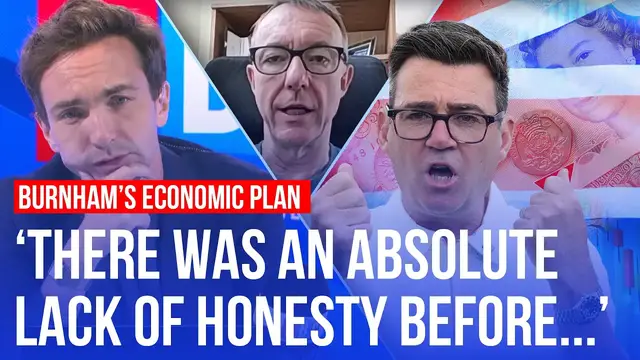
Lewis Goodall speaks with former Director of the Institute of Fiscal Studies, Paul Johnson about the shape of the UK economy Andy Burnham is likely to inherit. Johnson points out that UK taxes are at an 'all time high', in part due to Keir Starmer's government and the Conservatives that came before. Not entirely impressed with Chancellor Rachel Reeves' fiscal decisions, Johnson tells Lewis that the UK's borrowing has come 'back to bite us', insisting we need a robust plan going forward with a new prime minister. Whether that new PM will be Andy Burnham is yet to be decided, but it's looking increasingly more likely... Listen to the full show on the all-new LBC App: https://app.af.lbc.co.uk/btnc/thenewlbcapp #lewisgoodall #andyburnham #ukpolitics #keirstarmer #LBC LBC is the home of live debate around news and current affairs in the UK. Join in the conversation and listen at https://www.lbc.co.uk/ Sign up to LBC’s weekly newsletter here: https://l-bc.co/signup
Show More Show Less View Video Transcript
0:00
What is exactly the state of our fiscal health at the moment, our indebtedness and so on
0:07
Well, it's not great. It's one of these things where you'd say I wouldn't start from here
0:12
Our debt as a nation has risen by more than pretty much any other advanced economy over the last 20 odd years
0:20
It's now around 100 percent of national income, which is pretty high, though, about average for the biggest economies in the world
0:29
The government has a set of fiscal rules, which Andy Burnham has said he will sign up to
0:35
And those rules essentially say that in 2029 at the moment, which is the election year
0:41
we'll be borrowing only to invest and that debt will be falling in that year
0:47
And on current plans, we're just about meeting those rules, but really only just
0:52
and we're meeting them in part because the current Chancellor, I think rather implausibly
0:59
has promised to increase taxes and cut spending in election year. Now, I don't think that's the
1:04
most likely outcome. So that gives you a sense of the constraints that we like to face. I should
1:11
also add that taxes in this country are at their highest level in history at the moment, have gone
1:18
up absolutely enormously over this decade under the last government and this. This government
1:22
and the last government are almost identical in the speed at which they've raised taxes
1:28
over their periods in office. And of course, one of the reasons for that, and this is something that obviously an incoming
1:34
Burnham government is going to have to live with, is that the sort of fiscal trajectory
1:38
of the Parliament has already been set, at least to some extent, wasn't it? Because Rachel
1:43
Reeves did something in her first budget, augmented in her second budget, which was relatively
1:47
unusual, which is she basically decided to spend quite early on, and as you say, then
1:52
front load a lot of the pain towards the sort of election period, where normally, after
1:56
a general election, it's the other way around. Exactly. I mean, if we go back slightly further, I mean, I was, just before the last election
2:07
I was on the airwaves a lot saying, look, all of the parties are essentially being utterly
2:12
dishonest in what they're promising. both Labour and the Conservatives were saying
2:16
well, we don't need to raise taxes, there's plenty of money to spend
2:20
The Labour Party said it had a fully costed manifesto which would involve £6 billion of tax rises
2:27
pretty small, small bit of spending rises. What they did immediately was increase taxes by £40 billion
2:33
and then they've come back for another £10 or £20 and increased spending by a lot more than that
2:40
So I think part of the problem here is the absolute lack of honesty before the last election And then as you say I think partly for good reasons because there were lots and lots of requirements among public service and good case for increasing public investment They raised
2:56
spending very, very quickly. And last year on this, public spending went up really quite fast
3:03
But the plans are to really slow that down towards the end of the Parliament
3:08
which is exactly, of course, the point that people will be voting. Now, it may be, of course
3:13
that the increases in spending early on in the Parliament will then start to show fruit in much shorter waiting lists
3:19
for the NHS and better education outcomes and all those sorts of things that we want
3:25
But it may also be, I think it almost certainly will be the case, that the pressure for increasing spending will still be there
3:32
There is a lot of discussion at the moment about whether or not
3:37
and to what extent an incoming Burnham government would want to adjust the fiscal rules, potentially to allow for more borrowing
3:46
Now, of course, Rachel Reeves already has some flexibility, more than the last chancellor in terms of borrowing to invest within the fiscal rules
3:52
We are nonetheless, our deficit is still pretty high. How much flexibility do you think that there would be or might be with the markets
4:00
to allow greater borrowing over and above, to invest over and above what the current chancellor had forecast for
4:08
um well i think a number of things worth saying there i mean the first is that of course you know
4:15
in a sense an extra few billion of borrowing out of a um an economy in the trillions of pounds is
4:22
is not going to make a huge amount of difference and we do get a little obsessed with the idea
4:26
that we actually have to precisely hit these um these fiscal rules which are fiscal rules which
4:33
the government decides on themselves. These are not sort of laws of nature that you have to
4:38
keep to. So could you borrow a little bit more without economic Armageddon? Yes, of course you
4:44
could. But, and there is a very big but here, we are already paying a higher rate of interest
4:51
on our national debt than pretty much every other advanced country in the world. Last time I looked
4:58
it was either Iceland or New Zealand that was facing higher rates of interest on their debt
5:05
Now, that is an indication that the market's already a little bit concerned
5:09
It's also reflected in the fact that we are spending a fortune on our debt interest payments
5:16
So, yes, you can borrow more, but it is not a free lunch
5:20
And the amount of borrowing we've done over the last 25 years has really come back to bite us very hard
5:27
Now what would work would be if you were sure and you could persuade the markets that your additional borrowing really would have a long positive effect on growth Now how might you do that Well if you were really focusing investment on those areas that we know are very growth
5:46
that might be, for example, building roads and doing that effectively. That might be doing more to get house building going
5:55
That might be actually to support some of the devolution that Andy Burnham, I think, is interested in
6:02
But what would not fly would be additional borrowing to fund more spending on welfare or actually, frankly, on defence or net zero or things like that, which are not particularly associated with economic growth
6:17
In terms of a new government, it sounds like what you're saying, Paul, is that the flexibility for substantial difference in macroeconomic policy is pretty slender
6:26
Well, it does a macroeconomic policy. I think that is fairly slim. Of course, you could increase taxes further and increase spending to do that. But as I say, taxes are already at their highest levels
6:40
Now, it does depend on what you mean by macroeconomic policy. I mean, you could argue that a really big change to devolution to mayoral authorities would be a big economic shift. You could talk about big reforms to the structure of the tax system. You could talk about really shifting where you're doing the spending
7:04
But I would suggest that a great deal more borrowing, for example, is not really on the cards
7:13
And just finally, one idea which keeps coming up, and it's actually now been advocated by figures as divergent as West Reading, now Lou Haig, very close advisor, Randy Burnham, is at least some further equalization of capital gains and income taxes
7:28
Now, that's something that's obviously been resisted by the Treasury over many years
7:32
why would that, if you do think that, that might think that might be a problem
7:38
I think it's amazing, this kind of focus on capital gains tax. I mean, it's a fascinating
7:42
tax. It doesn't raise an enormous amount of money and it never will raise an enormous amount of
7:48
money. So it certainly needs to be reformed, but not as a way of raising tens and tens of billions
7:54
of pounds as you kind of get the impression that some of these people believe. But don't forget
8:00
We had capital gains tax rates levied exactly the same as income taxes, tax rates, all the way up to 1997
8:09
Nigel Lawson, who was Chancellor in the 1980s, did that, and it worked pretty well
8:15
One reason it worked well was that you got an allowance for your capital gains going up just in line with prices so for inflation and at the moment you pay capital gains tax even if your asset only rises in line with prices In other words you made no real gain You just hold something it goes up in line
8:33
with prices, you sell it, and you're still whacked with capital gains tax. So I do think that you
8:39
could equalise rates of capital gains tax with income tax, but only if you ensure that you at
8:46
least get an allowance for inflation. There used also to be quite a big tax-free allowance for
8:52
capital gains tax, which no longer exists, you might want to reintroduce that. But also
8:58
you've still at the moment got capital gains tax completely wiped out at death. In other words
9:04
if I buy something now and it goes up massively in value and then I leave it to my children
9:12
there's no tax on it whatsoever. No capital gains tax at all. Whilst you have that kind of crazy
9:17
structure, increasing the rates will just make it more likely that people will hold on to their
9:22
assets for longer. And if you don't give an allowance, at least for inflation, it will
9:28
potentially significantly damage incentives to invest. So that's a long way of saying this is
9:34
quite a complicated tax. It's quite an important tax. It won't raise very much money, but it does
9:39
actually definitely need reform. And this idea of breaking up the Treasury
9:44
which is a very old idea, different prime ministers have done it. Harold Wilson, of course, had the Department for Economic Affairs that eventually was folded back into the Treasury
9:52
But that seems to be an idea doing the rounds in the Burnham camp, having a sort of growth ministry and then a Treasury sort of more traditional sort of economic ministry on the basis of collecting taxes
10:02
Do you think that would be a good idea? Well, I mean, it might be in principle, but it's one of these zombie ideas that's been around since before I was born
10:09
As you say, it was kind of tried in a half-hearted way in the 1960s
10:13
It's been talked about every five or 10 years since then and hasn't come about
10:20
I mean, we do have a business department, which is supposed to be focusing on that to some extent
10:25
You could beef that department up somewhat. I should say I have a sense
10:33
I worked in the Treasury more than 20 years ago now. now. So I guess I have a natural
10:39
ex-Treasury civil servant scepticism of breaking it up. And you'd have to ask, what
10:47
is it that a third department, alongside a Treasury and alongside a business department, would
10:53
actually do? And what levers would it pull that you couldn't pull
10:57
at the moment? You'd also, of course, as you always have when you
11:01
change government departments around, you'd have a year or two years where everybody
11:05
involved all the civil servants they wouldn't be focused on growth they'd be focused on you know
11:09
who's going to get what job so i think we should just try and make what we've got
11:13
work rather than um throw everything up in the air and start again
#news