Up next in 10



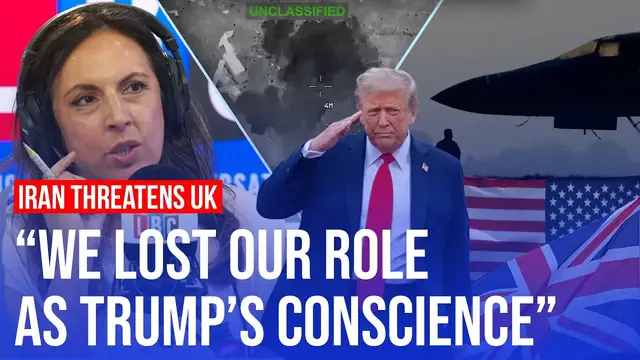
The government has said the UK is ‘ready to defend itself’ as Iran says it considers RAF Fairford a ‘legitimate target’ after the US used the base for bombing raids. Colonel Philip Ingram, former British Army intelligence officer and an expert on international security, joins Aasmah Mir to explain the threats. Listen to the full show on the all-new LBC App: https://app.af.lbc.co.uk/btnc/thenewlbcapp #AasmahMir #security #usa #uk #iran #uknews #LBC LBC is the home of live debate around news and current affairs in the UK. Join in the conversation and listen at https://www.lbc.co.uk/ Sign up to LBC’s weekly newsletter here: https://l-bc.co/signup
Show More Show Less View Video Transcript
0:00
I'm going to speak to Colonel Philip Ingram, who's a former British Army intelligence officer
0:04
and an expert on international security. Good afternoon to you. Good afternoon, Nazma
0:09
Is this just talk? We've heard this before, haven't we, from Iran, that, well, if you help America, you're a legitimate target
0:15
I'm pretty sure that sounds familiar. But is it to be taken seriously
0:21
Well, it is to be taken seriously. But, you know, an element of it is just talk
0:26
However, we have to put this into perspective. The Iranians see the British through the same lens they see the Americans
0:34
So the UK turning around saying we're not going to let the Americans use our bases. To the Iranians, that's meaningless
0:39
They see us as one, and therefore we are a continuous threat the whole way through
0:45
The Americans make good use of the bases in the UK to attack into Iran
0:49
Iran is not going to attack back using any conventional military capability
0:54
which is why the government can turn around and say we can defend it
0:58
I think any potential threat is something that would happen through terrorism
1:03
And our counter-terror police, MI5, working with our American partners are very good indeed
1:10
What does that mean though? I mean, I'm reassured and slightly terrified at the same time there
1:17
because you're saying that their retaliation would be terrorist-related rather than military
1:23
but the intelligence services are hopefully monitoring all this stuff? The sort of thing they do, the Iranians have got through their embassies
1:34
and through other sleeper cells, elements of the Iranian Revolutionary Guard Corps
1:39
across different countries throughout Europe. The particular element of that is from an organisation called the Quds Force
1:46
The Quds Force stimulate global international terror activity. They stimulate disruptive activity
1:52
So they're the sorts of people that are behind a lot of the different marches that we see, where they'll be funding them, they'll be influencing them, they're pushing people to carry out direct action against military bases
2:03
And part of that direct action is to test the security on those bases
2:08
And once they've got an idea of that, they can then look at ways and will have tried to identify ways where they can escalate that into potential attacks on bases, whether it be terror attacks, whether it be a protester breaking in to try and cause disruption, anything that they can do
2:24
And they'll claim that as their direct action in retaliation for what's going on
2:29
But this is something that the IRGC, the Revenuatary Guard Corps, the CODs Force, have been planning for years and practicing for years
2:36
And this is why the government has just prescribed the IRGC and our intelligence services The head of MI5 has been turning around and talking about the number of you know Iranian directly linked attacks that have been planned throughout the UK
2:52
This is something that has been ongoing in the background and the measurement of success is nothing happens, which is why the general public don't hear about it
3:01
But there's been a lot of success. Does this stuff raise the terror alert at all? Does it move it a notch or not
3:10
and it's something that the joint terrorist ysis center will um be monitoring and if
3:16
they think it needs to move the terror alert so that the general public are made more aware of it
3:21
then they will do that um however this is very specific you know it's focused on you know one
3:27
particular base in reality it's focused on all u.s bases in the uk and all uk military bases as well
3:34
and therefore there will be additional security processes put in place, in particular in the intelligence arena
3:41
making sure that any particular threats against those bases are identified and can be mitigated
3:47
And mitigation doesn't mean putting troops on the ground with air defence missiles and all the rest of it
3:53
A lot of this happens in the background where people just won't notice it
3:56
because we want people just to go about their normal day-to-day business and not notice what the counter-terrorist police
4:04
what our security services, what our US partners are doing in the background
4:07
to keep everyone safe. You said at the beginning of this interview that Iran just view us as one kind of homogenous blob
4:16
America and us. So the perceived delay that there was, perceived by Donald Trump
4:22
in allowing them to use our bases, was that pointless? It was completely pointless
4:29
What Kirsten Armour did was he upset Donald Trump in a way that took us away from the central table
4:36
where we could whisper in Donald Trump's ear and act as a conscience from. And because of this performative activity, without basing it in reality
4:44
because it was aimed at backbenchers and voters and everything as domestic politics instead of international geopolitics
4:51
it's actually made us less safe because we've had to fight a way to get back onto a table to be able to try and influence things
4:58
and we're still not there yet. So this is where domestic politics being played out
5:03
in the geopolitical environment just doesn't work. So even if we hadn't got involved in any way
5:10
because there'll be people who will phone up in this area who say we should never have got involved on any level
5:17
And obviously the level at this point is air bases for America
5:22
Because that makes us dangerous, that makes us a target. It's not a legitimate war
5:28
It Donald Trump war It going very badly It making his performance in terms of you know voting sorry in terms of popularity is affecting that
5:40
So what would you say to those people? Because they will no doubt call up. Well, let me be very clear. Donald Trump at no stage asked the UK to get involved in dropping bombs on Iran
5:50
in providing support services, i.e. refueling for US aircraft to drop bombs on Iran
5:56
However, we were directly involved in every other way. We were directly involved in the planning
6:01
UK air bases, UK civilian airfields have been used in US's preparation for their bombing campaign that went on
6:10
There are other capabilities that the UK's got, and I'm not going to go into them on air
6:14
that will have been directly involved in the planning and the targeting of the US bombing attacks
6:20
and looking at them immediately afterwards. and therefore whenever the Prime Minister turned around
6:25
and said he was going to deny the US permission, he denied the permission to use the runways
6:30
and one or two air bases, knowing perfectly well that there was a lot of other capability that we used
6:34
that was being used continuously. So he was misleading the British public on that
6:39
and he caused real damage in our relationship with Donald Trump because he doesn't take this sort of thing kindly
6:47
and it achieved nothing. He had to change his mind 48 hours later. well it actually put us in a more dangerous position
6:54
because we have lost that position at the table to be able to act as a conscience for Donald Trump
6:59
and give some influence in the direction where this is going so it's probably elongated it
7:04
it's put us at greater risk and it's achieved nothing domestically Now you said earlier that Iran's military capability
7:12
is probably not good enough for them to really launch any kind of attack on these air bases
7:17
but there was, I think I'm right in saying There was an attempted attack on our Diego Garcia base in the Shagos Islands in March
7:26
They fired two ballistic missiles. One reportedly failed and the other one was shot down by US warships
7:33
So they have actually attempted. Yeah, they have attempted. And theoretically on paper, they have got the capability to be able to potentially hit the UK
7:44
I'm putting as many caveats in there as possible. Actually, when you start to yse those ballistic missiles that they used against Diego Garcia
7:51
it looks as if they were leftovers from an Iranian space programme that they were using to launch satellites
7:59
The difference between a ballistic missile carrying a warhead and a ballistic missile carrying a satellite is slightly different
8:04
But they had a small number of these longer-range missiles. They used them in Diego Garcia. There's no indication that any are left
8:13
and actually it would be very difficult for them to target into the UK They can have a much better effect using an asymmetric attack a terrorist attack or something like that whether it be directly through the Iranian Revolutionary Guard Corps
8:28
or whether it be by proxy through different groups that Iran sponsors or is linked to them
8:34
That's where the primary focus will be. Our intelligence services, whether it be a foreign
8:39
intelligence service monitoring Iran, or domestic intelligence services, MI5, monitoring the threat
8:44
that there is within the country are very, very, very well connected and will have a good handle on this
8:49
This is one area where we're not relying on the Minister of Defence who are grossly underfunded and do not have the ability to protect
8:56
the United Kingdom from conventional attacks at the moment. I know that our involvement in this war is minimal
9:03
However, there are many people in this country who think we shouldn't even be involved at that level
9:10
Can you explain to them why you think we should be involved? Well, we're not directly involved
9:15
We're indirectly involved by allowing bases that our closest ally has been using for decades
9:21
to carry out activities that they think is important. We can step back and say we disagree with that activity, we're not going to get directly involved
9:28
and we at one stage have the ability to influence it and suggest what is going on
9:32
We have to remember that the United Kingdom is a permanent member of the Security Council of the United Nations
9:38
We have a global responsibility. We have a lot of overseas territories
9:43
We have a global responsibility. We're the sixth largest economy in the world. We have a global responsibility
9:49
We are one of the five eyes members alongside the United States, Australia, Canada and New Zealand
9:55
But in reality, it's two plus three eyes. It's UK and US from an intelligence sharing perspective
10:01
We are one of the founding members of NATO. We have a global responsibility putting all of this together
10:07
And with that global responsibility comes in looking after your global partners, not necessarily directly helping them or getting involved in things that they're doing, but keeping your relationships going so that you can influence what they're doing if they disagree
10:24
in the same way whenever the Falklands War happened. The Americans did not get directly involved
10:30
but because of the relationship that we had with them, they could tacitly help us quietly in the background
10:36
But they were sort of allies with Argentina or interested in South America at the same time
10:44
This is just the way geopolitics works. You can't become isolationist. It creates more danger to your domestic population
10:52
and creates a more difficult position for you in the future. It's great in theory
10:57
It's just completely impractical. Philip Ingram, thank you very much. Colonel Philip Ingram
11:03
former British Army intelligence officer and an expert on international security. There's a lot to unpack there
#news