Up next in 10



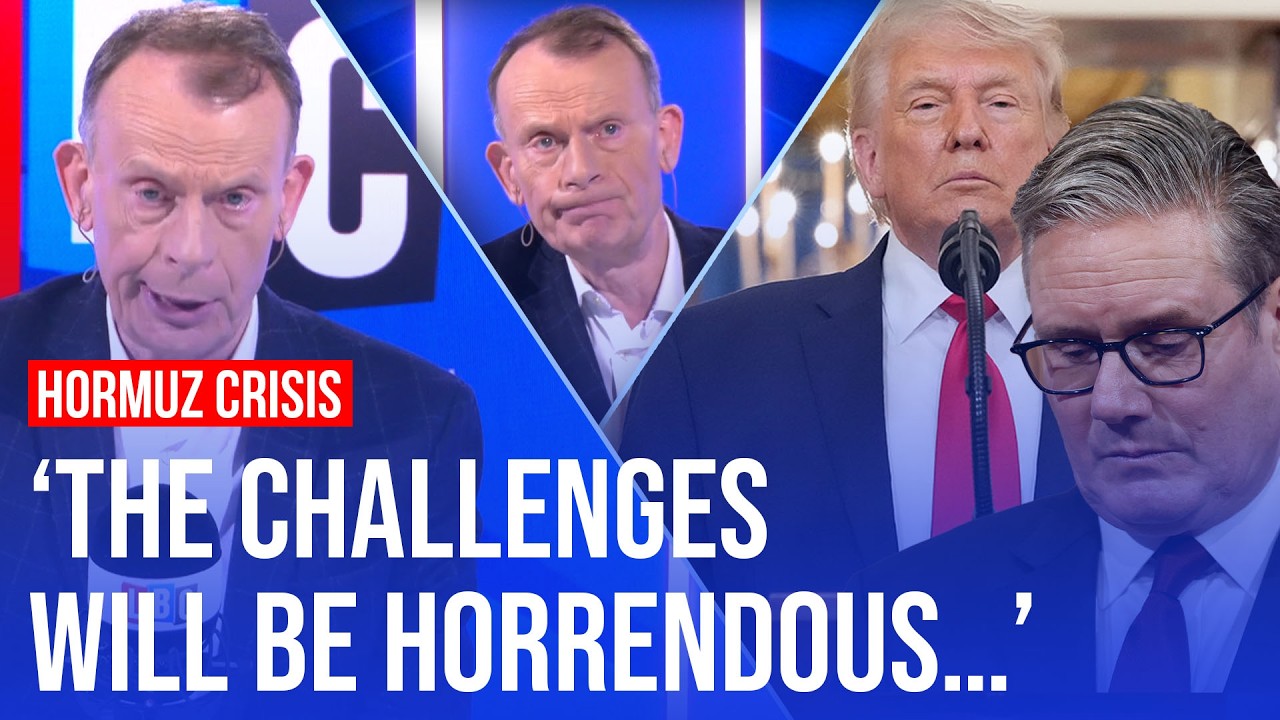
Britain could face shortages of chicken, pork and some other supermarket goods this summer if the conflict involving Iran continues, according to a report in The Times. The paper said secret government analysis has examined a “reasonable worst-case scenario” in which disruption in the Strait of Hormuz leads to shortages of carbon dioxide, a gas seen as critical to parts of the food industry. According to The Times, senior officials from No 10, the Treasury and the Ministry of Defence were among those involved in contingency planning under an exercise codenamed “Exercise Turnstone”. Andrew Marr is joined by his expert guests to discuss. #andrewmarr #uk #keirstarmer #uknews #donaldtrump #straitofhormuz #iran #lbc LBC is the home of live debate around news and current affairs in the UK. Join in the conversation and listen at https://www.lbc.co.uk/ Sign up to LBC’s weekly newsletter here: https://l-bc.co/signup
Show More Show Less View Video Transcript
0:00
Europe has just six weeks of supply of jet fuel left
0:04
The Executive Director of the International Energy Agency warns of flight cancellations
0:09
and calls it the largest energy crisis we have ever faced. Here, there have been warnings about the possibility of food shortages ahead
0:18
Both energy and fertiliser are essential for growing what we eat, and both are affected by the war
0:24
Shortages of carbon dioxide would affect chicken, pork, beer, and the shelf life of everything from salads to bread
0:33
All this comes at a time when the government has very little money for extra support anywhere
0:37
and the challenges facing the Chancellor, Rachel Reeves, are horrendous. So what's the plan, Stan
0:44
I'm joined in the studio now by the former chairman of the NatWest Group and director of the London School of Economics, Sir Howard Davis
0:51
Howard, great to have you back in the studio. things could hardly be harder for the Chancellor
0:56
Let me just first say that I passed my security vetting in 1973 in the Foreign Office
1:01
and so far I don't believe it's been rescinded. But let's leave that to one side
1:05
Well, I'm delighted to hear it. But, yeah, it isn't great, although the results today of the latest ONS survey
1:12
showing that the economy did grow in February were slightly pointing in a different direction
1:19
But I think where we are is that when we went into this crisis, the economy was growing slowly and there was some surplus capacity
1:26
and the Bank of England were basically saying, well, we're likely to be reducing rates further during the year
1:33
Now that has stopped and they are having to put things on hold
1:39
to see how this develops. If it's a short-term crisis, and it could be
1:44
then I think we will go back to probably rates reducing because there is surplus capacity in the economy
1:50
and the economy is not that strong. But if this lasts a long time, then we're looking at quite a different prospect
1:57
It's a global problem, obviously, but we seem to be in a particularly weak position
2:01
listening to the IMF and the World Bank, people looking at the British economy and saying
2:05
you know, our growth is worse than our competitors. As you say, February was better than expected by quite a margin
2:12
So there was a tantalising sense that we were slightly on the right path before we were hit by this
2:17
Yes, I think there was. And also, I think it's important not to exaggerate this UK hit worst
2:24
In fact, if you look over two years, the UK looks to be just about the most rapidly growing economy in the G7
2:32
But we were hit this year. Why? One, because we are energy importers unlike the US, like Germany, of course
2:39
although France has got nuclear power, which helps them. Secondly, that we have a large financial sector
2:44
and the financial sector tends to amplify the ups and downs in the economy
2:49
It's an exaggerator. Yeah. Thirdly, we have a currency which nobody has to hold
2:56
The dollar is pretty well inevitable in financial markets. The euro is a continental currency
3:01
We have to convince investors that sterling should be held and that tends to mean that our interest rates rise more rapidly than other people's do
3:12
because we have to raise rates in order to persuade people to buy our debt
3:16
Can I ask about the sort of infrastructure, the energy infrastructure in particular
3:20
because I read that we have very, very low capacity for gas storage compared to other countries
3:25
We have very low resilience inside the system. And very quickly, we have to start to go to the Americans and others for things like jet fuel
3:34
Yes, it does look as if that's the case. I mean I think this is probably that for a long time the UK has tended to take the view we can be a fortress economy You know we a big trading economy
3:46
We're an island. We have to depend on open markets. And we simply accept that
3:52
We've never had the mindset in this country of thinking that we could protect ourselves from global swings and roundabouts, if you like
4:00
And I think this is just one element of that. Very hard to say, I suppose, at this stage
4:04
But do you think we are approaching the moment where we have to change direction, change strategy quite radically
4:10
In other words, we have to have some kind of emergency government looking at more of a kind of resilience and fortress economy
4:15
Yeah, I think resilience has become a very important word. And I think that, for example, in the North Sea, which is the kind of where the rubber hits the road, if you like, up to now, I think many economists have said
4:28
well, why carry on extracting from the North Sea when it's expensive and it's a mature oil field when we can buy on open markets
4:38
Therefore, it's not really worth doing. I think now maybe that argument flips the other way
4:42
It is worth having your own security of supply because the world, driven by the White House, let's be clear
4:49
has become a more dangerous and volatile place. Do you think we are very far away from a world recession
4:55
Yes, I think we are. The IMF's worst scenario envisages the global economy growing at 2%
5:03
That's the worst that they can bring themselves to find. So I don't think we're looking at a global recession yet
5:09
Well, there is a piece of good news to end on, Howard Davis. Thank you very, very much indeed for coming in
5:15
Now let's get an assessment of the threats posed by what's happening in the Gulf from Chris Southworth, the Secretary-General of the International Chambers of Commerce UK
5:23
who joins us now from Manchester. So, Chris, very good to have you on the show
5:27
Can I ask, first of all, whether you think that the shortage of CO2, shortage of fertilizer, shortage of jet fuel means that the British public are in for a really tough summer
5:41
Well, yeah, absolutely. Well, this is definitely going to impact us. So, you know, I thought I'm going to try and break this down into simple English for everybody, because it's a really good example of the complexities of global supply chains and the UK economy
5:53
So if you look at our food production system, you know, we have sort of four big inputs into making our food
5:59
One is energy. You know, think diesel for tractors, transport trucks, aircraft fuel
6:05
So perishables tend to come on aircraft. So anything impacting the aircraft industry is going to impact food and the perishable sector
6:12
Then you have sort of big maize and grains, big bulk inputs that impacts meat production, cows, beef, pork
6:20
That's a heavy input for farmers. So fertilizer, 50% of global food relies on fertilizer and 30% of that comes through Hormuz
6:29
So any blockage in Hormuz has a direct impact on fertilizer and crop production
6:35
And then, of course, in the UK's case, transport, just getting food from A to B onto the shelves
6:40
You know, anything impacting the transport sector has a direct impact on us. And just to pick up on a point, which I think is well made, is, you know, we're a small island in the northern hemisphere with a large, dense population
6:52
We can't produce the food that we need. We need to import a significant component of that
6:58
And if you look at it in the economic sense, you know, we're 60 percent dependent on trade, 40 percent dependent on food and 30 percent dependent on energy
7:07
So anything impacting those will impact us, the consumers, business and anything hitting business will get passed on to the consumers
7:15
So that the sort of the overall context I think right now it mostly coming from increased energy costs is having an impact on the transport logistics sector And of course that going to increase inflation for consumers
7:30
The CO2 issue is quite interesting when you unpack it. You know, a lot of it's about packed
7:37
meats in the supermarkets. It's about fizzy drinks. It's about fresh food
7:42
Let's not forget beer, Chris. It's about beer as well, of course
7:45
And beer, yeah, fizzy drinks, definitely beer for those that drink it
7:50
But, you know, a lot of those products all rely on CO2. Now, we do produce our own CO2, but that relies on ammonia production
7:58
which relies on fertilizer, which a lot of it comes from the Middle East
8:02
So if we're not getting the fertilizer, we're not going to get the ammonia production
8:06
the costs are going to go up, and that impacts CO2, and therefore it impacts food on the shelves
8:11
and potentially that means more food waste, less variety, less shelf life, those sorts of issues
8:19
It all just reminds us what a kind of fragile, interlinked life we leave these days
8:25
Can I ask you about what the government can and cannot do? Because clearly the way things are going, the way interest rates are going and government borrowing costs
8:34
Rachel Reeves is not going to have much money and she's going to have lots of people hammering on her door
8:39
drivers, farmers and fuel protesters, ordinary families struggling to meet their food bills
8:46
asking for extra help. Do you think we're now going to go through a phase where whatever we say
8:51
the government is simply not going to be able to give people what they feel they need? Yeah, well, you know, the public purse is limited. We know that. We've been through this before
9:00
There's been multiple shocks. So the Treasury, the Chancellor is under immense pressure. So on a
9:05
Domestic level, it's extremely difficult because the causes of the problems are external
9:11
It's not coming from us. We didn't invite the war in Iran, but we are directly impacted in it
9:17
So I think the first priority is to help de-escalate the conflict, try and open up the Hormuz channel straight and make sure that that international system is working as well as it can do
9:29
because we, like lots of parts of the world, most of the world, in fact, rely on energy supply, fertilizer supply
9:37
and we need to work with our allies in the Middle East and Asia and Africa and other places to make sure that happens as quickly as possible
9:43
Well, Chris, we've been talking about very simple, basic things, after all
9:47
moving our ability to move around and our ability to feed ourselves
9:51
And on the second of those, I'm going to move on now. Thank you very, very much for everything you've told us
9:55
and go to Minette Batters, the former boss of the National Farmers Union
10:01
Lady Batters, as you are now, I'd like to address you properly. We've talked a lot about fertilizer and we've talked a lot about the cost of fuel spiking
10:10
How worried do you think that your former members in the NFU are going to be
10:15
when they look at what's happening? Andrew, I think they're going to be, and they are, incredibly concerned
10:22
because this has been building for a long period of time now
10:27
You know, we have had a decade, you know, leaving the EU, the COVID pandemic
10:32
the war in Ukraine that drove, you know, one point wholesale gas was 600% higher
10:39
2023, we had a billion less eggs produced simply because the contracts
10:45
that those farmers had signed weren't worth the paper that they were written on
10:49
when these costs went up so much. So this has been building for a while and it yet another huge shock to our national food security I think it been sort of mentioned previously but you know 70 million people on an island You don need much to go wrong to create a lot of challenge in food supply
11:13
And of course, farmers here in England working with a new policy, having left the EU, that is a global first
11:20
It is about public monies for public goods and paying for the environment alone
11:25
So Emma Reynolds, the Secretary of State at the Cabinet table, is the Environment Secretary
11:32
And I've done a review and a report on farming profitability for the government
11:37
And it's very clear to me that that position must be the Secretary of State for food and environment
11:43
We need to bring food producing crops back in and we need a different approach to deliver national food security
11:50
Sure. Back to the basics. Now, we do understand because of what's happened over the last couple of years
11:55
how reliant farming is on diesel and petrol costs in general. But we're learning today, I think everyone's beginning to learn
12:03
how important CO2 is in terms of what I might expect when I walk into my local supermarket and look around me
12:09
Just tell us a bit more about that. Well, CO2 is absolutely vital
12:16
We've been through this before. You know, we used to be making our own fertilizer here
12:21
So we had CF fertilizers. CO2 is a byproduct of the Harbour Bosch method, which is making fertilizer. We stopped making
12:32
fertilizer here. So we're now reliant on imports. So we haven't had, you know, that plant has been
12:39
mothballed. We haven't had our own supply of fertilizer and the byproduct, which is essential
12:48
of CO2. Sorry to jump in there, Minette, but this means that packages of meat, packages of pork and
12:56
chicken and all sorts of other things cannot be kept fresh for long enough. Is that right
13:01
Yeah, it's a vital component in our processing and manufacturing sector. We have had the ability
13:10
and as I say, we have been producing it ourselves. So there are a lot of questions when everyone's
13:14
talking about resilience as to you know how do we build resilience because i think you know a lot
13:21
of these challenges are going to be here to stay as i say we faced into this problem only a few
13:26
years ago and things corrected themselves just in time but it's surely we've got to learn lessons
13:34
and not take food for granted uh in the way that we have done because many people will remember in
13:39
covid that was rationing there were shortages of eggs shortages of flour they couldn't buy what
13:44
they wanted, when they wanted. And the population this size, the moment that happens, you drive
13:50
concern, you drive panic buying, and then you create further shortages. So I really hope that
13:56
we're going to learn some lessons from this and we're going to see change. I mean, Labour has
14:01
talked about the importance of defence security, food security, energy security. I would say on
14:08
food security, we really do have to now define how we are going to achieve this. And there's
14:15
plenty of examples. Your listeners will remember the fuel crisis, the shortages of food and COVID
14:22
You know, the industry is a very capable industry. And the moment these crises happen
14:29
government normally opens its doors and says, right, how do we resolve them? I think we've got to be working on this day to day, not just in a crisis
14:36
Absolutely. And meanwhile, the rest of us should keep calm, carry on, don't panic and certainly don't panic by yet
14:43
Minette Batters, thank you so much for joining me
#news