Up next in 10



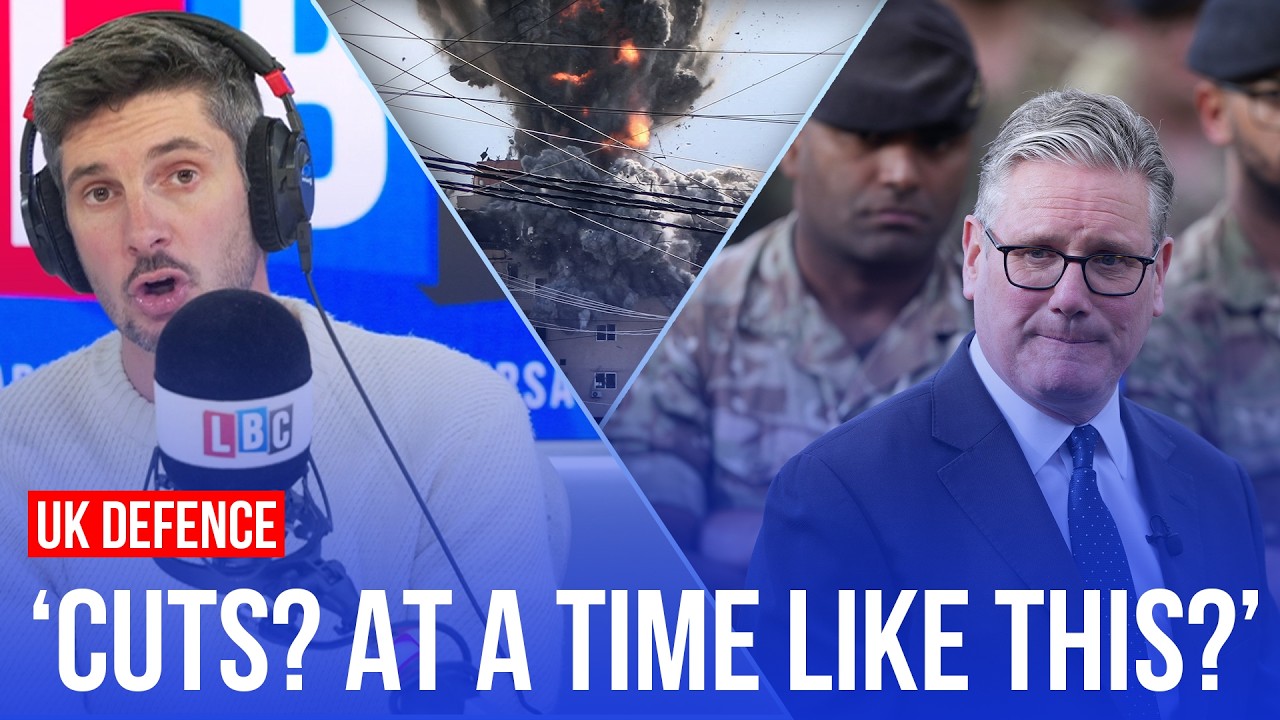
Former Labour defence chief Lord Robertson criticised Keir Starmer's defence strategy. Speaking in Salisbury he will say, "we are underprepared. We are underinsured. We are under attack. We are not safe... Britain's national security and safety is in peril." Tom Swarbrick is joined by Sir Michael Fallon, Former Conservative Defence Secretary, and Colonel Tim Collins OBE, Former Officer in the British Army best known for his rousing eve-of-battle speech in Iraq in March 2003. What is Starmer spending on? Should the UK keep boosting welfare and renewables? Is it safe to cut defence at a time like this? Listen to the full show on the all-new LBC App: https://app.af.lbc.co.uk/btnc/thenewlbcapp #tomswarbrick #ukpolitics #politics #defence #defense #worldnews #debate #news #iranwar #trump #labour #keirstarmer #starmer #britisharmy #royalnavy #NATO #military #LBC LBC is the home of live debate around news and current affairs in the UK. Join in the conversation and listen at https://www.lbc.co.uk/ Sign up to LBC’s weekly newsletter here: https://l-bc.co/signup
Show More Show Less View Video Transcript
0:00
The government has shown a corrosive complacency towards defence and put the UK in peril
0:06
According to a government advisor in a fierce criticism of Keir Starmer's military policy
0:11
George Robertson, the former NATO Secretary General and author of the Government's Strategic
0:15
Defence Review, believes that the Prime Minister is, I'll quote him, not willing to make the necessary investment. Lord Robertson also accuses non-military experts
0:24
in the Treasury of vandalism. He says, We cannot defend Britain with an ever-expanding welfare budget
0:32
He's going to make a speech later on this evening. He says, We are underprepared
0:36
We are underinsured. We are under attack. We are not safe. Britain's national security and safety is in peril
0:46
Sir Michael Fallon is a former Conservative Defence Secretary. Thank you very much indeed for coming on the programme, Sir Michael
0:50
To what extent do you agree with Lord Robertson? Afternoon. Good afternoon, Tom. 100%. George Robertson is not just any former Defence Secretary. He was Secretary General of NATO. But more importantly, he did the Strategic Defence Review last year for the government. The government accepted his review then, saying we were underinsured, we weren't ready, we weren't properly equipped. It accepted it then
1:16
Now, a year on, if it was true, if he was right a year ago, he's even more right today
1:22
We've seen the war going on in the Gulf and the increased threat from Russia in the North Atlantic
1:27
So he's 100% right. One of the concerns he has, of course, is that defence spending hasn't been rising fast enough
1:36
You were Defence Secretary at a time when defence budgets were being cut. To what extent does the previous Conservative government accept responsibility for the position we're in now
1:43
I think in your last, just before the news, you talked about putting it in context
1:50
From the fall of the Soviet Union and the end of the Berlin Wall and all the rest of it
1:56
right up to Crimea, for about 25 years, successive governments reduced defence expenditure
2:02
because they thought Russia was no longer a threat. With the invasion of Crimea in 2014, that all changed
2:09
And from that point on, we have been increasing defence spending. Now, you can perfectly well argue not increasing it fast enough, but it has slowly been increasing and it certainly now needs to increase faster
2:22
And the measure of that, Tom, is look at what the other European countries are doing
2:27
When I was defence secretary back in 14 and 15, we were the second biggest in terms of what we were spending per head across NATO
2:35
Now I think we 12th or 13th We behind the Nordic countries behind the Baltic countries We pretty close to spending what Romania is spending But should those it easy to say now but should those cuts have happened
2:49
Well, the cuts were after the Cold War had ended. We all thought we weren't going to be a confrontation
2:55
The Soviet Union had been dismantled. We didn't need the missile system
2:59
The cuts under David Cameron in 2010 increased, as you know. And I know, Michael, that you fought against whilst in government trying to persuade what Robertson calls the non-military experts in the Treasury that they were making the wrong call
3:11
Well, just let's be very clear. I'll repeat it. You know, from 1989 right through to 2014, successive governments, Labour and Conservative, yes, reduced defence expenditure
3:22
That tide turned in 2014. Why did it turn? because Crimea had been invaded
3:28
Another red signal flashing at danger, as George Robertson is telling us
3:33
We have those same signals now in the Middle East and from what Russia has been doing in Ukraine
3:38
and the North Atlantic. And it means, therefore, you've got to look at this again
3:42
and increase and accelerate defence expenditure faster again. Well, can I draw your attention then to a story
3:48
that Sky are breaking this afternoon, that UK military chiefs, I guess this is perhaps one of the hold-ups
3:53
in this defence investment plan, UK military chiefs have been asked to find £3.5 billion in efficiencies and other savings this
3:59
year. I wonder whether you think that that is something that it should have to do given
4:03
the context of where we find ourselves. Well certainly not, that's extraordinary
4:07
The government are claiming they're increasing defence spending extremely fast, yet they've not
4:12
given a date for when they're going to meet the new NATO target. They've not published the defence
4:17
investment plan that was part of George, that followed George Robertson's review. We were
4:23
promised it last autumn, we were promised it at Christmas, it has still not appeared. And it now
4:28
looks far from settling investment for the next 10 years and increasing the budget. It now looks
4:34
shockingly as if they're actually proposing to cut the current expenditure. And we've seen the
4:40
danger. We've seen our bases in the Middle East and our allies in the Middle East who look to us
4:46
for protection. We're not able to provide it. Where, if we're going to spend more money on
4:52
defence where should that money come from in your view oh the government has made choices it's been
4:57
increasing its spending it's not as if the whole government has been cutting its overall budget it
5:03
hasn't it's increased spending in areas like welfare in areas like climate change and expenditure on
5:10
renewables they made choices they decided to give more money to people who want to have a third or fourth child That a choice I would make that choice the other way I say the first priority before you talk about welfare before you commit to dealing with climate change
5:28
the very first priority has to be to defend your country. Now, if I can put it this way, Tom
5:33
I'm quite sure that Ukraine would like a larger welfare budget. I'm sure Ukraine signed up to some of these climate change targets
5:43
but you can't do that, spend on that stuff. If your country is being invaded, you have to spend on defence first
5:50
What did you make, finally, what did you make of the troubles that we've had with HMS Dragon
5:55
Slow to get out of Portsmouth in the first instance, and then I think still, as far as we know, in a port somewhere near the eastern Mediterranean
6:02
Well, I don't understand that. We have six very modern, very well-equipped destroyers
6:08
At least two of them are supposed to be operational at any one time. And I don't understand why at least one of them wasn't ready to move
6:16
And perhaps we need to send a second one. I don't understand what's happened there and whether perhaps crucial maintenance had been delayed or cut back
6:26
Maybe that's another example where you do need to spend money to make sure that the ships that you've got
6:32
the aircraft carriers, the frigates and the destroyers are ready and available to be deployed
6:40
and you need to make sure your aircraft are ready and available to be deployed and you need to make sure you've got enough troops
6:46
There were 80,000 in the British Army when I was in charge. I think it's under 70,000 now
6:51
Thank you for your time. Sir Michael Fallon is the former Conservative Defence Secretary
6:55
11 minutes past five listening to that. Colonel Tim Collins is a former officer in the British Army, best known, of course, for his eve of battle speech in Iraq in March 2003
7:03
Thanks for coming on the programme, Colonel. Your thoughts on the fact that we are so denuded of a defence, apparently
7:09
according to the former NATO Secretary General? Well, I think when someone with the gravitas of Lord Robinson speaks
7:15
people should stop and listen. He's one of the most prominent politicians we have in the country
7:23
and is a politician who comes from a background of deep knowledge
7:27
I think there's a lack of knowledge across government. I think there's a lack of knowledge across the population
7:34
and government shares that. to understand the relationship between the price of goods on the shelf
7:40
the security of your money in a bank, the ability to even communicate
7:44
on the internet and the rest, and defence. We are heavily dependent on imported goods
7:50
And if we cannot defend those, we are set to one side
7:55
Additionally there been much talk about whether the United Kingdom should or shouldn be involved in the war elsewhere in Iran The point would be that if we had a meaningful military we would have a vote
8:08
we would have an influence over the United States, and we could help shape policy to the better
8:14
But we don't have a meaningful military. We are unarmed, we're undefended, and therefore we don't
8:19
have a vote. When you say we're undefended, I mean, in what way? Because, you know, we're still
8:26
spending an awful lot of money. The spend on defence is projected to be 386.5 billion this
8:32
year. That's a lot of money. A lot of money. And a Russian tanker, a legal tanker, escorted by a
8:40
ramshackle, Russian destroyer, came through the, last week, came through the English Channel. And
8:49
the best we're able to do was send a fleet auxiliary out. That's like the police chasing
8:53
a criminal's car in a bin lorry. It's pathetic. So where's the money gone? Because we're not
9:00
spending £386 billion on nothing. That's a very good question. And actual spending on defence
9:09
we have to look at what's actually being spent on defence itself and what's reallocated to crises
9:14
which actually isn't core defence spending. So overall, we need to look hard at what we're doing
9:20
What we certainly can't be doing at this time is finding another 3.5 billion cuts
9:24
because the Navy's tied up to one side. We've got a broken down ship
9:29
And the thing about that is, for instance, we have two sovereign bases in Cyprus
9:35
Those are crucial to our relationship and our standing in the world. They're vital to the special relationship
9:41
for the information we can gather and the strategic ability we have to be there
9:47
We failed to defend those. Now, that's something that we can't go back on
9:52
We have lost the faith of the separates. We're going to have to rebuild that
9:57
Our Middle Eastern allies, they came to our staff colleges, they go to Sandhurst
10:03
The understanding for the trade and access they give us that in crisis will be there to defend us
10:09
We let them down. this is a crisis is it embarrassing of course it's embarrassing um you know i talked to friends
10:18
in gibraltar who um saw the the ramshackle state of our navy and what's going on and they're
10:24
thinking about well where do we stand on that we're an overseas base um is this like um what
10:32
the the priority you've given to the gulf is this the priority you've given the sovereign bases
10:36
errors. People are worried. Really good to talk to you. Thank you so much for coming on the programme
#news