Up next in 10



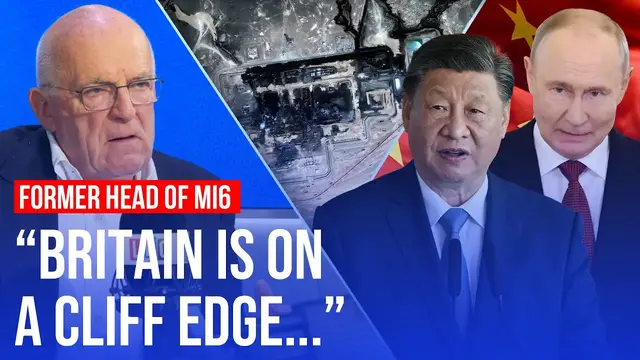
Tom Swarbrick is joined by former head of MI6 Sir Richard Dearlove and economics editor Ed Conway to discuss UK security.
Listen to the full show on the all-new LBC App: https://app.af.lbc.co.uk/btnc/thenewlbcapp
#tomswarbrick #mi6 #china #russia #putin #xijinping #ukpolitics #security #LBC
LBC is the home of live debate around news and current affairs in the UK.
Join in the conversation and listen at https://www.lbc.co.uk/
Sign up to LBC's weekly newsletter here: https://l-bc.co/signup
Show More Show Less View Video Transcript
0:00
I'm really worried about this because I'm not sure how many more shocks the UK can take
0:06
UK borrowing costs have now risen to a 28-year high, 30-year gilts at over or hovering around 6% yesterday
0:13
That is unheard of this century. We have forecast that interest rates will rise again maybe four or five times over the course of the next 12 months
0:20
as inflation ticks up to 3.1% as announced today, made up almost entirely by the increasing cost of petrol
0:28
the prices of which have jumped, wait for it, 9.1p a litre in one month
0:34
Diesel, 14.2p a litre up in one month. Motor fuels in total up 23%, adding to inflation
0:43
And while lifting interest rates might slow inflation down a bit, it can do precisely nothing about rising energy prices
0:50
To that end, Bloomberg reported yesterday that energy prices in January could go up by 25%
0:58
That is £427 a year for the average household. And there is no sign that this is going to slow down
1:05
Saudi's oil infrastructure keeps being hit by Yemeni-Huti rebels. It's meant that the Saudis have basically cut oil shipments to Europe until October
1:14
And I really, really worry now that for Europe, for the UK
1:18
this winter is about to get really bad. Because how much more of this can you actually afford
1:23
How many more times can your energy bills go up? 25% potentially in January, a 23% increase in petrol, we read
1:35
and some supply to Europe from Saudi Arabia now being cut because of those attacks
1:39
Unless something changes, we'll be paying 200 pence per litre by Christmas
1:46
No? So in that environment, in that incredibly squeezed set of circumstances that we are now talking about
1:52
with the UK government only really able to act in some of those areas
1:57
what can, what should the government now be doing to deal with this
2:01
if it can at all? 03456060973. We'll speak to the former head of MI6 in just a moment
2:08
Ed Conway is economics and data editor at Sky News, author of Trade World
2:12
the ties that bound our past and could unravel our future. Thanks for coming on, Ed. To what extent is our future rather unravelling in front of us
2:18
with these energy prices and these petrol prices? Afternoon. Afternoon. Yeah, I mean, it is a depressing story, especially when, you know, we have just been through crisis after crisis
2:30
Everyone is conscious of that. It doesn't feel for a lot of people. I mean, you know, economists look at the inflation numbers and say, oh, look, the cost of living crisis came to an end
2:38
Actually, for most people, it doesn't feel that way. No. Because for most people, it feels just, you go into the supermarket and things are 20% more expensive than they used to be a few years ago
2:46
And I'm afraid the news is just not particularly encouraging. And a lot of this is obviously coming our way
2:53
But it comes back to the fact that you've got war happening in the Persian Gulf
2:57
That is the single biggest source of hydrocarbons, you know, oil and gas
3:02
And we still need them. Like it or not, we still need them for basically every bit of economic activity out there
3:07
including things like AI. You know, AI servers are run for the most part with gas in the US at least
3:13
So we need these things. And then at the same time, over in Russia, you have, and in Ukraine, you have another war going on
3:20
So you have two wars that, to some extent, are coalescing with each other. Both of them happening in places that are big suppliers of global energy
3:28
And to some extent, we kind of just got lucky over the course of the summer
3:32
because oil prices didn't go up as high as a lot of people thought they were going to go. Diesel prices, obviously, we've all seen this, diesel prices, petrol prices, they went up
3:39
but they actually didn't get as high as they got in 2022. too. And part of the reason for that is actually there was quite a lot of resourcefulness and
3:46
below the radar you had shipping companies who were getting some of the oil out of the
3:50
Gulf and then as well as that you had a lot of oil going via this pipeline that goes across Saudi Arabia So basically that kind of worst case scenario we were talking about back in March when things started to kind of really erupt there it never quite materialised But the
4:04
worry is now we're seeing, you know, more of that coming through. And it's partly because
4:09
as you mentioned in your intro, you know, you've got those attacks on the pipeline. It's mostly this east-west pipeline that goes across Saudi Arabia
4:15
question marks over how soon that's going to be back up and running. and at the same time you know obviously when we see attacks on russian oil refineries by ukraine
4:25
there's there's a there's a big part of us that's like okay great you know ukraine is stocking it to
4:29
russia but the flip side is it means there's less diesel coming out of russia which doesn't
4:33
obviously go directly to the uk for the most part but it goes into the global system and it means
4:37
there's less diesel around the world and put it all together and unfortunately well okay final
4:42
Final thing, sorry to lump one miserable thing on top of another
4:46
but final thing that's worth being aware of is the amount of storage that we have across Europe of natural gas
4:53
which we're going to need this winter. Hopefully, it's not going to be a cold winter
4:58
but everything depends on that. The amount of storage we have right now, compared with previous Septembers
5:03
is lower than any previous September going back at least five years. So we have less storage now than we did in 2022
5:09
before, well, we all know what happened that winter. So put it all together
5:15
and it's hard not to conclude that inflation is going to be higher. The Bank of England will probably need to raise interest rates
5:20
at least once. Most economists think there'll be at least one. And the cost of living crisis is not over
5:27
The good news I would give, and maybe it's something to cling to at the moment
5:31
is we've had lots of kind of scary prognostications before. Like I say, we had lots of them in March
5:37
People said this was the worst supply shock ever. People out there in the Persian Gulf trying to get oil out of there
5:43
people out there trying to get oil out of other places like the U.S. are resourceful, and they're working their hardest to try to provide this stuff
5:51
The problem is that geography still matters. Where stuff comes from still matters
5:55
Physical things still matter. We like to think we've transplanted ourselves into this new world
6:00
where all of that stuff doesn't matter. It still matters. And here we are in 2026, and unfortunately we're seeing the result of it right now
6:07
brilliantly put and thank you very much indeed a conway economics and data editor at sky news
6:11
author of the new book trade world the ties that bound our past and could unravel our future talking
6:16
of unravelling our future i'm joined by sir richard dearlove former head of the british
6:19
secret intelligence service mi6 who is giving a speech later on this evening about the threat to
6:24
britain's energy security and just how vulnerable sir richard you believe we are thank you for coming
6:29
in in what way are we vulnerable well i think that we have vulnerabilities in our energy
6:36
infrastructure, which we've allowed to build through neglect over a long period of time. So
6:42
I want to draw attention to that. And then we have a problem with actual and potential exploitation
6:51
both by Russia and China. So what I'm trying to do in this talk is to get people, I mean
6:58
I'd like to think the government in particular, to link energy security much more closely with
7:04
national security and that we have a more thorough understanding of where things could go even worse
7:11
than the picture already painted for you. So you say in this speech we have as a nation negligently
7:17
wandered close to a cliff edge and the adversaries that you describe stand ready to help us over it
7:23
Talk us how we've got to that cliff edge. What does that mean? Well we've lost a lot of our heavy
7:28
industrial manufacturing capacity. And something like the grid has a circularity. Energy to heavy industry
7:38
industry manufacturing what you need for the grid. So for example, now
7:42
if you want to replace generators or step up transformers which require a very special type of steel and I not going to go into the detail because I not a technician There are two companies left in Europe which manufacture it but both of them are being undercut by the Chinese and are threatened with closure
8:06
And the Chinese are pretty close to having global domination of that market
8:13
So if you need to start replacing bits of the grid, which you will have to do inevitably
8:18
the manufacturing capability is in the hands of an adversary that the Director General of the Security Service
8:26
has identified in the long term as the greatest threat to our national security
8:31
But what could they do? What could China, what could Russia do if they become part of that grid system
8:36
if they are so intrinsically part of it? Well, I mean, not supply new generators. So, you know, our grid is in a mess
8:41
and we can't replace it. I mean, what we should be, I think, doing
8:46
is identifying points of vulnerability in the grid and thinking about how in the UK
8:54
we can, as it were, create contingencies to replace our dependence on hostile foreign suppliers
9:02
So, I mean, this is something that's sort of drifted over 10 or 15 years
9:07
No one's been thinking about it. Why do you think that is? Well, it's the emphasis..
9:11
Because it's cheaper. Obviously, it's cheaper. We've let a lot of our heavy industry be exported overseas
9:20
You know, our net zero policies have been sort of a discouragement to the continue of certain heavy industries
9:28
And the Chinese have been extremely strategic and clever in terms of the global economy of actually building contingencies in areas where they identify creating dependencies
9:45
So if you look at the documentation for the Chinese Communist Party Congress, you can see that they actually publish a list of 63 areas of contingency where China now dominates global manufacturing
10:00
And you've seen it with rare earths. I mean, you've seen a brilliant example with rare earths
10:05
You mentioned net zero. To what extent then has net zero in effect created a national security risk
10:12
I think the way it's been pursued in a sort of neglect of our own manufacturing industry, it has put us in a very vulnerable position
10:23
For example, the decline in shipbuilding, our failure, you know, to replace naval ships at a sufficient speed
10:30
I mean, there are all sorts of examples of this. Steelmaking. And I mean, OK, there is now this proposal by the government, which I don't disagree with, surprisingly, to nationalise steel manufacturing
10:43
But it's not just that. We need to rebuild components in the steel industry which can, as it were, create the specialised steel which is needed strategically, particularly for things like armaments and the grid
10:55
Can I ask you about drilling? I've talked a lot about oil, petrol prices, what have you. To what extent would you see it as a national security issue to drill in the North Sea
11:05
I think, okay, it's not going to change the price of energy now, but it is going to reduce over time our dependence on foreign suppliers
11:16
So, you know, if the wind doesn't blow, the sun doesn't shine, you know, we have connectors to other people's energy suppliers, France, for example
11:25
Those undersea cables, those undersea connectors are extremely vulnerable. And, you know, I'm sure people have read and seen about Russian submarines, you know
11:37
prospecting the connectors that the UK depends on. And I mean, they are strategic and really important
11:44
So the logic is that we should be thinking much more about our sort of energy independence I know that you know pricing doesn it might change the equation over 10 or 15
11:58
It's not going to change the equation in the short term, but it's going to make us safer. Well, just finally, arguably, this is what we've described is precisely the reason why we should go hell for leather at net zero
12:08
We should become energy independent via renewables. We then won't need Saudi oil, Russian oil, America's help
12:14
lng from catar we might need it that's not possible you can't rely on renewables totally because they are
12:22
they're interrupted i mean the wind doesn't blow and the sun doesn't shine sometimes
12:31
and we're always going to have to import other energy supplies i mean gas being the main
12:37
alternative we need as it were to have a range of alternatives you can't have a
12:42
you can't have a totally renewable grid. You can have a grid that benefits from renewables
12:49
And actually, when it comes to reviving heavy industrial manufacturing, you need fuels of a higher thermodynamic quality than renewables
13:01
And, you know, basically, that is anthracite coal. What's the thing that you worry about as you close your eyes and go to sleep at night
13:10
that could be happening to that energy system, to that grid system via foreign adversaries
13:15
What's the worst-case scenario here? A breakdown in the grid. Everything, everything, pretty much
13:23
that we depend on for the quality of our life is connected to the grid
13:28
And is shut off by a foreign adversary? Well, in a crisis, it could be
13:34
I'm not saying it would be. So there are two aspects. as replacing the grid when we need to
13:43
dependence on foreign suppliers who, as it were, could have a chokehold on it
13:48
And then there is a further problem with Chinese-manufactured cellular modules in bits of the grid which can be reprogrammed
13:59
over the Internet of Things from China and could, you know, in a crisis..
14:03
So they could shut it off? They could perhaps shut it off or they could shut off aspects
14:07
They could make life very difficult. So let's say an invasion of Taiwan
14:11
where we support the Taiwanese or an American attack on a Chinese attempt to occupy Taiwan
14:20
the Chinese could do some extremely nasty things. I mean, for example
14:25
moving away from the grid, they could immobilise pretty much every electric Chinese-manufactured vehicle
14:31
in the UK at the flick of a switch in China. I mean, that's an unbelievable degree of vulnerability
14:39
Well, you could immobilise every city in the UK by reprogramming the cellular modules in Chinese-manufactured cars
14:50
London Transport are just about to embark on buying Chinese-manufactured electric buses
14:57
They would be vulnerable to reprogramming programming by the manufacturer in China in a crisis
15:07
One to linger on. And I'm not a conspiracy theorist. No, no, no
15:11
I'm just trying to... I mean, let me just give you one example, because it's a good example
15:16
When the Russians captured John Deere tractors in Ukraine, when they invaded originally, those
15:24
John Deere tractors were immobilized by the manufacturer in the West, and the Russians
15:29
couldn't use them. So if we're doing it to our stuff, they will be doing it to their stuff
15:34
They can do it to their stuff. Much more, to a greater degree, in fact, because of the law in China
15:39
and the way industry relates to national security. They're compelled by law to respond to the Chinese government
#news