Up next in 10



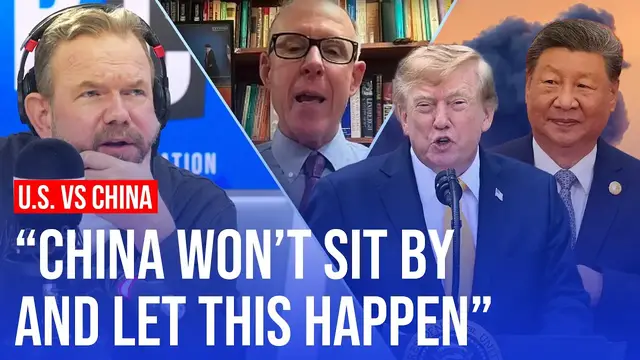
James O'Brien is joined by Middle East specialist Ross Harrison as China hits out at 'illegal' US sanctions on Iran.
Foreign ministry spokesman Lin Jian said China was firmly opposed to the "illegal unilateral sanctions" and would take "all necessary measures" to protect its interests.
This came after US Treasury Secretary Scott Bessent announced the new measures on Monday, warning any nation financially partnering with Iran would be isolated.
Listen to the full show on the all-new LBC App: https://app.af.lbc.co.uk/btnc/thenewlbcapp
#jamesobrien #china #usa #trump #xijinping #iran #politics #LBC
LBC is the home of live debate around news and current affairs in the UK.
Join in the conversation and listen at https://www.lbc.co.uk/
Sign up to LBC's weekly newsletter here: https://l-bc.co/signup
Show More Show Less View Video Transcript
0:00
Should we begin, Ross, with feasibility
0:03
I mean, I presume that the United States of America is capable of fully isolating Iran from the global economy and the financial system
0:12
Am I right to presume that? Well, you're right, James, that the United States has the ability to inflict considerable economic damage on Iran
0:21
But I think it's important to understand that to some degree that weapon that we've had has depreciated over time
0:30
And the reason for that is the United States has used that weapon against Iran in some fashion or another since the Iranian revolution almost
0:37
And certainly since Donald Trump in 2018 walked away from the Iran nuclear deal and imposed or reimposed punishing sanctions
0:48
So the idea was that by imposing sanctions and putting pressure on Iran, two things might happen
0:55
Number one, that the regime might capitulate to US demand, something that's unlikely to happen
1:00
And number two, that the Iranian people feeling the pressure would rise up against the regime
1:05
Again, unlikely to happen. So you are, I think you used the word recycle
1:09
We are trying to recycle an old strategy that has not delivered the desired results now and is unlikely, as of yet, and is unlikely to do it in the future
1:20
And how calibrated is the Iranian economy to resistance of sanctions? Because, you know, in the context of what you've just told us, I presume that they are almost wired to resist American power
1:31
Yeah, the regime has been wired for this kind of warfare, both the military warfare and the economic warfare, for a number of decades now, which is why the regime has been able to survive
1:41
I think it's also important to say that, yes, the Iranian economy is wired this way, but we don't know exactly what kind of damage is being done
1:52
done in terms of economic output on Iran because we're still in wartime
1:58
But the other thing I think, James, is important to say is that they're talking about strangling
2:03
Iran, but there's one piece of that that is missing. And that is that the State Department, the Treasury or the White House has singled out China
2:14
And China is Iran's single biggest trading partner, particularly when it comes to oil
2:19
So they use this hyperbolic language, but in reality, a lot of it is bravado
2:24
It's important, as you indicated earlier, it's important to take the word seriously
2:28
but it's also important to look behind the scenes and say what is real and what's not real, particularly at this point in time
2:34
So Beijing already threatening to retaliate if China is affected by these new sanctions
2:40
And saying, the foreign ministry spokesman, you'll know this, but my listeners may not
2:45
that China's ties with Iran should not be interfered with or undermined. So if you've got the two greatest powers on the planet, one of them is
2:53
threatening to cut you off entirely from the world economy. And the other one is saying, well, hang on
2:57
a minute we are a crucial ally of these people Who going to prevail There no earthly way China are going to sit by and let America do what they threatening to do
3:09
Well, remember, part of this is a distraction, James, because the reality is that there's not going to be
3:14
that much trade until the trade of Hormuz is normalized in some way
3:19
Because there are workarounds in terms of shipping oil different places, but bottom line is that most
3:25
much of the oil that's going towards China does come through, some of it comes through the Bab al-Mendeb, particularly that that's bought from Saudi
3:31
Arabia, but much of it from Iran comes to the Strait of Hormuz. So until the Strait of Hormuz
3:35
is open, then that requires two things. One, it requires the U.S. to release the blockade
3:41
And the second one, it requires the Iranians to release, open up the Strait of Hormuz itself
3:47
So some of this is a lot of posturing and positioning, because regardless of economic
3:53
sanctions, non-economic sanctions, sanctions against China, secondary sanctions. It's a bit of a distraction at this point. A lot of bravado. What's going to require this? The straight-up-whorm
4:04
moves is the key linchpin in this conflict right now. It was open before the war. It's now
4:10
it's a symptom or a byproduct of the war. And that's what has to happen in order to end this
4:18
crisis at this point. I mean, I sometimes have to check. Goodness knows what it's like for you
4:23
because I'm a generalist, you're a specialist. I sometimes have to check that I wasn't imagining things
4:28
It's only in June that the Memorandum of Understanding for Ending the Entire War was signed in Paris
4:33
after Donald Trump had spent weeks arguing that it was close. I think, unless I had a fever dream last night, Ross
4:41
I think yesterday I saw claims that every single explosive device in the Strait of Hormuz had been successfully removed
4:47
or successfully diffused. How do you keep... I think you're hallucinating. You are having dreams
4:56
No, I'm just joking. Don't do that to me. No, listen, you raise a very good point
5:03
Yes, the U.S. did say that all the mines, the strain has been demined
5:08
I have no way to confirm or deny that. I can tell you that you raised the membrane of understanding
5:15
That is what's being fought over because there was an understanding, And the understanding was that Iran would, with the help of Oman, would work to open up the Strait of Hormuz
5:25
The blockade would be ending and they would open up the Strait of Hormuz. What the U.S. did to circumvent the Iranian leverage that was created through that or reflected in that document was to get ships to hug the Omani coast, the southern coast, to circumvent the Iranians
5:40
That then showed the Iranians that their leverage was being compromised and being challenged
5:45
And so they started escalating. And so we are fighting in a way over that memorandum of understanding
5:52
And frankly, I know we don't have much time, but one of the things I must say is the Iranians are not going to let the status quo continue
5:59
Their belief is that their leverage is an asset that will depreciate over time And ultimately if the status quo continues and there no way out my sense is that they will probably escalate And what would that look like
6:13
That will look like probably a calibrated response, but if it does happen, it'll be further attacks on the Gulf Arab states
6:20
And that'll require U.S. action, and then that will be back in the sort of escalation trap
6:25
But the Iranians would rather have that and take that risk rather than lose leverage and then come to a situation where the conflict kind of attenuates
6:37
But now six months from now, a year from now, the Americans, the Israelis come back
6:42
So they're willing to escalate to bring things to a head rather than let the current situation languish
6:47
Good Lord. We've got three more minutes if you have. and I'd like to take you back if I may to the beginning
6:53
and your initial reaction to the news when you heard or read that the US and Israel
7:01
had launched these attacks upon Iran and where the Strait of Hormuz appeared
7:05
and how quickly it appeared in your thinking of what was likely to unfold. Well, you know, about a week or two before the war started
7:14
I was interviewed by Le Monde in Paris, which was then published
7:18
and basically I said that if the war starts, two things are not going to happen
7:24
or one thing is not going to happen, that the regime is not going to collapse because it's built
7:28
for, it was built for this kind of a conflict. And number two, if Iran feels that it has
7:35
is under existential threat, it will do two things. It will close the Strait of Hormuz
7:41
and it will wage attacks on its Gulf Arab neighbors, something that will do reluctantly
7:47
but it will do that. So everything that has happened, James, was knowable before the war
7:52
Well, why, I mean, how do you account for the failure, the intelligence failure in the White
7:56
House? It wasn't an intelligence failure. It was a policy failure. It's a policy failure
8:01
The intelligence was there. The head of the CIA, when Benjamin Netanyahu came to Washington and
8:08
sat in this unprecedentedly, unprecedentedly sat in the Situation Room of the White House
8:13
on February 11th, he basically made the case for war. And the intelligence community basically said
8:19
that the predictions that Netanyahu were making were false. Got it. An unlikely trend
8:24
So this was not an intelligence failure. It was a policy failure, a failure on the leadership of the United States
8:29
They're thinking that they could defy gravity almost. I mean, political gravity, military gravity, really
8:35
I feel like the events are upending my gravity as well. Now we're almost into the seventh month of this war
8:42
absolutely insane and this is not a fair question to ask you but it'll be my last one
8:46
how do you think it ends how do i think it ends i think there's only a couple ways it can end one
8:54
is which is probably one of the worst scenarios um is that this this sort of attenuates into kind
9:03
of a no peace no war situation and that a horrible situation because you don have any kind of resolution at that point on the Strait of Hormuz You have the potential for further conflict when the U rearms and Israel rearms and something
9:18
happens. So it could attenuate and lead into some kind of a sort of ambiguous situation
9:25
The other way it can end, which is quite possible, but seeming right this moment
9:30
we don't see the pathway is towards some kind of a negotiated settlement. Listen
9:33
Listen, negotiations work when both parties believe they have more to gain at the negotiating table on the battlefield
9:42
And the United States clearly does not believe that to be the case
9:46
And frankly, the longer this goes on, Iran also will believe that if it goes to negotiations now, while it's under siege
9:55
that it actually has more to gain by escalating, as I mentioned earlier, than by negotiating
10:01
That's the danger we're in. But at some point, you get to a point where both parties say
10:06
there's nothing to gain through kinetic action, there's nothing to gain by further economic pressure
10:12
and we have to negotiate. And remember, what are we negotiating? We're negotiating an opening of the Strait of War moves
10:18
that was opened before the war. So then you have to get to the point, no one's even talking about the nuclear issue
10:24
No. It's incredible how that drops off the agenda entirely as the weeks pass, isn't it
10:30
Well, the Israelis won't let that happen over time. But now in the context of this war, and I know I said that was my last question
10:37
but finally, how good was the JCPOA in terms of, I began by asking you about what was feasible in the context of what is going on with regards to these sanctions
10:45
but how good was the JCPOA, the agreement that Trump torched in term one
10:51
Yeah, well, James, it's hard to say because, I mean, I was in support of the JCPOA
10:55
The JCPOA was never a sure thing in terms of changing the polarity of Iran, moving into a more cooperative stance
11:04
What it was was a bet on the future. It was a bet that if we can find some kind of way to de-escalate on the nuclear issue
11:12
And remember, Iran, when the U.S. walked out of that agreement in May of 2018, I was actually with Iranians when this happened
11:19
In May of 2018, Iran was living up to the deal. So this was a breach. And your country, the UK, was a signatory to the JCPOA, Germany, France, Great Britain, China, and Russia
11:33
And so they didn't just walk out on Iran. They walked out on the entire permanent members of the Security Council plus Germany
11:39
And it was a bet on the future. It was not – and it was working
11:43
But in terms of whether it would have been a transformative kind of event, it just was never given a chance
11:48
So it was diplomatic. Walking out of that deal was diplomatic malpractice
11:53
And I'm glad we end on that note because it kind of brought us to where we are today
11:58
Gosh, thank you. That was absolutely brilliant. Ross Harrison, I hope we get to talk again because I now understand things that I didn't think I'd ever understand
12:05
let alone the things that I thought I might eventually. You're a senior fellow there at the U.S.-based think tank, the Middle East Institute
12:11
and the author of the book Decoding Iran's Foreign Policy
news