0:00
The following is a dramatized narrative,
0:02
inspired by documented patterns of
0:05
forensic misidentification
0:08
in rural jurisdictions during the 1980s
0:13
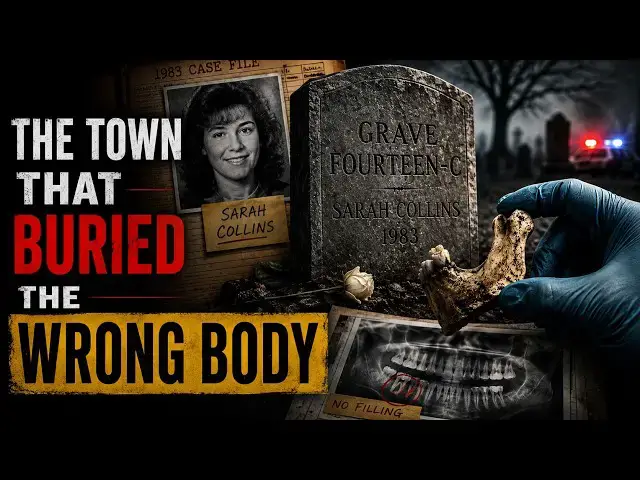
A technician kneeling in a cemetery
0:15
outside a small Midwestern town in the
0:20
lifted a fragment of bone from the soil
0:24
and knew immediately that the paperwork
0:26
in her other hand was wrong.
0:30
She had been sent to collect a DNA
0:32
sample from what the records called
0:37
belonging to a woman named Sarah
0:38
Collins, murdered in 1983,
0:41
and identified through physical
0:43
description before burial.
0:46
The exhumation was part of a statewide
0:48
cold case initiative.
0:52
But when the medical examiner compared
0:54
the skeletal measurements to the
0:56
original autopsy photographs pulled from
0:59
storage that morning, the height did not
1:03
The dental work described in the Sarah's
1:05
medical file, a filled cavity on the
1:08
lower left molar, was absent from the
1:10
jaw now resting under laboratory light.
1:14
Sarah Collins was not in this grave.
1:17
Her mother had visited this plot every
1:19
week for 18 years before she died.
1:24
Her younger brother still brought
1:25
flowers on her birthday.
1:27
They had grieved here.
1:30
They had spoken her name into the
1:33
And for 40 years, they had been speaking
1:37
The case file had been closed since
1:41
The investigation into Sarah's murder
1:44
had gone cold within months.
1:47
Detectives had retired.
1:49
Evidence had been archived, then
1:52
digitized, then tagged for the DNA
1:55
project that would finally reveal what
1:58
no one had questioned for nearly half a
2:02
The question now was not whether a
2:04
mistake had been made.
2:07
The bones confirmed that.
2:10
The question was whether anyone had
2:13
Sarah Collins disappeared on the night
2:21
Last seen leaving a diner parking lot
2:23
after her shift ended just past
2:26
Her car was found abandoned on a county
2:28
access road 4 days later.
2:31
Keys still in the ignition.
2:35
6 weeks after that, a surveying crew
2:37
discovered human remains in a wooded
2:40
area 11 miles from where the car had
2:44
Advanced decomposition.
2:46
The forensic pathologist assigned to the
2:48
case noted female, approximate age 20 to
2:54
Approximate height 5 ft 7 in.
2:57
Blond hair still attached to portions of
3:01
Sarah Collins had been 5 ft 7.
3:06
Reported missing by her family.
3:09
The medical examiner made the
3:12
Dental records existed.
3:15
Sarah's family dentist was still
3:19
But the autopsy report contains a
3:21
handwritten note clipped to the final
3:23
page, undated and unsigned.
3:27
Family confirms clothing.
3:29
Dental comparison deferred pending
3:33
The coroner's office had been operating
3:35
at a deficit for 3 consecutive years.
3:39
Dental consultations required
3:41
contracting an outside specialist.
3:45
Autopsies were already overbudget.
3:48
According to county records from that
3:50
period, the office had been instructed
3:53
to minimize costs wherever possible.
3:57
The body was released to the family for
3:59
burial within 72 hours of
4:04
Sarah's parents held the funeral on a
4:08
Small service, closed casket.
4:11
The grave was dug in the newer section
4:13
of the municipal cemetery.
4:16
A flat stretch near the perimeter fence
4:19
where the headstones were uniform and
4:21
the grass was kept short.
4:23
For 38 years, no one questioned it.
4:27
The case remained technically open.
4:29
Sarah's killer was never found, but her
4:32
identity was considered settled.
4:35
The detective who had handled the
4:37
investigation retired in 1992.
4:41
His successor inherited the file,
4:43
glanced through it once, and moved on to
4:48
By the time the cold case DNA initiative
4:51
was launched in 2020,
4:54
the original circumstances of Sarah's
4:57
had been buried under decades of
5:00
administrative transfers,
5:02
office relocations, and format
5:06
The exhumation order was signed by a
5:08
judge who had been in elementary school
5:13
The technician who arrived at the
5:15
cemetery that morning had performed this
5:19
She expected routine.
5:22
The grave was opened by a contractor
5:24
using a small backhoe.
5:26
The casket was removed and transported
5:28
to the state medical examiner's office
5:32
By 4:00 that afternoon, the measurements
5:36
The skeleton measured 5 ft 3 in.
5:39
Sarah's driver's license, still on file
5:42
in the original case folder,
5:44
listed her at 5 ft 7.
5:48
is not a rounding error.
5:51
The pelvis showed evidence of an old
5:57
Sarah's archived medical records,
6:00
requested from her former physician,
6:02
contained no mention of such an injury.
6:06
And the teeth told the rest.
6:08
Sarah had a documented dental filling
6:13
The receipt had been submitted by her
6:15
family during the original missing
6:17
persons investigation.
6:19
The skull from grave 14C showed no
6:24
no fillings, no dental work of any kind.
6:29
The examiner picked up the phone.
6:32
According to later testimony, the
6:34
conversation lasted less than 3 minutes.
6:37
The words exchanged were procedural,
6:42
but the conclusion was immediate.
6:44
They had buried the wrong woman.
6:47
The original investigation had been
6:49
handled by a two-detective unit
6:51
operating out of a sheriff's office with
6:57
The lead investigator was a man with
6:59
more than two decades of experience in
7:05
His partner was younger, newer,
7:08
and rarely made independent decisions.
7:18
When the body was discovered in August
7:22
it was logged, photographed, and
7:24
transported within 6 hours.
7:27
The forensic pathologist who performed
7:29
the autopsy noted blunt force trauma to
7:38
undetermined pending further
7:42
Identification was listed as
7:46
subject to confirmation.
7:48
That confirmation never occurred.
7:51
The case file contains the unsigned note
7:54
about deferred dental comparison.
7:57
It also contains a second document,
8:00
a one-page memo from the county
8:02
administrator's office to all department
8:05
heads dated June of 1983,
8:08
instructing staff to exercise maximum
8:12
fiscal restraint in discretionary
8:17
Dental consultations were discretionary.
8:20
The clothing recovered with the body,
8:23
denim jeans, white canvas sneakers,
8:26
remnants of a dark shirt,
8:28
matched the general description of what
8:30
Sarah had been wearing the night she
8:34
A co-worker at the diner, interviewed
8:37
during the missing persons
8:38
investigation, recalled Sarah in jeans
8:44
The lead detective wrote in his case
8:46
summary that the identification was
8:49
consistent with available evidence and
8:54
He recommended the body be released.
8:59
The death certificate was signed on
9:05
Sarah Elizabeth Collins,
9:09
Her family buried a woman they believed
9:12
was their daughter 3 days later.
9:16
They visited the grave.
9:18
They marked anniversaries.
9:21
And no procedural safeguard existed to
9:25
because the system had been designed to
9:27
assume that once a body was named and
9:30
the question was closed.
9:33
What the investigators did not know,
9:35
what could not have been known without
9:38
the technology that would not exist for
9:42
was that Sarah Collins had not been in
9:47
And somewhere else, another family had
9:51
>> 4 months after the exhumation, forensic
9:54
genealogists working with the cold case
9:57
unit uploaded the DNA profile from the
10:00
unidentified remains to a national
10:05
The process took 8 weeks.
10:07
The match was returned on a Tuesday.
10:10
The woman in grave 14C was named
10:13
Jennifer Marie Hale.
10:15
Jennifer had been reported missing in
10:17
early July of 1983 by her mother
10:21
who lived in a city 70 miles south.
10:27
last seen leaving a bus depot after
10:32
She never arrived home.
10:35
The missing person's report had been
10:37
filed with a different jurisdiction.
10:40
The cases were never cross-referenced.
10:44
The agencies did not communicate.
10:48
Jennifer Hale was 5 ft 3 in tall, blonde
10:53
She had fractured her pelvis in a fall
10:58
She matched the exhumed remains in every
11:03
Her mother had died in 2009
11:08
She had kept Jennifer's bedroom
11:14
She had hired private investigators
11:19
She had died without knowing where her
11:22
daughter had been buried.
11:25
Genealogists were able to locate
11:28
Jennifer's younger sister, now in in
11:30
late 50s, living two states away.
11:33
She agreed to provide a reference DNA
11:36
sample. The match was confirmed within
11:40
She requested that her sister's remains
11:42
be returned for reburial in the family
11:47
The request was granted.
11:50
But the correction of one grave raised
11:52
the second question.
11:54
If Jennifer Hale had been buried under
11:56
Sarah Collins's name in 1983,
12:00
then where was Sarah?
12:02
The cold case unit reopened Sarah's
12:05
file, now reclassified from closed to
12:09
active unsolved homicide.
12:12
They re-interviewed surviving witnesses.
12:14
They searched regional databases for
12:17
unidentified remains discovered between
12:23
They expanded the search to four
12:29
>> Sarah's younger brother provided a DNA
12:33
It was uploaded to every available
12:35
forensic and genealogical database.
12:38
No matches. No partial hits.
12:41
No investigative leads.
12:44
As of the most recent update,
12:46
Sarah Collins has been missing for 41
12:50
The state issued formal letters of
12:52
apology to both families
12:57
An internal review concluded that the
12:59
original identification had been
13:02
conducted below acceptable standards,
13:05
and that systemic budget pressures had
13:08
contributed to procedural failures.
13:11
No individuals were disciplined.
13:14
Everyone directly involved in the
13:16
original case was either deceased or
13:20
beyond the reach of administrative
13:23
Jennifer Hale was reburied beside her
13:26
mother in the spring of 2022.
13:30
Her sister was the only family member in
13:34
She told a journalist afterward that she
13:36
was grateful to finally bring Jennifer
13:40
She also said she wished their mother
13:43
had lived long enough to see it.
13:45
Sarah Collins' brother still visits the
13:50
But the grave he visits now is empty.
13:54
It was excavated, examined, and sealed
13:58
again without a occupant.
14:01
He brings flowers anyway.
14:03
In the language of administrative
14:05
review, the case is classified as a
14:10
due to insufficient verification
14:12
protocols and resource constraints.
14:16
But that language does not account for
14:18
the four decades that followed.
14:21
It does not account for the two mothers
14:23
who grieved in separate towns, each
14:26
believing they knew where their daughter
14:28
lay, neither knowing the truth.
14:31
The investigator who ordered the
14:34
was asked in a recorded interview
14:37
whether she believed Sarah Collins
14:43
She said she believed Sarah had died in
14:49
She said she believed there was another
14:51
grave in another cemetery
14:54
that had never been questioned.
14:57
And in that grave, she believed was a
15:00
body that had never been correctly
15:04
The system that allowed the mistake,
15:08
prioritized over verification,
15:11
administrative convenience prioritized
15:16
remains largely unchanged.
15:19
Forensic genealogy has created new tools
15:24
but it cannot correct what it never
15:27
And across the country, in small town