Up next in 10

Before Lucky Luciano...
Before Meyer Lansky...
Before the Five Families...
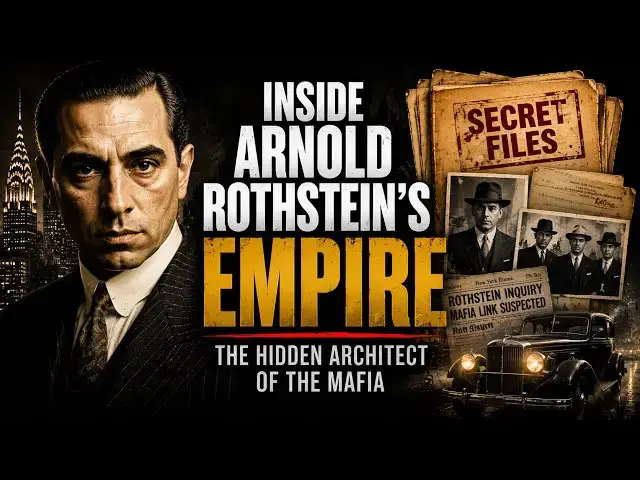
There was Arnold Rothstein.
The financier who transformed organized crime from street violence into a sophisticated criminal enterprise.
This documentary explores the life, influence, and mysterious death of the man who quietly shaped the modern American Mafia.
Based on historical records, court documents, FBI investigations, and published historical sources, this documentary examines:
• The 1919 Black Sox Scandal
• Prohibition and the bootlegging empire
• Lucky Luciano's rise
• Meyer Lansky's early career
• Political corruption
• Tammany Hall connections
• The mysterious disappearance of Rothstein's files
• The murder that changed organized crime forever
Show More Show Less View Video Transcript
0:00
November fourth, nineteen twenty-eight.
0:03
The Park Central Hotel, West Fifty-sixth Street, Manhattan.
0:08
A man in a gray suit stumbled through the service entrance and collapsed against the wall.
0:15
His name was Arnold Rothstein. He was forty-six years old.
0:20
He had been shot once, in the abdomen.
0:23
And he was still conscious — still thinking — when the first hotel employee found him.
0:31
Police arrived within minutes.
0:33
Rothstein was sitting upright, holding his side, entirely lucid.
0:38
They asked him who had done it.
0:40
According to investigators who later documented the exchange, he gave them words to this
0:47
effect: You stick to your business.
0:50
I'll stick to mine. That was the last useful thing he ever said to law enforcement.
0:57
He died two days later at Polyclinic Hospital. The wound had been survivable.
1:03
But Rothstein refused surgery for nearly twelve hours — long enough, some investigators
1:09
believed, for certain records to be moved.
1:15
Within forty-eight hours of his death, three things happened that would define the next
1:21
decade of American organized crime.
1:24
His personal files — reportedly containing the names and financial obligations of judges,
1:30
politicians, police captains, and at least two sitting members of Congress — vanished from
1:37
his office on West Fifty-seventh Street.
1:40
His wife, Carolyn, told investigators she knew nothing about the files.
1:46
His attorney said the same. His associates said nothing at all.
1:51
The silence was not accidental. It was architecture.
1:56
This account draws from court records, published histories, and documented testimony.
2:02
What makes Rothstein's story difficult to tell is not the violence.
2:07
Most of it happened elsewhere, carried out by men he financed but never touched.
2:13
What makes it difficult is the absence — how deliberately the record was cleaned.
2:20
How many powerful men needed it cleaned.
2:23
The question that investigators could not answer in nineteen twenty-eight — and that
2:29
historians still argue about — is not who killed Arnold Rothstein.
2:34
That was always secondary. The question is: what was in those files?
2:44
Arnold Rothstein was born on January seventeenth, eighteen eighty-two, on the Lower East
2:51
Side of Manhattan.
2:52
His father, Abraham, was a respected businessman and devout Jew — known in the neighborhood
2:59
as Abe the Just.
3:00
His brother Harry would become a rabbi. Arnold chose differently.
3:06
By the age of sixteen, he had stopped attending school and started spending his nights in
3:13
the pool halls and gambling rooms south of Houston Street.
3:17
He did not gamble recklessly. He watched. He calculated.
3:21
What fascinated him was not the game itself — it was the margin. The edge.
3:27
The understanding that in any contest between emotion and mathematics, mathematics always
3:34
won.
3:41
By nineteen oh-two, Rothstein was running his own card games out of rented hotel rooms near
3:48
Times Square.
3:49
He was twenty years old. He dressed quietly. He spoke softly.
3:54
He extended credit to men who could not get it from banks — and then collected with a
4:01
patience that made his competitors nervous.
4:04
According to those who knew him during this period, as documented in Leo Katcher's
4:10
biography, he never raised his voice.
4:13
He never had to.
4:15
The principle was simple. And it would define everything that followed.
4:21
Rothstein did not want to own the game. He wanted to own the debt.
4:27
By nineteen ten, his operation had expanded beyond gambling into real estate, insurance, and
4:36
legitimate business fronts.
4:38
He bought a townhouse on West Forty-sixth Street. He married Carolyn Greene, a showgirl.
4:47
He moved through the theater district like a man who belonged — because, in a financial
4:55
sense, he did.
4:57
He was not yet thirty.
4:59
He already understood something that most criminals never learn: the man who controls the
5:07
money controls everything else.
5:10
The muscle, the territory, the politics — all secondary instruments.
5:18
But the money was never the point, exactly.
5:21
What Rothstein understood — and what set him apart from every street-level operator in New
5:27
York — was that crime could be structured like finance.
5:31
Risk could be hedged. Outcomes could be priced.
5:35
And the man standing in the middle, holding the capital, never had to touch the product.
5:42
He was building something no one had a name for yet.
5:47
September, nineteen nineteen.
5:50
The Cincinnati Reds versus the Chicago White Sox in the World Series.
5:55
The greatest scandal in the history of American sports — and the event that would make
6:01
Arnold Rothstein's name permanently dangerous.
6:05
The story, as it entered public memory, was simple: Rothstein fixed the World Series.
6:11
He paid eight White Sox players to lose. He bet against them and collected a fortune.
6:17
The reality, according to the historical record — including trial testimony, grand jury
6:24
transcripts, and later investigative accounts — was more complicated and, in some ways, more
6:30
revealing.
6:32
Rothstein did not originate the fix.
6:35
The scheme was first proposed by several lower-level gamblers, including Abe Attell and
6:41
Sport Sullivan, who approached him for financing.
6:45
The players had already been sounded out. What Rothstein provided was not the idea.
6:51
It was the capital — and the organizational discipline to make the fix work across multiple
6:59
games in a best-of-nine series.
7:01
According to accounts later published by Katcher and by David Pietrusza in his study of the
7:08
scandal, Rothstein's initial instinct was caution.
7:12
As later recounted by associates who were present at the meeting, he told them words to this
7:19
effect: If a thing is worth doing — it is worth doing right.
7:23
And I am not certain you have the people to do it right.
7:28
He reportedly committed eighty thousand dollars — some estimates run higher — and placed
7:34
bets through intermediaries in multiple cities.
7:37
The returns were enormous.
7:39
Historians have estimated his total profit from the fix at between two hundred seventy
7:45
thousand and three hundred fifty thousand dollars — equivalent to several million in today's
7:52
money.
7:53
But the profit was not the most important outcome.
8:03
A grand jury was convened in nineteen twenty. Rothstein was called to testify.
8:09
He appeared voluntarily, dressed immaculately, and denied everything with a composure that
8:16
several reporters described as nearly theatrical.
8:20
According to the grand jury transcript, as cited in Pietrusza's account, Rothstein told the
8:27
panel words to this effect: I don't bet on ball games.
8:31
I never have. I am not a betting man.
8:35
He walked out of the grand jury room a free man.
8:39
No indictment was returned against him — though eight players were indicted and ultimately
8:45
banned for life by Commissioner Kenesaw Mountain Landis.
8:50
The players paid the price. Rothstein paid nothing.
8:54
What investigators missed — and what historians would only fully recognize decades later —
9:01
was that the World Series fix was not Rothstein's masterpiece.
9:05
It was his proof of concept.
9:07
He had demonstrated that a large, complex outcome could be engineered from a distance, using
9:14
capital as the only instrument, without the operator ever appearing in the room where the
9:21
action took place.
9:22
That model — financier, not operator — would become the architecture of American organized
9:29
crime for the next half century.
9:37
Nineteen twenty. The Eighteenth Amendment went into effect.
9:41
The manufacture, sale, and transportation of alcohol became illegal across the United
9:48
States.
9:49
For most criminals, this was an opportunity. For Rothstein, it was a business plan.
9:55
He did not run rum himself. He did not drive trucks.
9:59
He did not own speakeasies — at least not directly.
10:03
What he did was finance the men who did all of those things.
10:07
A bootlegger needed capital to buy liquor overseas, bribe customs officials, rent warehouse
10:14
space, and pay drivers.
10:16
That capital had to come from somewhere. Increasingly, it came from Rothstein.
10:23
According to historian Rich Cohen, writing in his account of the era, Rothstein functioned
10:29
as the central bank of the underworld — extending credit, setting terms, and collecting
10:35
interest with a reliability that legitimate banks could not match.
10:41
The men who borrowed from him read like a roster of the next generation's criminal
10:48
leadership.
10:49
Charles Lucky Luciano. Meyer Lansky. Frank Costello. Dutch Schultz. Waxey Gordon.
10:55
Every one of them, at some point between nineteen twenty and nineteen twenty-eight, owed
11:03
Rothstein money.
11:05
And owing Rothstein money was not like owing money to a loan shark on a street corner.
11:11
He did not threaten. He did not break bones.
11:14
He simply made it clear — through tone, through patience, through the quiet withdrawal of
11:21
future credit — that the debt would be paid.
11:24
As later described by associates, and documented in published accounts, the understanding
11:31
among those who dealt with him was simple: You don't cheat Rothstein.
11:36
Not because he'll hurt you. Because he won't do business with you again.
11:42
And then you're finished.
11:44
This was not merely a criminal network.
11:47
It was a credit system — and Rothstein was its only central authority.
11:53
He took no formal title. He held no territory. He ran no crew.
11:58
He simply sat at the center of a web of obligations that made him indispensable.
12:07
The narcotics trade followed the same model.
12:10
By the mid-nineteen twenties, Rothstein had begun financing large-scale heroin and cocaine
12:17
shipments from Europe, using intermediaries and front companies to insulate himself from
12:23
direct exposure.
12:24
According to federal investigators cited in later accounts, his drug network imported
12:30
product worth millions of dollars annually — but his name appeared on no shipping manifests,
12:37
no warehouse leases, no customs declarations.
12:41
He was, in every functional sense, invisible.
12:44
And invisibility, in the nineteen twenties, was the most valuable currency of all — because
12:51
it meant that law enforcement could not build a case.
12:55
They knew what he was. They could not prove what he did.
13:00
But the cost of that invisibility was accumulating.
13:04
Every loan extended was a relationship that could turn.
13:08
Every politician protected was a liability that could be exposed.
13:13
Every associate who knew the system was a potential witness.
13:18
Rothstein understood this better than anyone.
13:21
He kept meticulous records — and those records were his insurance.
13:26
If he went down, the records would surface.
13:30
And the records would take half of Tammany Hall with him. The protection was mutual.
13:36
And mutual protection, in crime, is always temporary.
13:46
September, nineteen twenty-eight. A high-stakes poker game in a Manhattan apartment.
13:53
The players included Rothstein and several professional gamblers. The game ran for two days.
14:00
When it ended, Rothstein owed three hundred twenty thousand dollars.
14:06
He refused to pay. This was extraordinary.
14:09
Rothstein had built his entire empire on the principle that debts were honored — that the
14:16
system worked because the system was reliable.
14:19
He had extended millions in credit over two decades on the understanding that repayment was
14:26
non-negotiable.
14:27
Now he was the one who would not pay.
14:31
According to multiple accounts, including those documented by Katcher and later by
14:37
Pietrusza, Rothstein told the other players that the game had been rigged.
14:42
That the cards had been stacked against him.
14:46
That he owed nothing because the contract — the unspoken contract of a fair game — had been
14:53
broken.
14:54
As later recounted by those present, he told them words to this effect: I'm not paying.
15:00
The game was not on the level, and you know it.
15:04
The men he owed — George McManus among them — disagreed.
15:08
They had won fairly, by their account.
15:10
And three hundred twenty thousand dollars was not a sum that could be absorbed or forgiven.
15:17
The debt sat unpaid for weeks. Then came the phone call.
15:24
On the night of November fourth, nineteen twenty-eight, Rothstein received a call at Lindy's
15:31
Restaurant on Broadway — his regular haunt, the place where half of New York's underworld
15:37
knew to find him.
15:39
According to the restaurant staff who later testified, he took the call, put on his coat
15:45
without finishing his meal, and left.
15:48
He walked to the Park Central Hotel. Room three-forty-nine.
15:53
What happened inside that room has never been fully established.
15:57
The accounts from that period do not agree on the sequence.
16:01
What is known is that a single shot was fired, and Rothstein staggered out of the room and
16:07
down the service stairs with a bullet in his abdomen.
16:11
George McManus was later arrested and charged with the shooting.
16:16
He was acquitted in nineteen twenty-nine.
16:19
The trial was widely described as a formality — the key witnesses were either unavailable or
16:25
unwilling to testify.
16:27
The investigating detective, a veteran named Patrick Flood, reportedly told colleagues that
16:34
the case was not solvable — not because evidence was lacking, but because too many people
16:40
needed it unsolved.
16:42
Rothstein lingered for two days. He spoke to police once more, in the hospital.
16:49
He identified no one. He explained nothing.
16:52
According to the police report, he told the officers at his bedside: Me mudder did it.
16:59
Whether this was delirium, contempt, or simply the reflex of a man who had never cooperated
17:06
with law enforcement in his life, no one can say.
17:11
He died on November sixth, nineteen twenty-eight. He was forty-six years old.
17:24
Within hours of his death, investigators attempted to locate the personal files Rothstein
17:30
was known to have maintained — the ledgers, the IOUs, the records of loans made to
17:36
politicians, judges, police officials, and criminal associates across three decades.
17:43
The files were gone.
17:45
Some historians believe they were destroyed by Rothstein's associates to protect themselves.
17:51
Others believe they were seized by Tammany Hall operatives before police could arrive.
17:57
A third possibility — that Rothstein himself arranged for their destruction before entering
18:04
the Park Central — has never been confirmed or ruled out.
18:08
The documents that survive tell only part of the story.
18:12
What the files contained — and who they would have implicated — remains one of the most
18:18
significant absences in the historical record of American organized crime.
18:24
What did surface, in the weeks and months that followed, was enough to cause panic.
18:30
Partial records recovered from Rothstein's estate revealed connections to narcotics
18:35
trafficking, judicial corruption, and political bribery on a scale that even veteran
18:41
investigators found difficult to absorb.
18:44
The partial records alone led to a major narcotics investigation, the exposure of several
18:50
corrupt officials, and a citywide reckoning with the depth of Tammany Hall's entanglement
18:57
with organized crime.
18:58
And those were just the files that were not destroyed in time.
19:08
The strangest part of this record is not what Rothstein built. It is what survived him.
19:15
Within five years of his death, the men he had financed, mentored, and organized had
19:21
restructured American organized crime along precisely the lines he had demonstrated.
19:28
Lucky Luciano abolished the old boss-of-bosses model and created the Commission — a
19:34
governing body that managed disputes between crime families through negotiation rather than
19:41
war.
19:42
The principle was Rothstein's: structure over violence. Capital over territory.
19:47
Meyer Lansky built a financial empire that stretched from Havana to Las Vegas, managing
19:54
money for multiple criminal organizations with a discipline that law enforcement could not
20:00
penetrate for decades.
20:02
He was, in every meaningful sense, Rothstein's successor — the man who took the model and
20:08
made it permanent.
20:10
Frank Costello became the prime minister of the underworld — a political fixer and power
20:16
broker who operated through influence rather than force.
20:20
His method of control — quiet payments, strategic relationships, institutional leverage —
20:27
was a direct inheritance from Rothstein's playbook.
20:30
According to those who studied the relationship, Costello's rise was a living illustration
20:37
of what Rothstein had taught him: power was not about fear.
20:41
Power was about making yourself necessary to people who could never admit they needed you.
20:50
Even Dutch Schultz, the most volatile and violent of Rothstein's former borrowers,
20:56
understood the principle — though he could never fully embody it.
21:00
Schultz's eventual murder by the Commission in nineteen thirty-five was, in a sense, a
21:06
Rothstein-style correction: the system removing an element that threatened the system's
21:12
stability.
21:14
The model Rothstein created — crime as finance, the operator as invisible banker, violence
21:21
as a cost to be minimized rather than a tool to be celebrated — did not die with him.
21:27
It became the default architecture of American organized crime for the next fifty years.
21:34
The Kefauver hearings. The McClellan hearings. The Valachi testimony. The RICO prosecutions.
21:42
Every major investigation of the mid-twentieth century was, in some sense, an attempt to
21:49
dismantle the structure that Rothstein had first demonstrated was possible.
21:55
And none of them fully succeeded.
21:58
Because the structure was not a hierarchy that could be decapitated.
22:03
It was a financial logic — a way of organizing criminal enterprise around credit,
22:09
insulation, and mutual dependency — that could be rebuilt by anyone who understood the
22:15
mathematics.
22:16
Rothstein had not built an empire. He had built a template.
22:21
The moral inversion at the center of this story is precise and uncomfortable.
22:26
Arnold Rothstein — the man who built the modern architecture of American organized crime,
22:33
who financed its expansion, who taught its future leaders how to operate — died because he
22:39
broke the one rule he had spent his entire career enforcing.
22:43
He refused to pay a debt.
22:46
The system he created was designed to survive exactly the kind of man he was: brilliant,
22:52
indispensable, and ultimately replaceable.
22:55
The man who made crime modern was consumed by the modernity he had invented.
23:01
The structure did not mourn him. It absorbed him.
23:05
His grave is in Union Field Cemetery, Queens. The headstone is modest. No title. No epitaph.
23:13
Nothing to suggest the scope of what he built or the depth of what he understood.
23:19
The system does not mark its architects. It does not need to. It simply continues.
#People & Society