Up next in 10

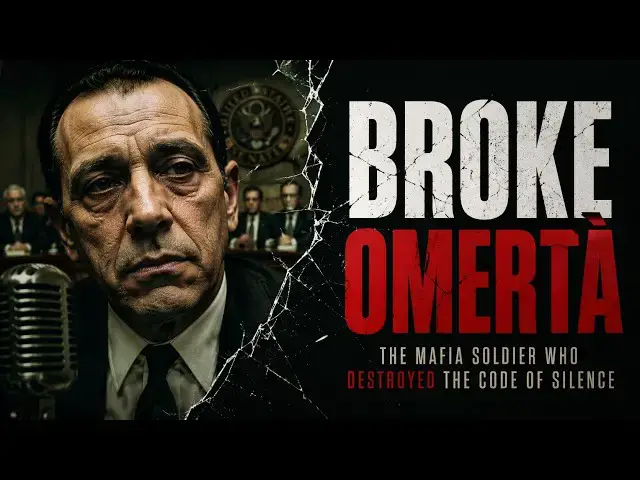
Watch the original Joseph Valachi testimony from 1963. See the moment a mob soldier publicly exposed the Mafia to the US Senate.
This video documents the historic Senate committee hearings where Joseph Valachi broke the code of silence. If you are interested in American mob history, this footage provides a direct look at the evidence boards and prison context surrounding his decision to speak to federal authorities.
By testifying, Valachi changed the public understanding of organized crime 1963. This archive footage captures his low-ranking perspective on the inner workings of La Cosa Nostra, offering a rare glimpse into how the government handled the first major defector from within the criminal organization.
Subscribe for weekly historical crime breakdowns, and comment below on which criminal case you want to see covered next.
Show More Show Less View Video Transcript
0:00
October first, nineteen sixty-three.
0:03
A man in a gray suit — fifty-nine years old, five foot six, hands clasped flat against a
0:09
wooden table — sat before the United States Senate.
0:13
He was not a politician. He was not a lawyer.
0:17
He was not an expert in anything the government would normally invite to testify.
0:23
He was a killer. A low-ranking soldier from the streets of East Harlem.
0:29
And what he was about to say would dismantle a century of silence.
0:34
The word he used was one most Americans had never heard. Cosa Nostra. He said it plainly.
0:41
Without drama. As if naming a company he had worked for — which, in a sense, he had.
0:49
This account draws from Senate hearing transcripts, published investigations, and documented
0:56
F-B-I records.
0:57
Before that morning, the American Mafia did not officially exist.
1:02
Not according to the Federal Bureau of Investigation. Not according to most prosecutors.
1:09
Not according to anyone in power who might have been expected to stop it.
1:15
For decades — generations — the organization had operated behind a single, invisible wall.
1:22
A rule so absolute it did not need to be written down. Omertà. The code of silence.
1:28
Omertà was not just a tradition. It was architecture.
1:33
Every business, every murder, every political arrangement the Mafia ever made depended on
1:41
one structural certainty — that no member would ever speak to outsiders about the existence
1:48
of the organization itself.
1:50
Not to police. Not to prosecutors. Not to journalists.
1:55
Not to family members outside the life. The rule was simple. You do not confirm.
2:02
You do not explain. You do not name. And if you break it — you die.
2:12
The man who sat before the Senate that morning knew this rule better than most.
2:18
He had lived inside it for thirty years. His name was Joseph Valachi. He was not a boss.
2:25
He was not a strategist.
2:27
He was not, by any measure, important within the hierarchy he was about to expose.
2:34
And that was precisely what made his testimony so devastating.
2:39
If a boss had spoken, the families could have called it a power play. A manipulation.
2:46
A bid for leverage. But Valachi was nobody. A street soldier.
2:51
A man who drove cars and collected debts and did what he was told for three decades.
2:58
When a man like that speaks — when a man with nothing to gain and everything to lose sits
3:05
before a microphone and says the words — it is not strategy.
3:09
It is surrender.
3:11
And surrender, inside Cosa Nostra, is the one thing the structure cannot absorb.
3:18
The question that matters is not what Valachi said.
3:21
Investigators already knew much of it — the names, the hierarchies, the territories.
3:27
The question that matters is why he said it. What broke inside the code.
3:32
What pressure finally exceeded the weight of silence.
3:36
And whether, once the code was broken, anything could put it back together.
3:48
To understand what Valachi destroyed, you have to understand what Omertà built.
3:54
By the late nineteen fifties, Cosa Nostra controlled territory in at least twenty-six
4:00
American cities.
4:02
Five families operated in New York alone.
4:05
Their combined revenue — from gambling, loan-sharking, labor racketeering, narcotics, and
4:12
extortion — ran into the hundreds of millions of dollars annually.
4:17
And almost none of it was prosecutable.
4:21
The reason was not incompetence. The reason was Omertà.
4:25
Without witnesses, prosecutors had no cases.
4:28
Without informants, investigators had no intelligence.
4:32
Without defectors, the public had no confirmation that the organization even existed.
4:39
The Mafia was not hidden because it was small.
4:42
It was hidden because every person inside it understood — at a cellular level — that silence
4:49
was the price of survival.
4:52
For nearly four decades, J.
4:54
Edgar Hoover — the director of the F-B-I — publicly denied the existence of a national
5:00
organized crime syndicate.
5:02
His reasoning, at least on the record, was institutional.
5:06
He argued there was no evidence of a coordinated national conspiracy.
5:11
What existed, he maintained, were local criminal enterprises — unconnected, independent,
5:18
manageable.
5:19
Historians have debated whether Hoover believed this, or whether the denial served a
5:25
different purpose.
5:27
What is not debatable is the result.
5:29
For decades, the most powerful law enforcement agency in the country refused to investigate
5:36
an organization that was operating in broad daylight.
5:40
Then came Apalachin. November fourteenth, nineteen fifty-seven.
5:45
A New York State Police sergeant named Edgar Croswell noticed an unusual number of expensive
5:51
cars arriving at a rural estate in the small town of Apalachin, New York.
5:57
He called for backup.
5:58
What followed was the single most embarrassing moment in the history of American organized
6:05
crime denial.
6:06
More than sixty men were detained at the property.
6:10
They had traveled from across the country — New York, New Jersey, Pennsylvania, Ohio, Texas,
6:18
California, even Cuba.
6:20
Many carried large sums of cash. Most had criminal records.
6:25
Nearly all of them refused to explain why they had gathered.
6:30
The meeting's host was Joseph Barbara, a known associate of northeastern Mafia figures.
6:37
The purpose of the meeting was never officially confirmed. But the message was unmistakable.
6:44
This was a national organization. It had a structure. It had coordination.
6:50
And it had been meeting like this — for decades — without detection.
6:56
Apalachin did not produce a single conviction. Not one.
7:00
The men arrested were charged with conspiracy to obstruct justice.
7:05
The convictions were overturned on appeal.
7:09
The legal system treated the raid as an inconvenience, not a breakthrough.
7:14
But Apalachin did something no indictment could. It forced the question into the open.
7:21
If sixty senior criminal figures from across the country were meeting secretly in rural New
7:28
York — then the organization Hoover denied was not a theory.
7:32
It was a fact that had simply never been spoken aloud.
7:39
Even after Apalachin, the code held.
7:42
Not one of the sixty men detained cooperated with investigators.
7:47
Not one offered a name, a structure, a purpose. The silence was total.
7:53
And this is the detail that made Omertà so effective — it was not enforced only by fear of
8:01
death.
8:02
It was enforced by belief.
8:04
The men inside the system genuinely understood that speaking was not merely dangerous.
8:12
It was a form of annihilation. You ceased to exist. Your name was erased.
8:18
Your family was marked. Silence was identity. And to break silence was to break yourself.
8:26
It would take six more years — and one terrified man in a federal prison — for that wall to
8:32
crack.
8:33
The crack did not start with courage. It started with paranoia.
8:45
Joseph Valachi was born in nineteen oh-three, on East One Hundred and Eighth Street in East
8:51
Harlem — a neighborhood that, by the time he was old enough to notice, ran on two economies.
8:58
The legitimate one. And everything else. He was not recruited. He was absorbed.
9:03
The way the neighborhood absorbed every young man who could not afford to leave it.
9:10
By his twenties, Valachi was a burglar, a driver, and an errand man for the Luciano crime
9:16
family — later known as the Genovese family.
9:20
His rank never rose above soldier. He was not strategic. He was not charismatic.
9:26
He was useful — which, inside Cosa Nostra, was the most a man of his education and
9:32
temperament could hope for.
9:35
According to accounts he later provided to the F-B-I, Valachi described his induction into
9:42
the organization in terms that would become some of the first public descriptions of the
9:49
Mafia initiation ritual.
9:50
A table. A saint's image. A pin prick of blood.
9:54
A burning piece of paper passed between cupped hands.
9:58
And the words — as Valachi later recounted them to investigators: This is the way I burn —
10:05
if I betray the secret of this Cosa Nostra.
10:09
That ceremony was not symbolic. It was contractual.
10:13
From that moment forward, Valachi belonged to the organization.
10:18
His loyalties were not negotiable. His silence was not optional.
10:24
His life — in the most literal sense — was no longer entirely his own. He understood this.
10:31
He accepted it. For thirty years, he lived inside it without deviation.
10:37
The money was not large.
10:39
Valachi ran a small numbers operation, managed a dress company as a front, and did what he
10:46
was told when he was told.
10:49
He was never wealthy. He never held power. But he was alive.
10:53
And inside Cosa Nostra, for a man of his rank, staying alive was the measure of success.
11:04
Then came Atlanta.
11:05
In nineteen fifty-nine, Valachi was sentenced to fifteen years for narcotics trafficking.
11:12
He was sent to the federal penitentiary in Atlanta, Georgia.
11:17
And there — inside the same prison — was the man who controlled his life. Vito Genovese.
11:24
The boss of the family that bore his name.
11:27
One of the most powerful Mafia leaders in American history.
11:32
Serving his own narcotics sentence.
11:35
At first, the relationship was what it had always been. Genovese was the boss.
11:41
Valachi was the soldier. The hierarchy traveled with them through the prison gates.
11:47
But prison distorts loyalty. It compresses suspicion into certainty.
11:53
And Genovese — aging, paranoid, stripped of his street power — began to suspect that someone
12:00
inside his own circle was cooperating with the government.
12:04
His attention turned to Valachi.
12:07
According to Valachi's later accounts to federal agents, Genovese's suspicion manifested in
12:15
a gesture so quiet it was almost invisible.
12:18
As Valachi recounted to the F-B-I — and as later detailed in Peter Maas's published account
12:25
— Genovese gave Valachi a kiss on the cheek.
12:29
Inside Cosa Nostra, the meaning was unmistakable. When he kissed me — I knew. That was it.
12:37
The kiss of death. Not a sentence carried out in the open. A signal. A branding.
12:44
It meant that Genovese believed Valachi was an informant — and that, sooner or later, the
12:51
order would come.
12:52
The terrible irony was that Valachi, at that point, was not cooperating with anyone.
12:59
He was loyal. He had been loyal for thirty years.
13:04
And his boss — the man he had sworn his life to — had decided, on suspicion alone, to kill
13:11
him.
13:12
That decision — Genovese's decision — would prove to be the single most destructive act in
13:19
the history of American organized crime.
13:22
Not because of what it did to Valachi. Because of what it made Valachi do.
13:28
June twenty-second, nineteen sixty-two. The yard at Atlanta Federal Penitentiary.
13:34
Valachi believed he was being stalked.
13:37
He believed Genovese had assigned other inmates to carry out the killing.
13:43
Every face in the yard was a potential executioner.
13:47
According to F-B-I records and Valachi's own testimony, he spotted a man he believed was
13:54
coming for him — Joseph Saupp, another inmate.
13:59
Valachi struck first.
14:00
He grabbed a length of iron pipe from the prison yard and beat Saupp to death.
14:07
The killing was immediate. Public. Irreversible. And it was a mistake.
14:13
Saupp was not an assassin.
14:15
He was, according to later investigation, not connected to any plot against Valachi at all.
14:23
Now Valachi faced a murder charge inside a federal prison.
14:28
He was already serving fifteen years. He was already marked for death by his own boss.
14:35
And he had just killed an innocent man in front of witnesses. Every door was closed.
14:41
Except one.
14:43
The F-B-I came to him within days.
14:45
The agents who approached Valachi understood exactly what they had — a man with nothing left
14:53
to protect, no loyalty left to honor, and thirty years of knowledge about an organization
15:00
the government could not officially prove existed.
15:04
According to later published accounts, the negotiation was not dramatic.
15:09
Valachi did not make demands. He did not bargain for freedom.
15:14
He wanted one thing — protection. From Genovese. From the family.
15:19
From the code he was about to shatter.
15:27
What Valachi offered was unprecedented.
15:30
Not the information itself — the F-B-I had accumulated intelligence about organized crime
15:37
for years, especially after Apalachin.
15:40
Individual agents understood pieces of the structure. What Valachi offered was confirmation.
15:48
From the inside.
15:49
A living witness who could name names, describe the hierarchy, explain the rules, and — most
15:56
importantly — say the words in public.
15:59
He could give the government what it had never had — a voice that proved the silence had
16:06
been real.
16:08
The debriefing lasted months.
16:10
According to published accounts of the F-B-I files, Valachi provided detailed information on
16:17
the structure of Cosa Nostra — the five New York families, the Commission, the roles of
16:24
boss, underboss, consigliere, capo, and soldier.
16:27
He named hundreds of members. He described murders spanning decades.
16:33
He mapped alliances, rivalries, and territorial agreements that had never been documented
16:40
from the inside.
16:41
The strange part — the detail that unsettles the narrative — is how ordinary Valachi's
16:48
knowledge was.
16:50
He was not revealing secrets from the inner circle.
16:54
He was describing what every soldier knew.
16:57
Which meant that every soldier, for decades, had carried this knowledge in silence.
17:04
The architecture of Omertà was not secrecy of information. It was discipline of silence.
17:11
Everyone knew. No one spoke. Until now.
17:15
Attorney General Robert F. Kennedy saw in Valachi something larger than a single witness.
17:22
He saw a weapon.
17:23
Kennedy had been building a legal campaign against organized crime since his days as chief
17:30
counsel to the Senate Rackets Committee.
17:33
He understood that the legal system's failure was not a lack of evidence — it was a lack of
17:40
public and institutional will.
17:42
Valachi could change that. Not by what he proved in court.
17:47
But by what he said on television.
17:50
According to Kennedy's published statements, the decision to bring Valachi before a Senate
17:57
hearing — live, on camera — was deliberate.
18:00
It was not a legal strategy. It was a political one.
18:05
As Kennedy reportedly framed it to colleagues, the public needed to see and hear a member of
18:12
the organization describe it in his own words.
18:16
The abstraction had to become human.
18:19
The Mafia will no longer be combated with the old excuse that it does not exist.
18:33
October nineteen sixty-three. The Senate Permanent Subcommittee on Investigations.
18:39
Washington, D.C. The room was packed. Television cameras lined the walls.
18:46
Reporters filled every available seat. Armed federal marshals stood at the doors.
18:52
At the center table — small, balding, visibly uncomfortable — sat Joseph Valachi.
19:00
Senator John McClellan of Arkansas chaired the proceedings.
19:04
He opened by noting that the witness was appearing under extraordinary security measures,
19:10
and that his testimony represented — in the committee's view — a unique opportunity to
19:16
examine the internal structure of organized crime in America.
19:21
What followed was, by any measure, one of the most extraordinary moments in the history of
19:28
American law enforcement.
19:30
Valachi spoke for days. His language was plain. His delivery was flat. He did not dramatize.
19:37
He did not perform.
19:38
He described — in the tone of a man explaining how a factory operates — the internal rules,
19:45
the oaths, the hierarchy, the territories, and the murders of Cosa Nostra.
19:51
According to the hearing transcripts, Valachi described the initiation ritual, the blood
19:58
oath, the structure of the five families, and the Commission — the governing body that
20:05
arbitrated disputes between bosses.
20:07
He named Vito Genovese, Carlo Gambino, and other senior figures.
20:12
He described how decisions about murder required authorization from above.
20:18
He explained the financial structure — how money moved upward, from soldier to capo to boss,
20:25
and how tribute was collected.
20:28
The committee pressed him on the code of silence itself.
20:33
As the transcript records, Valachi explained Omertà not as a grand philosophical principle
20:40
but as a practical survival mechanism — words to this effect: You don't talk about this
20:48
thing — not to your wife, not to your brother — nobody.
20:52
It's the first thing they tell you. And if you do — they don't give you a trial.
20:59
They just — that's it.
21:03
The American public watched. Millions of viewers.
21:07
For the first time, the Mafia was not a rumor, not a movie trope, not an ethnic slur
21:14
deployed by tabloid editors.
21:16
It was a man — an actual member — sitting in a government chamber and confirming what law
21:23
enforcement had denied for decades.
21:26
The organization was real. It had rules. It had structure. It had a name.
21:32
And the name — Cosa Nostra — entered the American vocabulary that week and never left.
21:39
The reaction inside the families was immediate.
21:43
According to published accounts from informants and later cooperators, word traveled through
21:50
every crew in every city within hours.
21:53
A soldier had testified. Publicly. On camera. And named names.
21:58
The old men — the bosses who had built their power on the certainty that this could never
22:05
happen — understood immediately what it meant.
22:09
Not that the government now knew their names. The government had always known their names.
22:16
What it meant was that the wall was breached.
22:19
The principle that held everything together — the absolute, unbreakable certainty that no
22:26
one would ever speak — was no longer certain.
22:31
Within the F-B-I, the response was more complicated.
22:35
Hoover, who had spent decades denying the Mafia's existence, now faced a public record that
22:41
made that denial absurd.
22:43
According to historians who have examined the internal bureau dynamics of this period,
22:50
Hoover pivoted — not gracefully, but effectively.
22:54
He began publicly discussing organized crime as if he had been investigating it all along.
23:00
The Bureau's institutional memory was, in effect, rewritten.
23:05
The accounts from that period do not agree on whether Hoover viewed the Valachi hearings as
23:12
an opportunity or a humiliation.
23:14
Both interpretations have documentary support.
23:18
What is not disputed is the legislative result.
23:22
Kennedy used the public attention generated by the hearings to push for expanded federal
23:29
authority to combat organized crime.
23:32
Wiretap authority. Witness protection.
23:35
RICO statutes — though those would come later, the political groundwork was laid in the
23:42
weeks and months that followed Valachi's testimony.
23:46
Omertà had protected the Mafia from prosecution for generations.
23:50
One man's voice — flat, unpolished, frightened — began to undo it.
24:04
Joseph Valachi did not walk free.
24:07
He was transferred to a series of federal facilities — always under protection, always under
24:14
surveillance, always alone.
24:16
He spent his remaining years in what amounted to a form of solitary existence, separated
24:23
from the general prison population, guarded against the contract that Genovese had placed on
24:30
his life.
24:31
The contract, according to F-B-I records, was never formally lifted.
24:36
It remained active for the rest of Valachi's life.
24:40
Peter Maas, the journalist who spent years interviewing Valachi, later published The Valachi
24:47
Papers in nineteen sixty-eight — a detailed account of Valachi's life and testimony.
24:52
The book became a bestseller and further cemented the public's understanding of Cosa
24:58
Nostra's internal workings.
25:00
But even the publication was contested.
25:03
According to published accounts, the Department of Justice initially attempted to block the
25:09
book's release, concerned about the precedent of a cooperating witness profiting from his
25:15
testimony.
25:16
The documents that survive from that dispute tell only part of the story.
25:21
What is clear is that the government wanted Valachi's words — but on its own terms, not his.
25:28
Valachi died on April third, nineteen seventy-one, at the La Tuna Federal Correctional
25:35
Institution in Texas.
25:37
He was sixty-six years old. He died of a heart attack. No family members were present.
25:44
No former associates.
25:45
No representatives of the government that had used his testimony to reshape American law
25:52
enforcement.
25:53
The paperwork was routine.
26:01
Here is what makes this record harder to explain than it first appears.
26:07
Valachi's testimony did not destroy the Mafia. It did not end organized crime.
26:13
It did not produce a wave of mass prosecutions — at least not immediately.
26:19
What it destroyed was the illusion.
26:22
After Valachi, the Mafia could not pretend it did not exist.
26:27
After Valachi, law enforcement could not pretend it did not know.
26:32
After Valachi, every future investigation — every wiretap, every RICO case, every informant
26:39
recruitment — operated on a foundation that one man's testimony had built.
26:46
The Mafia adapted. It always adapted. Bosses became more cautious.
26:51
Communication protocols changed.
26:54
The families learned to operate with greater insulation, greater distance, greater awareness
27:02
of surveillance.
27:04
But the code — the absolute certainty of silence — was fractured.
27:09
After Valachi, other men spoke. Jimmy Fratianno. Tommaso Buscetta. Henry Hill.
27:16
Sammy Gravano. Each one widened the breach.
27:20
Each one made the next defection slightly less unthinkable.
27:25
The strangest part of this record is not that Valachi spoke.
27:30
It is that the system he described — the oaths, the hierarchy, the rules, the silence —
27:37
survived his testimony by decades.
27:40
The families continued to operate. The Commission continued to meet.
27:45
Members continued to take the oath and burn the saint's image and swear their silence.
27:52
They did all of this knowing — as everyone now knew — that the silence could be broken.
27:58
That it had been broken.
28:00
That the man who broke it had not been killed for it, but had died of natural causes in a
28:07
federal hospital bed.
28:09
Omertà persisted.
28:10
But it persisted as something different — no longer an absolute, but a negotiation.
28:17
A calculation.
28:18
A bet that the man sitting next to you still believed in it more than he feared what was
28:25
coming.
28:26
Vito Genovese — the boss whose paranoia had driven Valachi to the government — died in
28:32
prison on February fourteenth, nineteen sixty-nine.
28:36
Two years before Valachi. He never testified. He never cooperated.
28:41
He died inside the code he had enforced his entire life.
28:46
And the man he had tried to silence — the low-ranking soldier he had kissed on the cheek in
28:53
a federal prison yard — outlived him.
28:56
The math never worked. It was never supposed to.
#Arts & Entertainment