Up next in 10

organization was building an empire in the shadows of North Philly.
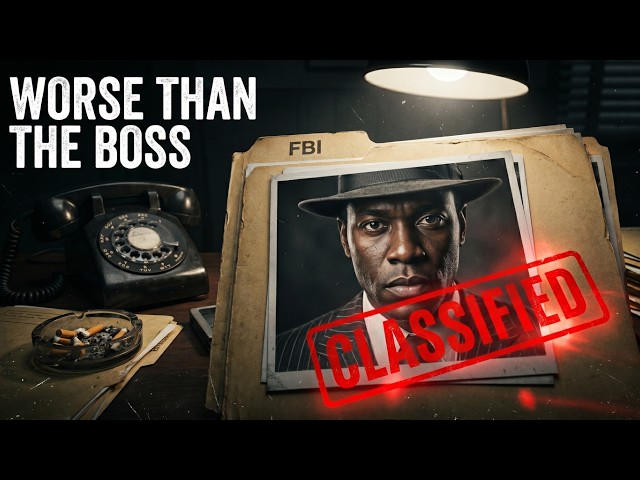
In this documentary, we go beyond the famous names like Sam Christian and Major Coxson to uncover the story of Eugene "Bo" Baynes. He wasn't the founder, and he wasn't the face of the organization, but he was a "load-bearing wall"—the middle-tier enforcer who kept the Black Mafia running through decades of violence, extortion, and systemic collapse.
Using court records, FBI documents, and the investigative research of Sean Patrick Griffin, we explore:
How the Black Mafia used religious legitimacy as a shield.
The brutal economic model of "pay or close."
Why the men in the middle are the most important part of any criminal system.
🕰️ Timestamps:
00:00 - Philly 1968: A City Fracturing
01:04 - Eugene "Bo" Baynes: The Man in the Shadows
02:08 - The Shield: Religious Legitimacy & The Nation of Islam
03:56 - The Economic Model: Pay or Close
06:10 - FBI Files: Tracking the Enforcement Arm
08:01 - The Tiered Structure: Why "Middle-Tier" Matters
11:58 - The Fall: Arrests, Sentences, and the Return
Show More Show Less View Video Transcript
0:00
Philadelphia. Nineteen sixty-eight. The city was fracturing.
0:06
Martin Luther King had been shot in April.
0:09
Riots had torn through neighborhoods that were already barely holding.
0:14
And in the streets of North Philadelphia , something else was taking shape — quiet,
0:21
organized, and dangerous.
0:22
A criminal organization was being built from the ground up.
0:27
Not by the Italian families who controlled so much of the city's underworld.
0:33
Not by any syndicate with a long history and a recognizable name. This one was different.
0:40
Some stories warn you before they begin. This one does not.
0:45
Before we go further — the events described in this video are drawn from court records,
0:51
F-B-I documents, and investigative reporting.
0:55
Where evidence is incomplete, it will be stated clearly.
0:59
Nothing here is presented as more certain than the record allows.
1:04
His name was Eugene Baynes . Most people called him Bo.
1:09
He wasn't the leader. He wasn't the founder.
1:12
His name doesn't appear in the history books that cover Philadelphia organized crime.
1:19
If you search for the Black Mafia — the organization that terrorized the city through much
1:25
of the nineteen seventies — you will find other names first.
1:30
Sam Christian . Major Coxson . Ronald Harvey . Bo Baynes comes later. Smaller print.
1:36
Sometimes no print at all.
1:38
But the men who were there — the investigators, the prosecutors, the survivors — they
1:44
remember him.
1:45
To understand Bo Baynes, you have to understand what he was part of.
1:51
The Black Mafia of Philadelphia was not a spontaneous uprising.
1:56
It was a deliberate construction — built on street-level muscle, narcotics money, extortion,
2:03
and something that gave it unusual cover for its time.
2:08
Religious legitimacy.
2:10
The organization developed ties to the Nation of Islam during the early nineteen seventies.
2:17
This connection gave its members a public identity that was difficult to attack.
2:22
Politicians didn't want to touch it. Community leaders were afraid to name it.
2:28
Law enforcement watched it grow for years before they could move.
2:33
The man who documented this most thoroughly was a journalist named Sean Patrick Griffin .
2:40
His book — Philadelphia's Black Mafia: A Social and Political History — published in two
2:47
thousand three, remains one of the most detailed accounts of the organization's structure
2:54
and membership.
2:55
Griffin spent years cross-referencing court documents, police files, and F-B-I surveillance
3:02
records.
3:03
And Bo Baynes is in those records. Not on every page. Not at the center of every story.
3:10
But present — consistently, quietly, lethally — across multiple criminal enterprises
3:17
spanning more than a decade.
3:19
Griffin described the Black Mafia's core membership as a rotating cast of violent men.
3:26
Some came in through the prison system.
3:29
Some through the street corners of West and North Philadelphia.
3:33
Some through the Nation of Islam mosques where the organization had its deepest roots.
3:40
Bo Baynes came through the streets.
3:42
He was, by multiple accounts, a man who understood violence as a tool — not as chaos, but as
3:49
enforcement.
3:50
He wasn't erratic. He wasn't reckless. That made him more dangerous, not less.
3:56
The organization he was part of operated on a clear economic model. Numbers running.
4:02
Drug distribution. Armed robbery.
4:05
Extortion of legitimate businesses — particularly those in the Black community, which had
4:11
nowhere else to turn for protection.
4:14
That last part is worth sitting with for a moment.
4:18
The Black Mafia didn't just exploit the neighborhoods it operated in.
4:23
It extracted money from the same community that was already being failed by banks, by city
4:30
government, by a legal system that had spent decades ignoring Black Philadelphia.
4:36
They weren't filling a vacuum. They were weaponizing one.
4:40
By the early nineteen seventies, the organization had become brazen enough to take on
4:47
targets that would have seemed untouchable.
4:50
One of the most documented cases — reported extensively at the time and confirmed in
4:57
subsequent court proceedings — was the murder of dealers who refused to pay tribute.
5:03
Street-level operators who thought they could work independently. They couldn't.
5:09
The enforcement arm of the Black Mafia was not subtle. It was designed to be seen.
5:15
The message was the violence. The violence was the message.
5:21
Bo Baynes operated within that enforcement structure.
5:25
The exact nature of every act attributed to him is difficult to reconstruct from public
5:31
records alone.
5:32
Some charges were prosecuted. Others were investigated without resulting in conviction.
5:39
The distinction matters — and the record will reflect it throughout this story.
5:45
What is documented is that Baynes was arrested multiple times through the nineteen
5:51
seventies.
5:52
What is documented is that he was known to law enforcement as an active associate of the
5:59
Black Mafia's inner structure.
6:01
What is documented is that he survived — for years — in an organization where survival
6:08
itself was a form of status.
6:10
The man who came to know the Black Mafia from the inside of a courtroom was F-B-I Special
6:17
Agent Frank Friel .
6:18
Friel spent years building cases against the organization's leadership.
6:24
He described the group, in sworn testimony, as one of the most violent criminal
6:30
organizations he had encountered during his career.
6:33
He would later write about his experiences in a book co-authored with John Guinther —
6:40
Breaking the Mob — published in nineteen ninety.
6:44
In that account, Friel described the challenge of prosecuting men who operated within a
6:50
community that had every reason to distrust law enforcement.
6:55
The testimony problem was real. Witnesses recanted. Memories failed.
7:00
And men like Bo Baynes understood exactly how that dynamic worked.
7:06
There is a scene that prosecutors and investigators described in multiple accounts.
7:12
A neighborhood business owner — his name is not part of the public record — had been
7:19
approached for tribute payments.
7:21
He refused. He was visited again. He refused again. The third visit was different.
7:28
The following is reconstructed from documented accounts of Black Mafia extortion patterns
7:35
described in court records and Griffin's research.
7:38
The specific individuals in this exchange are composites.
7:43
The investigator who reviewed the case later described what they found.
7:48
"The message wasn't complicated. Pay, or close. And if you close the wrong way...
7:55
you don't get to close at all." The business owner paid. Most of them did.
8:01
This was the operating logic of the organization Bo Baynes served. Not random criminality.
8:08
A system. With rules, with hierarchy, with enforcement.
8:12
Griffin's research identified a clear tiered structure within the Black Mafia.
8:19
At the top — the founding members and their direct lieutenants.
8:23
Below them — enforcers and earners who kept the money moving.
8:28
Below them — street-level workers who could be sacrificed if necessary.
8:34
Bo Baynes occupied the middle tier.
8:37
That position — not at the top, not expendable at the bottom — is precisely why his name
8:43
survives in the record at all.
8:46
He was important enough to be watched. Not important enough to be the story.
8:52
The nineteen seventies in Philadelphia were a particular kind of brutal.
8:58
The city had a murder rate climbing toward its worst years on record.
9:03
Drug markets were expanding.
9:05
And the institutions that were supposed to contain all of this — the police department, the
9:12
courts, the city government — were dealing with their own crises of legitimacy and
9:18
corruption.
9:19
Into that environment, the Black Mafia expanded. They controlled corners.
9:25
They controlled numbers routes.
9:27
They controlled the informal economy of entire neighborhoods.
9:32
And they did something else — something that Griffin and other researchers found
9:38
particularly striking.
9:39
They gave money away.
9:41
Not generously. Not out of community spirit. But strategically.
9:47
Donations to neighborhood organizations. Support for local events.
9:52
Quiet payments that bought silence and, sometimes, genuine loyalty.
9:58
It was a playbook as old as organized crime itself.
10:02
But in the specific context of North and West Philadelphia in the early nineteen seventies —
10:09
where legitimate institutions had failed so completely — it was remarkably effective.
10:17
The F-B-I had been watching the organization since its early formation.
10:22
Their surveillance files — portions of which have been released through Freedom of
10:29
Information requests and referenced in Griffin's research — paint a picture of an agency
10:36
that was building a case slowly, carefully, and with the knowledge that a premature move
10:42
would collapse the entire prosecution.
10:45
Names appear repeatedly in those files.
10:48
Sam Christian , over and over, as the acknowledged leader.
10:53
Ronald Harvey — linked to multiple homicides under investigation. And Eugene Baynes. Bo.
11:00
Present enough to be flagged. Connected enough to be tracked.
11:05
The question that hangs over any study of this organization is a difficult one.
11:11
How much did the men inside it believe in what they were doing?
11:16
Some clearly understood it as pure criminal enterprise — money, power, protection.
11:22
Others — particularly those with deeper ties to the Nation of Islam structure — seemed to
11:29
operate with a different self-image.
11:32
They saw themselves as part of something larger. A counter-economy.
11:37
A Black power structure that the mainstream world refused to build for them.
11:43
Whether Bo Baynes held that self-image — or whether he was simply a man doing violent work
11:50
for money — is not something the public record answers clearly.
11:55
That ambiguity is part of the story.
11:58
The arrests came in waves. Not a single decisive moment.
12:02
Law enforcement doesn't usually get that.
12:05
It's slower — an indictment here, a guilty plea there, a cooperative witness whose testimony
12:13
opens a door that was previously locked.
12:16
By the mid-nineteen seventies, federal and local prosecutors were moving against the Black
12:23
Mafia's structure systematically.
12:25
Some members cut deals. Some went to trial. Some fled. Bo Baynes went through the system.
12:32
He was prosecuted. He served time.
12:35
The exact parameters of his sentence and the charges that produced it are part of the
12:41
Pennsylvania court record — though reconstructing the complete timeline from public
12:48
documents alone requires careful sourcing, and gaps remain.
12:53
What the record does show is what happened after.
12:57
Because Bo Baynes did not simply disappear into the prison system and stay there.
13:03
He came back.
13:04
That return — the persistence of men who had served time and returned to the same
13:10
environment — was one of the defining characteristics of the Black Mafia's second chapter.
13:17
The organization had been fractured by prosecutions. Its leadership was scattered.
13:23
The Nation of Islam had publicly distanced itself from the criminal element.
13:29
But the streets remained.
13:30
And the men who knew those streets — who had worked them for years — returned to them.
13:38
Griffin's research traces this second phase with particular care.
13:42
The organization that re-emerged in the late nineteen seventies and early nineteen eighties
13:49
was not the same structure that had existed before.
13:53
It was smaller. More fragmented. Operating with less institutional coherence.
13:59
But it was still operating. The extortion continued — lower in profile, more careful.
14:05
The drug trade continued — now entangled with the crack market that was beginning to reshape
14:12
criminal economies across American cities.
14:16
And men like Bo Baynes remained part of that landscape.
14:20
There is something almost architectural about how these men existed.
14:25
They weren't icons of their organization.
14:28
They weren't at the table when the big decisions were made.
14:33
But they were load-bearing walls — the people who made the day-to-day operation possible,
14:39
who held the structure up from the inside.
14:42
When the structure collapsed around them, they rebuilt where they could.
14:48
When it collapsed again — they adapted.
14:51
That capacity for survival, for institutional continuity at the ground level, is what makes
14:58
figures like Bo Baynes significant to anyone trying to understand how criminal organizations
15:04
actually function.
15:06
Not from the top down. From the inside out.
15:09
The Philadelphia that Bo Baynes had known in nineteen sixty-eight was unrecognizable by the
15:17
late nineteen eighties.
15:18
The city's industrial base had collapsed.
15:22
Unemployment had hollowed out the same neighborhoods the Black Mafia had once controlled.
15:29
The crack epidemic had created new criminal economies — faster, more violent, less
15:35
structured — that operated differently from the organized networks of the previous decade.
15:42
The old hierarchy was gone.
15:44
What replaced it was chaos — territorial, lethal, and impossible to govern the way the Black
15:52
Mafia had once tried to govern its territory.
15:55
For men who had operated within the older system, that transition was often fatal.
16:02
Some adapted. Some didn't.
16:04
The final chapter of Bo Baynes's life in the public record is, fittingly, sparse.
16:11
Not dramatic.
16:12
Not a courtroom scene, not a headline, not a federal takedown with cameras and press
16:19
releases.
16:20
Just a man who had been part of something significant — who had been documented,
16:27
investigated, arrested, prosecuted — fading back into the city that had made him.
16:34
The F-B-I files on the Black Mafia organization were not fully declassified.
16:40
Portions remain restricted. The Pennsylvania court records contain his name.
16:46
Sean Patrick Griffin's research keeps his name in the historical record. And beyond that...
16:54
The file grows quiet.
16:56
That quietness is itself a kind of testimony.
17:00
In a world where the men at the top of criminal organizations become the subjects of
17:06
documentaries and true crime series — where the names Gotti and Genovese are known to anyone
17:14
who has ever watched cable television — the men in the middle tier are usually lost.
17:20
They don't write memoirs. They don't give interviews.
17:25
They don't become the basis for prestige drama characters.
17:29
They become footnotes in someone else's file. Bo Baynes was that kind of man.
17:35
And the question his story leaves behind is not whether he deserved what came for him — the
17:43
arrests, the prosecutions, the years inside.
17:46
The question is what we miss when we only tell the stories of the men at the top.
17:53
Because criminal organizations are not built by leaders alone.
17:58
They are built by the people who do the daily work of violence and enforcement and loyalty
18:06
and silence.
18:07
The people who never become symbols.
18:10
The people who keep the machine running when the symbol is in prison or in the ground.
18:17
Understanding them — really understanding them — is the only way to understand how these
18:24
systems persist across decades, across arrests, across the collapse of leadership after
18:31
leadership.
18:32
Bo Baynes. His name is in the file. The file remains open.
#Arts & Entertainment