Up next in 10

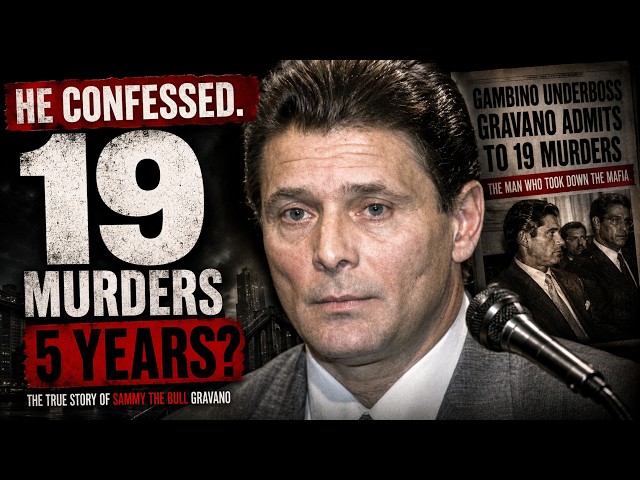
Discover the shocking true story of Salvatore "Sammy the Bull" Gravano, the man who rose from the streets of Bensonhurst to become the Underboss of America's most powerful criminal organization: the Gambino crime family. After admitting to 19 murders, Gravano made a historic deal with the government, betraying his boss, the "Teflon Don" John Gotti, in exchange for a mere 5-year prison sentence.
But the story doesn't end there. After entering Witness Protection and moving to Arizona, Sammy couldn't escape his old ways. He built a massive Ecstasy drug empire with his son, leading to a second downfall and a 20-year federal prison sentence. From the secret FBI Ravenite tapes to his modern-day podcast, explore the ultimate story of loyalty, betrayal, and survival in the American Mafia.
Hit that LIKE button, SUBSCRIBE for more true crime documentaries, and let us know in the comments: Was Sammy Gravano a traitor or just a master survivor?
👇 Video Chapters / Timestamps:
00:00:00 - Introduction: The Kid from Bensonhurst
00:03:30 - The First Murder: Joe Colucci
00:04:35 - Joining the Gambino Family
00:07:07 - Paul Castellano's Corporate Mafia
00:13:46 - The Sparks Steak House Assassination
00:17:02 - John Gotti Takes Control
Show More Show Less View Video Transcript
0:00
His name was Salvatore Gravano .
0:02
And before he was anything else — before he was an underboss, before he was a killer, before
0:09
he was the most consequential witness in the history of American organized crime — he was a
0:16
kid from Bensonhurst who couldn't read.
0:19
He had dyslexia. The school failed him. The street did not.
0:24
The following account draws on court records, F-B-I wiretap transcripts, federal indictment
0:32
documents, and Peter Maas's biography "Underboss," based on extensive interviews with
0:38
Gravano himself.
0:39
Some exchanges have been reconstructed from documented accounts.
0:44
Names, dates, and locations are a matter of public record.
0:50
Bensonhurst, Brooklyn. Nineteen forty-five. The neighborhood had rules.
0:55
They weren't written anywhere. You didn't go to the police.
0:59
You didn't borrow what you couldn't repay. You didn't disrespect a man in front of his crew.
1:06
And if someone came to collect — you paid.
1:09
These weren't the rules of one family or one block.
1:12
They were the operating system of the entire neighborhood. Passed down without ceremony.
1:19
Learned through consequence.
1:21
Salvatore Gravano was born into this system on March eighth, nineteen forty-five.
1:28
His parents were Sicilian immigrants. His father ran a small dress factory.
1:33
They were working class, honest, and entirely disconnected from organized crime.
1:40
The block was not.
1:42
By the time Sammy was thirteen, he had been arrested twice. Not for anything sophisticated.
1:49
Petty theft. A fight that put another kid in the hospital.
1:53
The kind of incidents that get a middle-class boy sent to a counselor and a Bensonhurst boy
2:00
sent to understand that the courts are just another system that can be navigated.
2:06
He dropped out of school in the eighth grade.
2:10
He started running with a local street gang called the Rampers.
2:14
And in the Rampers, Sammy Gravano found the first thing that ever made sense to him.
2:21
Not violence exactly. Something more specific than that.
2:25
He found that men with reputations didn't get pushed around.
2:30
And reputation, in Bensonhurst, was built one confrontation at a time.
2:36
The men Sammy admired weren't gang members. They were older. Quieter.
2:41
They sat in the same social club every afternoon.
2:44
They drove cars that didn't match their apparent income.
2:49
And when they walked down the street, people moved. These were Colombo family associates.
2:55
Lower-level earners who ran numbers, controlled small construction contracts, and handled
3:02
disputes that the neighborhood didn't want to take to a judge.
3:07
One of them noticed Sammy. Not because he was violent.
3:11
But because he was loyal, disciplined, and completely without fear.
3:16
At seventeen, Sammy Gravano was brought in as an associate. No oath yet. No ceremony.
3:23
Just work. And for the first time in his life, he was exactly where he was supposed to be.
3:30
Nineteen sixty-four. Sammy Gravano was nineteen years old.
3:34
The order came through a man he trusted.
3:37
The target was Joe Colucci — a local figure, not particularly important, who had committed
3:44
the specific kind of offense that the neighborhood settled privately.
3:49
According to Peter Maas's biography "Underboss," Gravano later described his state of mind
3:55
before the killing with a clarity that is more chilling than any dramatization.
4:01
He wasn't afraid. He wasn't conflicted.
4:04
He understood what was being asked of him, and he understood what it would mean for his
4:10
future if he delivered.
4:13
Colucci got into the car expecting a conversation. Sammy was already in the back seat.
4:20
Two shots. The body was left in a lot near Canarsie .
4:24
And Salvatore Gravano was, at nineteen years old, a killer who had proven he could be
4:31
trusted with the most serious work there was.
4:35
Within a year of the Colucci killing, Gravano made a transition that would define the rest
4:42
of his life.
4:43
He left the orbit of the Colombo family and aligned himself with the Gambino family, under a
4:50
capo named Salvatore Aurello — known throughout Brooklyn simply as Toddo .
4:56
Toddo Aurello ran construction rackets. He controlled union locals.
5:01
He collected tribute from contractors who wanted to work in Brooklyn without problems.
5:08
He was sixty years old, methodical, and had survived in organized crime longer than most men
5:15
managed by being careful with his words and even more careful about who he trusted.
5:22
He took Gravano under his wing. Not as a favor. As an investment.
5:27
Aurello told him directly. You work for me, you earn. You earn, you rise.
5:33
You cause problems, I can't protect you. Understand? Sammy understood.
5:39
He always understood the rules. What changed was which rules he was following.
5:46
The construction industry in New York City in the nineteen sixties and seventies was, in
5:53
significant part, a Mafia-controlled enterprise.
5:56
This is not a dramatic claim.
5:59
It is a documented reality confirmed by multiple federal investigations, congressional
6:05
testimony, and the cooperative statements of dozens of witnesses over three decades.
6:12
The mechanism was straightforward.
6:14
If you wanted a contract in New York — if you wanted your project to proceed without labor
6:21
disruptions, without materials disappearing, without inspectors finding sudden problems —
6:28
you paid.
6:29
You paid the union locals that the family controlled.
6:33
You paid the concrete companies they owned. And you paid the men who made the introduction.
6:41
Gravano became one of those men. He was not flashy about it. He did not drive a Cadillac.
6:47
He did not wear gold.
6:49
He showed up, he collected, he reported back, and he kept thirty percent of everything he
6:56
brought in.
6:57
By nineteen seventy, he had his own small crew.
7:00
By nineteen seventy-three, men were asking his permission before they started working.
7:07
At the top of the family that Gravano was climbing sat Paul Castellano . Big Paul. The boss.
7:14
Castellano had taken over the Gambino family after Carlo Gambino died in nineteen
7:20
seventy-six, and he had immediately begun transforming it from a traditional crime family
7:27
into something that looked, from a certain angle, like a holding company.
7:32
He ran meetings from his mansion in Todt Hill , Staten Island.
7:37
He wore suits that cost more than most of his soldiers made in a month.
7:42
He spoke about business in terms that sounded almost corporate.
7:48
Castellano had a theory about organized crime.
7:51
Violence, in his view, was a management failure.
7:55
It attracted attention, it created enemies, and it was almost always avoidable through the
8:02
right financial arrangement.
8:04
He was not wrong. He was also not entirely right.
8:08
Because the men beneath him were not all built for patience and restraint.
8:13
Some of them were built for something else.
8:17
Nineteen seventy-five.
8:19
Salvatore Gravano was formally inducted into the Gambino crime family.
8:25
The ceremony, as described in documented accounts and later confirmed in federal testimony,
8:32
followed the ritual that had remained largely unchanged since the organization's origins in
8:39
Sicily.
8:40
A finger was pricked. Blood on a burning card. The oath of omertà .
8:46
You were born into a family once, and you could leave it at death.
8:51
You were made into this family once, and the only exits were prison or a hole in the ground.
8:58
Gravano understood the weight of it.
9:01
What he could not know, standing in that room in Brooklyn in nineteen seventy-five, was that
9:09
thirty years later he would sit in a federal courtroom and describe this ceremony — this
9:15
oath — in precise detail.
9:17
To a jury. Under oath to a different system entirely.
9:22
The Gambino family in the late nineteen seventies was the largest and most powerful
9:29
organized crime family in the United States.
9:32
Five boroughs of New York. Construction. Garbage collection. The waterfront. Trucking.
9:39
Garment manufacturing.
9:41
And dozens of ancillary businesses that fed tribute upward through a hierarchy that had
9:48
remained structurally stable for decades.
9:52
At the top: the boss. Below him: the underboss and the consigliere.
9:57
Below them: the capos, each commanding a crew. Below the capos: the soldiers.
10:03
Below the soldiers: the associates. This was not a metaphor.
10:08
This was an organizational chart.
10:11
What separated Gravano from other earners in the Gambino family was not his willingness to
10:18
use violence.
10:19
Plenty of men were willing. Violence was not rare.
10:23
What separated him was that he used it precisely. He didn't fight because he was angry.
10:30
He didn't threaten because he enjoyed it.
10:33
When Sammy Gravano applied force — physical, financial, or reputational — it was calculated.
10:40
It solved a specific problem.
10:42
And it almost always sent a message that solved three problems he hadn't yet had to address.
10:49
Men in the family noticed this. Toddo Aurello noticed it first.
10:54
Then the men above Aurello began to notice it.
10:58
Not every killing Gravano ordered was a family directive.
11:03
In nineteen eighty-two, a man named Frank Fiala purchased a nightclub in Brooklyn called the
11:10
Plaza Suite from Gravano's crew for one million dollars.
11:14
The sale was agreed. The papers were signed.
11:18
Then Fiala began to act as though he owned the neighborhood as well.
11:23
He arrived at the club with an armed entourage. He made decisions that violated agreements.
11:30
He disrespected Gravano in front of witnesses.
11:34
And then, according to trial testimony and documented accounts, he attempted to renegotiate
11:41
the deal after it had already closed.
11:44
Gravano authorized his own response.
11:47
Fiala was shot in the head in the parking lot of the Plaza Suite.
11:52
In front of multiple witnesses. Not one of them went to the police.
11:57
The message reached every associate and contractor in Brooklyn within forty-eight hours.
12:04
Gravano hadn't asked permission from Castellano for the hit.
12:09
He handled it himself and reported it afterward. Castellano did not reprimand him.
12:16
He was promoted to capo shortly after.
12:19
Paul Castellano and John Gotti looked at Salvatore Gravano and saw two entirely different
12:26
men.
12:27
Castellano saw a productive capo.
12:30
A man who earned, who controlled his people, and who understood the value of discretion.
12:37
Gravano was an asset to be deployed — not a confidant, not an inner circle figure, but a
12:43
reliable instrument of the family's financial interests.
12:48
Gotti saw something else. He saw a man who was being undervalued.
12:53
He saw a soldier of genuine ability who was being kept at a distance by a boss who preferred
13:00
businessmen to warriors.
13:02
He saw the frustration beneath Gravano's discipline.
13:06
And he saw the potential of what that frustration could become, if it was properly directed.
13:13
Gotti began cultivating Gravano in the early nineteen eighties. Not with grand gestures.
13:20
With small ones. A conversation after a meeting.
13:23
A word of recognition that Castellano had never offered.
13:28
A suggestion, implied rather than stated, that under different leadership, Gravano's role
13:35
would look very different.
13:37
Gotti was building toward something.
13:39
Gravano would not understand exactly what until December of nineteen eighty-five.
13:46
By nineteen eighty-five, John Gotti had made a decision. Paul Castellano had to go.
13:53
The reasons were multiple.
13:55
Castellano had been indicted on federal charges and was facing trial.
14:00
There was genuine fear among some capos that he would cooperate with the government to save
14:07
himself.
14:08
There was also the simpler reality that Gotti, by temperament and ambition, was not built to
14:16
wait.
14:17
Killing a sitting boss without commission approval was one of the most serious violations
14:24
possible in the Mafia's internal code.
14:27
It had been done before. It had also ended in disaster before.
14:32
Gotti believed he could manage the aftermath.
14:35
To do it, he needed men he could trust completely. He went to Gravano.
14:40
Gravano would later testify to this conversation, or one substantively like it, in federal
14:47
court.
14:48
We have a problem with Paul. It needs to be solved. Are you with me? I'm with you.
14:55
What do you need?
14:56
What he agreed to that day set in motion the most consequential mob assassination in
15:02
American history.
15:04
December sixteenth, nineteen eighty-five.
15:07
Paul Castellano and his driver, Thomas Bilotti , arrived at Sparks Steak House on East
15:14
Forty-Sixth Street in Midtown Manhattan at approximately five forty in the evening.
15:20
Castellano was scheduled to meet with several capos for dinner.
15:25
He was expecting a business conversation.
15:28
What he got was four men in trench coats and Russian fur hats, positioned on the sidewalk in
15:36
a formation that had been planned and rehearsed.
15:40
As Castellano stepped out of his Lincoln Town Car, the shooters moved. Six shots.
15:47
Castellano was dead before he hit the pavement.
15:51
Bilotti was shot and killed on the other side of the car simultaneously.
15:57
The shooters walked away into the midtown crowd.
16:01
The entire operation took less than thirty seconds.
16:06
One block east of Sparks, on Second Avenue, John Gotti sat in a car and watched.
16:12
Sammy Gravano was across the street in a second vehicle. They were there as supervisors.
16:19
As witnesses. And as the men who would take control of what happened next.
16:25
Gotti watched Castellano fall. He did not get out of the car. He did not approach the scene.
16:33
He simply observed, satisfied himself that it was done, and drove away.
16:39
Gravano would later describe this moment in precise detail on the witness stand.
16:45
The prosecution asked him where he was when Paul Castellano was shot.
16:51
I was in a car on Second Avenue, watching. The prosecutor asked why he was there.
16:57
To make sure it went right. And to see it myself.
17:02
Two weeks after the Sparks assassination, John Gotti walked into the Ravenite Social Club on
17:09
Mulberry Street in Little Italy and declared himself the new boss of the Gambino family.
17:16
There was no formal vote. No commission approval.
17:20
He simply assumed the position with the confidence of a man who had already eliminated the
17:27
only obstacle.
17:28
The Ravenite became his court. Men came to pay their respects.
17:33
The message was clear: the family had a new direction. A new temperament.
17:39
And a new set of priorities. The era of the quiet businessman was over.
17:44
John Gotti wanted the world to know who he was. And the world obliged.
17:50
Within two years of the Sparks assassination, John Gotti had become something unprecedented
17:57
in American organized crime.
18:00
A celebrity. He appeared on the covers of magazines. News cameras followed him to court.
18:06
When he walked out of federal trials — acquitted three separate times between nineteen
18:13
eighty-four and nineteen eighty-seven — the crowds outside cheered.
18:18
The press called him the Dapper Don. Then the Teflon Don. And Gotti loved it.
18:24
Gravano did not.
18:26
Every camera shot outside the Ravenite was an F-B-I asset.
18:30
Every newspaper profile was a roadmap.
18:33
Every acquittal that Gotti celebrated publicly told the federal government exactly how hard
18:40
they needed to work to put him away permanently.
18:43
Gravano raised it with him more than once. John, the cameras.
18:48
Every day there's cameras out there. We're giving them everything. Let them watch.
18:54
You think they got anything? They got nothing.
18:57
But the F-B-I was already listening to more than Gotti knew.
19:02
In nineteen eighty-six, John Gotti formally elevated Salvatore Gravano to the position of
19:09
underboss of the Gambino crime family.
19:12
The number two position. The operational commander.
19:17
In practical terms, this meant Gravano ran the day-to-day business of the largest criminal
19:24
organization in the United States.
19:27
He managed the capos. He arbitrated disputes.
19:30
He collected tribute, approved contracts, settled debts, and authorized violence.
19:37
He was thirty-nine years old.
19:39
And he was, by any legitimate measure of power within that world, one of the most dangerous
19:47
men in America.
19:49
At trial, under direct examination, Salvatore Gravano admitted to participating in nineteen
19:56
murders.
19:57
Nineteen. Not all of them were his hands on the trigger. Some were orders he gave.
20:04
Some were logistics he arranged. Some were killings he approved before being asked.
20:11
But all nineteen were, by his own sworn testimony, his responsibility.
20:17
The prosecutor did not read the names all at once.
20:21
The names came out over nine days of testimony, one by one, each attached to a location, a
20:28
method, a reason, and a relationship.
20:31
This is what the list looked like. Not as numbers. As people.
20:37
The first name was Joe Colucci. Nineteen sixty-four. Gravano was nineteen years old.
20:44
Colucci had made enemies in the neighborhood.
20:47
Someone with authority over Gravano decided the problem should be resolved permanently.
20:55
Gravano was chosen to resolve it.
20:57
This was not, in the world Gravano inhabited, an aberration. It was an audition.
21:04
And he passed.
21:06
What is notable, looking back, is not the act itself. It is what came after.
21:12
Gravano did not fall apart. He did not become erratic.
21:17
He did not drink himself into confession or confide in anyone. He went back to work.
21:24
That quality — the ability to compartmentalize violence as simply another professional task
21:31
— is what made him valuable, and what made him, over the following thirty years,
21:38
extraordinarily dangerous.
21:40
Robert DiBernardo was a Gambino capo who controlled a substantial pornography distribution
21:48
operation and had significant influence among the family's rank and file.
21:53
In nineteen eighty-six, word reached Gotti that DiBernardo was undermining him — speaking
22:01
critically of the new administration, questioning decisions, creating quiet opposition.
22:07
Gotti's response was immediate. He told Gravano to handle it.
22:12
According to Gravano's trial testimony, DiBernardo was lured to a location in Brooklyn on
22:19
the pretense of a meeting.
22:22
He was shot in the back of the head.
22:24
His body was dismembered and disposed of in multiple locations. It was never recovered.
22:31
Gotti was learning that Gravano would do what he was told, without debate, without
22:38
conditions, and without aftermath.
22:41
That discovery would later cost both of them everything.
22:46
In nineteen eighty-eight, Gotti told Gravano to kill Louis Milito .
22:51
Louie Milito was not a problem associate or a rival. He was Gravano's friend.
22:57
A man he had worked alongside for years. A man whose family knew Gravano's family.
23:04
Gotti believed Milito was talking. That he had become a liability.
23:09
The evidence, as Gravano would later describe it, was thin.
23:13
But Gotti was not asking for a debate.
23:17
Louie's a problem. He talks too much. It needs to be handled. You're sure about this?
23:24
Louie's been solid. I'm sure. You handle it, or I start wondering about you too.
23:30
Gravano handled it. Milito was called to a meeting.
23:34
He came without suspicion because the call came from Sammy. His body was never found.
23:40
His wife, Linda Milito, later wrote a book about what it meant to be married to a man who
23:47
could disappear because his best friend decided to follow an order.
23:52
That book is called "Mafia Wife."
23:55
Louis DiBono was a Gambino associate who ran construction operations. He owed money.
24:02
He had missed meetings — multiple meetings with Gotti himself, which was an offense that
24:09
Gotti took as a personal insult.
24:11
The order came down in nineteen ninety.
24:14
DiBono was found dead in his parked car in the basement parking garage of the World Trade
24:21
Center in New York City.
24:23
Three bullets to the back of the head.
24:26
He had been sitting in his car, apparently waiting for someone who arrived not for a meeting
24:33
but for an execution.
24:35
This killing was among those specifically detailed in the federal indictment that would be
24:42
handed down weeks later.
24:44
It was, for all practical purposes, the last murder of the Gotti era.
24:49
The net had been closing for months. Neither Gotti nor Gravano knew it had already landed.
24:57
Nineteen. Gravano testified to nineteen murders over the course of his criminal career.
25:04
The question that prosecutors did not ask — because it was not their job to ask — was what
25:11
carrying that number did to a man over time.
25:14
Gravano himself addressed it in later interviews.
25:18
In Peter Maas's biography, and in his own podcast years after his release, he described the
25:26
killings not with remorse but with a kind of detached acknowledgment.
25:31
He believed, or said he believed, that the men who died had largely operated in a world
25:38
where that risk was understood.
25:40
He made an exception for one. Louie Milito. The friend he killed because Gotti told him to.
25:48
Whether that distinction matters is a question that belongs to the families of the other
25:55
eighteen.
25:56
While the killings were accumulating, the Federal Bureau of Investigation was assembling
26:03
something that would outlast every single one of them.
26:07
A case. F-B-I Agent Bruce Mouw led the Gambino squad.
26:11
He had been building the investigation for years. Surveillance photographs.
26:17
Financial records. Informant testimony from lower-level associates.
26:23
What Mouw needed was something that could penetrate the inner circle.
26:28
What he got, eventually, was better than anything he had designed.
26:34
He got the Ravenite apartment.
26:36
And in that apartment, John Gotti gave the government everything it needed to bury him.
26:43
Entirely by himself.
26:45
In nineteen ninety, F-B-I technicians installed a listening device in a private apartment
26:52
above the Ravenite Social Club on Mulberry Street.
26:56
The apartment belonged to the widow of a former Gambino associate.
27:00
Gotti had been using it for sensitive conversations — meetings he believed were too private
27:07
to have in the club itself, where he suspected surveillance.
27:12
He was right to suspect surveillance. He was wrong to believe the apartment was safe.
27:19
The device captured audio from conversations conducted in the apartment over a period of
27:25
months.
27:26
What it captured was extraordinary. Not because it revealed things the F-B-I didn't know.
27:33
But because the voice on the tapes was John Gotti's.
27:37
And John Gotti, in those private conversations, was not performing for cameras.
27:44
He was being exactly who he was.
27:46
The Ravenite tapes contained discussions of murders, financial arrangements, internal family
27:53
politics, and strategic decisions made at the highest level of the Gambino organization.
28:00
They also contained something the prosecution would use to devastating effect.
28:06
Gotti talking about Gravano. Not with loyalty. Not with respect. With blame.
28:12
In multiple recorded conversations, Gotti attributed organizational problems to Gravano.
28:19
Questioned his judgment. Expressed frustration with him.
28:23
Positioned him, in the internal narrative Gotti was constructing, as the source of
28:30
difficulties that the boss himself had no responsibility for.
28:34
The F-B-I noted this carefully.
28:37
Because if the tapes were ever played in a cell where Gravano could hear them, the
28:43
prosecution would not need to convince him of anything.
28:47
Gotti would do that himself.
28:50
December eleventh, nineteen ninety. F-B-I agents moved simultaneously on multiple locations.
28:58
John Gotti was arrested at the Ravenite Social Club. Salvatore Gravano was arrested nearby.
29:06
Consigliere Frank Locascio was arrested as well. The charges were federal. RICO statute.
29:13
Racketeering. Conspiracy. Murder.
29:16
For Gotti, the arrest was, publicly at least, another performance.
29:22
He walked to the waiting federal vehicle with his chin up and his suit straight.
29:28
For Gravano, it was something different. It was the moment he began calculating.
29:36
Gravano was held at the Metropolitan Correctional Center in lower Manhattan.
29:42
His attorney brought him transcripts of the Ravenite tapes.
29:46
Then played the recordings themselves.
29:49
Gravano listened to John Gotti's voice — the voice of the boss he had served, the man for
29:56
whom he had committed murders, the man whose empire he had helped build — describing him as
30:03
the source of the family's problems.
30:06
Not as a partner. Not as a loyalist. As a liability.
30:10
According to documented accounts and Gravano's own later statements, he listened to the
30:17
tapes without visible reaction.
30:19
Then he set the transcripts down. And asked his lawyer a single question.
30:25
What's the government offering if I cooperate?
30:29
What followed was not an impulsive decision.
30:32
It was a precise, methodical assessment of available options conducted by a man who had
30:39
spent thirty years surviving through exactly that kind of thinking.
30:44
Option one: go to trial alongside Gotti. The tapes existed. The witnesses existed.
30:51
The financial records existed.
30:53
The probability of acquittal was, in Gravano's own assessment, close to zero.
30:59
The likely outcome: life in federal prison. Option two: cooperate.
31:04
He had nineteen murders to account for. No prosecutor was going to offer him immunity.
31:11
But cooperation would mean a sentence that had a number attached to it.
31:16
A number with an end. And he had something the government wanted badly enough to trade for.
31:24
He had everything. Every murder. Every conversation. Every name.
31:28
Every structure of the family he had helped run for decades. He had John Gotti.
31:35
And the government wanted John Gotti more than they had ever wanted anyone.
31:41
In the fall of nineteen ninety-one, Salvatore Gravano entered into a cooperation agreement
31:48
with the United States Attorney's Office for the Eastern District of New York.
31:54
The terms were, by any standard measurement, remarkable.
31:58
Gravano would plead guilty to a single count of racketeering — an umbrella charge that
32:04
encompassed his participation in nineteen murders.
32:08
He would provide complete and truthful testimony in all cases where the government called
32:14
him as a witness.
32:16
In exchange, he would receive a sentence recommendation that was left to the discretion of
32:22
the judge, but which the government agreed to cap.
32:27
The actual sentence Gravano received was five years. For nineteen murders. Five years.
32:33
The reaction from the families of his victims, when the sentence was announced, was not
32:40
recorded in the court transcript.
32:43
But it was documented in the newspapers the following morning.
32:48
April second, nineteen ninety-two.
32:51
Salvatore Gravano was sworn in as a witness for the United States government in the trial of
32:58
United States versus John Gotti.
33:00
The courtroom at the Eastern District of New York in Brooklyn was packed.
33:06
Reporters filled the gallery.
33:08
Gotti sat at the defense table in a suit that had been pressed that morning.
33:14
The prosecutor was John Gleeson , a meticulous and methodical assistant United States
33:20
attorney who had been preparing for this moment for years.
33:25
Gleeson began simply. He asked Gravano to state his name. Salvatore Gravano.
33:32
He asked Gravano what he did for a living. I was the underboss of the Gambino crime family.
33:40
He asked how many people Gravano had been involved in killing. Gravano looked at the jury.
33:48
Nineteen. The courtroom did not react audibly.
33:52
But the silence that followed that word was, by every account of those present, absolute.
34:00
Over the next nine days, Salvatore Gravano testified in detail about the internal structure
34:07
and operations of the Gambino crime family.
34:11
He described the induction ceremony. The oath. The hierarchy. The tribute system.
34:17
The decision-making process for violence.
34:20
He described the Sparks assassination — where he was, what he saw, what happened in the
34:27
hours before and after.
34:29
He named names. He produced documents that corroborated his testimony.
34:35
And through all of it, he was consistent. Cross-examination did not break him.
34:41
Contradictions did not surface.
34:43
He simply answered the questions as they came, with the calm of a man who had decided that
34:50
the only thing left worth doing was telling the complete truth.
34:56
Albert Krieger , Gotti's defense attorney, was one of the most experienced criminal lawyers
35:02
in the country.
35:03
He understood that he could not disprove Gravano's testimony.
35:07
The corroborating evidence was too strong. So he attacked the witness.
35:12
You killed nineteen people, and you're asking this jury to believe you?
35:17
Gravano looked at him without expression.
35:20
I'm not asking them to believe me because I'm a good man.
35:24
I'm asking them to believe me because what I'm saying is true.
35:28
And it matches everything else they've already seen.
35:32
Krieger did not have a follow-up that landed.
35:35
June twenty-third, nineteen ninety-two.
35:38
The jury returned after thirteen hours of deliberation.
35:43
John Gotti was found guilty on all counts. Racketeering. Conspiracy. Five murders.
35:49
Obstruction of justice.
35:51
The judge sentenced him to life in federal prison without the possibility of parole.
35:58
Gotti was transferred to the United States Penitentiary in Marion, Illinois, and later to
36:05
the federal medical center in Springfield, Missouri, where he died of throat cancer on June
36:13
tenth, two thousand and two.
36:15
He never cooperated with the government.
36:18
He never publicly acknowledged what Gravano's testimony had done to him.
36:24
He never spoke to Salvatore Gravano again.
36:28
Salvatore Gravano received his sentence on September twenty-sixth, nineteen ninety-four.
36:35
Five years.
36:36
He had already served nearly four years in pre-trial detention and protective custody.
36:42
Which meant he walked out of federal custody in nineteen ninety-five having served, for
36:49
nineteen murders and decades of organized crime, less time than many people serve for a
36:56
first-offense drug conviction.
36:58
The reaction was immediate and lasting. Families of victims condemned the deal publicly.
37:05
Legal scholars debated whether the precedent it set was worth the outcome.
37:10
Law enforcement officials defended it on the grounds that it had broken the back of the most
37:17
powerful criminal organization in the country.
37:21
The government's position, stated plainly: Gravano gave them Gotti.
37:26
And Gotti was worth the price.
37:28
Whether that accounting was just depends entirely on which side of the ledger you were on.
37:36
In nineteen ninety-five, Salvatore Gravano entered the federal witness protection program.
37:43
He was given a new name. New documents. A new history. He became James Moran.
37:49
The government relocated him to the Phoenix, Arizona metropolitan area.
37:54
They provided a financial stipend.
37:57
They set him up with the tools to build a legitimate life.
38:01
Gravano started a construction business.
38:05
He had, after all, spent thirty years in the construction industry.
38:10
He knew it better than almost anyone. He kept a low profile.
38:14
He avoided contact with his former associates.
38:18
He played the role of an ordinary businessman in an ordinary suburb.
38:23
For approximately two years, this worked. Then it stopped working.
38:29
The witness protection program is designed to hide people.
38:34
It is not designed to transform them.
38:37
Salvatore Gravano had spent his entire adult life operating within a structure that provided
38:44
clear hierarchy, clear purpose, clear rules, and a constant stream of decisions that
38:51
required his specific skills.
38:53
Suburbia provided none of those things. He was fifty years old. He was healthy.
38:59
He was, by his own account in subsequent interviews, profoundly restless.
39:05
The construction business was real but small. The neighbors were pleasant but irrelevant.
39:12
The days were quiet in a way that a man who had run the underboss operation of the Gambino
39:19
crime family found genuinely difficult to tolerate.
39:23
He began spending more time with his son, Gerard . Gerard was not living quietly.
39:30
Gerard Gravano had begun dealing ecstasy in the Phoenix area in the mid-nineteen nineties.
39:37
Small quantities at first. Local distribution through nightclub connections.
39:42
Salvatore Gravano became aware of this.
39:45
According to federal court records from the subsequent prosecution, rather than stopping his
39:52
son, he became involved.
39:54
His involvement was not peripheral.
39:57
By nineteen ninety-seven, Gravano was operating a wholesale ecstasy distribution network
40:03
that was moving thousands of pills per week throughout the Phoenix and Tempe areas.
40:10
He used a construction company called Marathon as a legitimate front.
40:15
He organized the distribution through a loosely affiliated group of younger men who became
40:22
known to law enforcement as the "Devil's Advocates."
40:26
The parallel was not lost on the federal agents building the Arizona case.
40:32
The man who had been brought down in New York by F-B-I surveillance of his meetings was now
40:39
being surveilled by the D-E-A in Arizona.
40:43
The man who had testified about how the Gambino family used legitimate businesses as fronts
40:50
was now running a legitimate business as a front.
40:54
The man who had described, in clinical detail, how organized crime recruited young men and
41:01
gave them structure and income was now doing exactly that in the suburbs of Phoenix.
41:07
The agents documented his meetings. His phone calls. His financial transactions.
41:14
They built the case the same way the F-B-I had built the Ravenite case. Patiently.
41:20
Methodically. Until there was nothing left to argue.
41:25
February twenty-fourth, two thousand.
41:28
Federal and state law enforcement officers executed simultaneous search warrants at multiple
41:36
locations connected to Gravano's Arizona operation.
41:40
At Gravano's residence in Tempe, they found ecstasy pills, cash, and records documenting the
41:48
distribution network.
41:50
Salvatore Gravano was arrested for the second time in his life.
41:55
This time, there was no cooperation card to play. He had already used it.
42:01
He had no John Gotti to trade.
42:03
He had no organizational intelligence that the government didn't already possess.
42:10
He had nothing.
42:12
His lawyer entered a defense based on entrapment.
42:16
He argued that law enforcement had manipulated Gravano into resuming criminal activity.
42:23
The jury deliberated and rejected the argument.
42:27
In two thousand and two, Salvatore Gravano was sentenced to twenty years in federal prison.
42:34
He was fifty-seven years old when he was sentenced.
42:38
He would be in his mid-seventies when he was released.
42:43
The government that had given him five years for nineteen murders now gave him twenty years
42:50
for running a drug operation that had not killed anyone.
42:55
The families of his nineteen victims did not find this ironic. They found it insufficient.
43:02
And they said so, publicly, at every opportunity.
43:06
Salvatore Gravano was released from federal custody in September of two thousand and
43:13
seventeen.
43:14
He was seventy-two years old. He was placed on supervised release. He returned to Arizona.
43:21
And then he did something that no one who had known him during his Gambino years would have
43:28
predicted.
43:29
He became a media figure.
43:30
He launched a podcast called "Our Thing." He gave long-form interviews.
43:36
He spoke at length about his life, his decisions, the murders, the testimony, the deal, and
43:43
the years that followed.
43:45
He was not, in any of these appearances, contrite. He was explanatory. He was argumentative.
43:52
He was, in a way that was both compelling and deeply uncomfortable to watch, completely
43:58
certain that his choices had been rational.
44:01
In one documented interview, he said directly: I didn't betray anybody.
44:07
Gotti betrayed me first. On tape. In his own voice. You want to call me a rat, go ahead.
44:14
But look at what I was responding to.
44:16
The families of the men Gravano killed did not share his framework.
44:22
Linda Milito, whose husband Louie Gravano killed on Gotti's order in nineteen eighty-eight,
44:28
wrote about the experience of that loss in her memoir "Mafia Wife." She did not distinguish
44:35
between the man who gave the order and the man who pulled the trigger.
44:41
Other families made public statements over the years. Some spoke to journalists.
44:47
Some appeared in documentary projects.
44:50
Their position, expressed in various forms across various platforms, was consistent.
44:56
Salvatore Gravano killed their family members. He served five years.
45:01
He was then released, resumed criminal activity, was caught, was convicted again, and after
45:08
serving that sentence, returned to public life to tell his story on his own terms.
45:14
Whatever the government's calculation had been, the cost of that calculation had been paid
45:21
not by the state.
45:23
It had been paid by them.
45:25
Today, Salvatore Gravano is in his late seventies.
45:29
He lives in Arizona, on supervised release conditions that restrict his activities and
45:36
associations.
45:37
He continues to speak publicly about his life. The record shows the following.
45:43
He was a man of genuine organizational ability who rose to the second-highest position in
45:50
the most powerful criminal organization in America.
45:54
He killed nineteen people over the course of his career, by his own sworn testimony.
46:01
He provided cooperation that resulted in the conviction of John Gotti and, by federal
46:07
prosecutors' accounts, contributed to the disruption of multiple Mafia families across the
46:14
country.
46:15
He received five years for the murders.
46:18
He then returned to organized crime in a different city with a different product.
46:25
He received twenty years for that. He served the sentences.
46:29
And he came out the other side still arguing that his choices were defensible.
46:36
The government built its greatest organized crime prosecution on the testimony of a man who
46:43
had committed nineteen murders.
46:46
That prosecution worked. John Gotti died in prison.
46:50
The Gambino family lost its grip on New York.
46:54
And Salvatore Gravano walked out of federal custody, twice, and told his story to anyone who
47:02
would listen.
47:03
The Mafia's code said loyalty was everything. Gravano's life said loyalty was a variable.
47:10
Something you calculated, weighed, and discarded when the number on the other side of the
47:17
equation was large enough.
47:20
He wasn't wrong about Gotti. Gotti had already broken faith. The tapes proved it.
47:27
But the nineteen men whose names appeared in that federal indictment had not broken faith
47:34
with anyone.
47:35
They had simply been in the way. The file remains open. The questions remain unanswered.
#Arts & Entertainment