Up next in 10

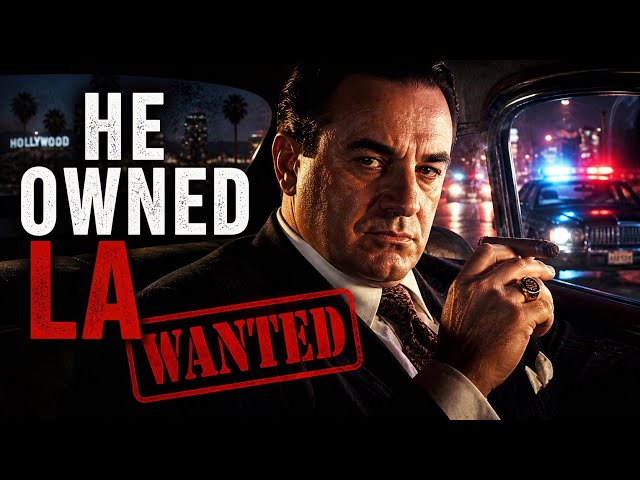
Mickey Cohen didn't just run Los Angeles; he owned the very air the city breathed.
From the tenements of Brooklyn to the neon-soaked chaos of the Sunset Strip, Mickey Cohen rose to become the most visible and violent mob boss in American history. While other gangsters hid in the shadows, Cohen held court in restaurants, cultivated the press, and treated the LAPD like his personal security detail.
But the higher you climb in the underworld, the harder the fall. This is the story of a teenage boxer who became the King of Vice, survived multiple hits, and was finally brought down—not by a bullet, but by a lead pipe and a tax bill.
This is the untold story of the man who turned crime into a Hollywood spectacle.
No textbook covers the true depth of the corruption that allowed the Cohen empire to generate over $100 million annually in today's money.
A powerful look at a man who refused to acknowledge the blood on his custom-tailored pinstripe suits.
⚠️ HISTORICAL DISCLAIMER: This documentary reconstructs events from historical records, court documents, oral histories, and investigative journalism. Some dialogue and scenes are dramatized based on documented accounts. Sources listed below.
📚 Sources & Further Reading:
→ Mickey Cohen: In My Own Words (Mickey Cohen)
https://www.amazon.com/Mickey-Cohen-My-Own-Words/dp/0135808529
→ L.A. Noir: The Struggle for the Soul of America's Most Seductive City (John Buntin)
https://www.randomhousebooks.com/books/20934/
Show More Show Less View Video Transcript
0:00
Meyer Harris Cohen was born on the fourth of September, nineteen thirteen. Brooklyn.
0:06
A tenement on the Lower East Side. Sixth child. Russian-Jewish immigrants.
0:12
He was four years old when his father died.
0:16
His mother moved the family to the Boyle Heights neighborhood of Los Angeles.
0:22
It was nineteen twenty-two. Mickey was eight.
0:25
Los Angeles was already something other cities weren't. Sprawling. Unfinished.
0:31
A city making itself up as it went.
0:34
By the time he was nine, Mickey Cohen was selling newspapers on the corner of Brooklyn
0:40
Avenue .
0:41
By ten, he was running numbers for local gamblers. Nobody taught him how the world worked.
0:47
He just... watched. And learned.
0:49
Some events in this story are reconstructed from court records, investigative reporting, and
0:56
Cohen's own memoir.
0:57
Where evidence is incomplete, that will be noted. He dropped out of school young.
1:03
The exact age is disputed — Cohen himself gave different answers at different times.
1:09
What isn't disputed is what happened next.
1:13
He fought. Mickey Cohen became a boxer.
1:16
Professional, by some accounts, as early as age fifteen.
1:20
He fought in the bantamweight division — small, fast, relentless. He won more than he lost.
1:26
But that wasn't what the ring gave him. The ring gave him a reputation.
1:32
By the late nineteen twenties, Cohen had drifted eastward — Cleveland, then Chicago.
1:38
He was working for Al Capone's outfit.
1:41
Running errands, collecting debts, learning the architecture of organized crime from the
1:47
ground floor up.
1:49
He was a teenager.
1:50
Chicago shaped him. But New York refined him.
1:54
In New York, Cohen caught the attention of Benjamin Siegel — known everywhere as Bugsy,
2:00
though no one called him that to his face.
2:03
Siegel saw something in the small, hard-edged kid from Los Angeles.
2:08
He brought him back west.
2:11
Los Angeles in the late nineteen thirties was a city with a problem. Gambling was illegal.
2:18
Prostitution was illegal. The city's population was exploding. And the demand for vice...
2:25
was not declining.
2:27
Siegel and Cohen built something systematic. Bookmaking operations across the city.
2:33
Wire services that fed race results to hundreds of betting parlors.
2:38
Enforcement teams that visited anyone who tried to operate outside the network.
2:44
It was an economy. Invisible to most. Indispensable to many.
2:49
How did it survive?
2:51
The Los Angeles Police Department of that era was not a disinterested party.
2:56
The department had its own relationships with the gambling world. Some officers collected.
3:03
Some looked away. Some did both. The line between the law and what Cohen was running...
3:09
was not always a line.
3:11
On the night of June twentieth, nineteen forty-seven, Benjamin Siegel was shot dead in the
3:19
Beverly Hills home of his girlfriend, Virginia Hill .
3:24
Four bullets. Living room window. He was forty-one years old.
3:30
The murder was never officially solved.
3:34
Mickey Cohen was now the most powerful organized crime figure in Los Angeles.
3:39
He hadn't planned it that way. He hadn't asked for it.
3:44
But Siegel was gone, and the territory was there, and Cohen understood one thing clearly: In
3:51
this business, you either fill the vacuum...
3:54
or you become it.
3:56
What made Cohen unlike almost any mob figure before him was this: He didn't hide.
4:02
He gave interviews. He cultivated journalists.
4:06
He was photographed in restaurants, at fights, on the street.
4:10
He understood — perhaps intuitively — that visibility was its own kind of armor.
4:17
A reporter once asked him directly what he did for a living.
4:22
Cohen answered without hesitation. "I'm a gambling man. I always have been.
4:27
That's all I've ever been." He said it the way a man explains his profession at a dinner
4:34
party.
4:35
Simple. Unapologetic.
4:36
Federal investigators later estimated that Cohen's bookmaking operations generated between
4:43
twelve million and fifteen million dollars per year at their peak.
4:48
In today's money — that is well over one hundred million dollars annually.
4:54
He employed dozens of men directly.
4:56
Hundreds more operated in loose affiliation with his network.
5:01
He spent money the way some men breathe. Custom suits. Dozens of them.
5:07
Shirts laundered so many times a day that tailors reportedly kept standing accounts just for
5:14
him.
5:15
He was known to bathe multiple times daily — a compulsive habit that acquaintances
5:21
attributed to anxiety, though Cohen himself never offered an explanation.
5:26
He was meticulous. Almost theatrical.
5:29
Between nineteen forty-seven and nineteen fifty, at least three serious attempts were made
5:36
on Mickey Cohen's life.
5:37
One shattered the front of his Brentwood home.
5:41
Another caught him in the parking lot of Sherry's restaurant on the Sunset Strip .
5:46
His bodyguard, Harry Cooper , was killed in that attack. Cohen walked away.
5:52
Who was trying to kill him?
5:54
The competing theory points to rival factions — Jack Dragna , the longtime boss of the Los
6:02
Angeles crime family, who regarded Cohen as an upstart.
6:06
An outsider. A man who'd never earned his place in the traditional hierarchy.
6:12
Dragna wanted Cohen gone. Cohen simply... refused to be.
6:17
Some accounts of Cohen's political connections are based on investigative journalism and
6:24
committee testimony.
6:26
Specific financial amounts related to political donations have not always been independently
6:33
confirmed.
6:34
What is documented is this: Cohen had relationships — some transactional, some social — with
6:41
a range of public figures.
6:43
Lawyers. Political fundraisers.
6:45
At least one figure connected to early California Republican politics.
6:51
The details remain contested. The relationships were real.
6:55
The federal government came for Mickey Cohen in nineteen fifty-one. Not for murder.
7:02
Not for extortion. Not for the gambling empire. For taxes.
7:07
In June of nineteen fifty-one, Cohen was convicted of federal income tax evasion .
7:13
The government argued he had received more than three hundred thousand dollars in income
7:20
over four years and declared almost none of it.
7:23
He was sentenced to five years at McNeil Island Federal Penitentiary .
7:28
He served four years and two months.
7:32
He came back. Nineteen fifty-five. Los Angeles. The same city. The same business.
7:38
Cohen was forty-one years old, and he behaved as though the conviction had been a minor
7:45
inconvenience — a delay, not a verdict on his life.
7:49
He reopened his operations. He gave more interviews.
7:54
The Kefauver Committee — the Senate Special Committee to Investigate Crime in Interstate
8:00
Commerce — had already been holding hearings across the country since nineteen fifty.
8:07
Cohen had testified. Reluctantly. Cautiously.
8:10
He understood the committee less as an investigation and more as a performance.
8:16
He performed accordingly.
8:18
During one exchange, a committee counsel pressed Cohen on the source of his income.
8:24
"I've had money given to me by friends. I don't know what else to call it." "Friends.
8:29
Can you name them?" "I'd rather not put my friends in any difficulty." The committee had no
8:35
mechanism to compel him further on that point.
8:38
He knew that.
8:40
In nineteen sixty-one, the federal government came for Mickey Cohen a second time.
8:46
Again: taxes. The I-R-S had spent years building a new case. New tax years.
8:53
New income calculations. New witnesses. Cohen's accountants had been careful.
8:59
But not careful enough.
9:01
In May of nineteen sixty-one, Cohen was convicted again on federal income tax evasion
9:08
charges.
9:09
This time the sentence was fifteen years. He was sent to Atlanta Federal Penitentiary .
9:17
Atlanta was different. McNeil Island had been hard. Atlanta was designed to break men.
9:24
In nineteen sixty-three, a fellow inmate named Burl Estes McDonald attacked Cohen with a
9:31
lead pipe in the prison laundry.
9:34
Cohen suffered severe brain damage.
9:37
He would spend the rest of his incarceration partially paralyzed.
9:43
Was the attack ordered? Cohen believed so. He told investigators it was not a random act.
9:49
That someone had arranged it. No conclusive evidence was produced.
9:55
No one was ever charged for ordering the assault.
9:58
The official record called it a prison altercation. Cohen called it an attempted murder.
10:06
Mickey Cohen was released from Atlanta in nineteen seventy-two.
10:10
He was fifty-eight years old. He walked with difficulty. His vision was impaired.
10:17
His empire had long since dissolved.
10:20
The men who had run beneath him were either dead, imprisoned, or aligned with other
10:26
factions.
10:27
Los Angeles had moved on.
10:29
In his final years, Cohen did what survivors do. He talked.
10:34
He sat with a writer named John Peer Nugent and dictated his memoirs.
10:40
The book was published in nineteen seventy-five under the title Mickey Cohen: In My Own
10:47
Words.
10:48
It is a remarkable document. Partly truthful. Partly self-serving. Largely unverifiable.
10:55
And completely his.
10:57
On the question of violence, Cohen said this: "I never killed anyone who didn't deserve it."
11:04
He paused in the recording.
11:06
Then added: "And I'm not even sure all of them deserved it." It is the closest thing the
11:13
memoir offers to remorse.
11:15
He attended church, occasionally. He donated to charitable causes.
11:20
He was photographed visiting sick children.
11:23
He also oversaw an organization built on extortion, violence, and the corruption of public
11:30
officials.
11:31
Both of these things were true.
11:33
Mickey Cohen spent his entire life refusing to acknowledge the contradiction between them.
11:40
Mickey Cohen died on the fourth of July, nineteen seventy-six. He was sixty-two years old.
11:47
Heart failure, in his West Los Angeles apartment.
11:51
He died without additional criminal charges. Without confessing to any murder.
11:58
Without providing the names investigators had spent decades trying to extract.
12:05
The gambling networks he built did not vanish when he died. They changed hands.
12:11
They adapted. The personnel changed. The methods evolved.
12:15
The infrastructure — the logic of it, the relationships, the template for how a city's
12:21
appetite for illegal commerce could be organized and profited from — that outlasted him by
12:28
decades.
12:29
Mickey Cohen is gone. The city is still there.
12:33
The machines he ran — the bookmakers, the fixers, the men who move money across the line
12:41
between legal and not — they adapted.
12:45
They always do. The man gets a biography. The system gets a successor.
12:51
In Los Angeles, it has always worked exactly that way.
#Arts & Entertainment