Up next in 10

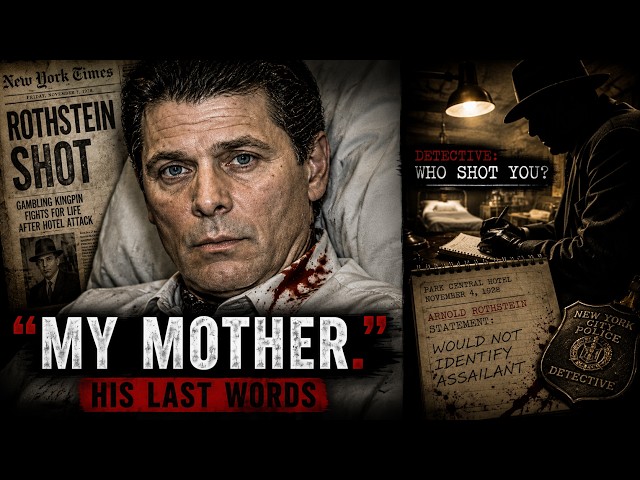
At the Park Central Hotel in 1928, one of the most powerful men in organized crime lay dying from a gunshot wound.
Detectives asked who pulled the trigger.
Arnold Rothstein gave them a different answer.
Known as “The Brain” and “The Big Bankroll,” Rothstein transformed American organized crime from street violence into a system built on money, leverage, political influence, and fear. He was linked to the 1919 Black Sox scandal, financed Prohibition-era bootlegging networks, mentored future Mafia legends, and built an empire where information was more valuable than bullets.
But when a high-stakes gambling debt shattered his reputation, the man who controlled credit across the underworld suddenly faced the one thing he could not negotiate.
This documentary explores the rise, influence, scandals, and mysterious death of Arnold Rothstein — the gangster who changed organized crime forever.
Based on historical records, court documents, biographies, contemporary reporting, and documented testimony.
⸻
🕰️ TIMESTAMPS
00:00:00 - Introduction: The Blood Trail & The Debt
Show More Show Less View Video Transcript
0:00
At the Park Central Hotel , the blood trail did not start with a gun.
0:05
It started with credit. A debt. A promise that one man refused to honor.
0:11
His name was Arnold Rothstein . Some accusations remain disputed.
0:16
We separate proven record from allegation, and we say so. Rothstein was called the Brain.
0:23
The Big Bankroll. The man who taught crime to keep books.
0:27
But on a November night in nineteen twenty-eight, the books came due.
0:33
Arnold Rothstein was born in New York City in eighteen eighty-two.
0:39
His father, Abraham Rothstein , was known as Abe the Just. That nickname mattered.
0:46
It meant discipline. Charity. Public respect. The son moved in the opposite direction.
0:53
The family argument survives only in shape. A father sees dice. A son sees freedom.
1:00
Abraham’s warning came before the voice switch.
1:04
"Dice again, Arnold?" "You shame a house that gave you everything." The boy did not need to
1:12
answer.
1:13
Silence was already his first wager.
1:16
Manhattan gave him the classroom he wanted. Not schoolrooms. Pool halls. Card tables.
1:22
Corners where small bets taught large lessons. He learned that men lied when frightened.
1:29
He learned they overplayed a good hand. He learned that pride could be priced.
1:35
That was Rothstein’s early education. Not violence first. Not loyalty first.
1:40
Information first.
1:42
If a man knew the odds, and had enough cash to survive bad luck, he did not need to shout.
1:48
He could wait.
1:50
By nineteen ten, Rothstein had moved through the Tenderloin district.
1:55
That neighborhood was not one thing. It was theaters. Brothels. Restaurants.
2:00
Police attention. Political protection.
2:03
And gambling rooms that changed addresses when needed.
2:06
Rothstein’s rooms were not built like street dens. They were controlled. Quiet.
2:12
Orderly enough to reassure rich men. Dangerous enough to frighten poor ones.
2:17
He was learning a style that would define him.
2:20
A criminal office could look like a business office. The difference was not the furniture.
2:27
The difference was what happened when the debt was unpaid.
2:31
A rare nineteen twenty-one interview preserved Rothstein’s own explanation.
2:37
The interviewer’s question came first.
2:39
"How did you become a gambler?" Rothstein answered without apology.
2:44
"I always gambled." "I can’t remember when I didn’t." "Maybe I gambled just to show my
2:50
father..." "he couldn’t tell me what to do." "But I don’t think so." "I think I gambled
2:57
because I loved the excitement." "When I gambled, nothing else mattered." That answer was
3:03
not confession.
3:04
It was architecture. He had turned appetite into method.
3:09
In nineteen oh nine, Rothstein married Carolyn Green . She came from the stage world.
3:16
His family did not approve. The marriage exposed the same fracture as the dice.
3:22
Home wanted order. Arnold wanted choice.
3:25
Carolyn later wrote about a husband who could be polite, controlled, and unreachable.
3:32
That matters because Rothstein’s empire did not grow from chaos. It grew from distance.
3:38
He did not need to be loved. He needed to be believed. At home, that made him cold.
3:45
In business, it made him useful.
3:48
The first real empire was not liquor. It was credit.
3:52
A bookmaker needed cash before race day. A gambler needed protection after losing.
3:58
A politician needed money without public paperwork. Rothstein supplied what each man lacked.
4:05
Then he wrote it down. Names. Amounts. Dates. Weaknesses. He was not simply lending money.
4:11
He was collecting leverage. Every loan created two records. One was financial.
4:17
The other was human. And the human record was often worth more.
4:26
The story turns in Chicago , in nineteen nineteen. Baseball was America’s public ritual.
4:33
The World Series was supposed to be clean.
4:37
Then the Chicago White Sox lost to the Cincinnati Reds .
4:41
Eight players were accused of taking money to throw games.
4:46
Rothstein’s name entered the scandal through gamblers near the plot.
4:52
That is where the record becomes dangerous. Not empty. Not settled. Dangerous.
4:58
Because the line between proof and reputation became almost impossible to police.
5:05
The players had grievances.
5:07
Chicago owner Charles Comiskey was widely criticized by players as tight with money.
5:13
Pitcher Eddie Cicotte became one of the central figures.
5:18
Shoeless Joe Jackson became the most famous name. But resentment does not prove a fix.
5:24
Money does. Meetings do. Testimony does. The Black Sox case was built from all three.
5:30
Then it was damaged by missing records, shifting stories, and men with reasons to lie.
5:37
Abe Attell , a former featherweight champion, moved near Rothstein’s world.
5:43
Sport Sullivan , a Boston gambler, also appears in accounts.
5:48
The narrator must be careful here. The meeting shape is documented.
5:54
The exact exchange is not. Attell’s position comes before the voice switch.
6:00
"They know your name opens doors." Sullivan’s answer followed.
6:05
"Then use the name before someone else does." No court proved that Rothstein ordered those
6:13
words.
6:14
But the scandal shows why his name had become a weapon.
6:24
Here is the central problem. Rothstein was never convicted for fixing the Series.
6:32
He was not indicted. Some historians argue he financed or profited from the fix.
6:39
Others argue his name was used by smaller gamblers.
6:44
The safest statement is also the most disturbing.
6:48
By nineteen nineteen, Arnold Rothstein had become powerful enough that a national scandal
6:57
could orbit him without proving him.
7:00
That is a different kind of power. Not innocence. Not guilt.
7:05
Influence strong enough to survive uncertainty.
7:10
Rothstein testified before a Chicago grand jury. His statement was polished.
7:16
Too polished, some critics thought.
7:18
The narrator introduces Rothstein before the voice switch.
7:23
"The whole thing started when Abe Attell..." "and some other cheap gamblers..." "decided to
7:29
frame the Series and make a killing." "The world knows I was asked in." "My friends know I
7:36
turned it down flat." "I was not in on it." "I did not bet a cent on the Series..." "after I
7:42
found out what was under way." The words denied everything.
7:47
The shadow remained.
7:49
The criminal trial did not deliver public clarity. The accused players were acquitted.
7:55
Key confessions had vanished from official custody.
7:58
The courtroom could not repair the damage. Baseball did what the court did not.
8:04
Judge Kenesaw Mountain Landis barred the eight players for life. His message was simple.
8:10
The game had to survive. Whether every legal question was answered did not matter.
8:16
Rothstein watched from the place he preferred. Near the center. Outside the final verdict.
8:22
The scandal changed Rothstein’s value.
8:26
Before nineteen nineteen, he was a gambler with money.
8:30
After the scandal, he was a rumor with money. That was more useful.
8:35
A rumor can enter rooms before a man arrives.
8:39
A rumor can threaten without raising its voice. A rumor can make borrowers pay on time.
8:46
The Jewish American underworld was not one family, and not one command. It was networks.
8:53
Friendships. Debts. Introductions. Rothstein did not need a crown.
8:58
He needed everyone to think he could afford one.
9:07
In January nineteen twenty, Prohibition became national law.
9:11
The Volstead Act turned ordinary thirst into a criminal market. Rothstein saw the opening.
9:18
But he did not have to stand on a dock with a gun. His role was cleaner. He financed.
9:24
He connected. He settled. He took percentages.
9:27
That made him harder to prosecute than a truckman caught with cases of whisky.
9:33
The law chased bottles. Rothstein chased ownership of the bottle’s journey.
9:39
Liquor needed routes. Canada . The Hudson River . Warehouses. Drivers.
9:44
Police windows that looked away. Every step needed money before profit arrived.
9:50
That was Rothstein’s advantage. He could bankroll a shipment. He could advance a bribe.
9:56
He could lend to one gang and quietly insure against another. This was not street courage.
10:02
It was liquidity. Cash moving faster than the law.
10:05
When a shipment failed, he still held the note. When it succeeded, he held the percentage.
10:12
Younger criminals studied him. Lucky Luciano learned polish. Meyer Lansky studied numbers.
10:19
Frank Costello understood contacts. Dutch Schultz saw scale. Legs Diamond saw opportunity.
10:25
Rothstein was not their father. That word is too sentimental. He was closer to a market.
10:32
Men came to him for money, protection, introductions, or permission.
10:36
They left with a lesson. Crime could dress better. Crime could speak softer.
10:42
Crime could use contracts, even when the contracts could never be shown in court.
10:48
His offices mattered. A street boss measured power by men outside a door.
10:54
Rothstein measured power by paper inside a drawer. Ledgers. Promissory notes.
11:01
Telephone numbers. Hotel accounts. Political favors.
11:05
A man who owed ten thousand dollars was useful. A judge who owed a favor was dangerous.
11:12
A policeman who accepted an envelope became part of the route.
11:17
The machine did not require everyone to be loyal. It required everyone to be compromised.
11:25
That was Rothstein’s genius. And his curse.
11:29
The narcotics allegations are darker.
11:32
Contemporary investigations and later biographies connect Rothstein to heroin and drug
11:39
financing.
11:40
The exact structure is harder to prove than the public myth suggests.
11:46
That uncertainty matters. But the pattern fits his method.
11:50
He preferred businesses where supply was risky, demand was steady, and capital controlled
11:58
access.
11:59
Liquor did that. Gambling did that. Narcotics did that with greater human damage.
12:05
Here, the glamour should stop. Behind the ledgers were addicts. Families. Bodies.
12:12
Rothstein treated markets as abstractions. The city did not experience them that way.
12:19
A borrower in Rothstein’s world did not meet a cartoon gangster. He met calm.
12:25
The collector enters only after the narrator places him in the room. "Mr.
12:31
Rothstein expects payment by Friday." The borrower’s fear came next.
12:37
"I need another week." The collector did not raise his voice.
12:42
"You already bought that week." The terror was in the accounting. Not the threat.
12:48
The borrower understood. Numbers could be merciless without sounding angry.
12:55
The public saw fragments. A racing scandal. A baseball scandal. A gambling room.
13:01
A whispered loan. Investigators saw something else.
13:05
A man sitting between legal and illegal worlds. That position was the empire.
13:11
Rothstein did not abolish older street violence. He made violence more selective.
13:17
He did not remove corruption. He made corruption easier to finance.
13:23
The consequence was institutional. Police chased crimes. Rothstein funded conditions.
13:29
Courts judged defendants. Rothstein invested in the space before defendants appeared.
13:43
Then the system found its contradiction.
13:46
Arnold Rothstein, the man who made others pay, owed money. Not a small sum.
13:53
Reports placed the disputed poker debt above three hundred thousand dollars.
14:00
He claimed the game was crooked. His opponents claimed the debt was real.
14:06
Both claims served the men making them. But one fact broke through every version.
14:13
Rothstein refused to pay. For an empire built on credit, that was not a private quarrel.
14:21
It was an earthquake.
14:26
His refusal changed the room around him.
14:29
If Rothstein could reject a gambling debt, then every borrower could ask why he deserved
14:36
better treatment.
14:37
If the Big Bankroll could call a game crooked, then his own rules weakened.
14:43
Reputation had lifted him. Now reputation trapped him.
14:47
He could not pay without admitting defeat. He could not refuse without inviting force.
14:54
This was the hidden danger in a credit empire. The money was real.
14:59
But the authority was performance. Once the performance cracked, men listened for the sound.
15:11
On the night of November fourth, nineteen twenty-eight, Rothstein went to the Park Central
15:18
Hotel.
15:19
Police reporting tied the meeting to a high-stakes card debt.
15:24
George McManus became the central suspect. Other names moved through the case.
15:30
Jimmy Meehan . Gamblers. Witnesses. Men who knew too much, and remembered too little.
15:36
Rothstein was shot inside the hotel. He was found near a service entrance.
15:42
A man who had entered by reputation was carried out by wound.
15:46
The image is almost too perfect, which means we should distrust it.
15:52
A gambler bleeding through a luxury hotel. A debt behind him.
15:57
A city waiting to see if he would talk. He was taken to Stuyvesant Polyclinic .
16:03
Doctors operated. Police waited. Newspapers prepared the legend before the body cooled.
16:10
Rothstein had survived by knowing what to say. Now detectives wanted one useful sentence.
16:17
A name. A shooter. A break in the code.
16:21
The hospital exchange became part of underworld folklore.
16:26
A detective asked the question before Rothstein’s voice entered.
16:32
"Who shot you?" Rothstein’s answer was evasive, bitter, and almost theatrical.
16:39
"My mother." The detective pressed again. Rothstein gave the line that made the myth harder.
16:47
"You stick to your trade." "I’ll stick to mine." If the wording varies, the meaning does
16:55
not.
16:56
He refused to identify the shooter.
17:00
Arnold Rothstein died on November sixth, nineteen twenty-eight.
17:05
The New York Times reported that he died without naming the man who shot him.
17:11
Police searched. Reporters wrote. Creditors circled. Files became suddenly valuable.
17:17
His apartment and papers drew attention because the real estate of his empire was not only
17:24
cash.
17:25
It was information. Who owed. Who paid. Who cheated. Who could be embarrassed.
17:31
Death did not erase the ledger. It made the ledger dangerous to everyone left alive.
17:38
George McManus was tried for murder. He was acquitted.
17:42
No one was convicted for killing Rothstein. That legal ending fits the larger pattern.
17:49
The man whose life moved between proof and rumor died inside the same fog.
17:55
Historians can trace debts. They can trace names. They can trace newspaper reports.
18:01
They cannot turn every shadow into fact. That is not failure. That is the record.
18:08
Rothstein built a world where people avoided clean statements.
18:13
Then his own death became one more dirty file.
18:17
The empire did not vanish. It fragmented. Luciano became more important.
18:22
Lansky became more important. Costello became more important.
18:27
The next generation took Rothstein’s lessons and removed his restraint.
18:32
They understood organization. They understood money.
18:36
They understood that politics could be rented.
18:39
They also understood something Rothstein’s death made plain.
18:43
A criminal bank needs enforcement. Credit alone is not enough.
18:48
After Rothstein, organized crime became less dependent on one man’s calm.
18:53
The machine learned to survive without the banker.
19:03
Culture kept his silhouette. F.
19:05
Scott Fitzgerald shaped Meyer Wolfsheim in The Great Gatsby from the legend of men like
19:13
Rothstein.
19:14
Damon Runyon turned Broadway criminals into language and myth.
19:20
But the real Rothstein was colder than fiction. He was not the loud gangster in the alley.
19:28
He was the quiet man at the table. The one who knew what everyone owed.
19:34
At the Park Central Hotel, the blood trail did not start with a gun. It started with credit.
19:42
And credit, in Rothstein’s world, was never just money.
#Arts & Entertainment