Up next in 10

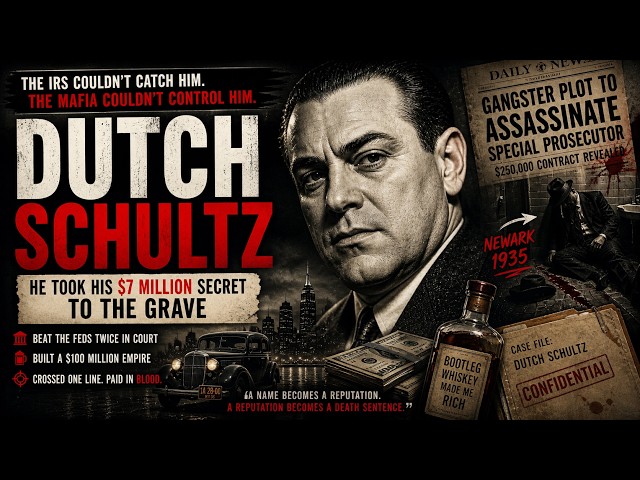
He was the man the IRS couldn't catch and the man the Mafia couldn't control.
In the 1930s, Arthur Flegenheimer—known to the world as Dutch Schultz—built a $100 million empire on the back of illegal beer and the Harlem numbers racket. He wasn't just a gangster; he was a political force that moved judges, police, and juries like chess pieces.
But when he proposed the unthinkable—the assassination of a high-profile Special Prosecutor—he crossed a line that even the Commission wouldn't tolerate.
This is the untold story of the 'Beer Baron of the Bronx,' a man who beat the federal government twice in court only to be brought down by his own ambition in a Newark restroom.
No textbook covers the psychological warfare Schultz used to win over a small-town jury in Malone, or the bizarre, poetic delirium of his final 22 hours on earth.
THEME: A haunting look at how a name becomes a reputation, and how a reputation becomes a death sentence.
⚠️ HISTORICAL DISCLAIMER: This documentary reconstructs events from historical records, court documents, oral histories, and investigative journalism. Some dialogue and scenes are dramatized based on documented accounts. Sources listed below.
📚 Sources & Further Reading:
→ The Last Words of Dutch Schultz (William S. Burroughs)
https://archive.org/details/lastwordsofdutch00burr
→ Kill the Messenger: The Life and Crimes of Dutch Schultz (Rich Cohen)
https://www.goodreads.com/book/show/12345
Show More Show Less View Video Transcript
0:00
His real name was Arthur Flegenheimer. Nobody called him that.
0:04
The name he chose — Dutch Schultz — carried more weight on the streets of the Bronx than any
0:11
birth certificate ever could.
0:13
And by nineteen thirty-five, that name was on every front page in America.
0:19
Some men are famous for what they did. Dutch Schultz was famous for what he got away with.
0:26
This is a documentary retelling of verified historical events.
0:31
Where exact words are lost, exchanges have been reconstructed from court records, testimony,
0:37
and contemporaneous reporting.
0:40
He was born in nineteen hundred and two, on the lower east side of Manhattan.
0:46
His father left when Arthur was fourteen. His mother ran a restaurant.
0:51
His uncle ran a pool hall. Neither could hold him.
0:55
By the time he was seventeen, he had been arrested for burglary.
1:00
By the time he was twenty-one, the Prohibition era had handed him something worth far more
1:06
than a pool hall.
1:08
It had handed him an empire.
1:10
The Bronx beer trade in the nineteen twenties was not subtle. Trucks moved at night.
1:17
Money moved in envelopes. Judges moved on schedules. Dutch Schultz understood all three.
1:24
He muscled into the illegal beer distribution business with a combination of violence and
1:31
financial precision that most of his rivals could not match.
1:36
Men who refused him were beaten. Men who still refused him...
1:41
did not get a third opportunity.
1:44
By the early nineteen thirties, he had expanded into Harlem.
1:48
The numbers racket — the street lottery that ran through nearly every poor neighborhood in
1:55
New York — was generating millions.
1:57
The people running it were small operators. Dutch Schultz was not small.
2:02
He moved into Harlem the same way he moved into the Bronx. With muscle. With money.
2:08
With patience.
2:09
And within two years, he controlled an operation that brought in somewhere between twenty
2:16
million and one hundred million dollars a year.
2:20
The man who ran it all was careful in specific ways and reckless in others.
2:26
He wore cheap suits. He ate at diners. He did not buy yachts or penthouses.
2:32
He did not throw parties. But he did order men killed.
2:36
And he expected everyone around him to understand the difference between a business decision
2:43
and a personal one.
2:45
There was, for Dutch Schultz, rarely a difference.
2:49
By nineteen thirty-three, the federal government had seen enough.
2:54
The Internal Revenue Service had been watching his finances for years.
3:00
They had done it to Al Capone in Chicago. They intended to do it again.
3:06
A federal indictment for income tax evasion was filed against Arthur Flegenheimer — known as
3:13
Dutch Schultz — in January of nineteen thirty-three.
3:18
The charge was specific. The evidence was substantial. And Schultz ran.
3:24
He spent more than a year as a fugitive. Moving between safe houses.
3:29
Communicating through intermediaries.
3:32
Continuing to run his organization from wherever he happened to be sleeping that week.
3:38
Law enforcement knew roughly where he was. Getting him was another matter.
3:44
When he finally surrendered in November of nineteen thirty-four, he did so on his own terms
3:51
— walking into a federal building in Albany with his lawyers beside him and his composure
3:57
intact.
3:59
The first trial was held in Syracuse , New York, in April of nineteen thirty-five.
4:05
The prosecution believed the case was airtight. They had financial records.
4:11
They had expert testimony. They had years of documentation.
4:15
What they did not have — and what they could not fully anticipate — was the jury.
4:22
After days of deliberation, the jury could not reach a verdict. A mistrial was declared.
4:29
The government tried again.
4:31
This time, the trial was moved to Malone , New York — a small town near the Canadian border,
4:39
far from Schultz's base of influence in the city.
4:42
The logic was obvious.
4:44
A rural jury, unfamiliar with Schultz, untouched by his money, removed from the politics of
4:51
New York City courts.
4:53
It should have been a cleaner fight. It was not.
4:57
What happened in Malone remains one of the more extraordinary episodes in the history of
5:04
American organized crime trials.
5:06
Schultz arrived weeks before the case began. He did not hide. He donated to local charities.
5:14
He attended church. He introduced himself to shopkeepers. He made himself a neighbor.
5:21
The prosecutor in the case was a man named Martin Conboy . Conboy was experienced.
5:26
He was methodical. He believed the evidence spoke for itself.
5:31
But the evidence was speaking to people who had spent the last several weeks watching Dutch
5:37
Schultz hand money to the local Catholic church and wave to children on the street.
5:43
Martin Conboy was not in the room for that part of the trial.
5:47
The Malone jury deliberated for over twenty-four hours.
5:52
A juror, speaking to reporters after the verdict, was asked how the panel had viewed the
5:58
defendant.
5:59
"He seemed like a decent enough fellow to us.
6:02
Not what we expected." The reporter pressed further. "We went by the evidence.
6:08
That's all I'll say." The verdict came back not guilty on all counts.
6:14
The courtroom erupted.
6:16
Schultz shook hands with his lawyers, smiled for the cameras, and walked out of the Malone
6:23
courthouse a free man.
6:25
It was August of nineteen thirty-five. He had beaten the federal government. Twice.
6:32
Special Prosecutor Thomas Dewey had been watching. Dewey was thirty-three years old.
6:39
He was meticulous, ambitious, and deeply unimpressed by the outcome in Malone.
6:44
He had been appointed specifically to dismantle the organized crime operations that had
6:51
taken root in New York City.
6:53
And Dutch Schultz was near the top of his list.
6:57
What Dewey began building after the Malone verdict was a new case.
7:02
This one would not rely on tax records. It would rely on witnesses.
7:07
On the numbers operation itself.
7:10
On the women and men who ran the slips and collected the money and moved through Harlem
7:17
every day.
7:18
Dewey intended to take Schultz's empire apart from the inside.
7:23
Schultz heard about it.
7:24
He brought it to the Commission — the governing council of the major organized crime
7:31
families that had formed in the early nineteen thirties.
7:35
His proposal was direct. "Dewey has to go.
7:39
We take him out now, before he builds the case." The room went quiet.
7:44
"You touch a prosecutor in this city, every cop in America comes down on all of us." Lucky
7:51
Luciano was not speaking out of sentiment.
7:54
He was speaking out of arithmetic.
7:57
The Commission voted. Schultz's proposal was rejected.
8:01
The decision reached across the table — and across the city — within days.
8:07
If Dutch Schultz was going to move on Thomas Dewey anyway, the Commission had a problem.
8:14
And the Commission, historically, solved its problems.
8:19
On the night of October twenty-third, nineteen thirty-five, Dutch Schultz was at the Palace
8:25
Chop House in Newark , New Jersey.
8:28
He was meeting with several associates. He stepped away from the table briefly.
8:34
Two men entered the restaurant. They were not there to eat.
8:39
Three of Schultz's associates were shot at the table.
8:43
Schultz himself was shot in the men's room. The bullet entered his side.
8:48
It did not kill him immediately.
8:50
He was taken to Newark City Hospital, where he remained conscious — barely — for nearly
8:57
twenty-two hours.
8:58
During those hours, he talked.
9:01
A detective named Luke Conlon sat beside the bed and wrote down everything he said.
9:07
What Schultz said, in those final hours, has become one of the stranger documents in
9:15
American criminal history.
9:17
He was delirious. He was in extraordinary pain.
9:21
He moved between coherence and something else entirely. Detective Conlon recorded it all.
9:28
Some of what Schultz said was name-dropping — people, places, old grievances.
9:35
Some of it was prayer.
9:37
Some of it was the kind of language that happens when the mind breaks loose from the body.
9:44
"A boy has never wept...
9:46
nor dashed a thousand kim..." "Oh, mama, mama, mama..." "I want to pay.
9:52
Let them leave me alone." He died on October twenty-fourth, nineteen thirty-five.
9:59
He was thirty-three years old.
10:02
The trial that Thomas Dewey had been building never happened.
10:07
The case against Dutch Schultz — the one built on witness testimony and the numbers
10:13
operation — died with him.
10:15
But Dewey kept going. He would go on to prosecute Lucky Luciano the following year.
10:21
He would become Governor of New York. He would run for President of the United States.
10:27
Twice. The man who was supposed to be the target outlived his would-be killer by decades.
10:34
The Palace Chop House murders were eventually attributed to a team working for the Mangano
10:42
crime family, acting on Commission orders.
10:45
The triggerman most often cited in historical accounts is Charles "Bug" Workman .
10:51
Workman was convicted of the murder in nineteen forty-one. He served twenty-three years.
10:58
He was released in nineteen sixty-four. He said very little publicly.
11:04
He outlived almost everyone involved.
11:07
Dutch Schultz left behind an estate that was nearly impossible to account for.
11:13
He had kept almost no records of his own finances — a habit that had helped him survive the
11:20
tax trials and made life very difficult for everyone who came after.
11:26
There are stories — persistent, unverified, almost certainly embellished — about a buried
11:33
treasure somewhere in the Catskill Mountains.
11:36
A strongbox. A fortune. Hidden before the end came. No one has ever found it.
11:42
Some people are still looking.
11:45
His real name was Arthur Flegenheimer.
11:48
He chose a different name because he understood something that most men in his business
11:55
missed.
11:56
A name is a reputation. A reputation is power.
12:00
Dutch Schultz spent his entire adult life building something that courts, prosecutors, and
12:07
federal agents could not take from him.
12:10
And in the end, it was not the law that brought him down. It was his own proposal.
12:17
His own plan. His own voice in that room, saying the wrong thing to the wrong people.
12:24
The last documented record of Dutch Schultz is Detective Luke Conlon's transcription of his
12:33
final words.
12:34
Twenty-two hours of fragmented speech. Names. Numbers. Prayers. The document is preserved.
12:43
The questions it raises are not answered inside it.
12:48
The file on Arthur Flegenheimer was closed on October twenty-fourth, nineteen thirty-five.
12:56
The city moved on. The machine kept running.
#Arts & Entertainment