Up next in 10

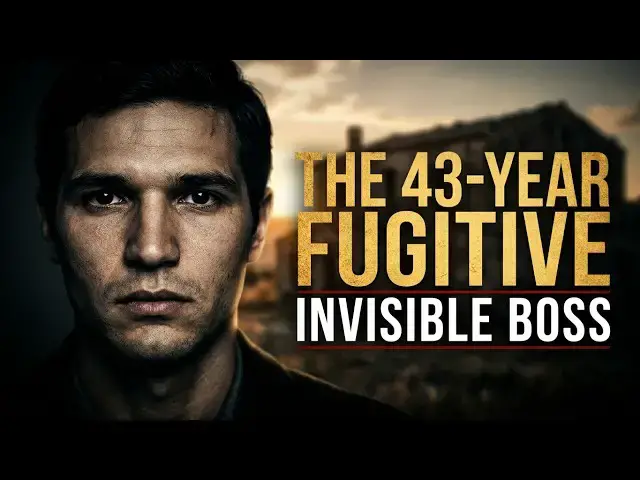
For more than four decades, Bernardo Provenzano remained invisible.
While Italy launched massive manhunts, arrested hundreds of Mafia members, and dismantled criminal networks, the man known as "The Tractor" continued running the Sicilian Mafia from the shadows.
How did one of the world's most wanted fugitives evade capture for 43 years?
This documentary uncovers the remarkable true story of Bernardo Provenzano—from his rise within Cosa Nostra to his secret communication system, his transformation of the Mafia, and the operation that finally brought his decades-long escape to an end.
Inside this documentary:
• The rise of Bernardo Provenzano
• The Corleonesi takeover
• The Second Mafia War
• Life as Italy's most wanted fugitive
• The secret "Pizzini" message network
• How he controlled Cosa Nostra while in hiding
• The investigation that finally caught him
• The legacy he left behind
Based on historical records, court documents, anti-mafia investigations, and published historical sources.
Show More Show Less View Video Transcript
0:00
April eleventh, two thousand and six. Corleone, Sicily.
0:04
Italian police had been looking for this man for forty-three years.
0:10
Forty-three years of warrants.
0:12
Forty-three years of surveillance operations, false leads, and dead informants.
0:18
And when they finally found him — he was sitting on a bed in a farmhouse, two miles from the
0:26
town where he was born.
0:28
His name was Bernardo Provenzano. He had not been photographed since nineteen fifty-nine.
0:35
The image Italian authorities circulated for four decades showed a young man with a narrow
0:42
face and dark eyes.
0:44
By the time they opened that farmhouse door, the man inside was seventy-three years old,
0:51
white-haired, and recovering from surgery.
0:54
On the nightstand — a Bible. A rosary.
0:57
And a folded slip of paper no larger than a postage stamp.
1:02
That slip of paper was a pizzino — a handwritten note, folded and refolded until it could
1:10
fit inside a hollow.
1:11
For more than a decade, Provenzano had run the entire Sicilian Mafia using these tiny scraps
1:19
of paper.
1:20
No phones. No emails. No intermediaries who could be wired.
1:25
Just handwriting, passed hand to hand through a chain of shepherds, farmers, and relatives.
1:33
The officers who entered the farmhouse found more than two hundred pizzini.
1:39
Some gave instructions to capos across Sicily. Others quoted scripture.
1:44
Several contained financial figures — sums that corresponded to public works contracts worth
1:52
tens of millions of euros.
1:58
This account draws from court records, published testimony, and investigative journalism.
2:04
What made the arrest extraordinary was not the capture itself.
2:09
It was the duration of the absence. Forty-three years.
2:13
From nineteen sixty-three to two thousand and six — longer than most political careers,
2:20
longer than most marriages — Bernardo Provenzano had operated as a fugitive.
2:26
And during that time, according to prosecutors, he had risen from a young gunman in a
2:33
provincial town to the supreme commander of Cosa Nostra.
2:38
The strangest part of the record is not how long he hid.
2:42
It is how visible his influence remained while he was invisible.
2:47
Construction contracts in Palermo bore his fingerprints.
2:52
Hospital renovations in Bagheria moved through companies linked to his associates.
2:58
Agricultural subsidies from the European Union flowed to farms whose owners answered to a
3:05
man no government could find.
3:07
The money never stopped. The man simply ceased to exist.
3:12
And yet — the question that investigators would circle for decades was never where
3:19
Provenzano was hiding.
3:20
It was who was helping him hide.
3:23
Because no man lives as a fugitive for forty-three years without institutional assistance.
3:29
Not in a country with a functioning police force, a judiciary, and a parliament.
3:35
Not unless someone, somewhere, was looking the other way.
3:42
The investigating magistrate who led the final operation later observed that Provenzano's
3:49
network of protection extended into areas that made the prosecution uncomfortable to discuss
3:55
in open court.
3:56
Certain names on the pizzini were never publicly identified.
4:00
That discomfort — that institutional silence — is part of the story.
4:06
But to understand how a man could vanish for four decades and still command an empire, the
4:14
record has to go back.
4:16
Back before the arrest. Before the pizzini.
4:19
Before the war that reshaped the Sicilian Mafia and left Provenzano standing in its ruins.
4:27
Back to Corleone. Nineteen sixty-three.
4:37
Corleone sits in the interior of western Sicily — a hill town with stone buildings and
4:44
narrow streets, surrounded by wheat fields and pasture.
4:48
In the early nineteen sixties, it was poor. Not the romantic poverty of travel writing.
4:55
The poverty of no running water in some houses, of illiteracy rates that shamed the Italian
5:02
government, of young men who saw exactly two paths: emigration or Cosa Nostra.
5:09
Provenzano chose the second path early.
5:12
By nineteen sixty-three, he was already wanted for murder.
5:17
According to court documents filed decades later, Provenzano had been part of the Corleonesi
5:24
faction — a group of mafiosi from Corleone who operated with a violence that unnerved even
5:31
Palermo's established bosses.
5:33
His partner in those years was Salvatore Riina — a man known as Toto — short, compact, with
5:40
a temper that burned through every negotiation.
5:44
Riina was the blade.
5:46
Provenzano, according to those who later turned state's witness, was something else
5:52
entirely.
5:53
The pentito Tommaso Buscetta — the most important Mafia informant in Italian history — later
6:01
described the division in terms that prosecutors found revealing.
6:06
As Buscetta recounted to the investigating magistrate Giovanni Falcone: Riina — he solved
6:13
problems by eliminating them.
6:15
Provenzano — he solved problems by making you believe there was no problem.
6:21
That distinction would prove decisive.
6:24
But in nineteen sixty-three, neither man was running anything. They were soldiers.
6:31
Enforcers for the Corleonesi boss Luciano Liggio, a man whose ambition was larger than his
6:38
territory.
6:39
The event that changed everything was the Ciaculli massacre.
6:44
On June thirtieth, nineteen sixty-three, a car bomb in the Palermo suburb of Ciaculli killed
6:52
seven carabinieri officers.
6:54
The bomb had been intended for a rival mafioso. It detonated in the wrong hands.
7:01
The Italian state responded with a fury that Cosa Nostra had not anticipated.
7:08
Mass arrests swept across Sicily. Hundreds of mafiosi were detained. Liggio was arrested.
7:15
Many capos surrendered or fled. Riina and Provenzano disappeared.
7:22
Disappeared — not metaphorically. They ceased to exist in any official register. No address.
7:30
No employment record. No photographs.
7:33
In a country where every citizen carried identity documents, these two men simply stepped
7:40
outside the bureaucratic record and did not step back in for decades.
7:46
For Riina, the fugitive life was temporary strategy. For Provenzano, it became identity.
7:54
What the record shows about those early years of absence is fragmentary.
8:00
Provenzano moved through the rural interior of western Sicily — staying with relatives,
8:06
farmers, and low-level mafiosi whose names meant nothing to police.
8:11
He learned, in those years, a discipline that most men in violent organizations never
8:18
acquire.
8:19
He learned to want nothing that could be seen.
8:23
The magistrate who later reviewed those years noted that the absence of documentation was
8:30
itself a form of documentation.
8:32
Every organization produces paper — receipts, phone records, utility registrations.
8:39
Provenzano produced none.
8:41
In an era before digital surveillance, that silence was almost impossible to maintain
8:48
without help.
8:49
Almost.
8:50
Meanwhile, the world outside kept moving.
8:54
Italy's economic miracle — the postwar boom — was transforming the north.
8:59
In Sicily, the transformation came through a different channel. Public works.
9:06
Infrastructure contracts.
9:08
European development funds pouring into a region officially classified as underdeveloped.
9:15
And Cosa Nostra, slowly, quietly, learned to follow that money. Not with guns.
9:21
With paperwork.
9:23
Provenzano, according to later testimony, understood this shift before most of his peers.
9:30
Violence attracted attention. Contracts attracted accountants.
9:35
And accountants, unlike magistrates, could be managed.
9:40
But none of that calculus would matter without first surviving what was coming.
9:46
And when they came back — Riina led with blood. Provenzano watched. And waited.
10:00
Nineteen seventy-nine.
10:01
Palermo's streets began producing bodies at a rate that shocked even veteran investigators.
10:09
Judges. Police commissioners. Prosecutors. Journalists.
10:13
And rival mafiosi — dozens of them — killed in a systematic campaign that investigators
10:21
later called the Second Mafia War.
10:23
The Corleonesi had declared war on everyone.
10:28
Riina's strategy was simple and devastating: kill not just the targets, but their allies,
10:34
their relatives, and anyone who might retaliate.
10:38
The Palermitan families who had dominated Cosa Nostra since the nineteen fifties — the
10:45
Bontade clan, the Inzerillo family — were dismantled, family by family, over three years.
10:51
The body count, according to prosecutors who later reconstructed the period, exceeded three
10:58
hundred.
11:00
Where was Provenzano in all of this? The honest answer is that the record is contested.
11:06
Some pentiti placed him at specific killings.
11:10
Others described him as increasingly distant from the violence — present in the decisions,
11:17
absent from the executions.
11:19
What is not contested is this: he signed off.
11:23
The Corleonesi operated as a partnership, and Provenzano was a partner.
11:29
The blood was shared.
11:35
But here the story becomes complicated in ways that matter.
11:39
Because even as the killings continued, Provenzano was building something the violence was
11:46
not designed to build.
11:47
He was building relationships with people who wore suits.
11:51
The money pipeline that investigators would later document in extraordinary detail began
11:58
taking shape in this period.
12:00
Construction companies in Palermo were fronted by men with clean records and Masonic lodge
12:06
memberships.
12:07
Public contracts — for roads, hospitals, schools — were awarded through a system of
12:14
coordinated bids that ensured Mafia-connected firms always won.
12:19
The mechanism was elegant in its simplicity: competitors submitted deliberately high bids.
12:25
The designated winner submitted a slightly lower one. Everyone received a percentage.
12:32
In some provinces of western Sicily, Cosa Nostra's financial network captured an estimated
12:39
thirty to forty percent of all public works spending.
12:43
Not through direct theft — through infiltration of the process itself.
12:48
The money did not look like crime. It looked like commerce.
12:53
And then came Giovanni Falcone.
12:56
The magistrate who would become the most important — and most dangerous — figure in the
13:02
history of Italian anti-Mafia prosecution was a small, careful man from Palermo.
13:08
He had grown up in the same neighborhoods where Cosa Nostra recruited.
13:14
He understood, as few prosecutors had before him, that the organization was not simply
13:20
violent.
13:21
It was financial.
13:23
Falcone began following the money.
13:26
Not the street-level cash of extortion and drug sales — the institutional money.
13:32
Bank accounts. Real estate transfers.
13:35
Shell companies registered in Luxembourg and Liechtenstein.
13:39
Wire transfers that moved through Switzerland before landing in legitimate-looking
13:46
enterprises in northern Italy.
13:48
The record Falcone built — the Maxi Trial of nineteen eighty-six — would result in three
13:55
hundred and sixty convictions.
13:58
But it also cost him his life.
14:01
On May twenty-third, nineteen ninety-two, a half-ton of explosives detonated beneath the A29
14:08
motorway near Capaci, Sicily.
14:11
Falcone was killed. His wife, Francesca Morvillo, was killed. Three bodyguards were killed.
14:18
Two months later, Judge Paolo Borsellino was killed in a car bombing in Palermo.
14:25
The state had been sent a message.
14:28
Both killings were later attributed to orders from Cosa Nostra's supreme commission.
14:35
Riina, as the operational boss, carried the primary responsibility in prosecutors' findings.
14:42
Provenzano's precise role in the authorization of these murders remains one of the most
14:48
contested questions in Italian judicial history.
14:52
Some collaborating witnesses described him as opposed — not on moral grounds, they said, but
14:59
on strategic ones.
15:00
Others placed him in the room when the decisions were made.
15:04
The record has never been fully closed.
15:08
What is documented is that Provenzano later described the killings of Falcone and Borsellino
15:15
as a catastrophic error.
15:17
Not in those words — Provenzano rarely used direct language about anything.
15:22
But the pizzini that investigators would later read suggested a man who believed the
15:29
bombings had destroyed the careful architecture of institutional tolerance that Cosa Nostra
15:36
had spent twenty years constructing.
15:38
Buscetta, who survived into exile, put it plainly to interviewers in his later years.
15:45
Falcone was not just a magistrate. He was a signal.
15:49
When they killed him — they killed the idea that they could operate in silence.
15:55
After that, silence became impossible.
15:58
The bombings triggered a political earthquake. Emergency anti-Mafia legislation.
16:05
Mass arrests. Confiscations. And one consequence that nobody in Corleone had anticipated.
16:12
The arrest of Salvatore Riina. January fifteenth, nineteen ninety-three.
16:18
Twenty-three years a fugitive.
16:21
Captured in a Palermo apartment by a unit acting on information from a pentito.
16:28
Riina went to prison.
16:29
And Bernardo Provenzano became, by default, the most powerful man in Cosa Nostra.
16:42
There is a detail that appears in multiple accounts of Provenzano's years as supreme boss
16:48
that prosecutors found both mundane and illuminating.
16:52
He kept sheep. Or at least — the farms where he hid kept sheep.
16:56
He moved through the Sicilian interior dressed as a farmer, sometimes actually working the
17:03
land.
17:04
To neighbors who saw him at all, he was a quiet elderly man with health problems and a
17:10
religious disposition.
17:12
Nothing more.
17:12
After Riina's arrest, Provenzano made a strategic decision that restructured Cosa Nostra
17:19
more profoundly than any internal war had managed.
17:23
He stopped the violence. Not all of it. Not everywhere.
17:28
But the spectacular, state-confronting attacks — the bombings, the assassination of senior
17:35
officials — these ended.
17:37
Provenzano's guiding philosophy, reconstructed from the pizzini and from testimony, was a
17:44
single Sicilian word: sommersione.
17:46
Submersion.
17:51
The idea was radical in its simplicity. Do not fight the state. Infiltrate it.
17:57
Do not bomb the courts. Own the construction companies that build them.
18:03
Do not threaten politicians. Fund their campaigns and sit across from them at dinner.
18:10
What Provenzano understood — what Riina apparently could not — was that Cosa Nostra's
18:16
greatest asset was not its capacity for violence.
18:20
It was its capacity for invisibility.
18:24
From his hiding places in the Sicilian interior, Provenzano began rebuilding the
18:30
organization's political relationships through the pizzino.
18:34
He would write by hand — in a cramped, idiosyncratic Italian full of biblical quotations and
18:41
indirect phrasing — and the note would be folded, passed to a trusted courier, and carried
18:48
through a chain of three or four intermediaries before reaching its destination.
18:54
Each note was designed so that any single link in the chain — if arrested — could reveal
19:01
only one step in either direction.
19:04
No courier knew the full route. No intermediary knew the final recipient.
19:09
It was analog encryption.
19:12
The content of the pizzini ranged from the mundane to the consequential.
19:17
Some dealt with organizational disputes — which capo had overstepped his territory, which
19:24
family had failed to pay its quota.
19:26
Others addressed the money pipeline directly.
19:30
Several pizzini that prosecutors later cited in court contained references to individuals —
19:36
identified by nickname only — who held positions in regional government.
19:42
Those nicknames were never fully decoded.
19:47
The financial architecture that Provenzano oversaw during these years was not a simple
19:54
criminal operation.
19:56
It was, according to economists who later examined the evidence at trial, a parallel
20:03
economy.
20:04
European agricultural subsidies. Regional development funds. Hospital construction.
20:10
Water infrastructure. Road contracts. These were not crimes of opportunity.
20:17
They were crimes of access.
20:19
Meanwhile, the human cost of the pizzo system was being paid by people who rarely appeared
20:26
in any document at all.
20:28
A shopkeeper in Bagheria who paid five hundred euros a month and told no one.
20:34
A small contractor in Palermo who lost a bid he had legitimately won and understood
20:41
immediately why.
20:42
A farmer in the Corleone hills who paid his quota and went home and did not discuss it with
20:50
his children.
20:51
These were the people financing the invisible throne.
20:59
And Provenzano, on his farm, with his Bible and his rosary and his folded slips of paper,
21:06
received reports, issued instructions, and — according to the testimony of several pentiti —
21:13
prayed.
21:14
He reportedly opened his letters with blessings.
21:17
He reportedly closed his instructions with scripture.
21:21
Whether this was genuine piety or a performance of piety designed to project an image of
21:28
benevolence — the record does not resolve.
21:31
Perhaps both things were true.
21:33
Inside Cosa Nostra, the years of Provenzano's leadership were not without internal tension.
21:41
The pizzini record shows multiple disputes — capos who believed the period of restraint had
21:48
lasted too long, younger men impatient with the sommersione strategy.
21:54
Provenzano's responses, as reconstructed from the archive, were characteristically indirect.
22:02
He did not issue threats. He adjusted relationships. He moved resources.
22:08
He created dependency.
22:09
According to one account, he told a capo who had pushed back on his authority words to this
22:17
effect: We are all servants of the same house.
22:21
A servant who breaks the windows — is still a servant. But he is also a problem.
22:27
The capo, investigators later noted, did not push back again.
22:33
By the late nineteen nineties, the investigation into Provenzano had become one of the
22:40
longest-running fugitive hunts in modern European history.
22:44
The Palermo Anti-Mafia Directorate had a dedicated unit.
22:49
The R-O-S, the Special Operations Group of the Carabinieri, ran parallel operations.
22:56
Interpol maintained active files. And yet.
22:59
The break, when it came, did not arrive through surveillance technology or informant
23:06
networks.
23:07
It came through a laundry.
23:09
In two thousand and four, investigators managed to trace a specific set of Provenzano's
23:15
shirts — sent out for cleaning through a chain of family members — back to a location near
23:21
Corleone.
23:22
The shirts were monogrammed.
23:24
The cleaning receipts, recovered through months of patient surveillance of couriers,
23:31
narrowed the search radius.
23:32
Provenzano had maintained extraordinary operational discipline in almost every dimension of
23:39
his life.
23:40
He had not accounted for clean laundry.
23:42
Simultaneously, the medical trail was narrowing the geography.
23:47
Provenzano suffered from a prostate condition serious enough to require regular treatment.
23:53
Investigators had been tracking medical supply purchases across western Sicily for several
23:59
years.
24:00
In the months before the arrest, the pattern began pointing toward the countryside outside
24:06
Corleone.
24:07
The arrest operation — codenamed Operation Primula — was authorized in the early hours of
24:13
April eleventh, two thousand and six.
24:16
Carabinieri units converged on the farmhouse before dawn.
24:20
They surrounded the property, cut communications to the surrounding area, and approached on
24:27
foot through the olive groves.
24:29
The door was not locked.
24:31
Inside, they found a man who did not resist. Did not run.
24:36
Did not speak, initially, beyond confirming his name. Bernardo Provenzano.
24:42
In a cardboard box beside the bed: more than two hundred folded pizzini, a typewriter, and a
24:49
copy of the Bible — several passages underlined in pencil.
24:54
The margins contained handwriting.
24:57
Investigators would spend months determining whether the marginal notes were personal
25:04
annotations or coded communication.
25:07
Some of them were never resolved.
25:15
The trial of Bernardo Provenzano was, in some respects, the easy part.
25:21
By the time he faced the Palermo court system, prosecutors had accumulated decades of
25:27
evidence.
25:28
The pizzini alone constituted a documentary record that linked him, directly or indirectly,
25:36
to murders, financial crimes, and the command structure of Cosa Nostra across multiple
25:43
decades.
25:44
He was convicted of Mafia association, of multiple murders, of directing the organization.
25:51
He received, ultimately, multiple life sentences. He would never leave prison.
25:57
He also, by most accounts, never spoke in any substantive way to investigators.
26:03
He declined to become a collaborating witness.
26:06
He gave no testimony that would have implicated others.
26:10
What prosecutors built, they built around him — from the archive, from informants, from the
26:17
testimony of men who had served under him and chosen, at some point, a different
26:23
calculation.
26:24
The pizzini archive, when analyzed in full by the Palermo prosecutor's office, produced a
26:31
picture that investigators described as simultaneously more detailed and more incomplete
26:38
than they had anticipated.
26:40
More detailed: the day-to-day administration of Cosa Nostra was documented at a granularity
26:48
that surprised even experienced prosecutors.
26:51
The disputes. The promotions. The financial instructions.
26:56
More incomplete: the references to external contacts — the politicians, the businessmen, the
27:03
institutional figures who appear in the pizzini as initials and nicknames — could not, in
27:10
most cases, be conclusively decoded.
27:13
The archive told half the story. The other half remained in the margins.
27:19
The question of institutional complicity — of who had helped Provenzano remain hidden for
27:26
forty-three years — was never fully answered in open court.
27:31
Prosecutors pursued several lines of inquiry.
27:34
Some led to convictions of individuals for aiding a fugitive.
27:39
But the larger structural question — whether any branch of the Italian state had, at any
27:45
level, arranged or tolerated his absence — remained, in the formal legal sense, unresolved.
27:52
The judges recorded what could be proven. What could not be proven was not recorded.
27:59
That silence in the record is its own kind of document.
28:04
Falcone had said, years before his death — and this is documented in published interviews —
28:11
that the relationship between the Italian state and Cosa Nostra was not simply adversarial.
28:17
Cosa Nostra is not outside Italian society. It lives within it. It grows from within it.
28:24
The people who sustain it are not always strangers.
28:28
The statement was controversial when he made it.
28:32
After the pizzini archive was published, it was quoted again.
28:36
Differently received the second time.
28:40
Provenzano died in prison on July thirteenth, two thousand and sixteen.
28:45
He was eighty-three years old.
28:47
In his final years, he had shown severe cognitive decline — whether genuine or, as some
28:54
defense-adjacent observers occasionally suggested, strategic, was disputed by the medical
29:01
record.
29:02
He died without having said, on the record, anything that mattered. That, too, was a choice.
29:09
Or the consequence of one made long before the farmhouse door opened.
29:14
What survived Provenzano was not simply a myth. It was a structure.
29:20
The families he had managed through the pizzini continued to function after his arrest —
29:27
disrupted, reduced, under surveillance, but functional.
29:31
The financial networks that investigators had mapped in the north did not evaporate when the
29:38
source of their authority was imprisoned.
29:42
Money, unlike loyalty, does not require a living patron.
29:46
Cosa Nostra was not the same after two thousand and six. But it was not finished.
29:53
The sommersione strategy — the philosophy of submersion, of infiltration over confrontation
30:00
— outlasted the man who had most systematically applied it.
30:04
Later investigations into Italian organized crime found patterns of institutional
30:10
infiltration that bore the structural logic of what Provenzano had built.
30:16
The invisible empire is harder to destroy than the visible one.
30:20
You cannot demolish what you cannot see.
30:24
What remains of Bernardo Provenzano is a cardboard box of folded paper and a set of
30:30
unanswered questions that the formal legal record has chosen not to ask.
30:35
The man is gone.
30:37
The money pipeline, investigators have noted in subsequent years, continues — in modified
30:43
form, through adapted structures, with different names at the top.
30:48
The architecture does not require the architect. It never did.
#People & Society