Up next in 10

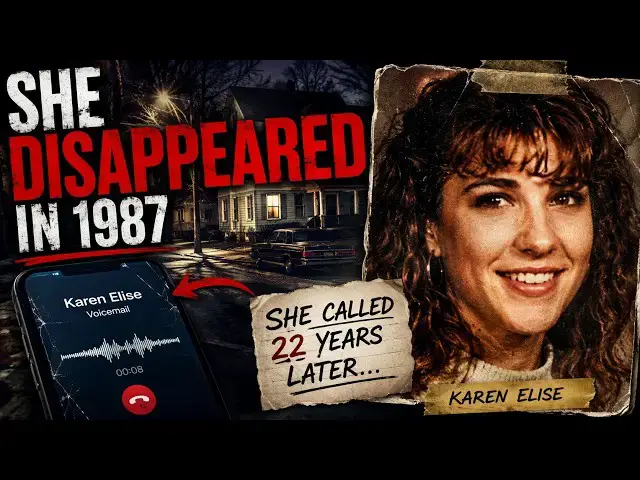
A single wrong phone number. A voicemail that should never have existed. One forgotten disappearance that refused to stay buried.
When blogger Jenna Caldwell accidentally dialed an old number in 2022, she expected silence. Instead, she heard the cheerful voicemail greeting of a woman who had vanished decades earlier. That unexpected moment opened the door to a mystery stretching back to 1987—one filled with unanswered questions, overlooked details, and unsettling coincidences.
In this documentary, we carefully reconstruct the timeline surrounding Karen Elise's disappearance, following investigators, witnesses, and the people whose lives became intertwined with the case. As the story unfolds, you'll discover how one accidental phone call revived interest in a mystery many believed had been forgotten. Every chapter reveals another piece of the puzzle while avoiding sensationalism and focusing on documented events and available historical context.
This documentary is created for educational and historical discussion. It is based on the available narration, publicly discussed case details where applicable, and is intended to present events responsibly. Any theories discussed are identified as such and should not be interpreted as established fact.
If you enjoy long-form true crime documentaries, unsolved mysteries, cold cases, investigative storytelling, and cinematic documentary content, you'll find more stories exploring forgotten disappearances, mysterious phone calls, and real criminal investigations on this channel.
👍 If you enjoyed this documentary, please Like, Subscribe, and turn on notifications so you never miss a new investigation. Let us know your thoughts in the comments—what detail stood out to you the most?
Thanks for watching.
#TrueCrime #UnsolvedMystery #ColdCase #Documentary #MissingPerson #Mystery #CrimeDocumentary
Show More Show Less View Video Transcript
0:00
On March 14th, 2022, a blogger named
0:03
Jenna Caldwell mistyped a phone number
0:06
into her cell and pressed call.
0:08
The line rang, not the dead tone you
0:12
expect from a disconnected number, not
0:14
the automated message that says the
0:15
person you are calling is no longer
0:17
available. It rang.
0:19
And then, it picked up.
0:22
>> Hi, you've reached Karen. I'm not here
0:25
right now, but leave me a message and
0:27
I'll call you back as soon as I can.
0:30
>> Jenna hung up. She checked the number
0:32
she dialed. It wasn't the one she'd
0:34
meant to call. She tried again. Same
0:37
result, same voice. She looked up the
0:40
number online.
0:41
It belonged to a woman named Karen
0:44
Elise, who had vanished on January 9th,
0:47
1987,
0:48
35 years earlier.
0:50
The phone line had never been
0:52
disconnected. Her family had been paying
0:55
the bill every month since the week she
0:57
disappeared. Her mother died in 2006,
1:00
her father in 2016.
1:02
Her younger brother took over the
1:04
payments after that. He couldn't bring
1:06
himself to let it go.
1:08
The question wasn't why the line was
1:10
still active. The question was, what
1:13
else had been left connected all this
1:15
time, quietly waiting in the
1:17
infrastructure of forgotten records that
1:19
no one had thought to look for?
1:22
This is a story about what happens when
1:24
a single overlooked detail outlives the
1:27
investigation that abandoned it, about
1:29
amateur investigators who treated phone
1:31
records like evidence, not nostalgia,
1:35
and about a man who lived 3 miles from
1:37
Karen Elise's apartment for 35 years,
1:40
never once questioned, because the
1:42
police had decided within 48 hours that
1:45
she had simply chosen to leave. Some
1:48
cases are never solved because the
1:49
evidence doesn't exist. This one was
1:52
never solved because no one looked.
1:54
[music]
1:55
Jenna Caldwell posted about the
1:57
voicemail on her true crime blog that
1:59
same night. She titled it, "I just heard
2:02
a missing woman's voice."
2:04
Within 6 hours, the post had been shared
2:06
4,000 times. Within 24, it had reached a
2:10
community of volunteer investigators who
2:12
specialized in cold cases, people who
2:14
knew how to pull property records,
2:16
cross-reference old directories, and map
2:18
the invisible trails left behind in
2:20
municipal archives.
2:23
One of them was a retired
2:24
telecommunications engineer named Alan
2:26
Brophy. He contacted Jenna within 2
2:29
days.
2:30
According to his later interview with a
2:32
podcast called The Unraveling, he told
2:34
her this,
2:36
>> "If that line's been active since '87,
2:38
there's a billing history. And if
2:40
there's a billing history, there's a
2:41
call log.
2:43
Carriers purge most of it, but not all
2:45
of it. Depends on the system migrations.
2:48
Some data gets orphaned, just sits
2:50
there."
2:51
>> Brophy wasn't talking about anything
2:53
illegal. He was talking about public
2:55
records requests, about knowing which
2:58
municipal databases still held fragments
3:00
of old telecom infrastructure data from
3:03
the pre-digital era. He filed 17 Freedom
3:06
of Information Requests across three
3:08
states. 11 came back empty. Four came
3:11
back redacted. Two came back with
3:14
something.
3:16
Partial call logs from Karen Elise's
3:18
landline, 1986 through 1991.
3:22
Incomplete, fragmented, but there.
3:25
The log showed inbound calls only. Most
3:29
were from numbers that no longer
3:30
existed. A few were from her workplace.
3:33
Several were from her parents' home
3:35
number.
3:36
And then there was one number that
3:38
appeared 47 times between October 1986
3:42
and January 7th, 1987, 2 days before she
3:46
disappeared.
3:47
The number belonged to a residential
3:49
line in the same zip code. The name on
3:51
the account? Gordon Avery.
3:54
Brophy ran the name through property
3:56
databases. Gordon Avery had purchased a
3:59
home on Hillmont Drive in 1984,
4:02
3.2 mi from Karen's apartment. He still
4:06
lived there.
4:06
>> [music]
4:07
>> He had never moved.
4:09
The online community began to organize.
4:12
Not vigilantes, not social media
4:14
detectives playing at justice. These
4:16
were people who understood chain of
4:18
custody, who knew how to preserve
4:20
records,
4:21
>> [music]
4:21
>> who documented everything they found and
4:23
forwarded it to the appropriate
4:25
authorities.
4:26
They called it Operation Callback.
4:28
Within a week, they had pulled together
4:30
a dossier, satellite images of Avery's
4:33
property from 1988 onward,
4:35
cross-referenced against county records,
4:38
municipal permits, and one very specific
4:40
detail that had been filed and forgotten
4:42
in a zoning dispute from 1993.
4:46
Avery had applied for a permit to expand
4:48
his basement. The application noted the
4:51
excavation of a below-grade storage area
4:53
beneath the existing foundation. The
4:55
permit was approved. No follow-up
4:58
inspection was ever recorded.
4:59
>> [music]
5:00
>> The document sat in a county archive for
5:03
29 years. No investigator had ever
5:06
looked at it because no investigator had
5:09
ever treated Karen Elissa's
5:10
disappearance as a crime.
5:13
The police closed her case on January
5:15
11th, 1987,
5:17
48 hours after she was reported missing.
5:20
Voluntary disappearance. No evidence of
5:22
foul play.
5:23
The file was a single page.
5:26
Karen Elissa was 24 years old when she
5:29
vanished. She worked the night shift as
5:31
a billing clerk at a medical supply
5:33
distributor in Queens. She lived alone
5:36
in a one-bedroom apartment on Steinway
5:37
Street. She had no history of mental
5:40
illness, no financial troubles, no known
5:43
romantic entanglements that raised
5:44
concern.
5:45
She was scheduled to work on the night
5:47
of January 9th, 1987.
5:50
She never arrived.
5:52
Her supervisor called her apartment at
5:54
11:30 that night. No answer.
5:57
Her parents called the next morning.
5:59
No answer.
6:01
Her father drove to her apartment that
6:03
afternoon.
6:04
The door was locked.
6:06
Her car was in the parking lot.
6:08
Her coat was still hanging by the door.
6:11
Her purse was on the kitchen counter.
6:13
Her keys were gone.
6:15
He called the police.
6:17
The responding officer took a report. He
6:19
noted that there were no signs of
6:21
struggle, no forced entry, no blood, no
6:25
evidence of disturbance.
6:27
He asked her father if Karen had been
6:28
upset recently, if she'd mentioned
6:31
wanting to leave, if there had been any
6:33
arguments.
6:34
Her father said no,
6:36
but the officer wrote it down as if he'd
6:38
said yes.
6:39
The report, later obtained through a
6:41
FOIA request by the Operation Callback
6:46
"Father states subject was under
6:48
personal stress, possible voluntary
6:51
departure."
6:52
Karen's father never said that. He would
6:55
spend the rest of his life insisting he
6:57
never said that, but it was in the
6:59
report. And once it was in the report,
7:02
it became the story.
7:04
On January 11th, the case was marked
7:07
closed. No follow-up interviews, no
7:09
canvassing of neighbors, no examination
7:12
of her phone records.
7:13
The detective who signed off on the
7:15
closure retired in 1994.
7:18
He died in 2008. His name was Lawrence
7:21
Denny.
7:22
According to later reporting by
7:23
investigative journalist Marsha Vest,
7:26
Denny closed an average of 92% of
7:28
missing person cases within 72 hours
7:31
during his tenure.
7:33
The department called him efficient.
7:35
Karen's family refused to accept it. Her
7:38
mother, Helen, kept her apartment lease
7:41
active for 6 months, paying the rent out
7:44
of her own savings, convinced Karen
7:46
would come back.
7:47
When the landlord finally insisted on
7:50
re-renting the unit, Helen took
7:52
everything. Every piece of furniture,
7:55
every photograph, every bill.
7:57
She stored it all in her garage.
8:00
And she kept paying Karen's phone bill
8:03
every month, without fail.
8:06
It wasn't hope, exactly. It was the
8:08
refusal to perform the ritual of letting
8:11
go.
8:12
Helen died in 2006. The payments
8:15
transferred to her husband, Donald.
8:17
Donald died in 2016. The payments
8:20
transferred to Karen's younger brother,
8:22
Michael.
8:23
Michael kept paying.
8:25
He told a reporter in 2022,
8:27
>> I don't even think about it anymore.
8:29
It's just automatic. It's like paying
8:32
the mortgage on a grave.
8:34
>> What none of them knew, what no one knew
8:37
until Operation Call Back began pulling
8:39
records in 2022, was that the phone line
8:42
had been receiving calls the entire
8:45
time. Not many. Mostly automated
8:48
dialers, wrong numbers, the occasional
8:50
[music] telemarketer. But one number
8:52
appeared in the fragmentary logs with
8:55
enough frequency to stand out. Gordon
8:58
Avery's number.
9:00
The last time it appeared, January 7th,
9:03
>> [music]
9:03
>> 1987.
9:04
By late March 2022, the Operation Call
9:08
Back team had compiled a map.
9:10
>> [music]
9:10
>> Not a literal map, a web of
9:12
intersections. Call logs, property
9:15
records, permit applications, and the
9:17
faint digital exhaust left behind by a
9:20
man who had never moved, never changed
9:22
his phone number, never once appeared on
9:25
law enforcement's radar.
9:27
Gordon Avery was 68 years old. He had
9:30
worked as a maintenance contractor for
9:31
the city's parks department from 1979
9:34
until his retirement in 2014. He had no
9:37
criminal record, no history of
9:39
complaints, no civil judgments.
9:41
He was invisible in the way that only
9:44
the unexamined can be.
9:46
The team found something else. A former
9:49
neighbor, tracked down through old voter
9:51
rolls, remembered Avery from the late
9:53
'80s. She agreed to speak on the
9:55
condition of anonymity. Her account was
9:57
published on a forum called The Long
9:59
Ledger in April 2022.
10:02
According to her statement, Avery had
10:04
been unusually active around his
10:06
property in early 1987.
10:08
He had rented a small excavator. He had
10:11
poured concrete in his basement. He had
10:13
told neighbors he was building a
10:14
workshop. She remembered because he had
10:17
asked to borrow her husband's
10:18
wheelbarrow. She remembered because he
10:21
returned it clean.
10:23
Operation Callback forwarded everything
10:25
to the NYPD's Cold Case Unit. The
10:27
response was silence.
10:30
They forwarded it to the Queen's
10:31
District Attorney's Office.
10:33
Again, silence.
10:35
They forwarded it to the FBI.
10:37
On May 2nd, 2022, two agents visited
10:41
Gordon Avery's home on Hillmont Drive.
10:43
They did not have a warrant. They were
10:45
conducting what they later described as
10:47
a welfare check based on community
10:49
concerns.
10:50
Avery answered the door. He was polite.
10:53
He invited them in.
10:55
They asked if he had known Karen Elisse.
10:58
According to the agents' report, he
11:00
paused.
11:01
Then he said,
11:03
"I knew her a long time ago. I haven't
11:05
thought about her in years."
11:07
The agents asked if he would consent to
11:10
a search of his property. He said no.
11:13
He thanked them for stopping by and
11:14
closed the door.
11:16
It took three more weeks to obtain a
11:18
search warrant. The application cited
11:21
the call records, the permit history,
11:23
and the statement from the former
11:24
neighbor.
11:26
On May 26th, 2022, investigators entered
11:29
Gordon Avery's home.
11:31
They found the workshop in the basement.
11:33
Clean, organized, tools hung on
11:36
pegboard, a workbench, a small space
11:39
heater.
11:40
And beneath the concrete floor in the
11:42
expanded storage area he had excavated
11:45
in 1993,
11:47
they found the outline of something that
11:48
did not belong. Ground-penetrating radar
11:52
confirmed it. A void, approximately 6 ft
11:55
long, 18 in wide.
11:58
They broke through the concrete on May
12:00
28th. The medical examiner's office
12:02
confirmed the remains on May 30th.
12:05
Dental records provided the final
12:07
identification on June 2nd.
12:10
Karen Elise had been 3.2 mi from her
12:13
family for 35 years.
12:16
Gordon Avery was arrested on June 3rd,
12:19
2022. He was charged with second-degree
12:22
murder, tampering with physical
12:23
evidence, and unlawful disposition of
12:25
remains. He pleaded not guilty. His
12:28
attorney argued that the evidence was
12:30
circumstantial, that the timeline could
12:32
not be definitively established, that
12:34
the case was built on conjecture.
12:36
The prosecution presented the call logs,
12:39
the permit records, the testimony of the
12:41
former neighbor, and one additional
12:44
piece of evidence that had been found
12:45
during the search. A small box locked in
12:49
a drawer in Avery's bedroom.
12:51
Inside, a driver's license.
12:54
Karen Elise's driver's license.
12:57
The trial began in March 2023. It lasted
13:00
4 weeks. Avery did not testify. His
13:03
defense rested on the argument that the
13:05
prosecution could not prove how Karen
13:07
had died, could not prove when she had
13:09
died, could not prove that Avery had
13:11
been the one responsible.
13:13
The jury deliberated for 11 hours. They
13:16
returned a verdict of guilty on all
13:18
counts.
13:19
Avery was sentenced to 25 years to life.
13:23
He is currently incarcerated at a
13:25
facility upstate.
13:26
He has never explained what happened.
13:29
He has never admitted guilt.
13:31
He has never said her name.
13:34
Michael Alise attended every day of the
13:36
trial. He gave a statement after the
13:38
verdict. It was brief. He did not cry.
13:41
He did not raise his voice.
13:44
She was 24. She had a whole life in
13:47
front of her.
13:48
And he took that.
13:50
And then he just
13:52
lived
13:54
right there.
13:55
Like it didn't matter.
13:58
The phone line was disconnected in July
14:00
2022. Michael made the call himself. He
14:04
said it felt like the first time he'd
14:05
been able to say goodbye.
14:08
Karen Alise was buried in a cemetery in
14:10
Flushing on August 6th, 2022. Her
14:13
parents' graves are beside hers now. The
14:16
plot had been waiting.
14:18
Operation callback dissolved after the
14:20
verdict. Its members returned to other
14:23
cases, other forgotten files, other
14:26
voices that had gone silent.
14:28
Jenna Caldwell still runs her blog. She
14:31
writes about cases where the system
14:32
stopped looking before the story ended.
14:36
Alan Brophy passed away in January 2024.
14:40
His obituary did not mention Karen
14:42
Alise.
14:43
But the people who worked alongside him
14:44
in those weeks remembered.
14:47
The police file from 1987 is still a
14:50
single page. It has not been amended. It
14:53
has not been updated. It still says
14:55
voluntary disappearance.
14:58
Because the system does not rewrite its
15:00
own mistakes, it simply waits for
15:03
someone else to prove it wrong.
15:05
The voicemail greeting is gone now. The
15:07
number rings dead.
15:09
But for 35 years, if you had dialed it,
15:12
you would have heard her.
15:14
Young, bright, smiling.
15:17
Waiting for a call that would finally
15:19
come.
#Arts & Entertainment