Up next in 10

The Mafia controlled New York.
Except for one man.
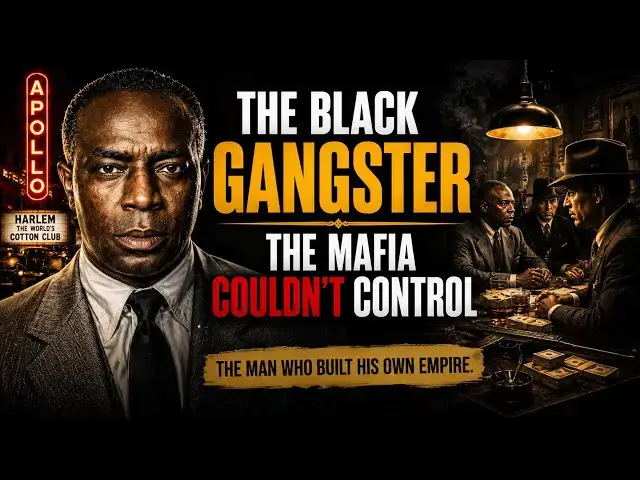
This is the true story of Bumpy Johnson, the Harlem crime boss who built an empire, negotiated directly with Mafia leaders, survived prison, and became one of the most powerful figures in New York's underworld.
From the numbers racket and Dutch Schultz to Frank Costello, Alcatraz, and the rise of Harlem's criminal empire, discover how Bumpy Johnson became the gangster the Mafia couldn't control.
Featuring:
• Bumpy Johnson
• Frank Costello
• Dutch Schultz
• Lucky Luciano
• Harlem Numbers Racket
• Alcatraz
• Organized Crime in New York
#BumpyJohnson #Mafia #TrueCrime #GodfatherOfHarlem #CrimeHistory #Documentary #OrganizedCrime #Harlem #MobHistory
Show More Show Less View Video Transcript
0:00
July seventh, nineteen sixty-eight.
0:03
Wells Restaurant, One Hundred and Thirty-Second Street, Harlem. A man collapses mid-meal.
0:11
Heart failure. He is sixty-two years old. In his jacket pocket — a receipt. Fried chicken.
0:19
A glass of bourbon still half-full on the table.
0:24
His name was Ellsworth Raymond Johnson .
0:27
But for forty years, every hustler, cop, numbers runner, and Italian underboss in New York
0:34
City knew him by one word.
0:36
Bumpy. The name came from a bump on the back of his skull.
0:41
The reputation came from something harder to explain.
0:46
Within hours of his death, the New York Amsterdam News ran the story.
0:52
Within days, Harlem's political brokers were already rewriting what he had meant. Protector.
1:00
Gangster. Robin Hood. Narcotics figure. Community leader.
1:05
The contradictions did not cancel each other out. They were the man.
1:12
This account draws from court records, published testimony, and documented history.
1:18
What makes Bumpy Johnson's story difficult to tell is not the violence.
1:23
It is the negotiation.
1:25
For four decades, he occupied a position that should not have existed — a Black man who
1:32
brokered terms with the Italian Mafia, ran Harlem's most profitable rackets, served time in
1:39
Alcatraz , and walked the same streets as the people he claimed to protect.
1:45
He was not a don. He was not a capo. He held no rank inside any recognized family.
1:51
And yet — when Frank Costello needed something done north of One Hundred and Tenth Street,
1:59
there was only one phone call to make.
2:06
The question was never whether Bumpy had power.
2:09
The question was what kind of power survives when every institution — the police, the Mob,
2:15
the federal government — wants you gone, and the neighborhood you claim to serve cannot
2:21
decide whether you are its protector or its problem.
2:25
To answer that, the record has to go back. Not to the body on the sidewalk.
2:30
Not to the restaurant receipt.
2:33
But to a teenage boy who arrived in Harlem with nothing — and understood, almost
2:38
immediately, that the only economy available to him was the one the law did not recognize.
2:51
Nineteen nineteen. Harlem.
2:53
A boy named Ellsworth Johnson, barely fifteen, steps off a train from Charleston , South
3:01
Carolina.
3:02
He has been sent north by his family after an altercation with a white man — the kind of
3:09
altercation that, in the Jim Crow South, does not end with an apology.
3:15
It ends with a lynching.
3:18
Harlem in the nineteen twenties was not the romantic place later nostalgia would suggest.
3:25
It was compressed. Overcrowded. Brilliant and dangerous in equal measure.
3:31
And it ran on one engine above all others — the numbers.
3:35
The numbers racket — policy gambling — was Harlem's parallel banking system.
3:41
A player picked three digits.
3:43
If those digits matched a published number — a stock exchange close, a racetrack total — the
3:51
payout was six hundred to one.
3:53
The odds were terrible. The participation was nearly universal.
3:59
The woman who controlled the largest share of that economy was Stephanie St. Clair .
4:05
Born in Martinique . Arrived in Harlem around nineteen twelve.
4:09
By the late twenties, she was running a numbers operation that cleared, by some estimates,
4:16
several hundred thousand dollars a year.
4:19
She was meticulous. She was ruthless.
4:22
She kept records that could have put half of Harlem's police precinct commanders behind
4:28
bars.
4:29
What she needed — and what she found in the young Bumpy Johnson — was a man who could hold a
4:36
room without raising his voice.
4:38
And who could empty a room when raising his voice was no longer enough.
4:43
According to those who later described the arrangement, Bumpy became St.
4:48
Clair's enforcer, then her strategist, and eventually something closer to a partner.
4:55
She was the one who later described his quality in terms that several published accounts
5:01
would echo.
5:02
One biographer recorded her assessment in words to this effect: Bumpy does not threaten.
5:09
He calculates.
5:10
That is why the Italians will never own him — and why they will always need him.
5:16
But the Italians were already coming.
5:19
Dutch Schultz — born Arthur Flegenheimer — had built a bootlegging empire across the Bronx
5:26
and upper Manhattan.
5:27
By the early nineteen thirties, Prohibition was ending. Schultz needed a new revenue stream.
5:34
He looked north. He saw Harlem's numbers operation.
5:38
He saw money without adequate protection.
5:44
What followed was not a gang war in the usual sense. It was an invasion.
5:50
Schultz's men moved into Harlem's policy banks by force. Runners were beaten.
5:56
Bankers were threatened. Several were killed.
6:00
The message was plain — Harlem's numbers now belonged to a white man from the Bronx.
6:07
Stephanie St. Clair fought back the only way she knew — publicly.
6:12
She took out advertisements in the Amsterdam News. She went to the police. She named names.
6:20
Bumpy fought back the only way he knew — privately. On the street.
6:26
What the accounts from that period describe is a campaign of targeted violence.
6:32
Schultz's collectors, harassed. His runners, ambushed.
6:36
His operations in Harlem, made expensive and dangerous enough that the profit margin began
6:44
to shrink.
6:45
According to several published sources, Bumpy later described this period with a kind of
6:52
cold simplicity.
6:53
Words to this effect: I didn't fight Dutch Schultz because I hated him.
6:59
I fought him because if he won, there would be nothing left for us. Not the money.
7:06
Not the dignity. Nothing.
7:08
The war with Schultz ended — not because Bumpy won it, but because Schultz lost a larger
7:15
one.
7:16
In October nineteen thirty-five, Dutch Schultz was shot and killed at the Palace Chophouse
7:22
in Newark , New Jersey.
7:24
The killing was ordered by the Commission — the governing body of the Italian-American Mafia
7:31
— reportedly because Schultz had proposed assassinating a federal prosecutor, which the
7:37
Commission considered suicidal for business.
7:40
Schultz was dead. His numbers operation was orphaned.
7:44
And the question of who would control Harlem's most profitable racket was suddenly,
7:50
violently, open.
7:56
Bumpy did not inherit the operation. He did something more dangerous. He negotiated for it.
8:04
Here is where the story turns — and where the historical record becomes harder to trust.
8:11
What is documented — after Schultz's murder, the Italian syndicate — specifically, the
8:17
organization associated with Lucky Luciano and later managed by Frank Costello — moved to
8:24
absorb Harlem's numbers racket.
8:26
They did not want to operate it directly. They wanted a percentage. They wanted a partner.
8:34
Bumpy Johnson became that partner.
8:36
The arrangement, as multiple historians have described it, worked like this — Bumpy ran the
8:43
street-level operation.
8:45
He managed the runners, the collectors, the policy bankers.
8:49
In return, the Italian organization provided protection from law enforcement — or at least,
8:56
a buffer.
8:57
And they took their cut. The precise terms were never written down. That was the point.
9:04
What this meant in practice was that Bumpy Johnson — a Black man from South Carolina with no
9:11
formal rank in any Mafia family — sat across tables from some of the most powerful organized
9:17
crime figures in American history.
9:20
And they dealt with him as something close to an equal. The word close matters.
9:25
It was never full equality.
9:27
The arrangement was asymmetric — the Italians could have replaced him.
9:32
They simply found it easier not to.
9:35
According to multiple accounts of his meetings with Frank Costello, the dynamic was
9:42
transactional but layered with a strange mutual recognition.
9:46
One associate later recounted an exchange — words to this effect: I don't presume to give
9:53
you orders.
9:54
And you know I wouldn't take any. Costello studied him for a long moment.
10:00
That's why this works, Bumpy. Because neither of us has to pretend.
10:05
It works because the money works.
10:08
The day the money stops — we'll see what pretending looks like.
10:13
The money did work.
10:14
Through the late nineteen thirties and into the forties, Bumpy's operation was, by most
10:21
accounts, generating substantial income — tens of thousands of dollars a week cycling
10:28
through Harlem's policy banks.
10:30
His personal lifestyle reflected it. Tailored suits. Cadillacs. A Harlem brownstone.
10:37
A reputation for generosity — buying groceries for the elderly, settling debts for
10:43
struggling families, financing neighborhood businesses.
10:48
But the myth must be weighed against the cost.
10:51
Because here is what else the record shows — Bumpy Johnson was arrested more than forty
10:57
times over the course of his life.
11:00
He served multiple prison terms.
11:02
His first significant federal conviction came in nineteen fifty-three — a narcotics charge
11:09
that sent him to one of the most isolated penal institutions in the country.
11:14
Alcatraz.
11:17
The Rock.
11:18
The island in San Francisco Bay where the federal government sent the men it most wanted
11:25
forgotten.
11:26
Al Capone had been there. George Machine Gun Kelly had been there.
11:30
And now Bumpy Johnson — the man who ran Harlem from a brownstone — was looking at the
11:36
Pacific Ocean through bars.
11:38
His associate Junie Byrd later described the impact of that sentence in terms that cut
11:44
through the mythology.
11:46
Words to this effect: When Bumpy went away, everything got quiet. Not peaceful. Quiet.
11:52
The kind of quiet where people start looking over their shoulders because nobody's in
11:58
charge.
11:59
The generosity. The suits. The Cadillacs. The community respect. Then — a cell on an island.
12:07
That was the arrangement.
12:09
That was what power looked like when you held it without a title, without institutional
12:15
backing, and without any guarantee it would be there when you came back.
12:28
Bumpy Johnson was released from federal custody in the early nineteen sixties.
12:34
He came back to a Harlem he recognized — but one that was changing underneath.
12:40
The numbers racket was still running. His name still carried weight.
12:45
But something else had entered the economy of upper Manhattan.
12:50
Something that moved faster, paid more, and destroyed everything it touched. Heroin.
12:57
The heroin epidemic that devastated Harlem through the nineteen fifties and sixties is one
13:03
of the most documented public health catastrophes in American urban history.
13:09
Entire blocks hollowed out. Families shattered.
13:12
A generation lost to addiction before the word epidemic was even applied.
13:18
And here the record on Bumpy Johnson fractures.
13:21
According to his wife, Mayme Johnson , in her published memoir — Bumpy was firmly opposed to
13:29
narcotics.
13:30
She described a man who refused to profit from heroin, who despised what it did to the
13:36
community, who saw drug dealers as parasites.
13:40
According to federal investigators and several independent historians — the picture was
13:46
considerably more complicated.
13:49
The nineteen fifty-three narcotics conviction was not an anomaly.
13:54
Multiple law enforcement sources placed Bumpy Johnson in proximity to heroin distribution
14:01
networks throughout the fifties and sixties.
14:04
The F-B-I maintained active surveillance on him. Wiretaps were authorized.
14:10
Informants were cultivated inside his circle.
14:13
The documents that survive tell only part of the story.
14:17
But the part they tell is difficult to reconcile with the image of a man who kept his hands
14:24
clean.
14:25
What is remarkable is not the contradiction.
14:29
It is how long the contradiction was allowed to stand.
14:33
For years, Bumpy Johnson simultaneously occupied two positions in Harlem — the neighborhood
14:39
benefactor who bought turkeys at Thanksgiving and settled disputes with a handshake, and the
14:46
narcotics-adjacent figure whose phone the federal government was recording.
14:51
Both were true. Neither was complete.
14:55
The F-B-I files from this period — partially declassified — reveal a surveillance operation
15:02
that treated Bumpy Johnson as a significant organized crime figure.
15:07
His movements were tracked. His associates were catalogued.
15:12
His conversations — at least those captured by wiretap — were transcribed.
15:18
One associate, speaking years later, described the atmosphere in words to this effect: Bumpy
15:26
knew they were listening.
15:28
He always knew. He just didn't think they'd ever get enough.
15:32
He thought he was smarter than the wire.
15:36
The wire does not care about intelligence. The wire cares about time.
15:41
And the federal government had more time than Bumpy Johnson.
15:48
In nineteen sixty-five, Bumpy was indicted again. Federal narcotics conspiracy.
15:54
The case was built on exactly the kind of evidence he had spent a career trying to avoid —
16:01
testimony from former associates, wiretap intercepts, surveillance logs.
16:06
He was sixty years old. His health was deteriorating.
16:10
And the government was no longer interested in the arrangement.
16:15
They were interested in the man.
16:18
The community that had celebrated him was fracturing too.
16:22
Younger operators — men who had come up during the heroin boom — did not observe the old
16:28
codes.
16:29
They did not defer to Bumpy's authority. They did not negotiate. They competed.
16:35
A man who had once brokered peace between Black Harlem and the Italian Mafia was now
16:41
watching his own neighborhood move beyond him.
16:44
The strangest part of this record is not what Bumpy Johnson did.
16:48
It is what Harlem needed him to be — and how that need kept changing until the man could no
16:54
longer keep up with the myth.
17:02
By nineteen sixty-seven, Bumpy Johnson was fighting on three fronts. The federal case.
17:09
His failing heart. And a Harlem that no longer operated by his rules. He was still feared.
17:16
Still respected. Still consulted. But the consultations were becoming ceremonial.
17:23
The real decisions — about territory, about product, about violence — were being made by men
17:31
half his age who had never sat across a table from Frank Costello and never would.
17:38
Mayme Johnson later described the final years in her memoir with a kind of controlled grief.
17:45
She wrote about a man who dressed every morning in a pressed suit, who walked the streets of
17:51
Harlem as if nothing had changed, who stopped at the same restaurants and spoke to the same
17:57
people — while his body was failing and his phone was tapped and his indictment was pending.
18:04
The discipline was the last thing to go.
18:07
The federal narcotics case dragged. Continuances. Delays.
18:12
Bumpy's attorneys argued his health made trial dangerous.
18:17
The government argued that justice does not accommodate convenience.
18:23
Neither side would yield.
18:26
According to those who saw him in his final months, Bumpy carried himself with a kind of
18:32
exhausted dignity.
18:33
He did not complain. He did not explain.
18:36
He moved through Harlem like a man who understood that the arrangement — the one he had
18:43
negotiated four decades earlier, the one that had given him power and cost him years of his
18:50
life — was over.
18:51
Not because anyone had cancelled it. Because the world it depended on no longer existed.
19:00
July seventh, nineteen sixty-eight. Wells Restaurant. One Hundred and Thirty-Second Street.
19:08
A summer evening. Bumpy Johnson sat down with friends. He ordered. He ate.
19:14
He spoke quietly — the way he always spoke.
19:18
And then, mid-sentence or mid-bite — the accounts differ on the exact moment — his heart
19:25
stopped.
19:26
He was sixty-two years old.
19:29
The receipt in his pocket was for fried chicken.
19:33
The bourbon on the table was still half-full.
19:37
The man who had brokered the most improbable criminal alliance in Harlem's history died in
19:44
the same neighborhood he had controlled, in a restaurant he had patronized for years,
19:51
surrounded by people who knew exactly who he was.
19:54
No bullet. No betrayal. No dramatic arrest. Just a heart that quit.
20:00
The paperwork — the indictment, the wiretaps, the surveillance logs — outlived the man they
20:07
were meant to convict.
20:09
His funeral drew thousands. Politicians attended. Community leaders attended.
20:15
Men who had spent careers trying to arrest him sent no representatives — but noted the
20:22
turnout.
20:23
The Amsterdam News called him a Harlem legend. Federal prosecutors closed their file.
20:37
What survived Bumpy Johnson was not an organization.
20:42
He had not built one — not in the structural sense the Italians understood.
20:47
He had built a position. A negotiating stance.
20:51
A role that existed only because one man was willing to occupy it, and because both sides of
20:58
a racial and criminal divide found it useful that he did.
21:02
When he died, the position died with him. The Italian arrangement did not survive.
21:09
The numbers racket was eventually absorbed by state lotteries.
21:13
Heroin continued to devastate Harlem — without the thin, uneven, and possibly self-serving
21:20
protection Bumpy had offered.
21:23
The myth, of course, survived everything. Books. Television series. Films.
21:29
The phrase Godfather of Harlem — a title Bumpy Johnson never used for himself and would
21:36
likely have found dangerously conspicuous — became his permanent epitaph.
21:42
But the myth obscures the harder question. He was not the godfather of anything.
21:48
He was the negotiator.
21:49
The man who sat between two systems — one that would not accept him and one that could not
21:57
function without him — and extracted from that impossible position something that looked,
22:03
from a distance, like power.
22:06
Whether it was power, or simply the most elaborate performance of power that Harlem had ever
22:13
seen, is a question the record cannot fully resolve.
22:17
The man is gone. The arrangement is gone. The neighborhood is changed beyond recognition.
22:24
What remains is the contradiction. And the receipt.
#People & Society