Up next in 10

For thirty years, nobody could stop him.
Not the FBI.
Not rival Mafia families.
Not even the courts.
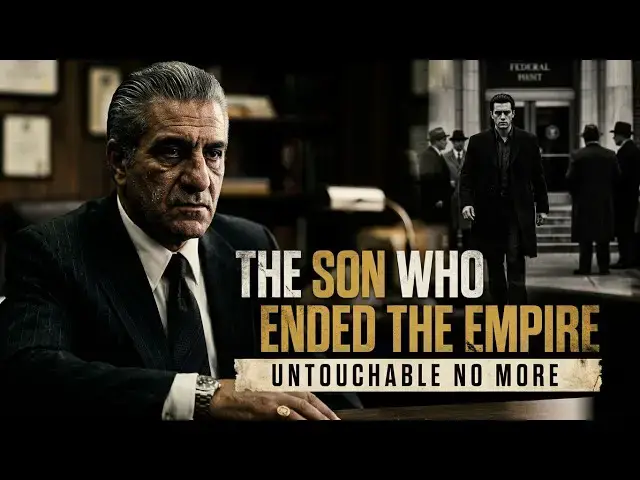
In the end, one phone call from his own son destroyed everything.
What happens when the person you trust most becomes your greatest enemy? In this video, we dive deep into the chilling true story of a Mafia empire that survived decades of police raids, only to be destroyed from within.
Discover the untold story of [Name of the Boss], the man they called 'Untouchable,' and the shocking betrayal by his own son that led to the downfall of one of the most powerful crime families in history.
🔔 Subscribe to Underworld Shadows for more deep dives into the world’s most notorious crime stories.
#TrueCrime #MafiaHistory #Betrayal #UnderworldShadows #Documentary
Show More Show Less View Video Transcript
0:00
Twenty-three federal agents. Four locations. One morning.
0:05
And the man they had been hunting for three decades — the man whose name prosecutors had
0:12
typed into indictment drafts and crossed out again, twice — was arrested without incident in
0:19
his own driveway.
0:21
No shootout. No chase. No years-long courtroom battle to extract a confession.
0:27
Just a government sedan. A pair of handcuffs.
0:31
And a witness the Federal Bureau of Investigation had not recruited, had not pressured, had
0:38
not found through any surveillance or informant or years of accumulated intelligence work.
0:46
The witness had found them. His name was Daniel Marcone. He was twenty-six years old.
0:53
He was the defendant's son.
0:56
Names and certain identifying details in this account are drawn from federal court
1:02
documents, unsealed trial records, published investigative reporting, and testimony entered
1:09
into the public record.
1:11
Composite reconstructions are labeled as such.
1:15
Anthony Marcone had been, by every measure available to the bureau that pursued him,
1:22
untouchable.
1:23
Not in the mythological sense. In the structural sense. The engineering sense.
1:29
Three decades. Two failed prosecutions.
1:32
One witness found dead in a drainage canal in southern New Jersey before he could testify.
1:39
And then one morning, all of it was over. Because of a conversation no wiretap had captured.
1:46
A decision made in private, by a young man who knew exactly what he was walking away from.
1:58
The indictment was forty-one pages. RICO conspiracy. Extortion across three states.
2:05
Money laundering through a network of legitimate business fronts operational for nineteen
2:13
years.
2:14
Two counts tied to murders for which no one had ever been formally charged.
2:20
Which is the federal prosecutor's way of saying: we believe we know who ordered them.
2:27
We simply could not prove it. Until now. Nine hundred pages. Thirty years.
2:34
Twenty-seven federal agents assigned at various points. One son.
2:39
South Philadelphia. Nineteen forty-three.
2:42
The neighborhood Anthony Marcone was born into was not the kind that produced criminals by
2:50
accident.
2:51
It produced them, when it did, by a specific logic — a logic of proximity, of available
2:57
structure, of the distance between a working family and organized crime measured not in
3:04
ideology but in city blocks.
3:06
He came up in a structure that already existed before he arrived. He did not create it.
3:13
He encountered it young, moved through it carefully, and eventually positioned himself
3:20
within it until the question of authority had been answered, quietly, in his favor.
3:27
By nineteen seventy-eight, he was no longer receiving instructions. He was delivering them.
3:34
Three pillars held the empire.
3:37
The waterfront — cargo moved without inspection, contracts awarded without competition, and
3:43
certain problems remained problems for whoever created them.
3:48
Wholesale food distribution — so deeply embedded in the regional supply chain that a sealed
3:55
federal filing noted it would disrupt produce pricing across the mid-Atlantic corridor if
4:02
dismantled.
4:03
And debt. Loan sharking. The oldest currency in the system.
4:07
In that economy, he was not a criminal in the sense that implies disorder.
4:13
He was an institution.
4:15
Former F-B-I supervisory special agent Richard Coyle worked organized crime cases in
4:22
Philadelphia for most of the nineteen eighties.
4:26
In his published memoir, he described Marcone as unlike any target the bureau had previously
4:33
pursued at that level.
4:35
Most bosses needed to be seen. Needed the restaurant, the recognition, the back table.
4:41
Marcone needed none of it. He communicated in person or not at all.
4:47
Owned nothing in his own name. Kept no ledger a prosecutor could introduce as Exhibit A.
4:54
A bureau surveillance analyst, in a memo that survived declassification, described him as
5:01
operating like a man who assumed every room he entered was already wired.
5:07
He was usually right. The absence of theater was itself a form of power.
5:12
And power that doesn't photograph doesn't get indicted.
5:17
But silence has a cost.
5:19
Every empire constructed on quiet requires enormous human maintenance.
5:25
People who know must be managed. People who owe must be kept in debt.
5:31
People who resist must be reminded — gently, or not — that resistance is expensive.
5:38
Reminder. Not always through violence, though violence appears in the record.
5:44
More often through proximity. A visit. A conversation.
5:49
An awareness left behind, like furniture someone else chose, that the man at the top knew
5:56
where you lived.
5:57
Architectures, no matter how precisely engineered, have one category of vulnerability that
6:05
no blueprint accounts for.
6:07
The people who live inside them.
6:15
Anthony Marcone had three children.
6:18
Two daughters kept at significant distance from the operational reality of his work.
6:24
And one son — Daniel — who was not.
6:26
By the time Daniel was in his early twenties, he was functionally embedded in a portion of
6:33
the organization's financial structure.
6:36
He had access to accounts, to names, to the logic of how money moved from where it was
6:42
earned to where it appeared legitimate.
6:45
He knew enough to make him either the most trusted person inside the organization or the
6:51
most dangerous one outside it.
6:53
That distinction would come to matter enormously.
6:57
A former associate of the organization, identified as a cooperating witness in the federal
7:05
record, later testified about what he observed between father and son.
7:11
According to those present, the dynamic had a specific quality.
7:16
Words to this effect: The old man talked about the kid like he was building something to
7:23
hand over.
7:24
Like the whole structure — it was supposed to land with Daniel. He never said it directly.
7:32
But you understood it. Everybody did.
7:35
Everything Anthony did, he did so Daniel wouldn't have to start from nothing.
7:41
The associate paused. Then added — carefully: The problem is, the kid understood it too.
7:49
No complete account of what specifically changed Daniel's calculation survives in any public
7:56
document.
7:57
The full cooperation debrief — several hundred pages — remains substantially sealed.
8:04
What the fragments suggest is this: at some point in the year before Daniel walked into the
8:10
federal field office, something was asked of him that he was not willing to do.
8:16
Not the financial work he had already been carrying. Something specific.
8:22
Something that moved the inheritance from theory into obligation.
8:27
Daniel Marcone did not refuse. He did not confront his father. He waited. He thought.
8:33
And then he got in his car, drove to the Philadelphia field office of the F-B-I, and walked
8:40
through the door.
8:48
The federal investigation into Anthony Marcone was not a single operation with a clean
8:54
history.
8:55
It was the layered product of years of accumulated effort across multiple investigative
9:01
branches — the F-B-I, the I-R-S criminal division, and the Eastern District prosecutor's
9:08
office — that had, at various points, come close enough to feel proximity but never close
9:15
enough to produce a case.
9:16
Two prosecutions attempted.
9:18
The first collapsed when the government's key witness became unavailable in the most
9:25
permanent way possible.
9:26
The second produced convictions against three mid-level figures and nothing above them.
9:33
The architecture held. Every time.
9:35
The F-B-I wiretap operation had spanned approximately four years across multiple telephone
9:43
lines and at least one fixed surveillance device.
9:47
The transcripts are notable for what they do not contain. Long stretches of ambient sound.
9:54
Conversations about weather, traffic, the weight of the week.
9:59
Almost never anything a federal prosecutor could introduce as evidence.
10:05
One transcript captured a fourteen-minute conversation between Marcone and a senior
10:11
associate.
10:12
Fourteen minutes. The bureau analyst's note, appended to the log, was two words.
10:19
Subject aware. He almost certainly was.
10:22
The case's first significant forward motion came from a peripheral figure — Vincent Carrara,
10:29
who managed the loan operation in Camden, New Jersey.
10:33
Facing a tax evasion charge with a sentence measured in decades, Carrara cooperated in
10:40
nineteen ninety-two.
10:41
What Carrara provided was not a direct line to Anthony Marcone.
10:46
His knowledge of the upper levels was limited — by design.
10:51
That was the point of the architecture.
10:54
Two years of working his leads produced convictions against mid-level figures.
10:59
The architecture remained.
11:01
The man at the center remained one insulating layer beyond what any single witness could
11:08
reach.
11:09
And then a twenty-six-year-old man walked into the field office and gave his name at the
11:16
desk.
11:19
According to a published account by investigative reporter Sandra Weiss in Philadelphia
11:26
Magazine, drawing on sources inside the investigation, what happened in that room had the
11:33
quality of something that had been building for a long time.
11:37
The agent who first received Daniel Marcone later told Weiss, in substance: He was calm.
11:44
That was the first thing. He wasn't scared — not visibly.
11:49
He looked like someone who had already made the decision and was past the hard part.
11:55
Daniel Marcone had not been brought there. Had not been turned by leverage.
12:01
Had not been offered anything before he walked through the door.
12:06
He simply walked through it.
12:09
Daniel Marcone's initial cooperation proffer was described, in filings unsealed after the
12:15
verdict, as among the most substantive single-source contributions the organized crime
12:21
division had received in years.
12:24
He had been inside the financial structure.
12:27
He could provide dates, amounts, names the investigation had never been able to attach to
12:33
documented activity.
12:35
He could explain the internal logic of how the organization had survived every previous
12:41
attempt to dismantle it.
12:43
He understood it because his father had explained it to him.
12:47
In the process of preparing Daniel to inherit the empire, Anthony Marcone had given his son
12:54
the precise map required to destroy it.
12:57
Over the months that followed, Daniel participated in recorded contacts with members of the
13:04
organization — conversations monitored by federal agents.
13:08
He was not confrontational. He asked questions calibrated to produce answers.
13:14
The men who trusted him provided those answers without any awareness that a federal
13:20
prosecutor would review them.
13:22
One exchange from the trial record involved a senior associate, Joseph Testa.
13:28
Reconstructed from the recording as entered into evidence: Your father wants this closed out
13:35
before the end of the month.
13:37
You understand what that means. I understand.
13:41
Walk me through it again — I want to make sure I have it right.
13:45
You already know how it works. Humor me.
13:48
Testa then described, in detail sufficient for prosecution, the mechanics of a money
13:55
movement the organization had been conducting for more than a decade.
14:00
The tape ran for forty-seven minutes.
14:03
Anthony Marcone did not know. He continued to have dinner with his son.
14:09
Continued to trust him. Continued to speak about the future.
14:13
For months, a man poured wine for his son and said, in the specific register of fathers who
14:20
believe they are providing: you know I built all of this so it would be there for you.
14:27
So you wouldn't have to start from nothing.
14:30
He did not know his son was building the case that would end the life he had constructed.
14:37
He did not know.
14:39
According to testimony entered at trial by the federal agent who monitored the wire, one of
14:46
the final recorded conversations between Anthony and Daniel Marcone was among the most
14:52
ordinary in the entire archive.
14:55
Anthony asked about Daniel's girlfriend. Asked whether Daniel had eaten.
15:01
Complained briefly about traffic on the expressway.
15:05
Then, near the end of the call, he said words to this effect: You know I built all of this
15:12
so it would be there for you.
15:14
Everything I did. You understand that.
15:17
Everything — it was so you wouldn't have to start from nothing.
15:22
The transcript shows a pause of approximately four seconds.
15:26
Then Daniel gave a non-committal response. And the call ended.
15:31
That four-second pause lives in the file. It has no annotation. It requires none.
15:45
February. A Tuesday. Six-fifteen in the morning. Twenty-three federal agents.
15:51
Four simultaneous locations.
15:53
The family home, a property associated with Joseph Testa, and two additional addresses named
16:01
in the indictment.
16:02
At the family home, Anthony Marcone was taken without incident.
16:07
No account of what he said in those first moments exists in any public document.
16:14
One account, published years later by a journalist who spoke on background with a former
16:21
agent, described a man who looked not shocked, not devastated.
16:26
Something closer to resigned.
16:28
As if some part of him had always understood that the architecture had one class of
16:35
vulnerability he could never engineer around.
16:38
The people inside it.
16:41
The arraignment was public.
16:43
The courtroom was full in the way that federal courtrooms get full when a case has been
16:50
anticipated for years — reporters, legal observers, people from the neighborhood who had
16:57
driven downtown for reasons they felt clearly even if they could not articulate precisely.
17:04
Forty-one pages of federal indictment. Eleven minutes to read aloud in full.
17:10
Anthony Marcone stood while they were read.
17:13
When asked to enter his plea, he said two words in a voice that carried no particular
17:20
emotion.
17:21
Not guilty. He was remanded into custody. He was sixty-one years old.
17:30
The trial lasted seven weeks.
17:32
The most significant witness took the stand in the fourth week.
17:37
Daniel Marcone was on the stand for three days.
17:40
The defense attempted, with the specific vigor a case of this magnitude demands, to
17:47
undermine his credibility.
17:49
Questions about motive. About the integrity of the recordings.
17:53
About the gap between what Daniel had agreed to provide and what the government had offered
18:00
in return.
18:01
Daniel answered each question in the composed, methodical manner of someone who had prepared
18:08
for this moment and was not surprised by any of it.
18:12
He did not look at his father during his testimony. His father looked at him.
18:19
A journalist who covered the trial for the Philadelphia Inquirer wrote that she had covered
18:25
a significant number of organized crime prosecutions and had never seen a defendant maintain
18:31
so complete an absence of visible response during family testimony.
18:36
She wrote, in the published piece: he sat the way a man sits when the thing that is
18:42
happening is something he does not yet have words for.
18:46
The jury deliberated for three days.
18:51
Guilty on twenty-seven of thirty-one counts. RICO conspiracy. Extortion. Tax evasion.
18:58
Two counts related to the facilitation of violence — the federal prosecutor's way, finally,
19:05
of placing Anthony Marcone in proximity to the murders the bureau had never been able to
19:12
attribute to him directly.
19:14
The sentence: forty years in federal prison.
19:18
He did not speak at sentencing beyond the formal statement required by the court.
19:24
His daughters were present. His son was not.
19:28
Forty-one names appeared in the indictment.
19:32
Twenty-seven individuals were eventually convicted on related charges.
19:37
The waterfront arrangements were disrupted. The wholesale distribution network collapsed.
19:44
The loan operation folded. The organization did not. Criminal structures rarely do.
19:51
The space Marcone's operation vacated was filled — by other men, different names, same
19:58
logic, different arrangements.
20:00
The institution survived. The man went to prison. That is, in the end, how it usually goes.
20:08
Daniel Marcone received time served plus three years of supervised release.
20:14
He was relocated to a city whose name appears in no public record. A new name.
20:21
A new ordinary life.
20:22
Whether that constitutes a fair exchange is a question no court document poses and no
20:29
verdict answers.
20:31
It sits in the record — surrounded by silence.
20:35
Anthony Marcone spent thirty years building an organization that could not be penetrated
20:42
from the outside.
20:44
He succeeded. What destroyed him was not a better investigation.
20:49
It was a decision he made — or did not realize he was making — when he brought his son close
20:56
enough to see everything.
20:58
The man they called untouchable was not undone by the law. He was undone by love.
21:05
Those are not the same thing. They were never the same thing.
21:10
He just didn't know it until it was too late.
21:14
The government sedan left the driveway by eight o'clock. The house remained.
21:20
The lights were off. No one came back.
#People & Society