Up next in 10

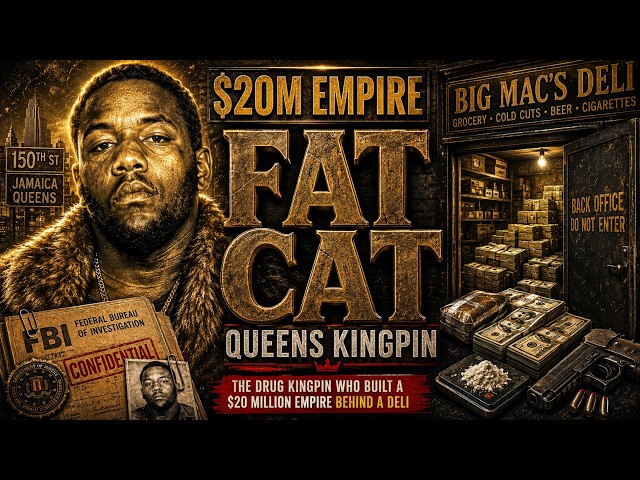
For years, Lorenzo "Fat Cat" Nichols operated one of the most powerful drug trafficking organizations in New York City.
From the back office of a small deli in South Jamaica, Queens, Fat Cat built a criminal empire that federal prosecutors estimated generated nearly $20 million per year. His organization controlled cocaine and heroin distribution, enforced loyalty through violence, and became one of the most feared criminal networks of the 1980s.
This documentary explores the rise of Lorenzo Nichols, his connections to organized crime, the murders linked to his enterprise, the federal investigation that brought down his empire, and the decades-long legal battle that followed.
Based on court records, federal documents, witness testimony, and historical reporting.
If you enjoy true crime documentaries, organized crime history, mafia stories, and real-life criminal investigations, subscribe for more.
Timestamps
00:00 - The Block: Where the Story Begins
00:25 - Lorenzo "Fat Cat" Nichols
00:55 - From Alabama to Queens
02:23 - Big Mac's Deli and the Hidden Empire
03:17 - Building a $20 Million Drug Network
04:50 - The Brian Rooney Conflict
05:41 - The Murder Plot Begins
07:41 - The Killing of Myrtle Horsham
09:28 - The Empire at Its Peak
Show More Show Less View Video Transcript
0:00
The block had a name. Not an official name.
0:03
Not the kind you find on a city map or a zoning record. They called it simply the Block.
0:09
A section of one-hundred-and-fiftieth Street in Jamaica, Queens.
0:13
And from the back office of a deli on that street, one man ran what federal prosecutors
0:19
would later estimate was a twenty-million-dollar-a-year narcotics operation.
0:24
His name was Lorenzo Nichols. They called him Fat Cat.
0:29
The account that follows draws from federal court records, sealed plea allocutions,
0:34
published testimony, and documents gathered over three decades of legal proceedings.
0:40
Where the record is incomplete, that incompleteness is noted.
0:45
Here is the first thing the record shows about Lorenzo Nichols that does not fit the
0:51
mythology built around him.
0:53
He was not from Queens.
0:55
He was born on December twenty-fifth, nineteen fifty-eight, in Bessemer, Alabama.
1:01
He arrived in New York as a child, landed in South Jamaica, and found himself in a borough
1:07
that was already organizing its underworld with the precision of a corporation.
1:13
He was soft-spoken. Bearded. Stocky. Intelligent, by all documented accounts.
1:18
A ninth-grade education. A mind that ran faster than his circumstances allowed.
1:24
The myth says he was inevitable. The record is less certain.
1:29
South Jamaica in the late nineteen-seventies was a neighborhood where money had already
1:35
decided which doors opened and which stayed shut.
1:38
The Mafia — Italian organized crime — controlled the primary supply lines for narcotics on
1:44
the East Coast.
1:45
Black and Latino dealers could move product, but they moved it on terms set by others.
1:50
Nichols found his way into that system through connection.
1:54
According to court documents and published accounts, he accessed supply through a Mafia
1:59
pipeline that gave him cocaine and heroin at wholesale rates.
2:03
He was not yet a kingpin. He was a middleman learning how the ceiling worked.
2:09
By the early nineteen-eighties, that ceiling had been raised.
2:13
Crack cocaine had not yet arrived in force, but Nichols was already building the
2:18
architecture of what would become one of the largest drug networks in Queens.
2:23
His headquarters was Big Mac's Deli on one-hundred-and-fiftieth Street.
2:28
A business he and his wife took over from her father.
2:31
On the surface, a neighborhood grocery.
2:34
In the back office — a different kind of commerce entirely.
2:37
From that back office, Nichols coordinated wholesale supply.
2:41
Cocaine at fifty thousand dollars per kilogram to mid-level distributors who ran
2:47
street-level operations in the housing projects of southeast Queens.
2:51
What is remarkable about this structure is not its brutality. It is its patience.
2:57
The inner circle of the Nichols enterprise was, in several cases, family.
3:02
Court records and testimony from cooperating witnesses indicate that members of Nichols's
3:08
crew included his mother and two of his sisters.
3:11
Howard Pappy Mason, a friend from prison, served as a key enforcer.
3:16
Brian Glaze Gibbs, Luc Spoon Stephen, and Joseph Mike Bones Rogers were among the trusted
3:22
associates.
3:23
Federal prosecutors would later describe this structure as the Nichols Enterprise — a phrase
3:29
that sounds almost administrative.
3:31
It was not administrative.
3:33
It was a system in which Nichols's word was, according to testimony, final.
3:38
And in which the man at the top never — according to accounts from that era — raised his own
3:44
voice when he used it.
3:50
The money was real. That part the myth gets right.
3:54
A hundred thousand dollars a week, according to federal prosecutors' estimates during the
3:59
later racketeering trial.
4:01
A rabbit-fur coat. Gold jewelry. The people on the block knew who he was.
4:06
Knew what he represented.
4:07
In South Jamaica in the early nineteen-eighties, that kind of visibility was its own
4:13
currency.
4:14
Rappers who grew up within walking distance of that block would spend the next twenty years
4:20
putting that image into verse.
4:22
What the verses left out was the cost.
4:24
On July twenty-ninth, nineteen eighty-five, police raided a building in Jamaica, Queens
4:31
linked to Nichols's operation.
4:33
What they found — two firearms. Heroin, cocaine, and marijuana.
4:38
And one hundred and eighty thousand dollars in cash. Nichols was arrested.
4:43
He posted seventy thousand dollars bail.
4:46
He was almost immediately rearrested — on a parole violation.
4:50
The man who made that parole violation stick was a Queens parole officer named Brian Rooney.
4:57
That name would define what came next.
5:00
Nichols had been arrested.
5:02
He went to Rooney's office and described the raid as a misunderstanding — he had, he
5:08
claimed, simply stopped at the store for a sandwich.
5:12
Rooney made a phone call to law enforcement. Heard a different account.
5:17
He handcuffed Nichols and arrested him for parole violation.
5:21
Two months passed while Nichols sat in a cell.
5:25
The record does not preserve what he thought during those two months.
5:29
But what he decided — and what he set in motion — is documented.
5:41
October tenth, nineteen eighty-five.
5:43
Brian Rooney received a call from a man named Perry Bellamy, who said he had important
5:48
information about the Nichols case and wanted to meet.
5:52
Rooney drove to a Queens bar called the Dog House in his personal car.
5:57
He went because he believed the meeting was legitimate. It was not.
6:01
Nichols had ordered the killing through his lieutenants, Pappy Mason and a man named Chris
6:07
Williams.
6:08
The contract, according to court records, paid five thousand dollars.
6:12
Mason and Williams approached Rooney's vehicle in Baisley Park.
6:16
Mason drew a weapon and fired repeatedly until Rooney was dead.
6:21
Rooney's partner on the job for years was Alan Reiter.
6:24
Reiter later spoke about what the killing meant to those who worked alongside Brian Rooney.
6:29
There's no reason why any of them should be released.
6:32
They murdered Brian, and it was a contract. He was marked for death because he did his job.
6:38
Nichols, decades later, would tell the parole board that he had only intended for Rooney to
6:44
be roughed up — not killed.
6:46
The account given by Rooney's colleagues and prosecution records describes it differently.
6:52
Both accounts exist in the public record. They do not agree.
6:55
What is not disputed is that Brian Rooney was dead, that the killing was ordered from a
7:01
position of institutional authority within the Nichols organization, and that it would take
7:06
seven more years and a federal racketeering case to bring formal charges.
7:12
What is strange about the period immediately following Rooney's murder is how little changed
7:17
on the surface.
7:18
Nichols remained at the center of the operation. The block continued. The money continued.
7:24
The killing had been meant to solve a problem. For a time, it appeared to have worked.
7:30
The internal logic of the organization was shifting.
7:34
Howard Mason — Pappy — had always been a more volatile element in the enterprise.
7:39
Where Nichols was described by investigators and journalists as controlled, measured, even
7:45
professorial, Mason operated differently.
7:48
By nineteen eighty-seven and into nineteen eighty-eight, Mason's escalation was becoming
7:54
something the organizational structure could not absorb.
7:58
In late nineteen eighty-seven, Nichols ordered the murder of a young woman named Myrtle
8:04
Horsham.
8:05
She was twenty years old. She was the mother of one of Nichols's sons.
8:10
According to federal prosecutors and witness testimony, Nichols ordered the killing because
8:16
he believed she had stolen money from him and spent it on another man.
8:20
In his own words, recorded in sealed plea allocution documents — because she made him look
8:26
bad in front of people who were within the organization.
8:30
Four men carried out the killing. They chased her. They shot her five times.
8:35
When Nichols learned the hit was done, he rewarded each man with five thousand dollars and a
8:41
quantity of cocaine.
8:43
The killing caused Nichols's own mother to disown him.
8:46
What is harder to explain than the violence is what it reveals about the system's internal
8:52
logic — a logic in which the people closest to the man at the top were not protected by
8:58
proximity.
8:59
They were exposed by it.
9:03
This was the period — roughly nineteen eighty-five through nineteen eighty-eight — that the
9:09
myth would later crystallize around.
9:12
The money. The fur coat. The block.
9:14
The name spoken in a certain tone that meant something specific in South Jamaica, Queens.
9:20
Rappers who were teenagers during this period would absorb all of it.
9:24
They would absorb the power and the flash and the fear. They would put it into verse.
9:30
What the verses could not fully contain was what was happening simultaneously inside the
9:36
organization.
9:37
The wiretaps were running. Federal investigators had been watching.
9:41
The structure that looked solid from the outside had been developing internal fractures that
9:47
are only visible in hindsight.
9:50
Federal prosecutors described the Nichols enterprise as bringing in approximately one
9:55
hundred thousand dollars per week at its peak.
9:58
To hold a number like that in your mind is to understand both why the organization continued
10:04
and why it could not be sustained.
10:06
A hundred thousand dollars a week requires management. It requires discipline.
10:11
It requires a level of enforcement that cannot be maintained without eventually producing
10:16
the kind of violence that draws institutional attention.
10:20
And the institution, eventually, always looks.
10:23
There is a detail in the Vanity Fair account — drawn from an interview with Nichols himself
10:29
— that the court documents alone do not capture.
10:32
The assistant district attorney who prosecuted Nichols in Queens was quoted saying: if you
10:38
put him in a brown corduroy jacket with patches on the elbows, he would look like a college
10:43
professor.
10:44
He's a soft-spoken guy — but those guys are the most dangerous.
10:48
He could say kill him in a real soft voice.
10:51
The distance between that description and what the record shows he ordered is the space the
10:56
myth lives in.
11:02
By the mid-nineteen eighties, Nichols had been arrested and incarcerated more than once.
11:08
What the federal case would later establish is that his imprisonment did not interrupt the
11:13
operation.
11:14
The orders continued from inside.
11:16
This is one of the institutional facts of the Nichols case that the mythology does not
11:21
always register.
11:22
The organization was structured so that its leadership could function even when physically
11:28
removed from the block.
11:29
That design eventually became evidence.
11:32
February twenty-sixth, nineteen eighty-eight. South Jamaica, Queens.
11:37
A twenty-two-year-old rookie police officer named Edward Byrne was sitting in a marked
11:43
patrol car on Inwood Street.
11:46
He had been assigned to protect the home of a local resident who had complained about drug
11:52
activity in the neighborhood.
11:54
At approximately three forty-five in the morning, a gunman approached the vehicle and fired
12:01
five shots into the car.
12:03
Edward Byrne was hit five times in the head.
12:06
He was dead before emergency responders arrived.
12:10
The official record on the Byrne killing is clear in some respects and contested in others.
12:16
Four men were convicted of the murder.
12:19
The killing was ordered by Howard Mason, according to court findings and testimony.
12:24
The question of Nichols's involvement is more complicated.
12:28
Nichols was, at the time, serving time in state prison.
12:32
Federal and state investigators long believed he gave approval for the killing.
12:37
He has consistently denied involvement. He was never charged. The accounts do not resolve.
12:43
The surviving record does not resolve them.
12:47
The murder of Edward Byrne was not a local story.
12:50
Then-Vice President George Bush visited South Jamaica. He stood in front of cameras.
12:55
He condemned the killing.
12:57
Federal law enforcement resources were redirected toward southeast Queens with an intensity
13:03
that had not previously been applied.
13:06
The block that had operated in the interstices of institutional attention was now at the
13:12
center of it.
13:13
Howard Mason was arrested. He was tried and convicted of ordering the Byrne murder.
13:19
He was sentenced to life in prison.
13:21
The man who had been Nichols's street enforcer — the muscle that protected and expanded the
13:27
operation — was gone.
13:28
In the federal investigation that followed, prosecutors assembled a case built in
13:34
significant part on wiretap recordings — conversations captured by court-authorized
13:39
surveillance that had been running on the Nichols network.
13:43
The tapes existed. The witnesses existed. The money trail existed.
13:47
What the government needed was time to assemble the picture completely.
13:52
Inside the organization, the pressure was producing fractures of a different kind.
13:58
Cooperating witnesses were emerging.
14:00
Joseph Rogers — Mike Bones — ultimately cooperated with federal prosecutors.
14:05
Brian Gibbs — Glaze — cooperated as well.
14:08
Men who had been inside the structure were now in rooms with federal prosecutors, building a
14:14
case from the inside out.
14:16
The Nichols organization had been designed to withstand arrest from the outside.
14:21
It was less prepared for collapse from within.
14:25
In September of nineteen eighty-nine, reporting from the New York Times indicates that
14:30
Nichols pleaded guilty to charges in Queens County court.
14:34
The full federal racketeering case would not be resolved until nineteen ninety-two.
14:39
But by the end of the nineteen eighties, the organizational structure that had generated
14:45
twenty million dollars a year from a back office on one-hundred-and-fiftieth Street had
14:50
effectively ceased to exist.
14:52
The block was still there. The deli was still there. But the enterprise was over.
14:58
And here is where the history and the mythology diverge most sharply.
15:02
Because at the exact moment the organization was collapsing under federal pressure — at the
15:07
exact moment the informants were talking and the wiretaps were being analyzed — a different
15:13
version of the story was taking shape.
15:15
A version that kept the money and the power and the visibility.
15:19
A version that did not have much room for the names of the dead.
15:28
In nineteen ninety-two, Lorenzo Nichols entered a plea in federal court before Judge Edward
15:35
Korman in Brooklyn.
15:36
He pleaded guilty to racketeering charges. He pleaded guilty to drug trafficking.
15:42
He pleaded guilty to ordering the murders of Brian Rooney and Myrtle Horsham.
15:47
He received a twenty-five-years-to-life state sentence.
15:51
A concurrent forty-year federal sentence.
15:54
What happened inside the sealed courtroom during the plea allocution is partially preserved
15:59
in a New York Times account.
16:01
On the Horsham murder, Judge Korman asked — was one of the purposes of this to teach other
16:06
people in the organization a lesson about not stealing from you?
16:10
It wasn't just the stealing.
16:12
It was the fact that she was my girl and that she took my money and spent it on another
16:17
person.
16:18
She made me look bad in front of people who was within the organization.
16:22
The legal record captures the language but not the tone.
16:25
What the exchange reveals is a man who, even in the act of legal accounting, was still
16:30
thinking in the organizational terms that had structured his decisions for over a decade.
16:36
Nichols cooperated with federal investigators.
16:38
He assisted prosecutors in obtaining at least one additional court-authorized wiretap.
16:44
His cooperation did not result in additional indictments, according to accounts from that
16:49
period.
16:50
Nichols himself described his decision to cooperate as something that troubled him.
16:56
He said — I'd wake up in the middle of the night, and it feel real, real, real bad.
17:01
The record does not tell us what he was thinking about in those moments.
17:05
There are several possibilities.
17:07
Thirty-four years.
17:08
That is how long Lorenzo Nichols spent in state and federal incarceration before the state
17:14
parole board voted to release him from his state sentence in April of twenty twenty-two.
17:20
Thirty-four years is a long time to be measured against what a person did at thirty.
17:25
It is also, for the families of Brian Rooney and Myrtle Horsham and Edward Byrne, a
17:30
different kind of accounting.
17:32
Both calculations are in the record. Neither cancels out the other.
17:37
In two thousand and ten, the New York Daily News published a letter that Nichols had written
17:42
from his prison cell.
17:44
I have nothing but time to ponder my misdeeds.
17:47
To the victims of my criminal activities, I offer my deepest regret and sincerest apology.
17:53
At his state parole hearing in February of twenty twenty-two, Nichols addressed the board
17:58
regarding the Rooney murder.
18:00
If I never set that in motion, it wouldn't have happened.
18:04
Although, that was never the intent — and see, that means nothing to the family or his
18:09
friends or his loved ones or colleagues.
18:12
It means nothing that that wasn't the intent.
18:15
Alan Reiter, Brian Rooney's former partner, was still alive when Nichols was paroled from
18:21
his state sentence.
18:22
Not one day of that sentence should have been reduced.
18:25
Brian was marked for death because he did his job. That's all.
18:32
In two thousand and seven, Nichols was convicted in Florida of running a car theft and title
18:38
fraud ring.
18:39
He was sentenced to ten years to run consecutively to his federal and state charges.
18:44
What it established was additional time — and additional legal complexity — that would
18:49
follow Nichols through the next decade of proceedings.
18:53
In February of twenty twenty-three, Brooklyn Federal Court Judge Edward Korman — the same
18:59
judge who had sentenced Nichols in nineteen ninety-two — ruled that Nichols had, in effect,
19:04
served his forty-year federal sentence and granted early release under the federal First
19:10
Step Act.
19:11
The New York City Police Benevolent Association issued a statement immediately.
19:15
Not even a millisecond should have been shaved off this murderous drug lord's sentence.
19:21
What is strange about the institutional aftermath is not that a judge applied a law enacted
19:27
by Congress to reduce a sentence.
19:29
That is the system working as designed.
19:31
What is strange is the distance between what the system was designed to measure — years
19:37
served, behavioral record, legal arguments — and what cannot be measured by any of those
19:43
instruments.
19:44
The distance between a sentence and a life.
19:46
The institutional record can account for the first.
19:50
It was never built to account for the second.
19:58
Before Lorenzo Nichols was sentenced. Before he cooperated. Before the thirty-four years.
20:04
The verses had already started.
20:07
Rappers who grew up in South Jamaica, Hollis, Springfield Gardens, and the Baisley Park
20:13
projects during the nineteen eighties absorbed the world of the block the way children
20:19
absorb everything — not analytically, but atmospherically.
20:23
Nas, Ja Rule, and others in the Queens rap ecosystem referenced figures from the drug
20:29
kingpin era.
20:30
Not always by name. Not always literally.
20:33
But by texture, by weight, by the particular feeling of a neighborhood where someone like
20:39
Fat Cat had been the organizing social fact.
20:42
The myth kept the money. The rabbit-fur coat. The hundred thousand dollars a week.
20:48
The name spoken on the block with a specific kind of gravity. The myth kept the power.
20:54
These things are real. They are in the record.
20:58
The myth left out Brian Rooney. Left out Myrtle Horsham.
21:02
Left out the four hit men sent to chase a twenty-year-old woman down a street and shoot her
21:08
five times.
21:09
Left out what thirty-four years inside looks like. The myth is not a lie.
21:14
But a myth that keeps the power and discards the cost is a myth that teaches the wrong
21:21
thing.
21:22
The strangest part of reviewing this record is not what was done.
21:26
It is how much of it was known while it was happening.
21:30
The neighbors on one-hundred-and-fiftieth Street knew what Big Mac's Deli was.
21:36
The people in the housing projects knew who was selling and who was collecting.
21:42
Law enforcement knew. Everyone, in their own domain, knew something.
21:47
And the system moved at the speed systems move — slowly.
21:51
And in the time it took the system to move, the human cost accumulated.
21:57
The crack era in New York did not only produce kingpins. It produced legislation.
22:02
The Rockefeller Drug Laws, among other mandatory sentencing frameworks, were shaped in part
22:08
by the political pressure generated by cases like the Nichols enterprise.
22:12
The institutional response to men like Fat Cat did not target only men like Fat Cat.
22:18
It targeted the neighborhoods they came from.
22:21
This is one of the ways in which the collapse of one man's enterprise leaves marks that no
22:26
sentence can fully account for.
22:33
The surviving record shows the following with reasonable confidence.
22:37
That Lorenzo Nichols built and led a drug trafficking organization in South Jamaica, Queens
22:43
that operated through the nineteen eighties and generated tens of millions of dollars in
22:49
revenue.
22:50
That the organization used violence — including murder — as a disciplinary and operational
22:55
tool.
22:56
That Nichols ordered the killing of Brian Rooney, a parole officer who had done his job.
23:02
That he ordered the killing of Myrtle Horsham, the mother of his son.
23:05
What the record does not show cleanly is the question of the Byrne murder.
23:11
Investigators believed, and have long stated publicly, that Nichols was involved in the
23:17
decision to execute Edward Byrne.
23:19
Nichols has denied it. He was never charged.
23:22
The gap between what law enforcement believed and what could be proven in a courtroom is not
23:29
a failure of the legal system, exactly.
23:32
That gap is the legal system working as designed.
23:35
Whether the belief is accurate or not, no one outside a small group of people who are either
23:42
dead or imprisoned knows for certain.
23:44
The record leaves that question open. It has always left it open.
23:49
As of early twenty twenty-three, Lorenzo Nichols had been released from federal custody.
23:55
He was transferred to Florida to serve the consecutive ten-year sentence.
24:00
He was sixty-four years old.
24:02
He had spent thirty-four years in state and federal incarceration.
24:07
His lawyer described him as a rehabilitated man.
24:10
The Queens district attorney's office and the police union disagreed, loudly and formally,
24:16
at every stage.
24:17
Both positions exist in the public record. Neither can be dismissed.
24:23
What is left when you have reviewed all of this is something the institutional record was
24:28
never designed to hold.
24:30
A neighborhood's imagination of itself.
24:33
The decision, made collectively and over years, to remember Lorenzo Nichols as Fat Cat — as
24:39
the man on the block in the fur coat — rather than as the man in the plea allocution,
24:44
explaining to a federal judge why he had a twenty-year-old woman killed because she made him
24:50
look bad.
24:51
Both versions are in the record. Only one became a verse.
24:55
The surviving record of the Nichols enterprise is extensive. Wiretap transcripts.
25:01
Cooperating witness testimony.
25:03
A forty-year sentence imposed by a federal judge who, three decades later, was still the
25:09
judge making rulings in the case.
25:11
That continuity is itself a kind of document.
25:14
The case that began on one-hundred-and-fiftieth Street in Jamaica, Queens, in the early
25:20
nineteen eighties was still generating legal proceedings in twenty twenty-three.
25:25
The block had moved on. The institution keeps running. It keeps producing paper.
25:31
The paper is what the record is.
25:37
Lorenzo Nichols was born on Christmas Day, nineteen fifty-eight, in Bessemer, Alabama.
25:43
He built an empire in a back office in Queens.
25:46
He ordered the killing of a parole officer who had filed a violation report.
25:50
He ordered the killing of a young woman who had been his girlfriend.
25:55
The men who carried out those orders did time, and several of them are no longer in prison.
26:00
The organization they served no longer exists.
26:03
The consequences are still being processed by the people they fell on.
26:08
And the verses are still playing. They will probably keep playing for a while.
26:13
That is the part of this story the institutional record cannot explain.
26:17
It is also the part that tells you the most about where we are.
#Arts & Entertainment