Up next in 10

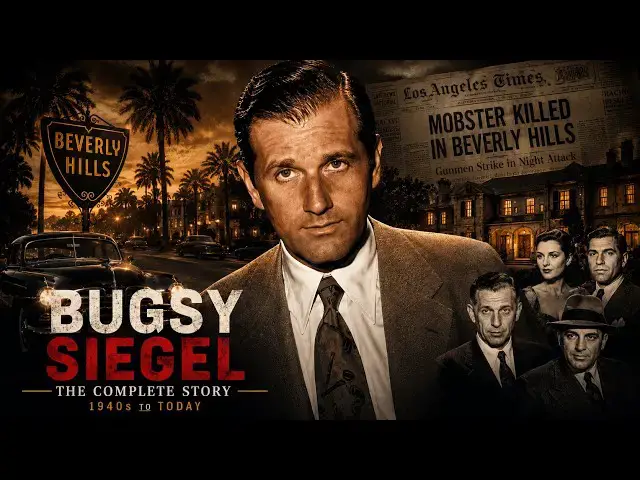
June twentieth, nineteen forty-seven. 810 North Linden Drive, Beverly Hills. Benjamin Siegel sat on a chintz sofa in Virginia Hill's living room, reading the Los Angeles Times. The evening was warm. The windows were open…
In this video, we explore the complete story of BUGSY SIEGEL NEW. From 1940s to today — pivotal moments and key figures.
🎬 In this video you'll discover:
▸ Key figures: Benjamin Siegel, Between March, Bugsy Siegel, Cary Grant, Charles Luciano
▸ Locations: Beverly Hills, Brooklyn, California, Chicago
🎬 Inside this documentary:
• The rise of Bugsy Siegel
• Murder Inc. and organized crime
• Meyer Lansky and Lucky Luciano
• Hollywood connections
• Virginia Hill
• The Flamingo Hotel
• The birth of the Las Vegas Strip
• The Beverly Hills assassination
• The investigation and unanswered questions
• Bugsy Siegel's lasting legacy
Show More Show Less View Video Transcript
0:00
June 20th, 1940.
0:02
7810
0:04
North Linden Drive, Beverly Hills.
0:07
Benjamin Siegel sat on a chintz sofa in
0:09
Virginia Hill's living room reading the
0:12
Los Angeles Times.
0:13
The evening was warm. The windows were
0:16
open. At approximately 9:45 p.m., nine
0:20
rounds from a .30 caliber military
0:23
carbine came through the front window.
0:25
Four struck him in the head and torso.
0:29
He died instantly. The newspaper was
0:31
still in his hands. When police arrived,
0:34
they found no signs of forced entry, no
0:37
struggle, no witnesses who would speak.
0:40
The shooter had fired from the rose
0:42
garden distance, approximately 15 ft,
0:46
then vanished into the night. Beverly
0:49
Hills detectives cataloged [music]
0:51
the scene with methodical precision.
0:54
Blood spatter patterns, bullet
0:56
trajectory, shell casings in the garden
0:59
soil, but the forensic detail only
1:01
confirmed what everyone already knew.
1:04
This was [music] not a robbery, not a
1:06
crime of passion.
1:08
This was an execution. Within 20 minutes
1:11
of the shooting, before the body was
1:13
even [music] removed, three men walked
1:16
into the Flamingo Hotel in Las Vegas.
1:19
They carried no weapons, no court
1:22
orders. [music] They simply informed the
1:24
management that ownership had changed.
1:27
The transfer was immediate.
1:31
Undisputed, institutional.
1:35
The timing was not coincidental. [music]
1:37
This documentary uses court records, FBI
1:40
files, witness testimony, [music]
1:42
and archival sources to reconstruct
1:45
Bugsy Siegel's rise and fall. [music]
1:47
Some dialogue is based on documented
1:49
accounts. Where evidence is incomplete,
1:52
we say so. The newspapers called him
1:55
Bugsy, a nickname he despised. They
1:58
described him as a gangster, a ladies
2:01
man, a Hollywood hanger,
2:05
one who got in over his head. But, that
2:07
version, colorful, cinematic,
2:09
convenient, misses the architecture
2:12
beneath. Benjamin Siegel was not a
2:14
reckless dreamer.
2:16
He was a founding member of Murder
2:18
Incorporated, a syndicate board member,
2:21
a man trusted to carry out the
2:23
organization's most irreversible
2:25
decisions. And for nearly 20 years, he
2:28
had been untouchable.
2:30
So, what changed? Why did the syndicate,
2:32
[music]
2:33
an organization he helped build, decide
2:36
he had to die? The answer lies not in
2:39
Hollywood myth, but in accounting. Not
2:43
in personality, but in power structure.
2:46
And it begins long before Las Vegas.
2:48
[music] In Brooklyn, Benjamin Siegel was
2:50
born February 28th, 1906, in the
2:54
Williamsburg section of Brooklyn. His
2:56
parents, Max and Jennie, were Jewish
2:58
immigrants from the Austro-Hungarian
3:00
Empire. They ran a small shop. The
3:03
family lived above it. The neighborhood
3:05
was dense, poor, and divided along
3:07
ethnic lines, Italian, Irish, Jewish.
3:13
Each block [music] had its own economy,
3:15
its own rules. And young Benjamin
3:18
learned early that respect was not
3:20
given, it was taken. Sometime around
3:23
1918,
3:24
he met Meyer Lansky. Lansky was small,
3:27
bookish, physically unimposing.
3:32
Siegel was the opposite. [music]
3:35
Athletic,
3:38
volatile, [music]
3:41
handsome. But, they recognized in each
3:43
other something rare, ambition married
3:46
to discipline. According to FBI [music]
3:47
records, by age 16, they were running a
3:51
protection racket targeting street
3:53
vendors. [music]
3:53
By 18, they controlled gambling
3:55
operations across three boroughs.
3:57
[music] It was not a gang. It was a
4:00
business. A federal prosecutor once
4:02
asked Meyer Lansky to describe his
4:04
relationship with Siegel. Lansky's
4:06
answer was precise. Ben and I understood
4:10
each other. We came from the same
4:13
streets. We knew what it meant to be
4:15
hungry. [music]
4:16
And we agreed on one thing.
4:18
We would never be hungry again. By the
4:20
late 1920s, prohibition had transformed
4:24
American organized crime. What had been
4:26
neighborhood operations became
4:28
interstate supply chains, liquor
4:30
importation,
4:32
distribution networks, enforcement.
4:33
[music]
4:35
Lansky and Siegel became essential to
4:38
what would later be called the National
4:40
Crime Syndicate, a coalition of Jewish
4:43
and Italian mobsters who agreed to
4:46
replace ethnic warfare with coordinated
4:48
profit. The architects included Lansky,
4:51
Siegel, Charles Lucky Luciano, and Frank
4:54
Costello. And they needed [music] an
4:56
enforcement mechanism. Murder,
4:58
Incorporated was not a formal name. It
5:01
was a press invention. But the
5:03
organization it described was real. A
5:06
group of contract killers based in
5:09
Brownsville, Brooklyn, available to
5:11
syndicate leadership for disciplinary
5:13
actions. Benjamin Siegel was not just a
5:16
client. [music]
5:17
He was one of its operators. FBI files
5:20
document his involvement in multiple
5:22
contract killings between 1930
5:24
>> [music]
5:25
>> and 1937.
5:26
The targets were not civilians.
5:29
They were syndicate members who had
5:30
violated internal rules.
5:34
Skimmed money.
5:37
Spoke to authorities. [music] Betrayed
5:39
trust. This is where the myth and the
5:41
man into separate. Hollywood would later
5:44
frame Siegel as a charming rogue, a
5:47
dreamer, a visionary who just wanted to
5:50
build something. [music] But the
5:51
documentary record, wiretaps, witness
5:54
testimony, forensic evidence, shows
5:56
something colder.
5:58
He was an enforcer, a killer, a man
6:01
[music] who understood that the
6:02
syndicate's entire economy rested on the
6:04
credible threat of irreversible
6:07
violence. And for [music] years, he
6:09
delivered that threat without
6:11
hesitation. By 1937,
6:13
law enforcement pressure in New York was
6:16
intensifying. District Attorney Thomas
6:18
Dewey had begun dismantling syndicate
6:21
operations. Wiretaps, raids, grand jury
6:24
subpoenas, the organization needed new
6:26
geography. California, with its gambling
6:28
ships, racetracks, and Hollywood money,
6:31
offered opportunity. And Benjamin
6:33
Seagal, with his looks and charm, was
6:36
the logical choice to open the
6:37
territory. A retired FBI agent who
6:40
tracked Seagal's movements described the
6:43
transition. Seagal wasn't sent to Los
6:45
Angeles to hide. He was [music] sent to
6:47
build.
6:49
To establish the syndicate's presence on
6:51
the West Coast, to make connections with
6:53
local politicians, union leaders, and
6:56
entertainment figures.
6:59
He wasn't running, he was expanding. In
7:01
1937,
7:03
Benjamin Seagal arrived in Los Angeles
7:06
and did something unusual for a mobster.
7:08
He rented a mansion in Beverly Hills. He
7:11
joined a country [music] club. He had
7:13
his teeth fixed. He cultivated
7:15
friendships with actors, studio
7:18
executives, [music]
7:18
and directors. He was seen at Ciro's
7:21
nightclub, at Santa Anita Racetrack, at
7:24
private parties in the Hollywood Hills.
7:27
And the Hollywood community, accustomed
7:29
to reinvention,
7:31
to people with invented pasts, welcomed
7:34
him. Publicly, Seagal presented himself
7:36
as a businessman, a sportsman, a man of
7:40
refinement. Privately, [music] he was
7:42
building the syndicate's West Coast
7:44
infrastructure. Offshore gambling ships,
7:48
wire services for bookmakers, narcotics
7:51
importation routes, union infiltration,
7:54
FBI surveillance logs from this period
7:56
show a man living two lives
7:58
simultaneously [music]
8:00
and maintaining both with discipline. He
8:02
became genuinely close with actors
8:04
[music] like George Raft and Cary Grant.
8:06
They were not mob associates.
8:09
>> [music]
8:09
>> They were friends. Raft himself from a
8:12
rough New York background saw Siegel as
8:15
authentic, charismatic, someone who had
8:18
made it on his own terms. What Raft
8:20
[music] didn't see or chose not to was
8:23
the violence that funded the lifestyle.
8:26
A studio executive who knew Siegel
8:28
socially later gave testimony.
8:31
Ben was charming,
8:33
impeccably dressed. He could talk about
8:35
horses, about film production, about
8:38
politics. You'd never know what he
8:40
really was, and maybe that was the
8:42
point. Maybe he was trying to become
8:45
something else. In 1941, Siegel met
8:48
Virginia Hill. She was a former Alabama
8:51
beauty queen who had become a courier
8:53
and associate for the Chicago Outfit.
8:56
She understood the world he came from.
8:58
She asked no questions about his
9:01
business, and she became both his lover
9:03
and, according to FBI reports, a
9:06
financial intermediary for syndicate
9:08
funds. [music]
9:09
The relationship was volatile, public,
9:12
glamorous, and it would later place her
9:15
at the center of the investigation
9:16
[music] into his death.
9:18
Here was the central tension of Siegel's
9:21
Hollywood years. He wanted the
9:23
legitimacy, the social acceptance,
9:25
[music]
9:25
the glamour of high society,
9:28
but he funded it with syndicate rackets,
9:30
[music] with violence, with the same
9:32
structures he had built in Brooklyn. He
9:35
believed he could inhabit both worlds
9:37
indefinitely. [music] The syndicate
9:39
believed otherwise. By 1945, the
9:42
syndicate was looking for new revenue
9:44
streams.
9:45
>> [music]
9:45
>> Wartime prosperity had created a
9:48
gambling boom, but East Coast operations
9:51
>> [music]
9:51
>> faced constant legal pressure. Nevada
9:54
had legalized casino gambling in [music]
9:56
1931, but outside of Reno, the
10:00
infrastructure was minimal. Las Vegas
10:03
was a desert railroad town population
10:07
8,000. [music]
10:08
Meyer Lansky saw potential. A city where
10:11
gambling was legal, where casinos could
10:14
operate openly without [music] police
10:16
raids or payoffs, and he asked Benjamin
10:18
Siegel to explore it. Years later,
10:21
Lansky described the initial vision. "We
10:24
weren't thinking [music] about what Las
10:25
Vegas became. We were thinking about a
10:28
legal operation, a place where we could
10:30
run a clean casino and not worry about
10:33
the cops shutting us down." Ben
10:35
understood the assignment, but somewhere
10:38
along the way,
10:39
>> [music]
10:39
>> he lost sight of whose money he was
10:42
spending. In 1945, Siegel took over a
10:45
stalled casino project on the Los
10:47
Angeles Highway, south of downtown Las
10:50
Vegas. The original developer had run
10:53
[music] out of money. The syndicate
10:55
bought the site and asked Siegel to
10:57
finish it. Plan was modest. A small
11:00
casino, a hotel, a restaurant. Budget $1
11:04
million. But Siegel had a different
11:07
vision. He renamed the project the
11:09
Flamingo, reportedly after Virginia
11:11
Hill's nickname, and he began expanding
11:14
the design.
11:16
He wanted luxury suites, a showroom, a
11:19
swimming pool,
11:20
air conditioning in every room, imported
11:23
fixtures, the finest materials
11:25
available.
11:27
He was not building a desert [music]
11:28
casino.
11:29
He he building a monument. Construction
11:32
costs spiraled immediately. Wartime
11:35
material shortages [music] drove up
11:36
prices. Contractors inflated invoices.
11:40
Some materials disappeared from the site
11:42
and were sold on the black market.
11:44
According to FBI financial analysis,
11:47
Siegel was either unable or unwilling to
11:50
control the bleeding. By mid-1946,
11:53
the budget had doubled, then tripled.
11:56
The syndicate demanded explanations. A
11:59
contractor who worked on the Flamingo
12:01
later testified before a Nevada Gaming
12:03
Commission. Ben wanted everything
12:05
perfect. If a tile wasn't right, rip it
12:08
out and start over. If the wood grain
12:11
didn't match, replace it. He didn't care
12:13
what it cost.
12:14
>> [music]
12:15
>> And some of us, I'll be honest,
12:18
we took advantage of that. By late 1946,
12:21
the Flamingo had consumed over [music]
12:23
$5 million in syndicate funds. Meyer
12:26
Lansky flew to Las [music] Vegas to
12:28
inspect the site personally. What he
12:30
found was a construction zone.
12:33
Incomplete rooms, unfinished
12:35
infrastructure, no clear timeline for
12:37
opening.
12:38
>> [music]
12:38
>> And Siegel, according to witnesses,
12:41
defensive, dismissive, insistent [music]
12:44
that the vision required patience. The
12:47
syndicate ordered Siegel to open the
12:49
casino by the end of the year,
12:51
finished or not.
12:54
He chose December 26th, [music] 1946.
12:59
It was a catastrophic decision. The
13:01
Flamingo's opening night was designed to
13:04
be a spectacle. Jimmy Durante performed.
13:08
Xavier Cugat's orchestra played.
13:10
Hollywood celebrities were flown in, but
13:12
the hotel rooms weren't finished. Guests
13:15
had to stay elsewhere. The showroom
13:18
wasn't complete. [music] The restaurant
13:19
was barely functional. And worst of all,
13:22
the casino lost money. High rollers won
13:25
heavily at the tables.
13:26
>> [music]
13:27
>> Some suspected the games were rigged in
13:29
the players' favor, either through
13:31
incompetence or sabotage. A casino
13:34
manager present that night later
13:36
described the atmosphere.
13:38
It was chaos. The dealers weren't
13:40
trained. The cashiers didn't know the
13:43
procedures, [music]
13:44
and Ben was walking around like
13:46
everything was perfect while the money
13:48
was flying out the door. You could feel
13:51
it in the room. This wasn't a grand
13:54
opening. This was a disaster. Two weeks
13:57
later, Siegel shut the Flamingo down.
14:00
Officially, it was for renovations.
14:02
[music]
14:03
Unofficially, it was because the
14:05
syndicate refused to provide more
14:07
operating capital until he could prove
14:09
the casino was viable. He had built a
14:12
palace in the desert, but he had not
14:15
built a profitable business. The
14:17
syndicate operated on cold arithmetic.
14:20
Money invested, money returned.
14:25
Profit margin, timeline. Siegel had
14:27
consumed over $6 million.
14:30
He had produced a closed casino and a
14:32
trail of debts.
14:34
And there were whispers, [music]
14:35
never proven,
14:37
that he had skimmed funds, that Virginia
14:39
Hill had deposited syndicate money in
14:41
Swiss bank [music] accounts. Whether
14:43
true or not, the suspicion was enough.
14:46
In early 1947,
14:48
syndicate leadership [music]
14:50
convened in Havana,
14:52
Cuba. Meyer Lansky, Frank Costello,
14:55
Charles Luciano, and others. The
14:58
subject, [music]
14:59
Benjamin Siegel. According to multiple
15:02
accounts, Lansky defended him, argued
15:05
for patience, pointed out that Siegel
15:08
had been loyal for 20 years. But the
15:10
consensus [music] was clear. Siegel had
15:12
mismanaged syndicate funds. He had
15:15
ignored warnings.
15:17
He had become a liability. And in the
15:19
syndicate's internal logic, there was
15:21
only one remedy. Between March and June
15:24
1947,
15:25
Benjamin Siegel reopened the Flamingo.
15:28
He fired staff.
15:31
He tightened procedures. He spent 14
15:34
hard days on the casino floor, watching
15:37
every table, every transaction, and
15:40
slowly the numbers began to improve.
15:45
By May,
15:47
the casino was turning a small profit.
15:50
Siegel believed he could save himself
15:52
with accounting. If he could demonstrate
15:54
[music] profitability, if he could show
15:56
that the Flamingo would eventually
15:58
recoup the syndicate's investment,
16:00
he would be safe. [music] He sent
16:02
financial reports to Lansky. He
16:04
requested more time.
16:06
He promised returns.
16:08
He did not understand the decision had
16:11
already been made. An [music] FBI
16:13
wiretap from May 1947 captured a
16:16
conversation between two syndicate
16:18
associates. [music] The transcript,
16:20
declassified decades later, is chilling.
16:25
Ben thinks numbers will save him. He
16:27
doesn't get it. This isn't about the
16:30
money anymore. It's about respect.
16:32
[music] It's about what happens when you
16:34
stop listening. In mid-June 1947,
16:38
Siegel flew to Los Angeles. Virginia
16:41
Hill left for Europe the same week. A
16:43
trip FBI agents later believed was
16:46
orchestrated to remove her from the
16:48
scene. Siegel stayed at her Beverly
16:50
[music] Hills mansion. He met with
16:51
attorneys. He reviewed financial
16:53
documents.
16:54
>> [music]
16:54
>> He made phone calls to Las Vegas.
16:57
He behaved, according to surveillance
16:59
logs, like a man who believed he still
17:02
[music] had a future. On the evening of
17:04
June 20th, Siegel had dinner with an
17:06
associate at a nearby restaurant. He
17:09
returned to the Linden Drive house
17:10
around 9:30 p.m. [music]
17:13
He sat on the sofa. He picked up the
17:15
newspaper. And at 9:45
17:18
the shooting began. The Los Angeles
17:20
Police Department launched a homicide
17:23
investigation. They interviewed
17:25
neighbors. They processed the crime
17:27
scene. They followed leads, but no
17:29
witnesses came forward. No physical
17:32
evidence pointed to a specific shooter.
17:34
The case was never solved. A detective
17:37
assigned to the case later admitted the
17:39
[music] obvious. We knew it was a mob
17:41
hit. We knew it was ordered from the
17:43
top, but knowing and proving are things.
17:47
Nobody talked. Nobody saw anything and
17:50
frankly, [music] nobody in the
17:52
organization cared if we solved it or
17:53
not. The message had been sent. Within
17:56
an hour of the shooting, the Flamingo
17:58
was under new management. The transition
18:02
was seamless. No violence, no confusion.
18:06
The syndicate [music] had planned the
18:07
succession before the trigger was pulled
18:10
and the casino, now free from Siegel's
18:12
expensive [music]
18:13
vision, began generating consistent
18:16
profit. The syndicate's decision to kill
18:18
Benjamin Siegel [music] was not
18:20
emotional. It was structural. He had
18:22
violated the organization's core
18:24
principle, money flows up,
18:26
accountability flows down. He had spent
18:29
the syndicate's capital as if it were
18:31
his own.
18:32
He had ignored warnings.
18:34
>> [music]
18:34
>> He had prioritized his vision over their
18:36
profit and in an organization built on
18:38
enforcement,
18:40
>> [music]
18:40
>> there could be no exceptions, not even
18:42
for a founding member 3 years after
18:44
Siegel's death, the Las Vegas Strip
18:46
[music] was unrecognizable. The Desert
18:49
Inn opened. The Sands, the Sahara, each
18:52
casino followed the blueprint Siegel had
18:54
sketched. Luxury, entertainment, [music]
18:58
spectacle.
18:59
But each was built with better
19:00
management, tighter accounting,
19:03
syndicate oversight. The vision had been
19:05
correct. The execution had been fatal.
19:08
By 1950, the Flamingo was one of the
19:10
most profitable casinos in Nevada.
19:13
The debts [music] were repaid. The
19:15
syndicate earned back its investment
19:17
many times over.
19:18
>> [music]
19:18
>> The palace Siegel built became exactly
19:21
what he promised, just not under his
19:23
name. A historian specializing in Las
19:26
Vegas development explained the irony.
19:29
Bugsy Siegel is credited with inventing
19:31
modern Las Vegas,
19:33
>> [music]
19:33
>> and in a sense,
19:34
he did.
19:35
He saw what the city could be, but he
19:38
didn't live long enough to see it
19:40
happen. The men who killed him became
19:42
the ones who profited from his vision.
19:45
Over the decades, Benjamin Siegel became
19:47
a mythological figure. Books, films,
19:50
television shows, each iteration
19:52
smoothing the edges, romanticizing the
19:55
violence, framing him as a tragic
19:58
visionary. The real man, a killer, an
20:01
enforcer, a syndicate operator,
20:04
disappeared beneath the Hollywood
20:06
version. But the documentary record
20:08
tells a different story.
20:11
A man who helped build Murder
20:12
Incorporated, who carried out [music]
20:14
contract killings, who enforced
20:16
syndicate discipline without hesitation.
20:19
A man who believed his charm and vision
20:22
made him indispensable, [music]
20:23
and who learned
20:25
too late that in the syndicate's
20:27
arithmetic, no one is indispensable.
20:32
Some questions remain unresolved. Did
20:35
Siegel skim syndicate funds? FBI
20:37
investigation suggested it, but never
20:40
proved it. Did Virginia Hill know the
20:43
killing was coming? Her sudden departure
20:45
suggests awareness, but she never
20:47
testified.
20:49
Who pulled the trigger? Multiple names
20:51
have been suggested, none confirmed. The
20:54
uncertainties are part of the story.
20:56
The syndicate continued for [music]
20:58
decades after Siegel's death. Las Vegas
21:00
became the most profitable illegal
21:03
enterprise [music]
21:04
in American history. The Flamingo, the
21:06
Sands, The Stardust, each generated
21:09
millions in revenue, much [music] of it
21:11
skimmed, laundered, distributed to
21:14
syndicate families across [music] the
21:16
country.
21:17
The system Siegel helped build outlived
21:20
him by generations. In the end, Benjamin
21:23
Siegel's story is not about glamour or
21:26
vision. It is about [music] the price of
21:27
ambition within a system that valued
21:30
loyalty over innovation, profit
21:33
>> [music]
21:33
>> over personality, discipline over
21:35
dreams.
21:36
He built an empire in the desert, but he
21:39
built it with other people's money. And
21:42
when he could not deliver their return,
21:44
the system did what it was designed to
21:46
do. It removed him. June 20th, 1947.
21:52
A chintz sofa,
21:54
a newspaper,
21:55
shattered glass catching the late
21:57
afternoon sun. Benjamin Siegel died the
22:00
way he had lived, violently, suddenly,
22:03
>> [music]
22:03
>> and on someone else's terms. The
22:05
Flamingo's neon sign still stands in Las
22:08
Vegas. His name does not appear on it.
#Arts & Entertainment