Up next in 10

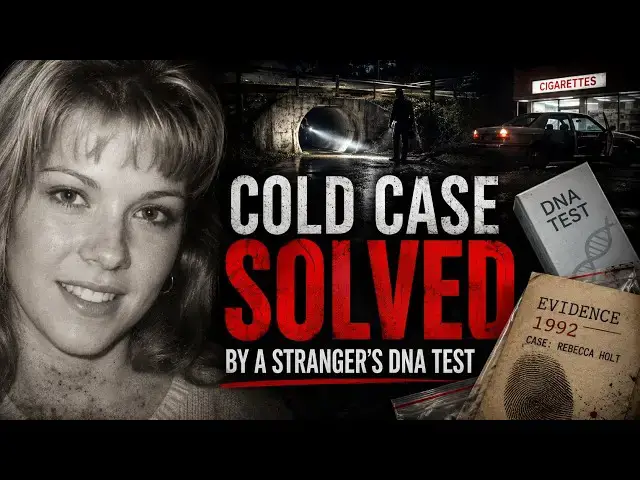
A young woman's murder remained unsolved for years. The killer left behind DNA, but in 1992, the technology to identify him barely existed. Decades later, an ordinary person's DNA test would uncover the truth in a way investigators never imagined.
This cinematic true crime documentary follows the investigation into the murder of Rebecca Holt, beginning with the discovery of her body in Burlington County, New Jersey, on October 14, 1992. With no eyewitnesses, no murder weapon, and only a partial DNA profile, detectives faced a case that seemed impossible to solve. As forensic science evolved, new investigative methods transformed forgotten evidence into the key that finally broke the mystery.
Without revealing the story's biggest twists, you'll experience the painstaking work of detectives, forensic genealogists, DNA analysts, and the people whose lives became unexpectedly connected to one of New Jersey's most compelling cold cases. This documentary explores how science, persistence, and chance intersected to solve a crime that had remained hidden for decades.
Historical Context & Disclaimer
📚 This documentary is a cinematic retelling based on the provided narrative and historical investigative techniques. Certain scenes may include visual reconstructions or dramatized dialogue for storytelling purposes while remaining faithful to the documented sequence of events. Developments in DNA profiling and forensic genetic genealogy have transformed many cold case investigations over the past three decades, allowing previously unidentified DNA evidence to generate new investigative leads.
If you enjoy deeply researched documentaries about cold cases, forensic science, DNA investigations, criminal psychology, unsolved murders, and real detective work, this story offers a detailed look at how modern forensic technology can reshape investigations long after a crime was committed.
👍 If you enjoy cinematic true crime documentaries, subscribe for new investigations every week. Each episode explores real cases through careful research, immersive storytelling, and documentary-style visuals.
▶ Watch next for another remarkable cold case where overlooked evidence changed everything.
#TrueCrime #ColdCase #DNA #ForensicScience #CrimeDocumentary #Investigation #Mystery
Show More Show Less View Video Transcript
0:00
The morning of October 14th, 1992, a
0:03
jogger found Rebecca Holt's body in a
0:06
drainage culvert off Route 73 in
0:08
Burlington County, New Jersey. She had
0:10
been stabbed 11 times. Her car was still
0:13
running in the parking lot of the
0:15
convenience store where she'd stopped
0:16
for cigarettes 20 minutes earlier. The
0:19
killer left no wallet, no weapon, no
0:23
witnesses, but he left blood. not his
0:27
own, hers on his hands, but enough of
0:30
his skin cells under her fingernails and
0:32
enough transferred evidence on her
0:34
jacket that the lab was able to extract
0:37
a partial DNA profile. In 1992, that
0:41
profile meant almost nothing. The
0:43
National DNA database had launched only
0:45
2 years earlier. It held fewer [music]
0:48
than 300 samples. Rebecca Holt's killer
0:51
was not among them. The profile went
0:54
into a file. The file went into a
0:57
cabinet. The cabinet sat in the
0:59
Burlington County Prosecutor's Evidence
1:01
Room for the next [music] 28 years.
1:05
Rebecca's mother, Margaret Hol, lived 8
1:08
m away. She kept the case open by
1:10
calling the detective assigned to it
1:12
[music] every 6 months, then every year,
1:16
then every other year. By 2018, she was
1:20
79 years old. The detective had retired.
1:24
Margaret kept calling anyway.
1:27
Then in March of 2019, a woman named
1:31
Lisa Jennings in Portland, Oregon,
1:33
someone who had never heard of Rebecca
1:35
Hol spit into a plastic tube, sealed it,
1:38
and mailed it to a company called Gan
1:40
Match for $99. She wanted to know if she
1:43
had Irish ancestry.
1:46
What she did without knowing it was
1:48
upload the genetic signature of the man
1:51
who killed Rebecca Hol because Lisa
1:54
Jennings was his second cousin. This is
1:57
the story of the cold case that was
1:59
solved not by a detective but by a
2:02
stranger who thought she was buying a
2:04
family tree. It is a story about what
2:06
happens when consumer technology
2:08
designed to sell you stories about your
2:10
ancestors becomes the most powerful
2:13
forensic tool in modern criminal
2:15
investigation. And it is a story about
2:17
how close a killer can live to the
2:20
people he destroyed for decades without
2:22
anyone knowing his name. Disclaimer: The
2:26
events described are reconstructed from
2:28
court records, investigative reports,
2:30
and interviews with law enforcement and
2:32
genetic genealogologists involved in the
2:34
case. Some dialogue has been
2:36
reconstructed from documented accounts.
2:38
Rebecca Hol was 28 years old when she
2:41
died. She worked as a medical
2:43
transcriptionist at a hospital in Mount
2:45
Holly. She lived alone. She had no
2:47
boyfriend, no recent disputes, no known
2:50
enemies. The convenience store security
2:52
camera showed her walking in at 9:47
2:55
p.m. buying a pack of Marbor lights and
2:58
walking out at 9:49. [music] The camera
3:00
did not cover the parking lot. By the
3:03
time the jogger found her body the next
3:05
morning, the investigating detectives
3:07
had already canvased the area,
3:09
interviewed the store clerk, and begun
3:11
pulling records on every vehicle that
3:13
had passed through the intersection that
3:15
night. They had a suspect pool of 216
3:19
people. None of them matched the DNA.
3:23
Detective Paul Alvarez, the lead
3:25
investigator, later described the case
3:28
in a deposition taken in 20120.
3:31
We knew we had him. We had his DNA. We
3:34
had his pattern. Ambush, blitz attack,
3:38
no sexual component. This was rage or
3:40
panic or both. We just didn't have his
3:43
name. The DNA profile was entered into
3:47
Kotus, the FBI's combined DNA index
3:50
system in 1993.
3:53
COTUS works by comparing crime scene DNA
3:55
to known offender samples, people
3:58
already arrested and processed. If your
4:00
DNA is not in the system, you do not
4:03
exist in the system. Rebecca Holt's
4:06
killer did not exist. The case stayed
4:10
active for 4 years. Alvarez chased every
4:13
lead. He reintered witnesses. He brought
4:16
in a criminal profiler who suggested the
4:18
killer might have known Rebecca
4:20
tangentially, someone she passed on the
4:22
street, someone who'd seen her at the
4:24
hospital, someone whose grievance was
4:26
invisible. The profile didn't narrow the
4:29
field. It widened it. By 1997, the case
4:34
was functionally cold. Alvarez moved on
4:37
to other homicides. The file remained
4:39
open, but no new leads came in. Margaret
4:43
Holt kept calling. Every 6 months, she
4:46
asked the same question.
4:49
Have you found him yet?
4:51
>> For 22 years, the answer was no. What
4:55
Margaret Hol did not know, what no one
4:58
knew in 1992 was that the answer was
5:02
already in the blood. It just required a
5:05
technology that did not yet exist. and a
5:08
woman in Oregon who had not yet been
5:10
born when her cousin committed murder.
5:14
Lisa Jennings was 34 years old in March
5:16
of 2019. She worked in marketing for a
5:19
software company in Portland. She had
5:22
grown up in Pennsylvania, but her family
5:24
had scattered. Divorce, relocation, the
5:27
usual fractures. She knew almost nothing
5:30
about her grandparents generation. She
5:33
bought the DNA kit on a whim. Gene Match
5:36
was one of several companies offering
5:38
direct to consumer genetic testing. You
5:41
spit in a tube. They sequence your DNA.
5:43
You get a report on your ethnic
5:45
background and a list of genetic
5:47
relatives, other users who share
5:49
segments of DNA with you. Most people
5:51
use it to find out if they're 10%
5:53
Scandinavian or to locate a birth
5:55
parent. Lisa Jennings used it to find
5:58
out if she had Irish roots. She did. She
6:01
also had a second cousin who had
6:03
murdered someone.
6:05
Lisa uploaded her DNA to GED Match, a
6:08
free third-party database that allows
6:11
users to compare their genetic data with
6:13
others. Unlike the commercial services,
6:16
GED Match is public. Anyone can search
6:19
it, including law enforcement. In May of
6:23
2019, a forensic genealogologist named
6:26
Dr. Colleen Fitzpatrick was contracted
6:28
by the Burlington County Prosecutor's
6:30
Office to review cold cases with viable
6:32
DNA evidence. Fitzpatrick had worked on
6:35
dozens of cases using genetic genealogy,
6:38
a method that combines traditional
6:40
genealological research with DNA
6:42
analysis to identify unknown
6:44
individuals. The process is simple in
6:46
theory. You take crime scene DNA, upload
6:49
it to a public database, and look for
6:51
matches. Those matches are distant
6:53
relatives, second cousins, third
6:55
cousins, people who share a common
6:57
ancestor. Then you build a family tree
7:00
backward, generation by generation,
7:02
until you find someone who was alive in
7:04
the right place at the right time.
7:07
Fitzpatrick uploaded the DNA profile
7:10
from Rebecca Holtz case to GED match
7:12
under a pseudonym. The system returned
7:15
43 potential matches. One of them was
7:18
Lisa Jennings.
7:20
Lisa shared approximately
7:23
120 cenommorggans of DNA with the
7:25
unknown subject, the genetic equivalent
7:27
of a second cousin. That meant they
7:29
shared a common great grandparent.
7:32
Fitzpatrick now had a starting point.
7:35
She began building the tree. Lisa's
7:38
greatgrandparents were Joseph and Anne
7:40
Callahan, who had lived in Trenton, New
7:42
Jersey, and had five children. Those 16
7:46
had 16 children of their own. Those 16
7:49
had 31. One of those 31 was the killer.
7:54
The work took three weeks. Fitzpatrick
7:57
cross-referenced birth records, marriage
7:59
licenses, death certificates, and census
8:02
data. She ruled out women. She ruled out
8:05
anyone who had died before 1992. She
8:08
ruled out anyone who had been
8:09
incarcerated or living outside New
8:12
Jersey at the time of the murder. She
8:14
was left with four men. One of them was
8:17
named Dennis Kowalsski. He was 62 years
8:20
old. He lived in Peton, New Jersey, 8
8:23
miles from Margaret Holtz House.
8:26
Fitzpatrick sent her findings to
8:28
Detective Alvarez, who had retired but
8:30
stayed on as a consultant. He pulled
8:32
Kowalsski's records. No criminal
8:35
history, not even a speeding ticket.
8:37
Dennis Kowalsski had lived in the same
8:39
house since 2001. Before that, he'd
8:43
lived in an apartment in Mount Holly,
8:45
three blocks from the convenience store
8:47
where Rebecca Hol bought cigarettes on
8:49
the night she died. Alvarez assigned a
8:52
surveillance team. They followed
8:53
Kowalsski for 2 weeks, waiting for him
8:56
to discard something they could test. A
8:58
coffee cup, a cigarette butt, anything
9:01
with his DNA on it. On June 11th, 2019,
9:05
Kowalsski threw a used water bottle into
9:07
a trash can outside a diner in Browns
9:09
Mills. The lab ran the sample. It was a
9:12
match. Dennis Kowalsski was not a ghost.
9:16
He had a job. He managed a small auto
9:18
parts store in Mount Holly. He had
9:20
neighbors. He had a sister in Florida
9:23
who called him twice a year. He paid his
9:25
taxes. He mowed his lawn. He had also in
9:28
1992 been responsible for a violent
9:32
incident in which a woman lost her life.
9:35
The question that haunted the
9:36
investigators was not whether he had
9:38
done it. The DNA was conclusive, but
9:41
why? Rebecca Hol and Dennis Kowalsski
9:45
had no known connection. They did not
9:47
work together. They had no mutual
9:49
friends. There was no evidence they had
9:52
ever spoken. The only link was
9:55
geography. In October of 1992, Kowalsski
9:59
lived three blocks from the store where
10:01
Rebecca stopped. Alvarez reintered the
10:05
store clerk from that night, a man named
10:07
Miguel Santos, who was now 53 and
10:10
working as a truck driver in Delaware.
10:12
Santos remembered Rebecca. He did not
10:15
remember anyone following her. But he
10:18
remembered something else. There was a
10:20
guy who used to come in a lot, late
10:22
shift, quiet, never said much. He'd buy
10:26
a Coke, stand by the magazine rack for a
10:28
while, then leave. I remember him
10:31
because he never bought a magazine, just
10:33
stood there. Alvarez showed him a photo
10:37
of Dennis Kowalsski. Santos hesitated,
10:40
then nodded.
10:42
Yeah, that's him. The theory that
10:45
emerged from the investigation was this.
10:48
Dennis Kowalsski was a regular at the
10:50
store. He had seen Rebecca before. Maybe
10:53
he had fixated on her. Maybe he had
10:55
spoken to her once and she had ignored
10:57
him. Maybe she had never noticed him at
11:00
all. On the night of October 14th, he
11:02
was in the parking lot when she came
11:04
out. He followed her to her car. What
11:07
happened next lasted less than 2
11:09
minutes. There was no evidence of
11:12
planning. The murder was chaotic,
11:15
brutal, inefficient. Kowalsski had not
11:18
brought a weapon. He used a folding
11:20
knife he carried in his pocket. He had
11:22
not chosen a location. The culvert was
11:25
visible from the road. He had not
11:27
cleaned the scene. He had simply walked
11:30
away. And then he had lived. For 27
11:34
years, he lived 8 miles from Margaret
11:37
Holt. He drove past the convenience
11:40
store where Rebecca died. He saw the
11:42
memorial that her family placed at the
11:44
sight of the covert, a small wooden
11:46
cross with her name on it. He saw it and
11:50
he kept driving. In June of 2019,
11:54
forensic psychologist Dr. Andrea Lim was
11:57
brought in to evaluate Kowolski's
11:59
behavior in the decades after the
12:01
murder. Her report filed with the court
12:04
included this assessment.
12:06
Subject exhibits no evidence of
12:08
escalation, no subsequent offenses, no
12:11
pattern of predatory behavior. The
12:14
murder of Rebecca Hol appears to have
12:16
been an isolated event, impulsive,
12:19
disorganized, and followed by decades of
12:21
what can only be described as dormcancy.
12:24
This does not suggest rehabilitation. It
12:27
suggests compartmentalization.
12:30
The subject has lived two lives
12:32
simultaneously.
12:33
One in which he committed murder and one
12:35
in which he did not. The report noted
12:39
one other detail. In 2007, Dennis
12:42
Kowalsski had driven past the memorial
12:44
cross and stopped. A witness, a woman
12:48
walking her dog, saw him standing by the
12:50
roadside for several minutes looking at
12:52
the cross. Then he got back in his car
12:55
and left. The woman did not think it was
12:58
unusual. She assumed he was a family
13:00
member. On June 18th, 2019, at 6:43
13:05
a.m., Detective Paul Alvarez and two
13:08
officers from the Burlington County
13:10
Prosecutor's Office arrived at Dennis
13:12
Kowalsski's home in Peton, New Jersey.
13:15
Kowalsski answered the door in a
13:17
bathrobe. Alvarez later described his
13:19
expression as blank. Not surprised, not
13:23
afraid, just blank. I said, "Mr.
13:27
Kowalsski, we need to talk to you about
13:29
October 14th, 1992." And he just nodded.
13:34
He said, "I know." Kowalsski was taken
13:38
to the prosecutor's office for
13:39
questioning. He waved his right to an
13:42
attorney. The interrogation lasted 4
13:44
hours and 17 minutes. A transcript was
13:47
entered into evidence at trial. For the
13:50
first two hours, Kowalsski said nothing.
13:52
He sat with his hands folded on the
13:54
table, staring at a point just past
13:56
Alvarez's shoulder. Then Alvarez
13:59
mentioned the DNA.
14:01
We have your DNA under her fingernails.
14:04
Dennis, we have your DNA on her jacket.
14:08
We matched it to a sample we took from a
14:10
water bottle you threw away 2 weeks ago.
14:13
There is no question. We know it was
14:16
you. The only question is why. Kowalsski
14:20
looked at him for the first time. I
14:23
don't know why. He confessed 20 minutes
14:27
later. The confession was brief,
14:29
mechanical, almost clinical. He
14:32
described following Rebecca to her car.
14:34
He described the argument, though he
14:36
could not remember what it was about or
14:38
if it had even been an argument. He
14:41
described the knife. He did not describe
14:44
remorse.
14:45
When Alvarez asked him why he had never
14:48
turned himself in, Kowalsski gave an
14:50
answer that became the central piece of
14:52
evidence in the psychological
14:54
evaluation.
14:56
I thought if I just kept going, it would
14:58
stop being real. And after a while, it
15:01
did. Dennis Kowalsski was charged with
15:04
firstdegree murder. His trial began in
15:07
March of 2020. The defense did not
15:10
contest the DNA evidence. Instead, they
15:13
argued that genetic genealogy had
15:16
violated Kowalsski's Fourth Amendment
15:18
rights, that using a third-party
15:20
database to identify him constituted an
15:23
illegal search. The judge rejected the
15:26
motion. The precedent had already been
15:28
set in California in the case of the
15:30
Golden State Killer. Lisa Jennings, the
15:33
woman whose DNA had led investigators to
15:36
Kowalsski, was called to testify. She
15:39
described uploading her sample to GED
15:41
match. She described receiving a call
15:43
from Dr. Fitzpatrick asking for
15:45
permission to use her genetic data in a
15:48
criminal investigation.
15:50
I didn't even know I had a second cousin
15:53
named Dennis. I still don't really
15:55
understand how we're related, but when
15:58
they told me what he'd done, I just
16:02
>> She paused.
16:04
>> Of course, I said yes. Margaret Hol
16:08
attended every day of the trial. She sat
16:11
in the front row directly across from
16:13
Kowalsski. He never looked at her. On
16:16
the day the verdict was read, guilty on
16:19
all counts. Margaret stood and walked
16:22
out of the courtroom without waiting for
16:23
sentencing. A reporter asked her later
16:26
how she felt.
16:28
>> I don't feel anything. I just wanted to
16:30
know his name.
16:32
Dennis Kowalsski was sentenced to life
16:34
in prison without the possibility of
16:36
parole. He is currently incarcerated at
16:39
New Jersey State Prison in Trenton. He
16:42
has not given any interviews. He has not
16:44
filed an appeal. Dr. Colleen
16:47
Fitzpatrick, the genealogologist who
16:49
identified him, went on to work on more
16:51
than 60 cold cases using the same
16:53
method. In an interview with a forensic
16:56
science journal in 2021, she was asked
16:58
whether she worried about the ethical
17:00
implications of using consumer DNA
17:02
databases for criminal investigations.
17:05
Her answer, I think about Rebecca Holt's
17:08
mother calling that detective every 6
17:10
months for 22 years. I think about the
17:14
families who never got answers. And I
17:17
think ethics are complicated, but
17:19
justice is not.
17:22
Lisa Jennings deleted her GED match
17:24
account 6 months after the trial. She
17:27
later said in an interview that she did
17:28
not regret helping, but that she could
17:30
not stop thinking about the randomness
17:32
of it. That if she had bought a
17:34
different brand of DNA test, or if she
17:36
had never uploaded her data, or if she
17:38
had done it a year earlier or a year
17:40
later, Dennis Kowalsski might still be
17:43
free.
17:45
>> I didn't solve anything. I just happened
17:47
to be related to the right person at the
17:49
right time. That's all it was, luck.
17:54
>> But it was not luck that built the
17:56
family tree. It was not luck that
17:58
matched the DNA. It was not luck that
18:01
put Kowalsski in a cell. It was a woman
18:04
in Oregon who wanted to know if she had
18:06
Irish ancestors and a mother in New
18:09
Jersey who refused to let her daughter's
18:12
name disappear. Rebecca Hol is buried in
18:15
Mount Holly, New Jersey. Her grave is
18:18
marked with a simple headstone that
18:19
reads, "Beloved daughter, October 14th,
18:23
1992. We never stopped looking."
18:26
Margaret Holt visits twice a year. She
18:29
brings flowers. She sits for a while,
18:31
then she leaves. She does not visit the
18:34
prison. She has never written to
18:36
Kowalsski. She has never asked him why.
18:39
She already knows the only answer that
18:42
matters. On the morning of October 14th,
18:45
1992, a jogger found Rebecca Holt's body
18:49
in a drainage culvert off Route 73. The
18:52
man who put her there lived 8 miles away
18:55
and he stayed.
#Arts & Entertainment