live_tv
Livestream Starting Soon
00
Hours
:
00
Minutes
:
00
Seconds
Up next in 10


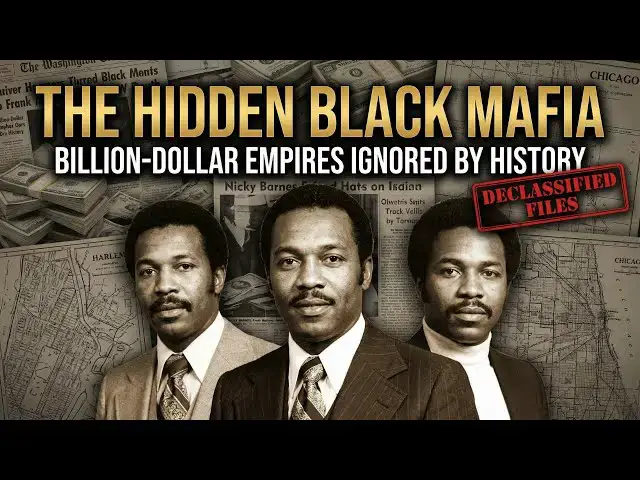
For decades, organized crime history focused exclusively on Italian families. The real story? Far more complex.
This is the hidden history of Black organized crime figures who built billion-dollar empires, innovated trafficking methods the Italian families later copied, and achieved sophistication that rivaled or exceeded traditional mob operations—all while operating largely invisible to mainstream narratives.
THE 7 BLACK MAFIA BOSSES:
💼 NICKY BARNES & THE COUNCIL — Created corporate structure for heroin distribution in 1970s Harlem. Controlled 80% of the trade. $50 million annual revenue (over $300M today). Appeared on NYT Magazine cover. Eventually cooperated, dismantling his own empire.
💼 FRANK MATTHEWS — Built East Coast drug empire exceeding $300M annually. Flew to South America to negotiate directly with cartels, cutting out Italian middlemen entirely. Disappeared with $15-20 million cash in 1973. Never found. FBI still searching 50 years later.
💼 BUMPY JOHNSON — Controlled Harlem gambling and protection 1940s-60s. Partnered with Italian families as EQUAL, not subordinate. Ran sophisticated policy banks generating millions. His organizational model influenced all who followed.
💼 CHAMBERS BROTHERS — Detroit organization that revolutionized crack distribution in 1980s. Created franchise system like McDonald's. Computerized operations. $55M annual revenue. Their business model spread nationwide fueling crack epidemic.
💼 FELIX MITCHELL — Oakland's "KINGPIN" controlled 70% of heroin trade before age 25. $10M+ annual operation. Strategic violence and community relations. Murdered in federal prison 1986.
💼 FRANK LUCAS — The American Gangster myth mostly fabricated. Real story? When he cooperated, exposed NYPD corruption leading to 50+ officer convictions. His testimony revealed system-wide rot.
💼 JEFF FORT & BLACK P-STONE NATION — Chicago organization achieving political influence, international connections (Libya terrorism plot), institutional permanence. Received federal grants while running criminal empire. Organization still operates today.
Show More Show Less View Video Transcript
0:00
Brooklyn Federal Courthouse, June 19th,
0:05
1977. The agents wheel in evidence boxes
0:09
that took three trucks to transport.
0:11
Inside those boxes, meticulously
0:13
organized ledgers documenting a drug
0:16
operation that moved $20 million in
0:18
heroin through Harlem in 18 months. The
0:21
handwriting is precise. The accounting
0:24
would impress a Wall Street firm. Every
0:26
transaction recorded, every payment
0:29
tracked, every debt documented with the
0:31
efficiency of a Fortune 500 corporation.
0:34
The prosecutors expected street level
0:36
chaos. What they found was a business
0:38
empire more sophisticated than most
0:41
legitimate companies. The ledgers
0:43
belonged to Nikki Barnes, the man Harlem
0:46
called Mr. Untouchable. But here's what
0:48
nobody tells you about that evidence.
0:50
Those ledgers represented just one
0:52
operation in a network of black
0:54
organized crime syndicates that rip the
0:56
Italian families in sophistication,
0:59
exceeded them in innovation, and in some
1:01
cases made them look like amateurs. For
1:04
five decades, the narrative about
1:06
organized crime in America has focused
1:08
almost exclusively on Italian mobsters,
1:11
the Gambinos,
1:13
the Genevases, the Chicago outfit.
1:16
That's the story everyone knows. But
1:18
running parallel to those families,
1:20
often invisible to mainstream media,
1:22
sometimes working with them, sometimes
1:25
competing against them, were criminal
1:27
organizations built by black
1:29
entrepreneurs who understood something
1:31
crucial. The same business principles
1:33
that made the Italians powerful could be
1:35
applied by anyone smart enough and
1:37
ruthless enough to execute them. These
1:40
weren't street gangs. These weren't
1:42
disorganized thugs. These were
1:44
sophisticated criminal enterprises with
1:46
corporate structures, international
1:48
connections, political influence, and
1:51
financial operations that would
1:52
eventually force federal law enforcement
1:54
to completely rethink how they
1:56
approached organized crime. The FBI
1:59
spent decades building RICO cases
2:01
against Italian families. While these
2:03
organizations operated in plain sight,
2:05
generating billions, building empires,
2:08
and creating power structures that still
2:11
influence American cities today. Today,
2:13
we're opening the vault. These are the
2:15
secrets they thought were buried
2:17
forever. We pulled the case files
2:19
declassified under Freedom of
2:21
Information requests. We analyzed
2:23
testimony from federal trials that
2:25
exposed organizational structures, law
2:27
enforcement didn't want to acknowledge
2:29
existed. We interviewed retired agents
2:31
who spent careers tracking these
2:33
networks, and former associates who
2:35
finally agreed to speak decades after
2:37
the fact. We traced financial records
2:39
through shell corporations and offshore
2:41
accounts. What emerged isn't the story
2:44
you've been told. This isn't about
2:46
street level drug dealing or gang
2:48
violence. This is about men who built
2:50
billiondoll criminal enterprises using
2:52
business models that rivaled and
2:54
sometimes surpassed traditional
2:56
organized crime families. The
2:57
sophistication level was stunning.
2:59
international smuggling routes,
3:02
legitimate business fronts, political
3:04
corruption networks, money laundering
3:07
operations that moved cash through
3:09
multiple countries before it reached
3:11
final destinations. These organizations
3:13
pioneered techniques. The Italian
3:15
families later, they innovated
3:17
distribution models that revolutionized
3:19
drug trafficking. They created corporate
3:22
structures that protected leadership
3:24
while expanding operations. And they did
3:26
it while navigating obstacles the
3:28
Italian families never faced. Systemic
3:31
racism that limited access to legitimate
3:33
business and banking, law enforcement
3:35
that treated them differently, and a
3:37
media that either ignored their
3:38
existence or sensationalized it beyond
3:41
recognition. What you're about to
3:43
discover are seven figures in
3:44
organizations that built criminal
3:46
empires in the shadows of the better
3:47
known Italian mob. Some worked with the
3:50
five families. Some competed against
3:52
them. Some exceeded them. All of them
3:56
rewrote the rules of American organized
3:58
crime in ways that still echo today.
4:01
Harlo, 1916th
4:04
Street. Nikki Barnes walks into a
4:05
meeting with 15 men who controlled drug
4:08
distribution across upper Manhattan.
4:10
He's 35 years old, former street dealer
4:12
who did time in Green Haven Correctional
4:14
for drug possession. Now he's about to
4:17
do something unprecedented. He's
4:19
creating a formal organization with a
4:21
corporate structure, defined
4:22
territories, and collective leadership.
4:25
He calls it the council. Seven men at
4:28
the top, each controls specific
4:30
territory. All decisions made
4:32
collectively. All disputes settled
4:34
internally. No public violence that
4:36
draws police attention. It's the
4:38
commission model the Italian families
4:40
use apply to the heroin trade with
4:42
innovations that make it more efficient.
4:44
Barnes understood what street dealers
4:46
didn't. The real money isn't in selling
4:49
drugs directly. It's in controlling
4:52
distribution networks. It's in buying
4:55
bulk directly from international
4:57
sources. It's in establishing exclusive
4:59
territories and eliminating competition
5:02
through business strategy rather than
5:03
constant violence. The council at its
5:06
peak in the mid1 1970s controlled 80% of
5:09
heroin distribution in Harlem. They
5:11
moved an estimated $50 million worth of
5:14
product annually.
5:16
That's over 300 million in today's
5:18
currency per year. From one organization
5:21
in one neighborhood, the business model
5:24
was brilliant. Barnes negotiated
5:26
directly with international suppliers,
5:28
cutting out middlemen and reducing
5:30
costs. The council established
5:32
relationships with corrupt police and
5:34
politicians that provided intelligence
5:36
and protection. They used legitimate
5:38
businesses as fronts, washing money
5:40
through Harlem's economy. They employed
5:42
legitimate accountants and lawyers who
5:45
structured their operations to minimize
5:47
legal exposure. The sophistication
5:49
shocked law enforcement when they
5:50
finally penetrated the organization.
5:53
These weren't street criminals. These
5:55
were businessmen who happened to sell
5:57
narcotics. Barnes himself drove a
6:00
Mercedes, wore custom suits, attended
6:03
Broadway shows, lived in a luxury
6:05
apartment on Central Park West. He
6:08
appeared on the cover of the New York
6:09
Times magazine in 1977 with the
6:12
headline, "Mr. Untouchable."
6:15
It was a fatal mistake that publicity
6:17
brought federal heat the council
6:19
couldn't dodge. Barnes went down in 1978
6:22
on federal drug charges. Life sentence
6:25
without parole. But here's the twist.
6:28
Nobody saw coming. Barnes eventually
6:31
cooperated with federal prosecutors,
6:33
testified against the council, and
6:35
entered witness protection. The man
6:37
Harlem considered untouchable became the
6:39
biggest informant in the history of
6:41
black organized crime. He helped convict
6:44
dozens of associates and dismantle an
6:46
organization that had operated for a
6:47
decade. Barnes died in 2012 in witness
6:50
protection. His real identity hidden,
6:53
his fortune seized, but the council's
6:56
business model survived. Organizations
6:58
across the country copit its structure.
7:00
The concept of collective leadership,
7:02
defined territories, and corporate
7:04
efficiency became standard in drug
7:07
trafficking operations nationwide. But
7:09
that's nothing compared to what comes
7:11
next. Darum, North Carolina.
7:14
February 1973. Frank Matthews walks out
7:18
of his lawyer's office in broad
7:19
daylight. He's carrying two suitcases.
7:22
He tells his wife he'll be back in a few
7:24
days. He's never seen again. Matthews
7:27
disappeared with an estimated 15 to20
7:30
million in cash adjusted for inflation.
7:33
That's over $100 million today. Law
7:36
enforcement has been searching for him
7:37
for 50 years. They've never found a
7:40
trace. Frank Matthews wasn't just
7:42
another drug dealer who vanished. He was
7:44
arguably the most successful black
7:46
organized crime figure in American
7:48
history. And his story reveals the
7:50
international scope these operations
7:52
achieved. Matthews, operating out of
7:55
Brooklyn and Philadelphia from the late
7:57
1960s to early 70s, built a heroin and
8:00
cocaine distribution network that
8:02
spanned the entire East Coast and parts
8:05
of the Midwest. At his peak, he was
8:07
moving multi-tonon quantities of drugs
8:09
monthly. His estimated annual income
8:11
exceeded 300 million in today's dollars.
8:14
What made Matthews different was his
8:16
vision. While other dealers bought from
8:18
Italian families who controlled
8:20
importation, Matthews went directly to
8:22
the source. He established relationships
8:25
with French connection heroin suppliers.
8:27
He flew to Venezuela and Colombia to
8:30
negotiate cocaine deals directly with
8:32
cartel representatives. He cut out the
8:34
Italian middlemen entirely, something
8:36
that had never been done successfully
8:38
before. This wasn't just about drugs.
8:41
This was about breaking the Italian
8:43
monopoly on international trafficking.
8:45
Matthews proved that a black criminal
8:47
organization could access the same
8:50
suppliers, move the same quantities, and
8:52
generate the same profits without
8:54
needing the traditional mob's permission
8:56
or partnership.
8:58
The Italians were furious. Matthews was
9:01
disrupting their business model and
9:03
proving they weren't essential to the
9:04
supply chain. He operated with
9:06
astonishing boldness. He owned
9:08
legitimate businesses, including a bar
9:10
and a clothing store that washed his
9:12
money. He purchased real estate across
9:14
multiple states. He threw lavish parties
9:17
attended by celebrities and politicians.
9:20
He lived like royalty while moving tons
9:22
of narcotics. When federal prosecutors
9:24
finally built a case against him in
9:26
1972, Matthews knew what was coming. His
9:29
trial was scheduled for January 1973. He
9:33
appeared in court, made bail, then
9:36
vanished. The FBI believes he's either
9:39
dead, murdered by associates who wanted
9:41
his money, or living under a new
9:43
identity somewhere with a fortune that
9:45
was never recovered. His wife, Cheryl,
9:47
died in 2007, never revealing if she
9:50
knew his location. Multiple sightings
9:53
over the years have been investigated
9:55
and dismissed. Matthews became a ghost.
9:58
His disappearance one of the great
9:59
unsolved mysteries in American crime.
10:02
What he left behind was proof that the
10:03
international drug trade wasn't
10:05
controlled by any single ethnic group.
10:07
It was open to anyone with the
10:09
intelligence, connections, and
10:11
ruthlessness to compete. The deeper you
10:13
go, the darker it gets. Harla, the 1940s
10:18
and 50s. Before the Italians supposedly
10:21
controlled everything, one man actually
10:24
did control Harlem. Ellsworth, Bumpy
10:27
Johnson. The numbers racket, the
10:29
protection, the policy banks, the
10:32
gambling, all of it flowed through
10:34
Johnson. And here's what the movies
10:36
never get right. Johnson wasn't working
10:39
for the Italians. He was working with
10:41
them as an equal. Johnson's relationship
10:44
with the Italian families, particularly
10:46
the Genevese family, was a partnership,
10:49
not subordination. He controlled
10:51
Harlem's illegal gambling through
10:52
superior local knowledge and community
10:54
connections. The Italians couldn't
10:56
replicate. They needed him as much as he
10:59
needed their protection and resources.
11:01
This arrangement made Johnson
11:02
extraordinarily wealthy and powerful for
11:05
three decades. The sophistication of
11:07
Johnson's operation is often overlooked.
11:10
He ran policy banks that took illegal
11:12
bets on numbers games, operations that
11:14
required complex accounting, cash
11:16
management, and payout structures. He
11:19
controlled these through a network of
11:20
local operators who collected bets, paid
11:23
winners, and kicked percentages up the
11:26
chain. The system was efficient and
11:28
generated millions annually. Johnson
11:30
also pioneered the protection racket in
11:33
Harlem, collecting from businesses and
11:35
gambling operations in exchange for
11:37
security and dispute resolution. He
11:39
maintained order, prevented violence
11:41
that would bring police attention, and
11:43
created an environment where illegal
11:45
businesses could operate profitably. His
11:47
political connections were extensive. He
11:50
had relationships with Harlem
11:51
politicians, police officers, and
11:54
community leaders. He presented himself
11:56
as a Robin Hood figure, someone who
11:58
protected the community from outside
12:00
exploitation while providing employment
12:02
and services. This public relations
12:04
strategy gave him legitimacy and
12:06
community support that made law
12:08
enforcement's job harder. Johnson went
12:10
to prison twice, serving over 15 years
12:13
total. But his organization continued
12:15
operating during his incarcerations,
12:18
proof of the institutional structure he
12:20
built. When he died of a heart attack in
12:22
1968, his funeral drew thousands of
12:24
mourers. His estate was minimal on
12:26
paper, but the business model he created
12:29
influenced every organized crime figure
12:32
who came after him in Harlem. Johnson
12:34
proved that black criminal organizations
12:36
could achieve equal status with the
12:38
Italian families through superior local
12:40
control and business acumen. And this is
12:42
where things get truly dangerous.
12:45
Detroit 19. The Chambers Brothers
12:48
organization is moving 200 kilos of
12:50
cocaine per month through Detroit's east
12:53
side. They've created a retail drug
12:55
empire unlike anything law enforcement
12:57
has seen before. They've invented crack
12:59
cocaine distribution as a business
13:01
model. The Chambers brothers, four
13:03
siblings from Arkansas, who moved to
13:05
Detroit in the late '7s, revolutionized
13:08
drug trafficking through innovation that
13:09
would reshape the entire industry. They
13:11
didn't invent crack cocaine, but they
13:14
perfected its distribution. They created
13:16
a franchise system for drug sales that
13:18
operated like McDonald's, specific
13:21
locations, consistent product,
13:24
standardized pricing, 24-hour operation.
13:28
They employed hundreds of people in a
13:29
hierarchical structure with clear roles,
13:32
lookouts, steerers who directed
13:34
customers, sellers who handled
13:36
transactions, and enforcers who maintain
13:39
security. Employees received wages,
13:42
benefits, and promotions. The
13:44
organization grossed $55 million
13:47
annually at its peak. That's over 140
13:50
million in today's currency. from one
13:53
organization in one city selling one
13:55
product. The business model was so
13:57
successful it was coped nationwide,
14:00
fueling the crack epidemic of the 1980s.
14:02
What made the Chambers brothers
14:04
significant wasn't just the money. It
14:06
was the organizational innovation. They
14:09
computerized their operations using
14:11
early personal computers to track
14:13
inventory and sales. They established
14:16
safe houses for product storage. They
14:18
created a communications network using
14:20
code words and runners. They paid
14:22
lawyers retainers to represent employees
14:24
arrested during operations. The
14:26
sophistication forced Detroit police to
14:29
create specialized task forces.
14:31
Traditional drug enforcement strategies
14:33
didn't work because this wasn't a
14:35
traditional drug operation. This was a
14:37
corporation that happened to sell crack
14:39
cocaine. Federal prosecutors eventually
14:41
dismantled the organization using RICO
14:44
statutes developed to fight the Italian
14:46
mob. Multiple members received life
14:49
sentences, but the business model
14:51
survived and spread. Cities across
14:53
America saw similar organizations
14:55
emerge, all using the Chambers Brothers
14:58
playbook, the crack epidemic that
15:00
devastated communities in the 80s and
15:02
'90s was fueled by the distribution
15:04
innovations this organization pioneered.
15:07
They proved that drug trafficking could
15:08
be industrialized, standardized, and
15:11
scaled like any legitimate business. The
15:13
consequences were catastrophic for
15:15
communities, but highly profitable for
15:17
those running the organizations. What
15:20
comes next? Even the FBI couldn't
15:22
believe it. Oakland, California, 1979.
15:27
Felix Mitchell controls 70% of heroine
15:29
distribution in Oakland through an
15:31
organization called 69 Mob. His network
15:34
employs hundreds. His annual revenue
15:37
exceeds $10 million. He drives a
15:40
Rolls-Royce with a custom license plate
15:42
reading kingpin. He's 23 years old.
15:45
Felix Mitchell built one of the most
15:47
violent and successful drug
15:49
organizations on the West Coast before
15:51
he could legally rent a car. Starting in
15:54
the mid Mitchell created a distribution
15:56
network that controlled East Oakland's
15:58
heroin trade through a combination of
16:00
business acumen and extreme violence.
16:02
What made Mitchell's organization
16:04
notable was its street level efficiency.
16:06
He created a network of dealers who sold
16:09
exclusively his product in defined
16:11
territories. He established safe houses
16:13
throughout Oakland for storage and
16:15
packaging. He employed enforcers who
16:17
eliminated competition and maintained
16:19
discipline within the organization. The
16:21
violence was strategic. Mitchell didn't
16:24
tolerate freelance dealing in his
16:26
territories. Competitors were warned
16:29
once, then eliminated. The brutality
16:31
sent a message that made expansion
16:33
easier because dealers joined his
16:36
organization rather than competing
16:38
against it. But Mitchell also understood
16:40
community relations. He threw enormous
16:42
parties in East Oakland. Distributing
16:45
food and gifts, he hired local youth,
16:47
providing employment in a community with
16:49
few opportunities. He presented himself
16:52
as a businessman, not a thug.
16:55
Cultivating an image that gave him local
16:57
support. Oakland police and federal
16:59
agents watched his operation grow, but
17:01
struggled to build prosecutable cases.
17:04
Mitchell insulated himself through
17:05
organizational layers. Street dealers
17:09
didn't know him. Mid-level managers
17:11
handled daily operations. Mitchell
17:13
stayed removed from direct involvement
17:15
in drug transactions. The breakthrough
17:17
came through federal wiretaps and
17:19
testimony from organization members who
17:21
turned informant. Mitchell was convicted
17:23
in 1985 on federal drug trafficking
17:26
charges and sentenced to life in prison.
17:28
In 1986, he was murdered inside
17:31
Levvenworth Federal Penitentiary,
17:33
stabbed to death in a fight whose
17:35
circumstances remain suspicious. His
17:37
funeral in Oakland drew thousands of
17:39
mourners and a procession that included
17:42
a horsedrawn carriage. The spectacle
17:44
made national news, highlighting the
17:46
complex relationship between drug
17:48
traffickers and the communities they
17:50
exploit and employ. Mitchell's
17:52
organization dissolved after his death,
17:54
but the territory wars that followed his
17:56
removal created violence that plagued
17:59
Oakland for years. His story illustrates
18:02
the destructive cycle these
18:03
organizations create, providing economic
18:06
opportunity while fueling addiction and
18:08
violence. Hold that thought. Number two,
18:11
changes everything. Harlem. Late 1960s.
18:16
Frank Lucas claims he's importing heroin
18:19
directly from Southeast Asia, cutting
18:21
out the Italian metalmen and flooding
18:23
Harlem with pure product he calls blue
18:26
magic.
18:29
The story becomes legend,
18:32
a movie starring Denzel Washington, the
18:35
American gangster myth. Except here's
18:38
what actually happened. Most of it was
18:40
exaggeration.
18:42
Lucas was a successful heroin dealer. He
18:44
worked for Bumpy Johnson and took over
18:47
parts of that operation after Johnson's
18:49
death. He made millions. He lived
18:52
lavishly. But the core story about
18:54
importing heroin hidden in coffins of
18:56
American servicemen killed in Vietnam
18:59
largely fabricated.
19:02
The Blue Magic brand existed but wasn't
19:04
the revolutionary product. Lucas claimed
19:07
the direct importation from Southeast
19:09
Asia. He bought from the same suppliers
19:11
as other dealers, just in larger
19:13
quantities. So why does Lucas land so
19:15
high on this list if his story was
19:18
partly myth? Because of what he revealed
19:20
when he cooperated with federal
19:22
authorities. When Lucas was arrested in
19:24
1975, he faced life in prison. He made a
19:28
calculated decision. He became an
19:30
informant. And the information he
19:32
provided exposed something law
19:34
enforcement didn't want to acknowledge.
19:36
widespread corruption among NYPD
19:38
officers and federal agents. Lucas
19:41
testified that he had dozens of police
19:42
officers on his payroll. He named names.
19:46
He detailed payment structures. He
19:48
exposed a network of corruption that led
19:50
to the conviction of over 50 law
19:51
enforcement officers. This revelation
19:54
was devastating. It confirmed that
19:56
organized crime, whether Italian or
19:58
black, couldn't operate without
20:00
corrupting the system meant to stop it.
20:02
The trials that followed Lucas'
20:03
cooperation revealed that NYPD's special
20:06
investigations unit, supposedly elite
20:09
narcotics detectives, were actually
20:11
working with drug traffickers,
20:13
protecting operations, and sharing
20:15
intelligence. Lucas's cooperation got
20:18
him released after serving just 5 years.
20:20
He lived until 2019, dying at 88 years
20:23
old. His legacy isn't the exaggerated
20:26
story of the American gangster. It's the
20:28
documented corruption he exposed and the
20:31
mythmaking that turned a moderately
20:33
successful dealer into a folk hero. His
20:35
story shows how the line between truth
20:37
and legend in organized crime is
20:39
deliberately blurred by the criminals
20:41
themselves and by a media hungry for
20:44
dramatic narratives. Landing at number
20:46
one, the organization that proved black
20:49
organized crime could achieve
20:51
institutional permanence. The Black Peon
20:53
Nation, Chicago, 196. Jeff Fort creates
20:57
what appears to be a street gang, but
20:59
actually functions as a sophisticated
21:01
criminal corporation with political
21:03
influence, international connections,
21:05
and an organizational structure that
21:07
survived federal prosecution and still
21:10
operates today. The Black Peace Nation,
21:13
which evolved from the Blackstone Ranger
21:15
Street Gang, became something
21:16
unprecedented in American organized
21:19
crime. Fort transformed a southside
21:21
Chicago gang into an organization with
21:23
over 5,000 members, legitimate nonprofit
21:27
fronts that received federal grants and
21:30
operations including drug trafficking,
21:32
weapons sales, and eventually
21:35
international terrorism. The
21:37
sophistication was remarkable. The
21:39
organization had a formal hierarchy with
21:42
fortis chief Malik, a governing body
21:44
called the main 21, and structured ranks
21:47
throughout. It operated legitimate
21:49
businesses and nonprofits that provided
21:52
employment and washed money. It
21:53
negotiated with city politicians,
21:56
delivering votes in exchange for
21:58
influence and reduced law enforcement
22:00
pressure. In the late 1960s, the
22:02
organization received federal poverty
22:05
program grants exceeding $1 million,
22:08
ostensibly for community programs.
22:10
Investigations later revealed much of
22:12
that money funded criminal operations
22:15
and Fort's lifestyle. This was taxpayer
22:18
money financing organized crime. The
22:20
political connections were extensive.
22:22
The organization delivered votes for
22:24
Chicago politicians. It maintained
22:27
relationships with alderman and state
22:29
representatives. It operated with a
22:31
level of impunity that shocked federal
22:33
investigators when they finally
22:34
penetrated the organization. The
22:36
international dimension emerged in the
22:38
early 1980s when Fort operating from
22:40
prison negotiated with Libyan government
22:43
representatives to commit terrorist acts
22:45
in the United States in exchange for
22:47
payment. He was caught in an FBI sting
22:50
and convicted of conspiring to commit
22:51
terrorism, adding a federal terrorism
22:54
conviction to his existing drug
22:56
trafficking sentences. Fort received 80
22:58
years and is currently serving time in
23:01
federal supermax prison, but the
23:03
organization survived. Various factions
23:06
continue operating in Chicago and other
23:09
cities. The structure Fort created
23:11
proved resilient enough to outlast his
23:13
imprisonment. The black peace donation
23:15
represents the apex of black organized
23:18
crime. Even it achieved political
23:20
influence, international connections,
23:23
institutional permanence, and
23:24
multigenerational continuity that rivals
23:27
traditional organized crime families. It
23:29
proved that the barriers to organized
23:31
crime success weren't racial or
23:33
cultural. They were about access to
23:35
resources, political protection, and
23:37
organizational vision.
23:40
Fort had all three seven organizations
23:42
and figures who built criminal empires
23:45
that rivaled or exceeded the Italian
23:47
families in sophistication, innovation,
23:50
and profitability. Nikki Barnes and the
23:52
council created corporate structures for
23:54
drug distribution that became the
23:56
industry standard. Frank Matthews broke
23:58
the Italian monopoly on international
24:00
trafficking and disappeared with a
24:02
fortune that's never been found. Bumpy
24:05
Johnson achieved equal partnership
24:06
status with the five families through
24:08
superior local control. The Chambers
24:11
brothers industrialized crack
24:12
distribution with innovations that
24:14
reshaped drug trafficking nationwide.
24:17
Felix Michelle proved extreme youth
24:19
wasn't a barrier to building
24:20
multi-million dollar operations. Frank
24:23
Lucas exposed police corruption that
24:25
showed organized crimes dependence on
24:27
system infiltration and Jeff Foot
24:29
created an organization that achieved
24:31
political influence and institutional
24:34
permanence. What these stories reveal is
24:36
a truth American media has consistently
24:39
avoided. Organized crime has never been
24:41
limited to any single ethnic group. The
24:44
Italian families are famous because they
24:46
operated when media coverage exploded
24:49
and because popular culture romanticized
24:51
them. But running parallel to their
24:53
operations, often invisible to
24:55
mainstream narratives, were equally
24:57
sophisticated criminal enterprises built
25:00
by black entrepreneurs who understood
25:02
the same business principles and applied
25:04
them as effectively. The difference in
25:06
coverage reveals biases in how American
25:09
media and law enforcement approached
25:11
organized crime. Italian mobsters were
25:13
treated as businessmen who broke the
25:15
law. Black organized crime figures were
25:18
often portrayed as gang members or
25:20
street criminals. Even when running
25:22
operations with corporate structures and
25:24
international reach, this distinction
25:26
wasn't about the crimes committed or the
25:28
sophistication of operations. It was
25:30
about perception and systemic bias in
25:33
how different communities criminal
25:34
enterprises were understood and
25:36
prosecuted. The financial scale was
25:39
comparable. Frank Matthews at his peak
25:41
moved as much product as major Italian
25:43
families. The Chambers's brother's
25:45
revenue rivaled anything the Gambino
25:47
family generated from narcotics. Felix
25:50
Mitchell controlled Oakland as
25:52
completely as any mob boss controlled
25:53
their territory. The organizational
25:55
structures were often more innovative.
25:58
The council's collective leadership
25:59
model was more sophisticated than the
26:01
traditional bossunderboss hierarchy. The
26:03
Chambers brothers franchise system
26:05
pioneered distribution methods. The
26:08
Italian family's later Jeff Fort's
26:10
political influence in Chicago exceeded
26:12
what most mob bosses achieved. Yet these
26:15
figures remain largely unknown outside
26:17
their communities. their stories untold
26:19
in mainstream organized crime
26:21
narratives. The eraser is deliberate,
26:24
reflecting discomfort with acknowledging
26:26
that sophisticated criminal enterprise
26:28
exists across all communities and that
26:30
some of the most innovative organized
26:32
crime in American history was built by
26:34
people the system preferred to dismiss
26:36
as street criminals. If you want the
26:39
full cinematic story of the groups
26:41
behind these secrets, check out our 100
26:43
episode master series on our main
26:45
channel, Global Mafia Universe. The link
26:49
is in the description. Go deep.
#Crime & Justice
#Law Enforcement
#Drug Laws & Policy