live_tv
Livestream Starting Soon
00
Hours
:
00
Minutes
:
00
Seconds
Up next in 10


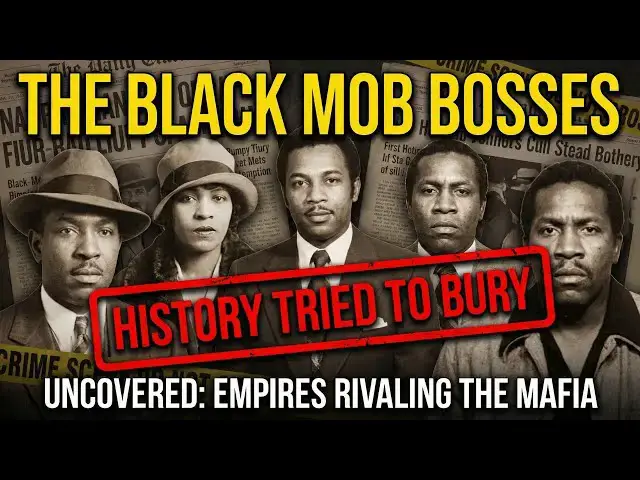
The history of American organized crime has been whitewashed—and these are the kings they tried to erase.
This documentary exposes five Black crime bosses who built empires rivaling the Italian Mafia, generating hundreds of millions in revenue and commanding respect from the Five Families themselves. We're investigating the organizational brilliance, the strategic alliances, and the cultural impact of men who have been systematically excluded from the story of American organized crime.
You'll discover how Bumpy Johnson won a war against Dutch Schultz and negotiated as an equal with Lucky Luciano. Why Nicky Barnes's corporate structure made The Council nearly impossible to destroy. The shocking truth about Frank Lucas's military-grade smuggling operation. The mystery of Frank Matthews—the billion-dollar kingpin who vanished in 1973 and was never found. And the forgotten pioneer Casper Holstein, who invented the numbers game and funded the Harlem Renaissance with gambling profits.
This investigation draws from FBI surveillance archives, DEA case files, court testimonies, and the recorded words of the men themselves. Every empire examined. Every erasure corrected.
For the complete cinematic exploration of organized crime's hidden histories, explore our 100-episode master series on the main channel, Global Mafia Universe. Link in description.
Which of these Black crime bosses deserves a major Hollywood film? Drop your pick below.
0:00 The Hidden Kings of Organized Crime
1:25 Why This History Was Buried
3:15 Bumpy Johnson: The Original Harlem Godfather
6:10 Nicky Barnes: Mr. Untouchable
9:05 Frank Lucas: The Country Boys Empire
12:15 Frank Matthews: The Billion-Dollar Vanishing Act
15:30 Casper Holstein: The Forgotten Inventor
19:00 Reclaiming the History
Show More Show Less View Video Transcript
0:00
Harlem, 1952.
0:02
A black Cadillac rolled through 125th
0:05
Street like a presidential motorcade.
0:07
Shop owners stepped onto sidewalks to
0:10
wave. Numbers runners stopped counting
0:12
to bow their heads. And the man in the
0:14
back seat, dressed in a tailored gray
0:16
suit worth more than most apartments in
0:18
the neighborhood, controlled an empire
0:20
generating over $50 million annually.
0:23
His name was Ellsworth Raymond Johnson.
0:26
The streets called him Bumpy. And for
0:29
three decades, he ruled Harlem with an
0:31
authority that made Italian mob bosses
0:33
seek his permission before doing
0:35
business above 110th Street. Here's what
0:38
every mafia documentary leaves out. The
0:40
most powerful criminal organizations in
0:42
American history weren't exclusively
0:45
Italian. Parallel empires rose in black
0:47
communities across the country, built by
0:50
strategic geniuses who developed their
0:52
own hierarchies, their own enforcement
0:53
mechanisms, and their own codes of
0:56
conduct. These weren't street gangs.
0:58
These were sophisticated criminal
1:00
enterprises that generated hundreds of
1:02
millions in revenue and commanded
1:04
respect from the very Italian families
1:06
that supposedly dominated organized
1:08
crime. Why has this history been buried?
1:11
Because it contradicts the convenient
1:13
narrative. The story of American
1:15
organized crime has been told as an
1:17
Italian story with occasional footnotes
1:19
for other ethnic groups. But the truth
1:22
reveals something far more complex.
1:25
Black crime bosses didn't just survive
1:27
alongside Italian organizations. They
1:29
carved out territories so valuable that
1:31
the Italians chose partnership over
1:33
warfare. They pioneered distribution
1:36
networks that Italian families later
1:38
copied. They built political connections
1:40
that rivaled anything in the five
1:41
families playbook. Consider the
1:43
mathematics of power in mid-century
1:46
Harlem. By 1960, the numbers racket
1:48
alone generated over $100 million
1:51
annually in the black community. Heroin
1:53
distribution through black controlled
1:55
territories moved product worth hundreds
1:57
of millions more. These operations
1:59
required organizational infrastructure,
2:02
management, accounting, enforcement,
2:05
legal protection. The men who built
2:07
these systems were every bit as
2:08
sophisticated as their Italian
2:10
counterparts. Some were more successful.
2:12
The figures were about to examine didn't
2:14
just participate in organized crime.
2:16
They redefined what organized crime
2:19
could achieve. They challenged the
2:21
racial hierarchies of the underworld.
2:24
They built empires that survived federal
2:26
prosecution, territorial wars, and the
2:29
constant pressure of operating in a
2:31
system designed to deny them power.
2:33
Their stories deserve to be told with
2:35
the same respect given to any Godfather
2:38
narrative. What happened to them? How
2:40
did they build such wealth? What secret
2:43
alliances made their operations
2:45
possible? These questions have answers
2:47
that challenge everything you think you
2:49
know about American organized crime.
2:52
Today, we're opening the vault. These
2:54
are the secrets they thought were buried
2:56
forever. What you're about to hear draws
2:59
from FBI surveillance files that tracked
3:01
these organizations for decades. It
3:03
comes from court testimonies that
3:05
detailed operations worth hundreds of
3:07
millions. It comes from deinvestigations
3:10
that revealed international connections
3:12
spanning continents. And it comes from
3:14
the words of the men themselves recorded
3:17
in interviews, memoirs, and confessions
3:20
that paint a picture far different from
3:21
the stereotypes. Five criminal empires,
3:25
five leaders who wrote their names in
3:26
the history of American organized crime.
3:29
Five stories of power, strategy, and
3:32
survival in an underworld that didn't
3:34
want to share space with them. Each one
3:36
reveals a different aspect of how black
3:38
crime bosses built their kingdoms. Each
3:41
one challenges the assumptions that have
3:43
shaped how we understand criminal power
3:45
in America. These weren't subordinates
3:47
waiting for permission from Italian
3:49
bosses. These were autonomous operators
3:52
who commanded respect through a
3:53
combination of intelligence, violence,
3:56
and business acumen. Some worked with
3:59
the Italian families as equals. Others
4:01
built empires so large they didn't need
4:03
Italian approval at all. All of them
4:05
left legacies that shaped the criminal
4:07
landscape for generations. The history
4:09
of American organized crime has been
4:11
whitewashed. Today, we're restoring what
4:14
was erased. First up, the original King
4:17
of Harlem, June 1948.
4:20
A basement social club on 134th Street.
4:23
The air hung thick with cigar smoke and
4:26
tension. Dutch Schultz's former
4:28
territory had been in chaos for over a
4:30
decade, and someone needed to bring
4:32
order. The man who stood to address the
4:34
room had spent the previous decade
4:36
proving he was that someone Ellsworth
4:39
Bumpy Johnson had arrived to claim his
4:42
crown. Bumpy Johnson didn't inherit his
4:44
empire. He built it through a
4:46
combination of strategic violence and
4:48
brilliant alliance making that no one in
4:51
Harlem's criminal history had previously
4:53
achieved. Born in Charleston, South
4:56
Carolina in 1905, he arrived in New York
4:59
as a teenager and immediately understood
5:01
something crucial. The numbers racket,
5:04
not prostitution or robbery, represented
5:07
the path to real power. The numbers game
5:10
was the lottery before lotteryies were
5:12
legal. Players bet pennies and dollars
5:14
on threedigit combinations with payouts
5:17
reaching 600 to1. The mathematical edge
5:20
belonged entirely to the operators who
5:22
kept roughly 40% of all money wagered.
5:25
By the 1930s, Harlem's numbers
5:28
operations were generating $20 million
5:30
annually. Bumpy wanted control. His rise
5:34
required confronting Stephanie Sinclair,
5:36
the numbers queen who had dominated
5:38
Harlem's gambling since the 1920s.
5:41
Rather than destroy her, Bumpy made a
5:43
calculated decision that would define
5:46
his leadership style. He allied with
5:48
her, combining their operations while
5:50
positioning himself as the enforcement
5:52
arm. When Dutch Schultz tried to muscle
5:54
into Harlem's numbers racket in 1931,
5:57
Bumpy led the resistance. Here's what
6:00
the history books minimize. Bumpy
6:02
Johnson didn't just fight Dutch Schultz,
6:04
he won. The war lasted four years and
6:08
cost dozens of lives on both sides.
6:10
Schultz had the resources of a major
6:12
bootlegging operation and connections
6:14
throughout the city. Bumpy had local
6:16
knowledge, community support, and a
6:19
willingness to match violence with
6:20
violence. By 1935, Schultz was dead,
6:24
killed by his own Italian associates,
6:26
who tired of the expensive Harlem
6:28
conflict. Bumpy had outlasted a man with
6:30
10 times his resources. The partnership
6:33
that followed shaped Harlem for 30
6:35
years. Lucky Lutano and the Govi's
6:37
family recognized something in Bumpy
6:39
that they rarely acknowledged in black
6:41
criminals. He was an equal. The
6:44
arrangement gave bumpy autonomy over
6:46
Harlem's gambling operations in exchange
6:49
for a percentage flowing downtown. More
6:51
importantly, it established a model of
6:53
territorial cooperation that protected
6:55
both organizations from law enforcement
6:57
pressure. Bumpy's peak came in the late
7:00
1950s when his organization employed
7:02
over a thousand people and generated
7:04
annual revenues exceeding $50 million.
7:07
He controlled not just numbers but also
7:10
lone sharking, labor racketeering, and
7:12
protection operations throughout upper
7:14
Manhattan. Politicians sought his
7:16
endorsement. Police captains accepted
7:19
his envelopes. Judges received his
7:21
Christmas gifts. The parallel power
7:23
structure rivaled anything in the
7:25
Italian families. His downfall came not
7:28
from rivals, but from federal narcotic
7:30
charges in 1,952.
7:33
Bumpy served significant prison time,
7:35
but maintained his organization from
7:37
behind bars, a testament to the loyalty
7:39
he had cultivated. He died in 1968 of a
7:42
heart attack while eating at Wells
7:44
Restaurant, his favorite Harlem
7:46
establishment.
7:47
Thousands attended his funeral. The king
7:50
had fallen, but his kingdom would never
7:52
forget him. But that's nothing compared
7:54
to what comes next. Coming in at number
7:57
four, the man who made himself
7:59
untouchable.
8:00
September 1977,
8:02
a crowded courtroom in Manhattan. The
8:05
defendant sat in an Italian suit worth
8:07
$3,000. Diamond rings glinting as he
8:10
gestured dismissively at the
8:12
prosecution's evidence. Leroy Nicholas
8:14
Barnes had been indicted on drug
8:16
trafficking charges that could send him
8:18
to prison for life. He looked like a man
8:20
who expected to walk free. He was right
8:22
to be confident. He had beaten every
8:25
charge thrown at him for over a decade.
8:27
Nikki Bonds understood something that
8:29
transformed him from street dealer to
8:31
criminal mastermind. He understood
8:34
organization. While other drug
8:36
operations functioned as loose
8:37
hierarchies dependent on a single
8:39
leader, Barnes created a corporate
8:41
structure he called the council. Seven
8:44
equal partners, shared power, profits,
8:47
and risk. If one fell, six remained to
8:50
continue operations. The structure made
8:53
the organization nearly impossible to
8:55
decapitate. His education came from an
8:58
unlikely source. During a 1965 prison
9:01
sentence at Green Haven Correctional
9:02
Facility, Barnes befriended Joseph Crazy
9:05
Joe Gallo, an Italian mobster with
9:07
revolutionary ideas about racial
9:09
integration in organized crime. Gallow
9:12
taught Barnes the Italian model of
9:13
organization while encouraging him to
9:16
build independent black power in the
9:18
drug trade. The mentorship produced a
9:20
student who would surpass his teacher.
9:22
Barnes emerged from prison in 1970. With
9:25
a blueprint, he recruited six partners,
9:27
each controlling separate geographic
9:29
territories in the New York metropolitan
9:31
area. The territories didn't compete.
9:34
They cooperated, sharing suppliers,
9:37
laundering money through common fronts,
9:39
and providing mutual defense against law
9:41
enforcement. Weekly meetings at a Harlem
9:43
restaurant called the Hubba Hubba Club
9:45
coordinated strategy across the entire
9:47
network. The numbers reveal the scale of
9:50
his success. By 1976, the council
9:53
controlled an estimated 70% of heroin
9:55
distribution in New York City. Annual
9:57
revenues exceeded $80 million. Barnes
10:00
himself maintained a personal fortune
10:02
estimated at 20 million, funding a
10:04
lifestyle that included custom cars,
10:07
designer wardrobes, and multiple
10:09
residencies. He became the visible face
10:11
of black criminal success, a status he
10:14
cultivated deliberately. Here's the
10:16
hidden truth about Barnes's empire. His
10:20
real power came from connections that
10:22
crossed racial boundaries entirely.
10:25
Barnes sourced heroin through Italian
10:27
suppliers, initially through gallows,
10:29
Columbbo family contacts, and later
10:31
through the Lucazi family's powerful
10:33
drug networks. He laundered money
10:35
through banks that Italian families had
10:37
corrupted decades earlier. His lawyers
10:40
had defended Italian bosses before
10:42
defending him. The mythology of separate
10:44
criminal worlds collapsed under the
10:46
reality of shared commerce. His downfall
10:48
came from within after a 1978 conviction
10:52
finally sent him to prison for life.
10:54
Barnes made a calculation that shocked
10:56
the underworld. He became a federal
10:58
witness. Testifying against his former
11:00
council partners and providing
11:02
information that led to over 50
11:04
convictions. The man who had styled
11:06
himself untouchable chose cooperation
11:08
over loyalty when facing eternity behind
11:11
bars.
11:12
Some called it betrayal. Barnes called
11:15
it survival. The deeper you go, the
11:18
darker it gets. Number three takes us to
11:21
the most successful heroin operation in
11:23
American history. Newark, New Jersey.
11:27
1,967.
11:30
A former Army sergeant stood in a
11:31
warehouse examining bricks of pure
11:34
Southeast Asian heroin valued at over $4
11:37
million wholesale. Frank Lucas had just
11:40
accomplished something no American drug
11:42
trafficker had achieved before. He had
11:44
cut out every middleman between the
11:45
poppy fields of the Golden Triangle and
11:47
the streets of New York. The country
11:50
boys had arrived. Frank Lucas grew up in
11:53
rural North Carolina where he witnessed
11:56
the murder of his cousin by Ku Klux Clan
11:58
members when he was 6 years old. The
12:00
experience he later claimed burned away
12:02
any moral hesitation about violence. By
12:05
15, he had moved north to Harlem, where
12:08
he eventually attracted the attention of
12:09
Bumpy Johnson himself. Lucas became
12:11
Bumpy's driver, his collector, and his
12:14
most promising student. When Bumpy died
12:17
in 1968, Lucas inherited neither
12:20
territory nor organization.
12:23
What he inherited was knowledge. He
12:26
understood how Bumpy's operation
12:28
functioned. He understood the supplier
12:30
relationships, the distribution
12:31
networks, the protection arrangements,
12:34
and he understood that the entire system
12:36
had a weakness. The Italian families
12:38
controlled heroin supply, which meant
12:40
they controlled prices. Lucas decided to
12:43
change that. His solution was audacious.
12:46
rather than buy heroin from Italian
12:48
distributors.
12:50
At marked up prices, Lucas traveled to
12:52
Bangkok, Thailand, and established
12:55
direct relationships with producers in
12:57
the Golden Triangle region where Laos,
13:00
Thailand, and Burma converge. He
13:03
negotiated wholesale prices that were a
13:05
fraction of what New York distributors
13:07
charged. Then he developed a
13:09
transportation method that became
13:10
criminal legend. Here's what law
13:12
enforcement eventually confirmed about
13:14
Lucas's smuggling operation. He shipped
13:17
heroin into the United States inside the
13:19
coffins of American soldiers killed in
13:21
Vietnam. The cargo moved through
13:23
military channels that received minimal
13:25
customs inspection. The volume ranged
13:28
from 50 to 100 kg per shipment,
13:31
quantities that dwarfed conventional
13:33
smuggling methods. At street value, each
13:36
shipment represented over $20 million in
13:39
potential revenue. The Country Boys
13:41
organization Lucas Built employed family
13:43
members from his North Carolina
13:44
hometown, creating a distribution
13:46
network that law enforcement found
13:48
almost impossible to penetrate. These
13:51
weren't professional criminals with
13:52
records and known associates. They were
13:55
cousins, nephews, and childhood friends
13:58
whose loyalty Lucas trusted absolutely.
14:00
The organization moved product worth an
14:03
estimated $1 million daily at its peak.
14:05
Lucas claimed at various points that his
14:08
operation generated over $100 million
14:10
annually. D. Investigators estimated the
14:13
figure was closer to 50 million, still
14:15
an astronomical sum for a single
14:17
criminal enterprise. He owned apartment
14:20
buildings throughout New Jersey. He
14:22
bought a cattle ranch. He drove a luxury
14:24
car collection worth hundreds of
14:26
thousands. The boy who witnessed clan
14:28
violence in North Carolina had become
14:30
one of the wealthiest criminals in
14:32
American history. His fall came through
14:34
cooperation, not conviction. After his
14:38
1975 arrest, Lucas provided testimony
14:41
that led to over 100 convictions of
14:43
corrupt police officers and fellow
14:46
traffickers. His cooperation reduced a
14:48
70-year sentence to time served, and he
14:51
was released in 1981. He returned to
14:54
prison on subsequent drug charges,
14:56
served additional time, and died in 2019
14:59
at 88 years old.
15:01
The Country Boys had become history. And
15:04
this is where things get truly
15:06
dangerous. Landing at number two, the
15:08
invisible billionaire who vanished.
15:10
Biladia
15:12
1,973.
15:15
A man who looked like a successful
15:17
businessman sat in a modest rowhouse
15:20
counting currency that filled multiple
15:22
suitcases. Frank Matthews had just
15:24
concluded a transaction that moved 100
15:26
kg of cocaine from Colombian suppliers
15:29
to American distributors. The profits
15:32
from that single deal exceeded $5
15:35
million, and this was a slow week. Frank
15:39
Matthews built an organization so
15:41
sophisticated that Dagents initially
15:43
refused to believe a black man could
15:45
have constructed it. He controlled
15:47
distribution networks spanning 21
15:49
states. He maintained supplier
15:51
relationships in South America that
15:53
predated the Colombian cartel's
15:55
dominance. He generated annual revenues
15:57
that federal investigators estimated
15:59
between 50 and $300 million depending on
16:03
which agency was counting. Born in
16:05
Dudham, North Carolina in 1944. Matthews
16:09
moved to Philadelphia as a young man and
16:11
quickly demonstrated a gift for the drug
16:13
trade that bordered on genius. By his
16:16
mid-ents, he had established himself as
16:18
a major regional distributor. By 30, he
16:21
had gone international, traveling to
16:23
South America to negotiate directly with
16:25
cocaine and heroin producers. The
16:27
Italians didn't introduce him to these
16:29
suppliers. He found them himself. His
16:32
organizational model anticipated the
16:34
drug cartels that would later dominate
16:36
the trade. Matthews created a vertically
16:39
integrated operation that controlled
16:40
every stage from international
16:42
procurement to street level sales. He
16:45
owned the trucks that moved product. He
16:47
owned the properties where it was
16:48
stored. He owned the businesses that
16:50
laundered the proceeds. The operation
16:52
ran with the efficiency of a Fortune 500
16:55
company. Here's what made Matthews
16:57
unique in the history of American
16:59
organized crime. He attempted to unite
17:01
black drug distributors nationwide into
17:04
a formal organization modeled on the
17:05
Italian Commission. In 1971, he convened
17:08
a meeting in Atlanta that brought
17:10
together major black traffickers from
17:12
across the country. The agenda was
17:14
simple. Coordination, territory
17:17
agreements, and mutual defense against
17:19
law enforcement. The meeting represented
17:21
the most ambitious attempt at black
17:23
criminal unification ever attempted. The
17:26
Italians noticed. According to
17:28
Dintelligence, representatives from
17:30
multiple Italian families monitored
17:32
Matthews's activities with growing
17:34
concern. His supply connections bypassed
17:37
their networks entirely. His
17:38
distribution reach threatened their
17:40
markets. his organizational efforts
17:42
could create a rival power structure.
17:45
Some investigators believe Italian
17:46
bosses eventually decided that Matthews
17:49
represented an existential threat. On
17:51
July 2nd, 1973, Frank Matthews vanished.
17:55
He was awaiting trial on federal drug
17:57
charges. Free on bail of $325,000.
18:01
He told Associates he was going to Las
18:03
Vegas. He never arrived. Over 50 years
18:06
later, he has never been found. No body,
18:11
no confirmed sighting, no death
18:14
certificate, just theories. Some believe
18:17
the Italian families eliminated him,
18:20
removing a competitor who had grown too
18:22
powerful. Others believe Matthews
18:23
orchestrated his own disappearance,
18:26
escaping with an estimated $20 million
18:28
in hidden assets. Federal agents have
18:31
chased leads across four continents
18:33
without resolution. Frank Matthews
18:35
remains on the DEA's most wanted list.
18:38
One of the most successful fugitives in
18:39
American history. What comes next? Even
18:43
the FBI couldn't believe it. Position
18:45
one belongs to the man who invented the
18:47
numbers game itself. Harlem, 1928.
18:51
A well-dressed black man stepped out of
18:53
a chauffeur-driven limousine outside a
18:55
building he owned on 135th Street. He
18:58
had just returned from the horse races
19:00
at Belmont where his entries competed
19:02
against thoroughbreds owned by the
19:04
wealthiest white families in America.
19:06
Casper Holstein controlled an empire
19:08
worth over $12 million annually. He was
19:11
the first black millionaire in New York
19:13
City history and most Americans have
19:15
never heard his name. Casper Holstein
19:17
arrived in New York from the Danish
19:19
Virgin Islands in 1894. A Caribbean
19:22
immigrant with limited prospects in a
19:24
nation that treated black men as
19:25
secondclass citizens at best. He worked
19:28
as a porter, saved money obsessively,
19:31
and studied the gambling operations that
19:33
flourished in Manhattan's workingclass
19:35
neighborhoods. What he observed became
19:37
the foundation of an empire. The numbers
19:40
game as we know it was Holstein's
19:42
invention. Previous lottery style
19:43
gambling relied on complex arrangements
19:46
and limited the player pool. Holstein
19:49
simplified everything. Players bet on a
19:52
three-digit number. The winning number
19:54
came from a publicly verifiable source.
19:56
Initially, the last three digits of the
19:59
daily Treasury balance. Bets could be as
20:01
small as a penny. Payouts were
20:03
immediate. The system was elegant,
20:06
transparent, and perfectly designed for
20:08
communities with limited access to
20:10
legitimate financial systems. By 1920,
20:13
Holings's Harlem operation processed
20:15
over 30,000 bets daily. At an average
20:18
bet of 50 cents and a 40% house edge,
20:21
this generated over $6,000 in daily
20:24
profit. Annual revenues exceeded $2
20:27
million. Holstein expanded throughout
20:29
black communities in Brooklyn, Queens,
20:32
and New Jersey. He recruited an army of
20:34
numbers runners who collected bets and
20:36
delivered payouts with the reliability
20:38
of male carriers. Here's the hidden
20:40
truth about Holstein's empire. He used
20:42
his wealth to transform Harlem into a
20:45
cultural capital. Holstein financed the
20:47
Harlem Renaissance. He funded literary
20:49
prizes that launched the careers of
20:51
major black writers, including Langston
20:53
Hughes and Zora Neilher. He built
20:56
affordable housing for workingclass
20:58
families. He donated two churches,
21:00
schools, and community organizations
21:03
throughout the neighborhood. The numbers
21:05
money became the financial engine of
21:06
black cultural achievement. His
21:08
political influence rivaled any Tam Hall
21:11
operator. Holstein cultivated
21:13
relationships with politicians at every
21:15
level of New York government. Police
21:17
captains receive monthly payments that
21:20
ensured his runners operated without
21:21
harassment. Judges who handled gambling
21:24
cases received generous campaign
21:26
contributions. When reformers
21:27
occasionally prosecuted his operations,
21:30
Holstein's lawyers achieved acquitts or
21:32
minimal sentences. The kidnapping of
21:35
1928 revealed how valuable Holstein had
21:38
become. On September 21st, a white gang
21:40
snatched Holstein off a Harlem street
21:42
and held him for $50,000 ransom. The
21:45
incident made national headlines and
21:47
outraged the black community. Holstein
21:50
was released after 3 days. Reportedly,
21:53
after paying the ransom, police arrested
21:55
several suspects, but the masterminds
21:57
were never convicted. Some historians
22:00
believe Italian mobsters orchestrated
22:02
the kidnapping to test whether they
22:05
could move into Harlem's lucrative
22:07
numbers territory. Holstein's decline
22:09
came through the same Italians. By the
22:12
early 1930s, Dutch Schultz had decided
22:14
that Harlem's numbers operations were
22:16
too profitable to leave in black hands.
22:19
Schultz used violence and political
22:21
pressure to force Holstein and other
22:23
black operators to seed control or
22:25
accept drastically reduced shares.
22:27
Holstein fought back but ultimately
22:29
lacked the firepower to resist a
22:31
criminal army funded by bootlegging
22:33
millions. He died in 1944,
22:36
impoverished and largely forgotten. The
22:39
empire he built generated billions over
22:41
subsequent decades, but the profits
22:43
flowed to Italian families who had
22:45
seized what Holstein created. The man
22:47
who invented the numbers game, who
22:50
funded black literature and culture, who
22:52
proved that black enterprise could
22:53
compete with any criminal organization
22:55
in America, was erased from the story of
22:58
organized crime until. Now, what these
23:01
five empires reveal together is a hidden
23:04
history of American organized crime that
23:06
challenges every assumption we've been
23:08
taught. Black crime bosses didn't
23:10
operate on the margins of the
23:11
underworld. They built kingdoms that
23:13
generated hundreds of millions in
23:15
revenue, employed thousands of workers,
23:18
and commanded respect from the very
23:19
Italian organizations that supposedly
23:22
dominated criminal America. The patterns
23:24
across these stories reveal something
23:26
profound about power and race in
23:28
America. Each of these men succeeded
23:30
precisely because they understood
23:32
systems. They understood the economics
23:34
of illegal gambling. They understood the
23:36
logistics of drug distribution. They
23:39
understood the politics of protection.
23:41
They applied intelligence and discipline
23:43
to criminal enterprise in ways that
23:45
produced results rivaling or exceeding
23:48
their Italian counterparts. Their
23:50
methods often prove more innovative than
23:51
what Italian families developed.
23:53
Holstein invented the modern numbers
23:55
game.
23:57
Lucas revolutionized drug smuggling
24:00
logistics. Barnes created organizational
24:02
structures that anticipated corporate
24:04
models. Matthews built supplier
24:06
relationships that bypassed established
24:08
channels entirely. These weren't men who
24:11
coped Italian methods. These were men
24:13
who created new methods that Italians
24:15
later adopted. The history of American
24:17
organized crime has been told as a story
24:20
of Italian families with occasional
24:22
footnotes for other groups. That
24:24
narrative is incomplete. It erases men
24:27
who built empires worth billions. It
24:30
ignores organizational innovations that
24:32
shaped the criminal landscape. It denies
24:35
the reality of multi-racial criminal
24:37
cooperation that defined how these
24:39
enterprises actually functioned. Some
24:41
mysteries remain unsolved.
24:44
Where is Frank Matthews? What happened
24:46
to the fortunes these men accumulated?
24:48
How much did their Italian partners
24:50
actually know about their operations?
24:52
The answers lie in files that remain
24:54
classified, in memories that died with
24:57
witnesses? In secrets that the men
24:59
themselves took to their graves. But
25:01
what we do know is this. The kings of
25:04
Harlem and beyond built criminal empires
25:07
that deserve recognition alongside any
25:09
Italian crime family. Their stories
25:11
challenged the convenient mythology that
25:13
organized crime was an Italian
25:15
specialty. Their legacies shaped the
25:17
criminal organizations that followed
25:19
them and their erasia from history
25:21
represents one more injustice in a
25:23
nation that is never fully reckoned with
25:25
the achievements of black Americans.
25:27
Even when those achievements operated
25:29
outside the law, the vault has been
25:31
opened. The Black Kings have been named.
25:34
History has been corrected. If you want
25:37
the full cinematic story of the groups
25:40
behind these secrets, check out our 100
25:42
episode master series on our main
25:44
channel, Global Mafia Universe. The link
25:47
is in the description. Go deep.
#Movies
#Social Issues & Advocacy