live_tv
Livestream Starting Soon
00
Hours
:
00
Minutes
:
00
Seconds
Up next in 10


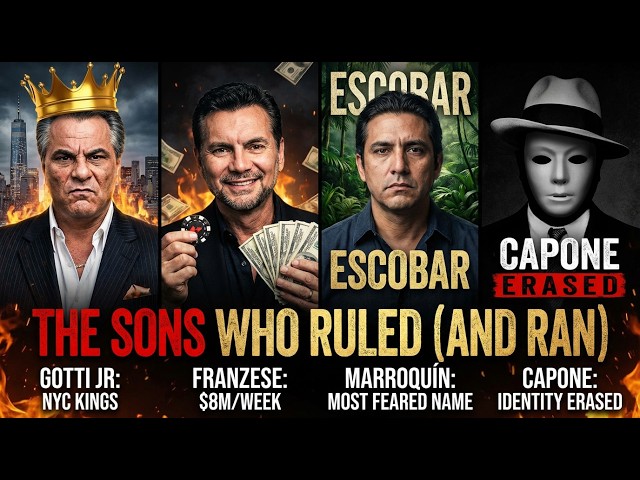
A father dies. A son inherits an empire built on fear.
Four men. Four choices. Four different endings.
John Gotti Junior could have ruled New York. Michael Franzese made eight million a week. Sebastian Marroquín carried the most feared name in history. Alphonse Capone erased his own identity.
This is what happens when sons inherit thrones they never asked for.
Legal Disclaimer: This documentary presents historical events based on court records, published memoirs, and journalistic accounts. Dialogue has been reconstructed for narrative purposes. Individuals mentioned who have denied allegations are identified as such.
📚 Sources & Further Reading:
→ Shadow of My Father (John Gotti Jr. Memoir)
https://www.amazon.com/Shadow-My-Father-John-Gotti/dp/1250048796
→ Blood Covenant: Michael Franzese Memoir
https://www.amazon.com/Blood-Covenant-Michael-Franzese-Story/dp/0883687917
→ Pablo Escobar: My Father (Juan Pablo Escobar)
https://www.amazon.com/Pablo-Escobar-My-Father/dp/1250104629
Show More Show Less View Video Transcript
0:00
Some men inherit money, others inherit empires, and some inherit prisons they'll never
0:06
escape. New York, 1992. John Goti Jr., walks into a room he's
0:13
been inside a thousand times. But today, something's different. The men don't
0:18
look at him the same way. His father, John Goti, Senior, the most famous mob
0:24
boss in America, sits in a federal prison cell. And the question hanging in
0:29
the air isn't if Junior will take over. It's whether he can survive what comes
0:34
next. Four men, four sons of the most powerful criminals in history. Each one
0:41
born into a world where loyalty is currency and blood is the only contract
0:46
that matters. Each one faced with the same impossible choice. Inherit the
0:52
empire or destroy everything their fathers built to become free. This is
0:58
the story of what happens when sons inherit thrones made of violence. The
1:03
events you're about to hear are based on court records, published memoirs, and
1:09
documented accounts. Some dialogue has been reconstructed for narrative
1:15
clarity. Individuals who have denied criminal allegations are identified as
1:20
such throughout. John Goty Jr. didn't choose his name. He didn't choose his
1:26
face. and he definitely didn't choose the life that came with both. Born on
1:31
Valentine's Day 1964 in the Bronx, Junior grew up watching his father climb
1:37
from hijacker to boss of the Gambino crime family. The feds called John
1:43
Senior the Teflon Dawn because charges never stuck. The media called him the
1:50
last of the old school godfathers. But to Junior, he was just dad. Except dad's
1:56
business was murder. Junior tried to stay out. He really did. Went to
2:01
military academy, talked about college, but in 1988 at 24 years old, he made the
2:08
decision that would define the rest of his life. He got made a formal induction
2:14
ceremony into the Gambino family. His father allegedly performed the ritual
2:20
himself. Blood in, blood out. That's the rule. By 1992, John Senior was sentenced
2:27
to life without parole. Convicted of murder, rakateeering, obstruction of
2:33
justice. The dappa dawn was done. And according to federal prosecutors, the
2:39
family needed a new boss. They chose Junior not because he wanted it, because
2:44
the structure demanded it. The feds say he became acting boss at 28. Junior has
2:51
consistently denied this, claiming he was a low-level associate trying to go straight. But the indictments tell a
2:58
different story. They say he oversaw lone sharking, illegal gambling,
3:04
extortion. They say he carried the weight of a $300 million a year
3:09
operation. Imagine being 28 and responsible for an empire your father
3:15
built with his fists. Here's what the pressure looks like. In 1998, Junior
3:21
gets arrested. Racketeering charges. The feds want him to flip, testify against
3:27
the family, enter witness protection, change his name, disappear. He refuses.
3:34
Four trials, four hung juries. The government couldn't convict him, but
3:39
they didn't need to because by then Junior had already made a different choice. In 1999, he claims he formally
3:48
left the mob, quit, walked away, told the family he was done. The mob doesn't
3:53
accept resignation letters, but Junior insists he found a way. He wrote a book,
3:58
gave interviews, started saying things like, "I'm not my father." He appeared
4:04
on talk shows, documentaries, reality TV, always maintaining the same line. "I
4:11
left. I'm out. I'm a legitimate businessman now. Federal prosecutors
4:16
didn't believe him. They kept charging him. Kept dragging him back to court.
4:21
And every time juries refused to convict. Maybe they believed him. Maybe
4:27
they just didn't trust the government's witnesses. Former mobsters who'd flipped to save themselves. And years later, one
4:34
name would appear in the margins of this story. A man who did what Junior claimed to do, but left no doubt about it.
4:42
Michael Franes. By 2009, after four mistrials, the feds gave up. They
4:49
dropped the charges. Junior walked out of his last courtroom a free man, legally at least. But here's the
4:56
question nobody can answer. When you're the son of John Goty, when your name is
5:02
synonymous with organized crime, when the feds spent a decade trying to bury
5:07
you, can you ever really be free? Junior says yes. He lives quietly now,
5:13
according to reports, stays out of the headlines, writes, reflects. He's given
5:19
interviews where he talks about the cost of the life, the friends dead, the years
5:24
lost, the childhood his own kids never got because their grandfather's name was
5:30
a target. He's called his father's choices selfish. He said the mob
5:35
destroyed his family, and he's maintained over and over that he got out and stayed out. Critics say it's
5:42
impossible that once you're in, you're in for life. that Junior's public
5:47
persona is just another con, another performance from a family that made an
5:53
art form out of deception. Who's right? That depends on what you choose to
5:58
believe. But here's what we know for sure. John Goty Jr. inherited a name
6:04
that opened every door in New York and closed every door to a normal life. He
6:10
inherited loyalty from men who'd kill for him and suspicion from a government
6:16
that would never stop watching. He inherited his father's face and his father's enemies and his father's debt.
6:23
And whether he's free or just pretending, he's still paying it. Now,
6:29
let's talk about a man who made more money than any of them and walked away to prove it could be done. Michael
6:36
Franes was different from the start. Born in 1951 in Brooklyn, the son of
6:41
John Sunny Fran's underboss of the Columbbo crime family, Sunny was a
6:47
killer, a real one, the kind of man whose name made grown men nervous. He
6:53
was allegedly responsible for dozens of murders. Feared, respected, untouchable
6:58
for decades. Michael didn't want that life. He wanted to be a doctor. Went to college, premed, had a plan, a future,
7:06
clean. Then his father got arrested. 1967, sentenced to 50 years. The family needed
7:14
money for lawyers, for Sunny's wife, for the life they'd built. And 18-year-old
7:20
Michael made a decision. He'd earn it, not with a scalpel, with the only currency his world understood. He
7:28
dropped out of college and went to work. By the mid 1980s, Michael Franes was one
7:34
of the richest mobsters in America. Not through drugs, not through murder for
7:39
hire, through something almost beautiful in its simplicity. A gas tax scam.
7:45
Here's how it worked. Gas stations pay federal and state taxes on every gallon
7:50
sold. Michael created Shell companies that bought gas, sold it to stations,
7:56
and then disappeared before paying the taxes. The stations got cheap gas.
8:02
Michael's companies pocketed the tax money and the government was always one
8:07
step behind. At its peak, according to federal estimates, Michael was
8:13
generating 8 to 10 million a week. That's over $400 million a year. Fortune
8:19
magazine listed him as number 18 on their list of the 50 most wealthy and powerful mob bosses in history. He was
8:27
34 years old. But Michael wasn't like the others. He didn't want power. He
8:33
wanted money. And once he had enough, he started thinking about something nobody in his position ever considered.
8:40
Quitting. The problem is the mob kills quitters. Michael's father, Sunny, once
8:47
allegedly told him, "You only leave one of two ways. In a box or in the witness
8:53
protection program as a rat." Neither was acceptable. Michael wanted a third
8:59
option. walk away alive. No betrayal, just done. People said it was
9:04
impossible. The Columbbo family wouldn't allow it. The other families wouldn't
9:09
trust it. And the feds sure as hell wouldn't believe it. But in 1987,
9:15
Michael did something nobody expected. He sat down with his father in prison.
9:21
And according to Michael's account, he told Sunny the truth. I'm out. I'm leaving. I'm done. Sunonny didn't bless
9:28
it, but he didn't order his son killed either. And in that world, silence is
9:34
permission. Michael walked away. He didn't testify, didn't flip, didn't enter witness protection. He just
9:41
stopped, paid his debts, settled his accounts, and disappeared from the life. The feds didn't buy it. They indicted
9:48
him anyway. Racketeering, tax evasion. He went to prison, served time, and when
9:54
he got out, he did something even more shocking. He became a bornagain Christian, started giving motivational
10:02
speeches, wrote books, launched a YouTube channel that now has millions of
10:07
followers. Today, Michael Franes is one of the most famous former mobsters
10:13
alive. He talks openly about the life, about the money, about the violence,
10:19
about his father, who reportedly died in 2020 at age 103, never having fully
10:26
forgiven his son for leaving. But Michael doesn't apologize. He says he found something more valuable than
10:33
power. Freedom. Real freedom. Not just from the mob, but from the man he used
10:38
to be. Critics still doubt him. They say he's running a long con. that once a
10:44
mobster, always a mobster, that his whole redemption arc is just another scam. Michael's response, "Watch my
10:51
life. Judge for yourself." And whether you believe him or not, one thing is undeniable. Michael France is alive.
10:59
He's free. And he got out without betraying anyone. If he's telling the truth, he did the impossible. But not
11:06
every son had the option to walk away. Some inherited names so heavy the only
11:12
escape was to erase themselves completely. Sebastian Maroquin was born
11:17
Juan Pablo Escobar, the son of the most infamous drug lord in human history. His
11:24
father, Pablo Escobar, didn't just run a cartel. He was the cartel. At his peak
11:31
in the 1980s, the Medelan cartel controlled 80% of the global cocaine
11:38
trade. Pablo was making an estimated $22 billion a year. He was so rich he
11:46
allegedly spent $2500 a month just on rubber bands to hold his cash. But the
11:53
money came with a body count. Conservative estimates say Pablo was responsible for over 4,000 deaths.
12:01
politicians, police, judges, journalists, rival traffickers, and
12:07
thousands of innocent civilians caught in bombings, assassinations, and massacres. Juan Pablo grew up inside
12:15
that empire, private zoos, mansions, helicopters, and always, always, the
12:21
violence. When Pablo died in a rooftop shootout in 1993, Juan Pablo was 16. And
12:29
immediately the cartels that hated his father came for him. Death threats,
12:34
kidnapping plots, rival families wanted revenge. They wanted Pablo's son dead.
12:41
Juan Pablo's mother took him and his sister and fled Colombia. They tried
12:46
Argentina, changed their names. Juan Pablo became Sebastian Maroquin. He
12:52
thought a new name would give him a new life. It didn't. Everywhere he went, the
12:57
name Escobar followed. The press found him. The authorities watched him. And
13:03
the ghosts of his father's victims haunted every step. Sebastian tried to
13:08
build a normal life, studied architecture, got married, had a son,
13:13
but the shadow never lifted. Then he did something radical. He stopped running.
13:19
In 2009, Sebastian published a memoir called Pablo Escobar, My Father. In it,
13:26
he didn't defend his father. He condemned him. He called the violence inexcusable. He acknowledged the
13:33
suffering and he did something almost unheard of for the son of a cartel king.
13:39
He apologized, not in private, in public. He sought out the children of
13:44
his father's victims, met with them, looked them in the eye, and said, "I'm sorry for what my father did." Some
13:52
accepted, some refused, but Sebastian kept trying. He gave interviews, made
13:58
documentaries, and dedicated his life to one message. I am not my father. Today,
14:05
Sebastian lives in Argentina under his chosen name. He's an architect, an
14:11
author, a speaker. He talks to young people about the cost of violence, about
14:16
breaking cycles, about refusing to inherit hate. But even now, decades
14:21
later, he admits the name still haunts him. His father's legend is too big, the
14:27
crimes too vast, the pain too deep. Sebastian Maroquin escaped his father's
14:33
empire, but he'll never fully escape his father's name. And that brings us to the
14:39
son who found the only true escape, Erasia. Alpon Capone Jr., the son of the
14:46
most famous gangster in American history, Al Capone. Scarface, the king
14:52
of Chicago. Al Capone ruled the city in the 1920s and30s. Bootlegging, gambling,
15:00
prostitution, murder. His organization made an estimated $100 million a year during
15:08
prohibition. He ordered the St. Valentine's Day massacre. He corrupted
15:13
judges, politicians, police. He was untouchable until the IRS got him for
15:19
tax evasion in 1931. Al went to prison, got syphilis, went
15:26
insane, died in 1947. His brain rotted. His empire collapsed. His legend
15:32
immortalized. And his son, Alpon Jr., called Sunny, wanted nothing to do with
15:38
any of it. Sunonny Capone hated violence, hated crime, hated the name
15:44
that made him a target. So, he did the only thing that made sense. He disappeared, changed his name to Albert
15:52
Francis Brown, moved to California, became nobody. He worked regular jobs,
15:59
stayed quiet, avoided the press, raised a family, and lived in total obscurity.
16:05
For decades, people didn't even know Al Capone had a surviving son. Sunny gave
16:11
no interviews, wrote no books, made no money off the name. He just lived. And
16:16
in 2004, he died quietly in Florida. Far from Chicago, far from the headlines,
16:24
far from the legend. His daughters later said he wanted one thing in life to not
16:30
be his father's son and in the end he got it. Four sons, four paths. John Goty
16:37
Jr. says he's out but the name never let him go. Michael France walked away and
16:42
built a second life in the spotlight. Sebastian Maroquin confronted his father's sins and tried to make peace
16:50
and Sunonny Capone erased himself to find freedom which one escaped which one
16:56
is still trapped. That depends on what you think freedom means. Because the
17:01
question isn't just whether they left the life it's whether the life ever left them and whether a man can truly be free
17:09
when the world refuses to forget who his father was. The answer might be simpler
17:15
than you think or more complicated than any of them will admit. Stay with me
17:21
because the story of what these men gave up to get out is about to get darker.
17:27
The moment Michael Franes decided to leave, he knew what he was risking. It's
17:32
1986. He's sitting in a restaurant in Long Island. Across from him, three men from
17:39
the Columbbo family. They're not there to eat. They are there to deliver a message. Someone high up doesn't trust
17:46
Michael's recent behavior. He's been distant, distracted, talking about his
17:52
girlfriend too much. A girl who's not Italian. A girl who's making him think
17:57
about things he shouldn't be thinking about. One of them leans forward. According to Michael's later account,
18:03
the man says something like, "Your father gave his whole life to this thing. You're going to disrespect that."
18:11
Michael doesn't answer right away. He's doing math in his head. If he walks away, they might kill him. If he stays,
18:18
he becomes his father, and his father is in prison, 70 years old, with decades
18:24
left on his sentence. He looks at the three men. And according to his telling,
18:29
he says, "I'll think about it." That was the beginning of the end. Michael Fran's
18:35
escape wasn't a single moment. It was a process. a slow, calculated extraction
18:42
from a world designed to never let you go. And the key to understanding how he
18:47
did it is understanding what he sacrificed to make it possible. First, the money. At his peak, Michael was
18:54
worth an estimated $300 million. He had homes, cars, power, respect. When he
19:02
walked into a room, people moved. That's not something you just give up. But Michael had something most mobsters
19:08
don't. A reason to leave that was stronger than the reason to stay. Her
19:14
name was Camille Garcia, a dancer, a Christian, a woman who had no idea who
19:20
Michael really was. When they met, she found out and instead of running, she gave him an ultimatum. Leave the life or
19:28
leave me. Most mobsters would have chosen the life. Michael chose her. But
19:33
leaving wasn't as simple as walking away. He had obligations, debts,
19:38
partners who depended on him, and a family structure that didn't recognize retirement. So, Michael did something
19:46
brilliant. He engineered his exit like he engineered his gas scam.
19:51
Methodically, legally, carefully, he started winding down operations, paying
19:57
off debts, settling accounts. He stopped taking new deals. And critically, he
20:03
didn't betray anyone. He didn't wear a wire. He didn't testify. He didn't give
20:08
the feds a single name. That's how he survived. The Colombo family didn't like
20:13
it. But they didn't kill him either. Why? Because Michael had le. He knew too
20:20
much. And as long as he kept his mouth shut, killing him would have been bad business. It would have risked him
20:26
talking from the grave through associates, through documentation, through the chaos that follows a
20:32
high-profile murder. So, they let him walk barely. In 1985, Michael married
20:39
Camille. In 1986, he had his first child. And in 1987, he sat down with his
20:46
father in prison and told him the truth. According to Michael, Sunonny Franes
20:51
listened, didn't yell, didn't threaten, just looked at his son and said something like, "You're making a
20:58
mistake, but you're a man. Make your own choices." That was as close to a
21:03
blessing as Michael was going to get. But the feds weren't done. They indicted him in 1985.
21:10
Racketeering, conspiracy, tax evasion. They wanted him to flip testify against
21:16
the Columbos, the Gambinos, everyone. Michael refused. He took a plea deal
21:23
instead 10 years. He served time in multiple prisons. And the whole time
21:29
Camille waited, visited, raised their kids, believed in the man he said he
21:34
wanted to become. When Michael got out in 1994, he did something that shocked
21:40
everyone. He became a motivational speaker. started talking to churches, to
21:46
schools, to businesses, about choices, about consequences, about the cost of
21:52
the life. People thought it was an act, a con, another scam from a professional
21:57
liar. But Michael kept doing it year after year. He wrote books, started a
22:03
YouTube channel, and he told the truth about the mob in a way nobody had before. Not as a rat, not as a witness,
22:11
but as someone who lived it and walked away. Today, Michael Franes has over a
22:17
million subscribers on YouTube. He's been interviewed on every major platform. He talks openly about his
22:24
past, about the violence, about the money, and he always ends with the same message. I got out, you can, too.
22:32
Critics still don't believe him. Former mobsters have called him a fraud. said he's still connected, still earning,
22:40
that the whole Christian reformed mobster thing is just another hustle. Michael's response, "Look at my life.
22:47
I've been out for 35 years. I'm still alive. I didn't testify and I'm free."
22:53
If that's a con, it's the longest one in history. But here's the real question.
22:59
Did Michael escape the mob, or did he just find a more profitable way to stay connected to it without breaking the
23:05
law? because his entire brand now is built on being a former mobster. Every
23:11
speech, every video, every book, it all goes back to the life. So, in a way, he
23:17
never really left. He just monetized the exit. Is that freedom or is that just a
23:23
different kind of prison? Take a breath. Because from here on, the story only
23:29
gets darker. Not every son had Michael's options. Some were born into cartels
23:35
where leaving wasn't a negotiation. It was a death sentence. Sebastian
23:40
Maroquinn didn't get to walk away slowly. He got thrown out violently.
23:46
When Pablo Escobar died on that Medelan rooftop in December 1993,
23:51
his empire didn't just collapse, it exploded. Rival cartels moved in. The
23:58
Cari Cartel, the North Valley Cartel, paramilitary groups. Everyone wanted a
24:04
piece of what Pablo built and everyone wanted revenge on his family. Juan Pablo
24:10
was 16. His sister, Manuela, was nine, and their mother, Maria Victoria, was a
24:17
widow with a target on her back. The threats started immediately. Phone
24:22
calls, letters, messages delivered through intermediaries. We are coming for Pablo's son. Tell him
24:29
to run. They tried Germany, denied entry, tried Mozambique, denied. Tried
24:35
Ecuador, denied. Every country that might have given them asylum refused.
24:40
The Escobar name was too toxic, too dangerous. Nobody wanted the baggage.
24:46
Finally, Argentina let them in under one condition. Change your names, disappear,
24:52
and never ever talk about who you were. Juan Pablo became Sebastian Maroquin.
24:58
His mother changed her name. His sister changed hers. They moved into a small
25:04
apartment in Buenos Iris. No guards, no wealth, no protection. Just three people
25:11
trying to pretend they weren't the most hunted family in South America. It didn't work. The press found them within
25:18
months. Photographers camped outside their building. Reporters tracked
25:23
Sebastian to school. The Argentine government opened investigations into
25:28
how much money Pablo had hidden in their country. And the whole time the death
25:34
threats kept coming. Sebastian tried to live normally. He enrolled in
25:39
architecture school, made friends, fell in love, but the shadow of his father
25:44
never left. Every time someone learned his real name, the relationship changed.
25:50
fear, fascination, disgust. Nobody saw Sebastian. They only saw Pablo's son.
25:57
And here's the part that haunts him. Deep down, he loved his father. Pablo
26:03
wasn't just a drug lord to Sebastian. He was dad, the man who played with him,
26:08
who built him a private zoo, who told him bedtime stories, who promised him
26:14
the world. And when Pablo died, Sebastian lost the only person who ever made him feel safe. But he also
26:21
inherited the guilt. Thousands dead, families destroyed, a country
26:27
traumatized, and Sebastian carried the weight of every single one of those crimes, even though he didn't commit
26:34
them. So in 2009, Sebastian made a choice. He wrote a book
26:41
not to defend his father, not to profit from the legend, but to tell the truth,
26:46
the whole truth, the violence, the paranoia, the horror of growing up
26:51
inside a war zone, and he did something almost unheard of. He reached out to the
26:57
sons and daughters of his father's victims. There's a documented moment in
27:02
2014, a meeting in Colombia. Sebastian sits across from the son of a politician
27:09
Pablo ordered killed. The man's father was assassinated in 1989,
27:15
gunned down in the street. And now 25 years later, Sebastian looks at this man
27:21
and says, "I'm sorry." The man doesn't forgive him. Not at first. He's angry.
27:27
He says something like, "Your father destroyed my family. You think an apology fixes that?" Sebastian doesn't
27:35
argue. He just listens. And according to those who were there, he says, "No, it
27:41
doesn't fix anything, but it's all I have to give." That moment changed something. Not forgiveness, but
27:48
acknowledgment. The son of the victim and the son of the killer sitting in the
27:53
same room sharing the same pain. Sebastian has done this multiple times
27:58
with families of police officers, journalists, politicians, civilians
28:04
killed in bombings. Every time he carries the same message, I am not my
28:09
father, but I will carry his debt. Is that justice? Is that redemption? Or is
28:16
that just the guilt of a son who knows he can never undo what his father did?
28:21
Sebastian would probably say it's all three. Today, Sebastian Maroquin lives
28:27
quietly in Buenos Iris. He's a successful architect, a father, a
28:33
speaker. He gives talks about peace, about breaking cycles of violence, about
28:38
choosing a different path. But even now in interviews, you can see it. The wait,
28:44
the exhaustion, the knowledge that no matter what he does, no matter how many
28:49
apologies he makes, he'll always be Pablo Escobar's son. He changed his
28:55
name, changed his country, changed his life, but he couldn't change his blood.
29:01
And that's the trap. Because unlike Michael, who could walk away and reinvent himself as a success story,
29:08
Sebastian's reinvention is built on apology, on distance, on denial of
29:14
everything his father was. Michael embraced his past to move beyond it.
29:20
Sebastian had to reject his past to survive it. Two different strategies,
29:25
two different costs. But there's a third option, one that almost nobody talks
29:30
about. The son who didn't fight the name, didn't monetize it, didn't apologize for it, he just erased it.
29:39
Alons Capone Jr. didn't write a book, didn't give interviews, didn't start a
29:44
YouTube channel. He did something far more radical. He became invisible.
29:50
Sunonny Capone was born in 1918 when his father, Al Capone, was still building
29:56
his empire. By the time Sunny was 13, Al was in prison for tax evasion. By the
30:03
time Sunonny was 29, Al was dead, brain destroyed by syphilis. And Sunny wanted
30:10
absolutely nothing to do with any of it. He changed his name to Albert Francis
30:15
Brown. Not legally at first, just socially. He told people his father was
30:21
dead, which was true. He told people his father wasn't Al Capone, which was a
30:27
lie, but it worked. Sunny moved to California, worked regular jobs, got
30:32
married, had children, and lived in total anonymity. No one in his
30:38
neighborhood knew. No one at his job knew. His own kids barely knew. He gave
30:43
one interview, one in 1966 to a reporter who tracked him down. And according to
30:50
that interview, Sunny said something like, "I'm not my father. I'm nobody,
30:55
and I want to stay that way." The reporter asked if he profited from the Capone name. Sunny reportedly said, "I'd
31:03
burn every dollar if it meant people would forget who my father was." And then he disappeared again for another 38
31:11
years. Sunonny Capone died in 2004 in Florida. quietly. His obituary didn't
31:19
mention Al Capone. His funeral was private and most of the world didn't
31:24
even know Al Capone had a son until after Sunny was gone. His daughters later said he lived his entire life
31:32
trying to outrun a name he was born with. And in the end, he succeeded. He
31:37
became nobody. Is that freedom or is that just a different kind of death?
31:42
Because here's the thing. Michael Franes and Sebastian Maroquin are both alive
31:48
and visible. They've built new identities, new purposes. They are
31:53
known, recognized, discussed. Sunonny Capone erased himself so completely that
32:00
his freedom looked like non-existence. So which one really escaped? The son who
32:05
left but stayed famous, the son who apologized but stayed burdened, or the
32:11
son who disappeared entirely? Maybe the answer is that none of them escaped.
32:16
They just chose different prisons. Michael chose the prison of performance. Every speech, every video, every
32:24
interview, he has to be the reformed mobster. That's his identity now. And if
32:29
he ever stops performing it, the narrative collapses. Sebastian chose the
32:35
prison of guilt. He'll spend the rest of his life apologizing for crimes he didn't commit. And no amount of
32:41
apologies will ever be enough. Sunny chose the prison of erasia. He lived a
32:47
quiet life, but he also lived a lie every day, every conversation, every
32:53
relationship built on hiding who he really was. Three prisons, three sons,
32:59
three different bars on the same cage. And then there's John Goty Jr., The one
33:05
who claims he got out but never really left. The one whose name still opens doors and closes them. The one who says
33:13
he's free but still gives interviews about the life. What's his prison? The
33:18
prison of doubt because no one believes him. Not the feds, not the press, not
33:23
even the people who want to believe him because the got name is too big, the legend too powerful, and Junior's
33:31
denials too convenient. So he's trapped in limbo, not in, not out, just
33:37
suspended between two worlds, trusted by neither. Claimed by both. Is that worse
33:42
than the others? Or is that just more honest? Because maybe the truth is this.
33:48
You don't escape a legacy like that. You just choose how you carry it. Michael carries it like a trophy. Sebastian
33:56
carries it like a cross. Sunny buried it like a corpse. And Junior carries it like a question mark. Four men, four
34:03
burdens, four lives defined not by what they did, but by what their fathers did
34:09
before they were born. And the weight of that, it never gets lighter. It just gets more familiar. Now, here's what no
34:17
one tells you about walking away from that kind of power. The world doesn't let you. Even when you're gone, they
34:24
keep pulling you back through lawsuits, through investigations, through people who refuse to believe the
34:30
exit was real. Stay with me because what happens next reveals the one thing all
34:36
four of these men learned the hard way. The mob might let you leave, but society
34:42
never does. The government spent 20 years trying to prove John Goti Jr. was
34:48
lying. 2002 federal courthouse in Manhattan. Junior
34:54
sits at the defense table for the first of what will become four separate trials. Same charges. Racketeering,
35:02
extortion, conspiracy, different juries, different years, same outcome every
35:08
time. Hung jury. The prosecution brings witness after witness. Former mobsters
35:14
who flipped. FBI agents with surveillance logs. recordings, photos,
35:20
financial documents. They paint a picture of a man who allegedly ran the Gambino family from 1992 to 1999.
35:30
Junior's defense is simple. I left in 1999.
35:35
Everything before that I paid for. Everything after I had no part in. The
35:41
juries can't decide. Some believe him, some don't. But none of them can convict
35:47
beyond reasonable doubt. By 2009, after four mistrials, the Justice Department
35:54
does something almost unheard of. They give up. They issue a statement saying
35:59
they will not retry John Goti Jr. The cases are dropped. Junior walks out of
36:05
that courthouse legally free. But here's the question. Does anyone actually
36:10
believe he's out? The press doesn't. Articles still refer to him as alleged
36:16
Gambino associate. Documentaries still list him as former acting boss. True
36:23
crime forums debate whether his whole retirement is just cover for continued operations. And Junior can't win. If he
36:31
stays quiet, people say he's hiding something. If he speaks publicly, people
36:36
say he's trying too hard to convince them. He wrote a book in 2015, Shadow of
36:43
My Father. In it, he talks about the cost of the life, the friends who died,
36:48
the paranoia, the guilt. He calls his father's choices selfish, says the mob
36:54
destroyed his family. Some people read it as confession, others read it as
37:00
performance, a calculated move to rehabilitate his image while cashing in
37:05
on the Goty name. Which one is true? Maybe both. Because here's what happens
37:11
when you're the son of a legend. The world doesn't see you. They see a symbol. And symbols don't get second
37:18
chances. They just get reinterpreted. John Goti senior was charismatic,
37:24
powerful, theatrical. He wore expensive suits, smiled for cameras, played the
37:30
role of the last great American gangster. The media loved him for it.
37:35
Junior inherited that image, but he didn't inherit the charisma. So when he
37:40
tries to play the role of reformed family man, it doesn't land the same way, it feels scripted, defensive, like
37:49
he's trying to convince himself as much as anyone else. And that's the trap.
37:54
Because the more he insists he's out, the more people assume he's in. Michael
37:59
Fran's doesn't have that problem. When Michael says he's out, people believe him. Or at least they want to. Why?
38:07
Because Michael gives them permission to believe. He's not defensive. He's not angry. He doesn't argue with critics. He
38:15
just lives his life in public and lets people judge for themselves. Junior doesn't have that luxury. The Gotti name
38:22
is too heavy. The feds watched him too closely. And his father's legend is too
38:28
big to escape. So Junior exists in this strange limbo, not proven guilty, not
38:35
fully believed innocent, just suspended in permanent suspicion. Is that freedom?
38:41
Legally, yes. Practically, no. Because freedom isn't just about what the law
38:46
says. It's about what society allows you to be. And society won't allow John Goti
38:53
Jr. to be anything other than his father's son. Now, let's talk about what
38:58
happens when you don't just leave the life. When you actively work against everything it stands for. Sebastian
39:05
Maroquin didn't just walk away from his father's legacy. He turned it into a mission. After the book, after the
39:13
apologies, after the meetings with victims families, Sebastian did
39:18
something that shocked even the people who believed in his redemption. He started working with the Colombian
39:25
government. Not as an informant, as an advocate for peace, for demobilization
39:32
of armed groups, for breaking the cycles of violence that consumed his country
39:37
for decades. In 2016, Colombia signed a peace deal with the FARC guerrillas,
39:44
ending 50 years of civil war. Sebastian was there, not in an official capacity,
39:50
but as a voice, a symbol of what's possible when someone chooses a different path. He gave speeches, talked
39:58
to former combatants, told them the same thing he tells everyone. I know what
40:04
it's like to inherit violence, and I know you can choose to end it. Some people saw it as genuine. Others saw it
40:12
as opportunism, using his father's name to build a career as a peace activist.
40:18
Sebastian's response in interviews has been consistent. I didn't choose this
40:24
burden, but I can choose what I do with it. And that's the difference between him and the others. Michael monetized
40:32
his exit. Junior defended his exit. Sunny hid from his exit. Sebastian
40:38
weaponized his exit. He turned his father's legacy into a cautionary tale.
40:44
And he spent two decades trying to prove that blood doesn't determine destiny.
40:49
But here's the cost. Sebastian will never be known for anything else. He's a
40:54
successful architect. He's designed buildings, won awards, built a
41:00
legitimate career. But when people introduce him, they don't say architect.
41:05
They say Pablo Escobar's son. When he gives a speech, they don't list his
41:10
accomplishments. They list his father's crimes. He's trapped in the same prison
41:15
as the others, just decorated differently. Because the world needs him to be Pablo Escobar's son. That's the
41:23
story. That's the narrative. That's what makes his redemption arc meaningful. If
41:29
he was just Sebastian Maroquinn, architect from Argentina, nobody would
41:35
care. But he's Pablo Escobar's son who became an architect. And that
41:40
distinction is everything. So in a way, his escape requires him to constantly
41:46
remind people of what he escaped from, which means he never really gets to leave it behind. It's a paradox. The
41:54
more he distances himself from his father, the more he has to invoke his father's name to make that distance
42:01
meaningful. And that's exhausting. In interviews, you can see it in his eyes.
42:07
The weight, the fatigue, the knowledge that he's going to have this same conversation for the rest of his life.
42:14
Yes, Pablo Escobar was my father. No, I'm not like him. Yes, I've apologized.
42:21
No, it doesn't erase what happened. Over and over for decades until he dies. And
42:28
even then his obituary will read, "Pablo Escobar's son dies. Not architect dies.
42:35
Not peace advocate dies. Pablo Escobar's son. That's the cost of inherited
42:41
infamy. It doesn't matter what you build. It only matters what you were born into. But here's where it gets
42:48
complicated. Because unlike the others, Sebastian had no choice. He never
42:53
committed a crime. Never took his father's money. at least not knowingly as an adult. Never participated in the
43:00
cartel. He was just a kid. And when his father died, he inherited a debt he
43:06
didn't owe. John Goty Jr. got made. He participated. He chose the life, at
43:12
least initially. So when he says he's out, there's a legitimate question. Did
43:17
you earn the right to leave? Michael Fran's built an empire, made hundreds of
43:23
millions. He chose every step. So when he says he's reformed, there's a
43:28
legitimate question. Are you truly different or just smarter about the con?
43:33
But Sebastian, he was 16 when his father died. He didn't choose any of it. And
43:39
yet he carries the heaviest burden because his father's crimes were so vast, so public, so brutal that the
43:46
guilt is inescapable. That's not justice. That's inherited punishment.
43:52
But society doesn't care. Society needs villains. And when the villain dies,
43:59
society transfers the debt to whoever shares his blood. It's biblical. The
44:04
sins of the father visited upon the son. Except Sebastian doesn't believe in
44:10
that. He spent his whole life fighting it and he's losing. Not because he's
44:15
doing anything wrong, but because the world won't let him win. Pay attention
44:20
to what happens next. It's easy to miss. The real question isn't whether these
44:26
men escaped. It's whether escape is even possible when your identity is defined
44:31
by someone else's choices. Think about it. Michael Fran's is the mobster who
44:37
got out. That's his identity now. Not businessman, not Christian, not father,
44:43
the mobster who got out. Sebastian Maroquinn is Escobar's son. Not
44:49
architect, not author, not peace advocate. Escobar's son. John Goti Jr.
44:55
is the Dappedon's son, not his own man, his father's son. And Sunonny Capone
45:01
spent his entire life trying to become nobody. And he succeeded. But the cost
45:07
was that he had to live a lie every single day. So none of them escaped the
45:12
identity. They just renegotiated the terms. And maybe that's the best you can
45:17
hope for when you're born into a name like that. Not freedom, just better terms. But there's one more thing, one
45:26
piece of this story that reveals the real trap. These men all left the
45:31
criminal enterprise, but they can't leave the attention, the fascination,
45:36
the morbid curiosity that the public has with mob families. John Goty Jr. could
45:42
disappear, but he doesn't. He does interviews, documentaries. He's on
45:48
social media. He engages. Why? Maybe because he's genuinely trying to tell
45:54
his side of the story. Or maybe because after a lifetime of being watched, he
45:59
doesn't know how to exist without an audience. Michael Fran's built an entire
46:04
second career on talking about his first career. his YouTube channel, his books,
46:11
his speeches, all of it funded by the fascination people have with the mob.
46:16
He's not committing crimes, but he's profiting from the crime. Is that escape
46:22
or is that just a loophole? Sebastian gives interviews, makes documentaries,
46:28
writes books all about his father, all trading on the Escobar name. He says
46:33
it's about peace, about education, about breaking cycles. And maybe it is, but
46:39
it's also how he pays his bills. The only one who truly disconnected was
46:44
Sunonny Capone, and he had to erase himself to do it. So, here's the pattern. The sons who stayed visible
46:52
found ways to monetize the legacy without breaking the law. The son who disappeared had to give up everything,
46:59
including his identity. Which means the real prison isn't the mob. It's the
47:05
attention, the legend, the myth. And as long as people are fascinated by these
47:11
names, the sons will never be free because freedom would mean obscurity.
47:17
And obscurity means irrelevance. And irrelevance means poverty. So they are
47:23
stuck. Not by the mob, not by the law, but by the public's insatiable appetite
47:28
for mob stories. And that's the darkest part. Because it means we are the
47:34
jailers. Every view, every click, every documentary watched, every book bought,
47:40
we're the ones keeping them in prison. Because we want the story more than we want their freedom. Stop. Rewind that in
47:48
your mind because it matters. These men didn't just inherit their father's
47:53
empires. They inherited our fascination with their father's empires. And that
47:59
fascination is more powerful than any crime family. Because crime families can
48:04
be dismantled. Bosses can be arrested. Enterprises can be shut down. But
48:10
legends legends live forever. And the sons of legends are condemned to live in
48:17
the shadow of immortality. John Goti Senior has been dead since 2002,
48:23
but his name still sells books, still gets clicks, still dominates
48:28
documentaries. Pablo Escobar has been dead since 1993,
48:33
but Netflix made a whole series about him, video games, movies, t-shirts. Al
48:40
Capone has been dead since 1947, and he's still one of the most recognizable criminals in history. These
48:48
men are more famous dead than most people ever get to be alive. And their
48:53
sons, their sons are cursed to be footnotes in someone else's legend. Not
48:59
authors of their own stories, just epilogues to their fathers. And the crulest part, they know it. You can see
49:07
it in every interview, every speech, every moment when they are asked once again, what was it like being father's
49:14
name as son? Not who are you but who was your father. That question is the cage
49:21
and it's a cage society built not the mob. Michael Franes has given hundreds
49:27
of interviews and in almost everyone the first question is what was it like being
49:32
Sunny Franes's son. Sebastian Maroquin has written books, designed buildings,
49:39
advocated for peace, and the first question is always, "What was it like being Pablo Escobar's son?" John Goty
49:48
Jr. could cure cancer, and the headline would still be, "John Goty's son cures
49:54
cancer." The father's name always comes first, and that's the life sentence. Not
50:00
prison, not poverty, not violence. permanent secondary identity. You are
50:06
never yourself. You are always your father's son. And that doesn't end when you leave the mob. It doesn't end when
50:12
you change your name. It doesn't end when you apologize. It ends when you
50:18
die. And even then, only maybe. Because Sunonny Capone died in 2004.
50:25
And 20 years later, we are still talking about him. Still defining him by his
50:30
father. Still asking what it was like to be Al Capone's son. He's been dead for
50:35
two decades. And he still can't escape. So if death doesn't free you, what does?
50:41
Maybe nothing. Maybe the sons of infamous men are just condemned. Not by law, not by choice, but by history. And
50:49
history doesn't forgive. It doesn't forget. It just files you under your father's name and moves on. Four men,
50:56
four lives, four different strategies for escape. And all four still trapped.
51:02
Not by the life, by the legend. Now, here's the question nobody wants to ask.
51:08
If these men can never truly be free, what does that say about us? About our need for villains, about our obsession
51:15
with crime families and mob stories and the sins of powerful men? Because the
51:21
truth is, we could let them go. We could stop watching, stop clicking, stop
51:27
caring, but we don't. Because we need the story more than they need freedom.
51:32
And that makes us complicit. Not in their father's crimes, but in their son's imprisonment. Stay with me.
51:40
Because what comes next is the reckoning. the moment when we have to decide what these men's lives actually
51:47
mean and whether redemption is real or just another performance we pay to see.
51:53
So what does freedom actually look like when you're born into a name like that? Let's go back to the beginning. Four
52:00
men, four choices. John Goti Jr. says he walked away in 1999.
52:07
Claimed he formerly left the Gambino family. Told them he was out. According to his account, he sat down with the
52:14
administration and resigned. The mob doesn't have an HR department. There's
52:19
no exit interview, no twoe notice. You don't just quit. But Junior insists he
52:26
did. And here's the evidence he points to. After 1999, he wasn't caught on a
52:32
single wire tap discussing mob business. Not one. The FBI had him under
52:37
surveillance for years. They were listening, watching, waiting for him to
52:42
slip. He didn't. Four trials, four hung juries, and in every single one, the
52:48
prosecution's case relied on events before 1999. They had nothing after. Does that prove
52:55
he left, or does it just prove he got smarter? The juries couldn't decide. And
53:01
maybe that's the answer. Maybe with someone like Junior, you can never know for sure because the life he's living
53:08
now, quiet, private, occasionally public when he chooses to be, could be genuine
53:14
retirement. Or it could be the perfect cover. And the tragic part is it doesn't
53:20
matter which one is true because society has already decided. He's guilty by
53:26
association, guilty by name, guilty by birth. John Goty Jr. will never get the
53:33
benefit of the doubt. Not from the press, not from the public, not from history. And maybe that's the point.
53:40
Maybe the real punishment isn't prison. Its Chinese letter Chinese letter
53:46
suspicion. Living the rest of your life knowing that no matter what you do, no
53:52
one will ever fully believe you've changed. That's a life sentence of a different kind. Michael Franes took a
53:59
different route. He didn't hide. He didn't deflect. He didn't ask for the
54:04
benefit of the doubt. He just lived his new life so publicly, so consistently
54:10
for so long that eventually the doubt faded. Not completely, but enough. 35
54:16
years. That's how long Michael has been out. 35 years of speeches, ministry,
54:22
family, YouTube videos, interviews, books. If it's a con, it's the longest,
54:28
most elaborate, least profitable con in mob history. Because here's the thing
54:33
about Michael. He could have made more money staying in. He was generating millions a week. He walked away from
54:40
that, went to prison, lost everything, and started over from scratch. His whole
54:47
life now is built on being a former mobster. But he's not glorifying it. He's warning people away from it. Every
54:54
speech ends the same way. The life looks glamorous. It's not. It's prison, death,
55:00
or betrayal. I got out. Most don't. Is that redemption? Or is that just a
55:06
different kind of hustle? Maybe both. Maybe redemption is a hustle. Maybe the
55:12
only way to truly change is to perform the change so consistently that
55:17
eventually the performance becomes real. Michael's bet was that if he lived the
55:22
life of a changed man long enough, he'd actually become one. And 35 years in,
55:28
it's hard to argue he lost that bet. But here's the cost. He's still defined by
55:34
what he left, not by what he became. He's not Michael Fran's motivational
55:40
speaker. He's Michael Fran's former mob captain turned motivational speaker. The
55:47
former mob captain part always comes first and that's the cage. Even in
55:53
redemption, you're still identified by your sin. Sebastian Maroquin carries a
55:59
different burden. He didn't commit the crimes. He didn't profit from them, at least not by choice. He was just born.
56:07
And yet, he spent more time apologizing than the others. More time seeking forgiveness. More time trying to make
56:14
amends for something he didn't do. Why? Because his father's crimes were so
56:19
enormous, so public, so destructive that someone had to answer for them. And
56:25
Pablo's dead. So the debt falls to the sun. That's not justice. That's
56:31
transference. But Sebastian accepted it anyway, not because he's guilty, but
56:37
because he understands something the others don't. Guilt isn't logical. It's
56:42
emotional. And the families of Pablo Escobar's victims don't care about
56:47
logic. They care about someone, anyone, acknowledging their pain. So, Sebastian
56:53
became that person, the standin, the representative, the living apology for a
57:00
dead man's crimes. And in doing so, he found something resembling peace. Not
57:05
for himself, for them. That's the most selfless version of redemption in this
57:11
entire story. And it's the one that gets the least credit because people don't
57:16
want to believe that the son of a monster can be good. It complicates the narrative. It ruins the clean lines
57:24
between villain and victim. So even when Sebastian does everything right,
57:29
apologizes, advocates for peace, dedicates his life to breaking cycles of
57:35
violence, there's still doubt, still suspicion, still people saying he's
57:40
profiting off his father's name. And technically, they are right. His career
57:46
as a speaker, as an author, as an advocate, it's all built on being Pablo Escobar's son. But what's the
57:53
alternative? Should he have stayed silent, changed his name, and disappeared like Sunny Capone? Maybe.
58:01
But then the victim's families would never have gotten their apology. The kids growing up in cartel territories
58:08
would never have heard someone say, "You can choose differently." So Sebastian
58:13
made the harder choice. Stay visible. Stay vulnerable. Carry the name and use
58:19
it to try to undo some of the damage. Is that redemption? It's as close as anyone
58:24
in his position is ever going to get. And then there's Sunonny Capone, the
58:30
ghost, the one who chose Erasia over everything else. Sunonny didn't want redemption. He didn't want attention. He
58:37
didn't want understanding. He wanted to disappear. And he did. Changed his name.
58:43
Moved across the country, lived a quiet, anonymous life, died unknown. And for
58:49
decades, people said that was the smart choice. the honorable choice. The only
58:55
real way to escape. But here's what no one talks about. Sunny spent 70 years
59:01
pretending to be someone else. 70 years lying to friends, neighbors, co-workers.
59:07
70 years hiding. That's not freedom. That's witness protection. Without the
59:12
government's help, he escaped the attention. But he never escaped the shame. Because if he'd truly made peace
59:20
with who he was, he wouldn't have needed to hide. Sunonny Capone's erasia wasn't
59:25
strength. It was survival. And survival isn't the same as living. So which one
59:32
really escaped? Junior, who stayed visible but stayed suspicious. Michael
59:37
who monetized his redemption. Sebastian who turned guilt into purpose. Or Sunny
59:43
who disappeared entirely. The answer is none of them because escape isn't
59:49
possible when you're born into a legacy like that. You don't escape. You just choose which part of the cage you're
59:56
most comfortable in. Junior chose the cage of doubt. He's out, but no one
1:00:01
believes him. So, he lives in the tension between freedom and suspicion. Michael chose the cage of performance.
1:00:09
He's redeemed, but only as long as he keeps performing redemption. The moment
1:00:14
he stops telling the story, the story stops being true. Sebastian chose the
1:00:20
cage of guilt. He's innocent, but he carries his father's debt anyway, and he'll carry it until he dies. Sunny
1:00:27
chose the cage of anonymity. He was free, but only because he stopped being himself. Four cages, four men, four
1:00:36
different ways of being trapped. and the crulest part. They're all better off than they would have been if they'd
1:00:42
stayed because the alternative wasn't freedom. The alternative was prison,
1:00:48
death, or becoming their fathers. And compared to that, a cage you choose is
1:00:54
still better than a cage you're born into. But it's still a cage. And that's the truth about legacy. You don't
1:01:01
inherit just the name. You inherit the weight, the expectations, the sins, the
1:01:06
enemies, the debt. And no matter how far you run, how much you change, how hard
1:01:12
you work to be different, the world will always see you as your father's son first and your own person second. That's
1:01:20
not fair. But fairness has nothing to do with it. Because legacy isn't about what
1:01:26
you deserve. It's about what you inherit. And you can't uninherit blood.
1:01:32
Now, here's the question that matters. If you were born into that, what would you choose? Would you fight for your
1:01:39
innocence like Junior, knowing no one will ever fully believe you? Would you turn your past into a platform like
1:01:46
Michael, knowing you'll never be defined by anything else? Would you carry
1:01:51
someone else's guilt like Sebastian, knowing it's the only way to give victims peace? or would you erase
1:01:58
yourself like Sunny knowing it's the only way to truly disappear? There's no
1:02:04
right answer because they are all prisons. You're just choosing which one you can live with. And maybe that's the
1:02:10
lesson. Not that redemption is possible, but that it's complicated, messy,
1:02:17
incomplete. You don't get to fully escape your father's sins, but you do get to choose how you carry them. And
1:02:24
some men carry them with grace. Some carry them with defiance. Some carry
1:02:29
them in silence. But they all carry them because the sins of the father don't
1:02:34
disappear. They just get passed down. And the sons spend the rest of their lives trying to figure out what to do
1:02:41
with the weight. John Goty Jr. is in his 60s now. By all accounts, he lives
1:02:47
quietly, stays out of trouble, spends time with family. He's given interviews
1:02:53
where he talks about regret, about wishing he'd made different choices,
1:02:58
about the cost of loyalty to a father who couldn't protect him from the consequences of his own legend. He's not
1:03:05
asking for sympathy. He's just telling the truth. And the truth is he lost
1:03:11
decades to a life he says he didn't want. Whether you believe him is up to you. Michael Fran's is 73, still doing
1:03:20
speeches, still making videos, still telling people about the life and the
1:03:25
cost of the life. He's been married to Camille for almost 40 years. They have
1:03:30
seven kids. By all visible measures, he's built a good life, but he'll never
1:03:35
just be Michael. He'll always be former mob captain Michael Franes, and he's
1:03:41
made peace with that. Sebastian Maroquin is in his 40s, still designing
1:03:47
buildings, still giving talks, still living in Argentina under the name he
1:03:52
chose. His children don't carry the Escobar name, they carry his. And maybe
1:03:58
that's the victory, breaking the chain for the next generation. But he'll spend
1:04:03
the rest of his life answering for crimes he didn't commit. And he's accepted that. Sunonny Capone died 20
1:04:10
years ago in peace, in obscurity, in freedom, if you can call it that. He
1:04:16
never gave another interview after 1966. Never wrote a book, never tried to cash
1:04:22
in. He just lived. And when he died, most of the world didn't notice. Maybe
1:04:28
that's the truest escape. Not redemption, not reinvention, just irrelevance. But it's also the saddest
1:04:36
because it means you have to give up being known to be free and most people can't do that. So here we are. Four men,
1:04:43
four lives, four different answers to the same impossible question. Can you
1:04:48
escape your father's shadow? The answer is no. But you can choose how you stand
1:04:53
in it. Some men stand defiantly. Some stand apologetically. Some stand
1:04:59
silently. And some just stop standing and disappear. But the shadows still
1:05:05
there. Because shadows aren't cast by the living. They're cast by legends. And
1:05:11
legends never die. John Goti, Pablo Escobar, Al Capone, Sunonny Franes.
1:05:18
Those names will outlive their sons. They'll outlive their grandchildren.
1:05:23
They'll outlive anyone reading this because infamy is immortal. And the
1:05:29
suns, the suns are just footnotes, postcripts, epilogues, not stories of
1:05:35
their own, just appendices to someone else's legend. And that's the life sentence. Not prison, not death, not
1:05:42
poverty. Chinese letter, Chinese letter, secondary identity. You can change your
1:05:48
name. You can change your country. But the blood in your veins never forgets what your father built. So was John Goti
1:05:56
Jr. a mob boss or a man trying to go straight? Was Michael Fran's redeemed or
1:06:02
just rebranded? Was Sebastian Maroquin a victim or a propheteer? Was Sunonny
1:06:08
Capone free or just hiding? The answer is yes to all of it. Because people
1:06:14
aren't binary. They're not good or bad. They're not innocent or guilty. They are
1:06:20
complicated, contradictory, trying their best with impossible circumstances. And
1:06:26
maybe that's all any of us can do. Make the best choice we can with the hand we
1:06:31
are dealt. Some of us are dealt good hands. Some are dealt bad ones. And some
1:06:36
are dealt their father's crimes. And if you're one of those, you spend the rest of your life playing a game you never
1:06:43
asked to be in with cards you didn't choose under rules that were written before you were born. That's not fair,
1:06:51
but it's real. And these four men are proof. You can leave the life, but the
1:06:56
life never leaves you. You can change your name, but you can't change your blood. You can spend decades proving
1:07:04
you're different, but the world will always see you as your father's son.
1:07:09
That's the cage, and it has no bars, no walls, no locks, just a name and a
1:07:14
shadow, and a debt that can never be fully paid. So, what do you think? Did they escape or are they still trapped?
1:07:22
Comment one word, escaped or trapped because the truth is we all carry
1:07:28
something. Maybe not our father's crimes, but his expectations, his
1:07:33
failures, his legacy, and we all spend our lives trying to figure out if we're
1:07:38
living for ourselves or living in reaction to him. These four men just had higher stakes. If you want to hear more
1:07:45
stories like this, stories about power, legacy, and the impossible choices
1:07:50
people make when born into worlds they didn't choose, subscribe, hit the bell.
1:07:56
We go deeper every week. Some men inherit empires, others inherit prisons,
1:08:02
and some inherit both. The question is never whether you can escape. It's
1:08:08
whether freedom is possible when the cage is made of a
#Legal
#News
#Social Sciences