live_tv
Livestream Starting Soon
00
Hours
:
00
Minutes
:
00
Seconds
Up next in 10


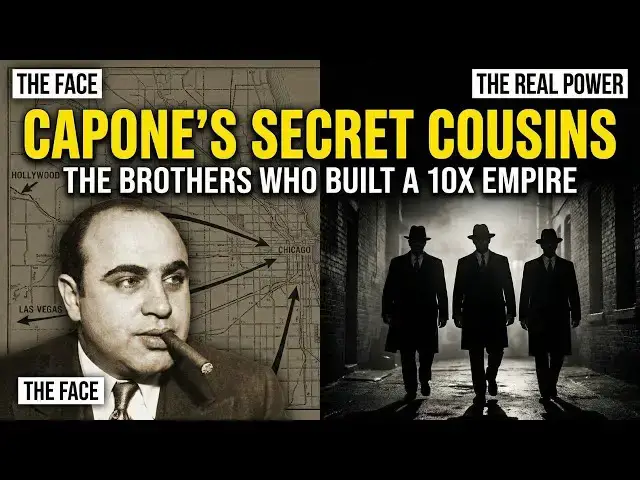
Everyone knows Al Capone. Nobody knows the cousins who inherited his empire and made it ten times bigger.
This documentary exposes the Fischetti Brothers—Charlie, Rocco, and Joseph—Al Capone's blood relatives who silently took control when Scarface went to prison and built a criminal dynasty that lasted fifty years. We're investigating how they transformed a regional bootlegging operation into a national enterprise controlling Hollywood, Las Vegas, and Chicago's underworld.
You'll discover how Charlie Fischetti invented the mob's Hollywood shakedown that extracted millions from major studios. Why Rocco Fischetti served as the Outfit's national diplomat, negotiating with crime families across America. The true nature of Joseph Fischetti's relationship with Frank Sinatra and how it shaped Las Vegas. The secret 1943 meeting at Chicago's Drake Hotel that created the first national entertainment industry conspiracy. And why the FBI spent four decades investigating the brothers without achieving significant convictions.
This investigation draws from FBI surveillance archives, Kefauver Committee testimonies, IRS financial investigations, and court records that document the family's incredible rise. Every claim verified. Every secret exposed.
For the complete cinematic exploration of Chicago organized crime, explore our 100-episode master series on the main channel, Global Mafia Universe. Link in description.
Why do you think the Fischettis have been left out of Capone's story? Hidden on purpose, or just overlooked? Drop your theory below.
0:00 The Empire's True Heirs
1:25 Why This Family Was Hidden
3:15 Charlie Fischetti: The Mastermind
6:30 Rocco Fischetti: The Enforcer-Diplomat
9:15 Joseph Fischetti: The Hollywood Ambassador
12:30 The National Hollywood Conspiracy
16:00 The Legacy That Outlasted Everything
19:00 What They Truly Accomplished
Show More Show Less View Video Transcript
0:00
March 1951.
0:02
A sprawling mansion in Miami Beach.
0:05
Inside, a man clutched his chest and
0:08
collapsed onto Italian marble floors
0:10
worth more than most houses in America.
0:12
Charlie Fisceti, the highest drinking
0:14
blood relative of El Capone, still
0:16
operating an organized crime, died of a
0:18
heart attack at 50 years old. Federal
0:21
agents had been circling for months. The
0:23
Kofover committee wanted him to testify
0:25
about an empire worth over $200 million.
0:28
He took those secrets to his grave, but
0:30
his brothers carried on, and the dynasty
0:33
they built together outlasted every
0:35
other legacy from the Capone era. Here's
0:38
what every Capone documentary ignores.
0:40
When Scarface went to prison in 1932,
0:43
his criminal empire didn't collapse. It
0:45
didn't fragment into waring factions. It
0:48
transferred almost seamlessly into the
0:51
hands of men who had been preparing for
0:53
that exact moment. The Fisceti brothers
0:55
weren't just relatives writing a famous
0:57
last name. They were operational
0:59
architects who had been building
1:01
parallel power structures since the
1:03
1920s.
1:04
When Capone fell, they rose. Everyone
1:07
knows Al Capone. Nobody knows the
1:10
cousins who made more money than he ever
1:12
did. Charlie Roco and Joseph Fisceti
1:15
transformed a regional bootlegging
1:17
operation into a national criminal
1:19
enterprise spanning gambling, labor
1:21
racketeering, entertainment, and
1:24
political corruption. They didn't just
1:26
inherit Capone's Chicago. They expanded
1:28
into Hollywood, Las Vegas, and
1:31
Washington DC. They controlled which
1:34
stars got contracts and which
1:36
politicians got elected. They built an
1:38
empire so sophisticated that legitimate
1:40
businesses couldn't compete. Why has
1:42
this story been buried? Because the
1:44
Fiscetis understood something Capone
1:46
never learned. Real power doesn't seek
1:49
publicity. It avoids headlines. It
1:52
operates in shadows while letting others
1:54
take the spotlight. Al Capone posed four
1:57
photographs and gave interviews. The
1:59
Fiscetis slipped through decades of
2:01
federal investigations with barely a
2:03
conviction between them. They perfected
2:05
the art of invisible empire. The money
2:08
they moved defies belief. By 1950, the
2:11
Chicago outfit generated annual revenues
2:14
exceeding $150 million. The Fiscetis
2:17
controlled significant portions of these
2:19
operations while maintaining interests
2:21
in legitimate businesses worth millions
2:23
more. Their real estate holdings alone
2:25
would qualify them among Chicago's
2:27
wealthiest families. Yet, they'd been
2:29
reduced to footnotes in their cousin's
2:31
biography. What really happened after
2:33
Capone went away? Who truly controlled
2:36
the outfit during its golden age? How
2:38
did three brothers from Brooklyn build a
2:40
criminal corporation that influenced
2:41
American politics and culture for five
2:44
decades? Today, we're opening the vault.
2:46
These are the secrets they thought were
2:48
buried forever. What you're about to
2:50
hear comes from FBI surveillance files
2:52
that tracked the Fiscetis across three
2:54
decades. It comes from Kefover Committee
2:57
testimony that exposed their operations
2:59
to congressional scrutiny. It comes from
3:02
IRS investigations that tried and failed
3:04
to untangle their financial web. And it
3:07
comes from informants inside the outfit
3:09
who finally revealed the family's true
3:11
position in the hierarchy. Three
3:13
brothers,
3:16
one mission, an empire that outlasted
3:18
every rival, every investigation, and
3:20
every attempt to bring it down. Their
3:22
story reveals how organized crime really
3:24
works when it's run by professionals
3:26
instead of publicity seekers. Their
3:28
methods became the template that
3:30
criminal organizations still follow
3:32
today. Their influence shaped American
3:34
entertainment, politics, and commerce in
3:37
ways that persist into the present. The
3:39
Capone legend has been told a thousand
3:41
times. The Fisceti truth has been hidden
3:44
for a century. That ends now. First up,
3:48
the man who made the family's fortune.
3:51
Charlie Fisceti didn't look like a
3:53
gangster. Tall, handsome, impeccably
3:56
dressed in custom suits that cost more
3:58
than a factory worker's annual salary.
4:00
He spoke quietly, smiled often, and
4:03
possessed a genius for organization that
4:05
his famous cousin never matched. While
4:07
Capone made headlines, Charlie made
4:10
money, and by 1935, he had positioned
4:13
himself as the most powerful fisceti in
4:15
an organization full of killers. Born in
4:17
1901 in Brooklyn, Charlie arrived in
4:20
Chicago as a teenager following the
4:22
Capone migration that would transform
4:24
American organized crime. His mother was
4:26
a Rayola, sister to Capone's mother,
4:29
Terz. This blood connection opened
4:30
doors, but Charlie's intelligence pushed
4:33
him through them. He understood
4:34
immediately that bootlegging was a
4:36
temporary business. Prohibition would
4:38
end eventually. Smart operators needed
4:41
to diversify. Charlie built his power
4:43
base in gambling. While others focused
4:45
on beer trucks and speak easy
4:47
protection, he studied the numbers. He
4:49
learned which games produced the most
4:51
reliable profits. He developed
4:53
relationships with wire services that
4:55
transmitted horse racing results across
4:57
the country. By the late 1920s, Charlie
5:00
controlled gambling operations,
5:01
generating over $5 million annually.
5:04
This was side money compared to
5:05
bootlegging, but it was sustainable side
5:07
money. His rise accelerated after
5:10
Capone's imprisonment. The outfit needed
5:12
steady leadership during a dangerous
5:14
transition. Frank Niti took the public-f
5:16
facing boss role, absorbing the heat
5:19
that inevitably came with that position.
5:21
But behind Niti, a council of senior
5:23
members made the real decisions. Charlie
5:26
Fisceti sat on that council. His voice
5:28
carried weight because his operations
5:30
produced consistent revenue without
5:32
attracting unwanted attention. Here's
5:35
what the official histories minimize.
5:37
Charlie Fisceti essentially invented the
5:39
outfits Hollywood operation. In the late
5:41
1930s, he recognized that the
5:44
entertainment industry offered
5:45
opportunities far beyond anything
5:47
Chicago's streets could provide. Movie
5:49
studios generated hundreds of millions
5:51
in revenue. They employed unionized
5:53
workers who could be organized and
5:55
controlled. They created celebrities
5:57
whose careers depended on favorable
5:59
publicity. Charlie saw dollar signs
6:02
where others saw only movie screens. The
6:05
method was elegant. The outfit gained
6:07
control of the international alliance of
6:09
theatrical stage employees. The union
6:12
representing projectionists, stage
6:14
hands, and technicians throughout the
6:16
film industry. Without these workers, no
6:18
movie could be shown. Studios faced a
6:21
choice. Cooperate with outfit demands or
6:24
watch their films sit in cans. Most
6:27
studios chose cooperation. Payments
6:30
flowed from Hollywood to Chicago,
6:32
totaling over $2 million annually. By
6:34
1940, Charlie's peak came in the
6:36
post-war years. He maintained a mansion
6:38
in Miami Beach that served as a winter
6:41
headquarters for outfit leadership.
6:43
Politicians sought audiences with him.
6:45
Entertainers cultivated his friendship.
6:48
legitimate businessman partnered with
6:50
his front companies. He had transcended
6:52
the street level criminality of Capone's
6:54
era, becoming something closer to a
6:56
shadow CEO of American vice. His
6:59
downfall came from the same ambition
7:00
that built his empire. The keover
7:03
committee's 1950 investigation into
7:05
organized crime put Charlie in its
7:07
crosshairs. Investigators had traced
7:09
connections between the outfit and
7:11
political corruption at the highest
7:12
levels. Charlie was scheduled to testify
7:15
on March 11th, 1951.
7:18
Before he could appear, his heart gave
7:20
out. The secrets he carried died with
7:23
him, but his brothers were already
7:24
prepared to continue. But that's nothing
7:27
compared to what comes next. Coming in
7:29
at number four, the enforcer who became
7:32
a diplomat. Roco Fisceti possessed a
7:35
skill set that perfectly complemented
7:37
his brother's talents. While Charlie
7:39
planned and Joseph charmed, Roko handled
7:42
problems that required more direct
7:43
solutions. Born in 1904, 3 years after
7:47
Chart, he grew into a man who could
7:48
negotiate peacefully when possible and
7:51
violently when necessary. This
7:53
combination made him invaluable during
7:54
the outfit's most dangerous years.
7:57
Roco's early career involved the brutal
7:59
work of territorial expansion. During
8:01
prohibition, he participated in the
8:04
conflicts that established Capone's
8:06
dominance over Chicago's south side.
8:09
Court records indicate involvement in
8:12
multiple violent incidents, though
8:14
convictions proved elusive. Witnesses
8:16
had a habit of forgetting what they'd
8:18
seen. Those who remembered often met
8:20
unfortunate accidents before trial dates
8:22
arrived. His evolution from enforcer to
8:25
executive demonstrated the
8:26
professionalization that characterized
8:28
the Fisceti approach. By the 1940s, Roco
8:32
had transitioned into labor
8:33
racketeering, controlling unions that
8:35
provided leverage over legitimate
8:37
businesses throughout the Midwest. His
8:39
particular focus was the hospitality
8:41
industry. Hotels, restaurants, and
8:44
nightclubs depended on unionized
8:46
workers. Those unions depended on Roo's
8:49
approval. The scope of his operations
8:52
becomes clear through FBI surveillance
8:54
summaries from the period. Roco
8:56
maintained interests in over 40 Chicago
8:58
area establishments, ranging from
9:00
legitimate restaurants to gambling clubs
9:03
operating behind legal fronts. His
9:05
annual take from these operations
9:07
exceeded $3 million. This wasn't
9:10
protection money in the traditional
9:11
sense. These were ownership stakes,
9:13
partnership agreements, and consulting
9:16
fees that looked legal on paper while
9:18
representing criminal control in
9:19
practice. Here's the hidden truth about
9:22
Rocco's power. He served as the family's
9:25
primary liaison to other crime
9:27
organizations across the country. When
9:29
the Chicago outfit needed to coordinate
9:31
with New York's five families, Roco
9:33
handled the meetings. When territorial
9:35
disputes arose with Detroit or Cleveland
9:38
operations, Roco negotiated the
9:40
settlements. His reputation for fairness
9:42
in these matters, combined with an
9:44
understood capacity for violence, made
9:47
him the ideal middleman. His role in the
9:49
Continental Press Service revealed the
9:51
national scope of Fisceti influence.
9:53
This wire service transmitted horse
9:56
racing results to bookmakers across the
9:58
country. Control of the wire meant
10:00
control of illegal gambling nationwide.
10:02
Continental press generated over $20
10:05
million annually in subscription fees
10:08
from bookmakers who couldn't operate
10:10
without timely race results. Roco helped
10:12
maintain Chicago's dominance over this
10:15
crucial infrastructure. The CFO
10:17
investigation bruised but didn't break
10:19
Roko. Unlike Charlie, he survived the
10:22
congressional scrutiny, taking the fifth
10:24
amendment over 200 times during his
10:26
testimony. The committee exposed his
10:28
connections but couldn't produce
10:30
criminal charges. He returned to Chicago
10:32
and continued operations for another
10:34
decade. His death in 1964 came quietly
10:37
from natural causes. In a luxury he had
10:40
earned through decades of criminal
10:42
professionalism, the deeper you go, the
10:44
darker it gets. Number three takes us to
10:47
the brother who conquered Hollywood.
10:50
Joseph Fisceti was the youngest, the
10:52
smoothest, and ultimately the most
10:55
influential of the three brothers. Born
10:57
in 1905, he grew up watching Charlie and
11:00
Roco establish themselves in Chicago's
11:02
underworld. By the time Joe reached
11:04
adulthood, the family had carved out
11:07
positions of power. His role would be
11:10
different. He would be their ambassador
11:12
to the legitimate world. Joe's genius
11:14
lay in his ability to move between
11:16
criminal and straight society without
11:18
visible transition. He dressed like a
11:20
movie star. He spoke like an educated
11:23
businessman. He cultivated relationships
11:25
with celebrities, politicians, and
11:27
corporate executives who would never
11:29
knowingly associate with organized
11:31
crime. Many of them didn't know who Joe
11:34
really was. Those who suspected found
11:36
the knowledge useful rather than
11:38
troubling. His connection to Frank
11:40
Sinatra became the most famous and
11:42
controversial relationship in
11:43
entertainment history. FBI files
11:45
document extensive contact between
11:47
Fisceti and Sinatra beginning in the
11:49
late 1940s. Joe photographed with
11:52
Sinatra at nightclubs on vacation at
11:55
private parties. The singer's
11:57
association with Joe Fisceti would haunt
11:59
his career for decades, contributing to
12:01
the loss of his gaming license and
12:03
requiring repeated denials before
12:05
congressional committees. Here's what
12:07
nobody tells you about the Fisceti
12:09
Sinatra relationship. It wasn't just
12:12
friendship. It was business. The outfit
12:15
had invested heavily in Las Vegas as
12:17
casinos opened in the postcore era. They
12:20
needed entertainers to draw crowds.
12:22
Sinatra was the biggest draw in show
12:24
business. Through Joofi Sketi, the
12:26
outfit ensured that Sinatra performed at
12:28
their venues, attracted their desired
12:30
clientele, and contributed to the
12:32
legitimization of Las Vegas as an
12:35
entertainment destination. The
12:36
arrangement benefited everyone involved,
12:39
which is why it lasted for decades.
12:41
Joe's influence extended beyond single
12:43
celebrities. He maintained relationships
12:46
throughout the entertainment industry,
12:47
connecting outfit interests with studio
12:50
executives, talent a production
12:52
companies. When the outfit wanted
12:54
something from Hollywood, Joe made the
12:56
request. When Hollywood needed problems
12:58
solved, Joe provided solutions. This
13:01
mutual dependency gave Chicago leverage
13:04
over the cultural output of the nation's
13:06
dream factory. His political connections
13:08
proved equally valuable. Joe cultivated
13:10
relationships with Democratic Party
13:12
operatives at every level from Chicago
13:14
Ward bosses to national committeemen,
13:16
FBI surveillance, documented meetings
13:19
between Fisceti and politicians who
13:20
later achieved prominence in state and
13:22
federal government. The specific content
13:24
of these meetings remains largely
13:27
unknown, but the pattern of contact
13:29
suggests systematic cultivation of
13:32
political influence. The Las Vegas
13:34
operation represented Joe's crowning
13:36
achievement through investments
13:38
laundered through legitimate appearing
13:40
partners. The outfit secured ownership
13:41
stakes in multiple casinos along the
13:43
developing strip. Joe served as the
13:46
family's eyes and ears in this new
13:49
frontier, reporting on which operations
13:51
were performing, which managers needed
13:53
replacement, and which opportunities
13:55
deserved additional investment. By the
13:57
1960s, casino holdings connected to
14:00
Chicago generated over $50 million
14:03
annually. Joe outlived both brothers.
14:06
Surviving until 1975,
14:09
he spent his final years in Miami. A
14:11
wealthy retiree whose source of wealth
14:14
remained officially mysterious. Federal
14:16
investigators had pursued him for
14:18
decades without achieving significant
14:20
convictions. The connections he'd built
14:22
with powerful people provided protection
14:24
that outlasted any individual
14:25
investigation. He died peacefully,
14:28
having beaten every serious legal threat
14:30
thrown at him. And this is where things
14:32
get truly dangerous. Landing at number
14:34
two, the operation that made everything
14:37
possible. February 1943,
14:41
a suite at the Drake Hotel in Chicago. A
14:44
meeting was occurring that would shape
14:45
American organized crime for the next
14:47
four decades. Representatives of the
14:49
Chicago outfit sat across from members
14:51
of New York's Lucaz and Genevese
14:53
families. The subject was Hollywood. The
14:56
Fisceti brothers had orchestrated this
14:58
gathering and what emerged from it
15:00
demonstrated their true position in the
15:03
national criminal hierarchy. The
15:04
Hollywood scheme that the Fiscetis had
15:06
pioneered required national
15:08
coordination. The motion picture
15:10
industries unions operated across the
15:12
entire country. Studios had facilities
15:14
in New York as well as California. A
15:17
purely Chicago operation couldn't apply
15:19
sufficient pressure. What was needed was
15:21
a consortium, a cooperative arrangement
15:23
between the major criminal organizations
15:26
that could present a united front to
15:28
studio executives. The arrangement that
15:30
emerged from this meeting divided
15:32
responsibilities and revenues across
15:34
participating organizations. Chicago
15:36
would maintain primary control through
15:38
the IATS union leadership they had
15:40
corrupted. New York families would
15:42
support the operation through their
15:44
control of East Coast distribution and
15:46
exhibition. Revenues would be shared
15:48
according to a formula that reflected
15:50
each organization's contribution. The
15:52
Fiscetis had negotiated a deal that gave
15:54
Chicago the dominant position. Here's
15:56
the hidden truth about this arrangement.
15:58
It represented the first truly national
16:01
criminal conspiracy in American
16:03
entertainment. Previous mob involvement
16:05
in Hollywood had been localized,
16:07
individual, opportunistic. The Fisceti
16:10
scheme systematized the extraction of
16:12
money from the motion picture industry.
16:14
Studios paid for labor peace. Theater
16:17
chains paid for access to films.
16:19
Everyone along the distribution chain
16:21
understood that Chicago's permission was
16:23
required for smooth operations. The
16:25
money flowed for over a decade. FBI
16:27
estimates suggest that the Hollywood
16:29
operation extracted between 40 and $60
16:32
million from the entertainment industry
16:34
during its peak years. This
16:36
revenue-funded outfit expansion into new
16:39
territories, financed political
16:41
corruption campaigns, and provided the
16:43
capital for Las Vegas investments that
16:45
would generate even greater returns. The
16:47
operation's exposure came through
16:49
betrayal. William Boff, a corrupt union
16:52
official who had fronted for the outfit
16:53
in Hollywood dealings, decided to
16:55
cooperate with federal prosecutors after
16:58
his 1943 conviction. His testimony
17:00
revealed the structure of the scheme,
17:02
identified the outfit figures involved,
17:04
and provided documentary evidence of
17:06
payments from studios to criminals.
17:08
Several outfit members received lengthy
17:11
prison sentences. The Fiscetis emerged
17:13
relatively unscathed. Their distance
17:16
from the operational details protected
17:18
them from prosecution. Though they had
17:20
orchestrated the entire arrangement,
17:22
they had demonstrated a principle that
17:24
would guide their operations thereafter.
17:26
principles should never be directly
17:28
connected to criminal activity. Layers
17:30
of intermediaries, corrupt officials,
17:33
and plausibly deniable agents, provided
17:35
the insulation that kept the brothers
17:37
free, while subordinates went to prison.
17:40
What comes next? Even the FBI couldn't
17:43
believe it. Position one belongs to the
17:45
legacy they built that still operates
17:47
today. December 1975,
17:50
a quiet hospital room in Miami. Joseph
17:53
Fisceti, the last surviving brother,
17:55
drew his final breaths, surrounded by
17:57
family members and an empire that had
18:00
outlasted every effort to destroy it.
18:02
The FBI had opened files on the Fiscetis
18:04
in the 1930s. For decades later, with
18:07
all three brothers dead, those files
18:09
remained largely incomp. The family had
18:12
won. Their victory wasn't measured in
18:14
acquitt though they accumulated those in
18:16
abundance. It was measured in influence
18:18
that persisted across generations. The
18:21
systems they created for extracting
18:23
money from entertainment, for
18:24
controlling labor, for corrupting
18:26
politics outlived their individual
18:29
supervision.
18:30
Subordinates they had trained continued
18:33
operations. Investments they had made
18:35
continued generating returns. The
18:37
Fisceti approach had become
18:39
institutional knowledge within the
18:41
outfit. Consider what they accomplished
18:43
between 1925 and 1975.
18:46
They transformed a regional bootlegging
18:49
operation into a diversified criminal
18:51
corporation. They established Chicago's
18:53
dominance in the wire service business
18:55
that controlled nationwide gambling.
18:57
They pioneered systematic extraction
18:59
from the entertainment industry. They
19:02
built Las Vegas from desert into casino
19:04
wonderland. They corrupted political
19:06
processes at every level of American
19:08
government. And they did it while
19:10
maintaining the low profile that their
19:12
famous cousin never achieved. Here's
19:14
what the FBI eventually concluded about
19:16
Fisceti influence. According to bureau
19:18
estimates from the 1970s, criminal
19:21
enterprises connected to the Chicago
19:23
outfit generated annual revenues
19:25
exceeding $200 million. The Fisceti
19:28
brothers had played central roles in
19:30
establishing the most profitable of
19:32
these enterprises. Their share of this
19:34
revenue across three decades of active
19:36
operation totaled hundreds of millions
19:38
of dollars in pure profit. The political
19:40
influence outlasted even the money.
19:43
Politicians cultivated during the
19:44
Fisceti era continued serving in office
19:46
long after the brothers died. The
19:48
relationships they had built with labor
19:50
unions persisted through leadership
19:52
changes and organizational reforms. The
19:54
entertainment industry connections they
19:56
had forged influenced casting decisions,
19:59
studio policies, and creative content
20:01
for decades. Their fingerprints remained
20:03
on American institutions that had no
20:05
visible connection to organized crime.
20:08
Their greatest achievement was
20:09
invisibility. Al Capone remains the face
20:12
of Chicago organized crime despite
20:14
having actively operated for barely a
20:16
decade. The Fisceti brothers who
20:18
operated four or five decades and
20:20
generated far more revenue remain
20:22
unknown to the general public. They
20:24
understood that celebrity was a
20:26
liability in their profession. They
20:28
cultivated anonymity. The wake upon
20:30
cultivated headlines. The strategy
20:33
worked. What these brothers revealed
20:35
together is a truth about organized
20:37
crime that contradicts the mythology.
20:39
The most successful criminals aren't the
20:41
most famous. They're the ones who
20:43
operate so effectively that they never
20:45
become famous at all. The Fiscetis built
20:48
an empire. They protected that empire
20:50
from law enforcement. They transferred
20:52
that empire to successors who continued
20:54
their methods and they accomplished all
20:56
of this while remaining shadows behind
20:59
their cousin's spotlight. The pattern
21:01
across their careers reveals
21:02
sophisticated understanding of power
21:04
that transcended criminal enterprise.
21:07
They diversified revenue streams before
21:09
business schools taught portfolio
21:11
theory. They built redundant
21:13
organizational structures that survived
21:15
the loss of key personnel. They
21:16
cultivated political relationships as
21:19
investments rather than expenses. They
21:21
understood that legitimate and criminal
21:23
worlds could be made to serve each
21:25
other. Some mysteries remain. How much
21:29
money did the Fiscetis actually
21:31
accumulate? FBI estimates range from 50
21:34
million to several hundred million, but
21:36
the true figure remains unknown. Where
21:38
did that money go? Their estates passed
21:41
two family members who have successfully
21:43
avoided public scrutiny. What became of
21:45
the political relationships they
21:48
cultivated? Some of those politicians
21:50
went on to national prominence, carrying
21:52
secrets about their past associations.
21:54
The vault has been opened. The Fisceti
21:57
legacy has been exposed. But the
21:59
brothers themselves would probably
22:01
appreciate the irony. Even now, decades
22:04
after their deaths, most of their
22:06
secrets remain hidden. The systems they
22:08
built continue functioning. The
22:10
influence they establish persists in
22:13
institutions they helped shape. They won
22:15
the only game that mattered to them.
22:17
They built an empire that outlasted
22:19
their lives. Al Capone died in 1947,
22:23
mentally destroyed by syphilis,
22:25
abandoned by the organization he had
22:27
once led. The Fisceti brothers died
22:29
wealthy, comfortable, and surrounded by
22:32
family. They had learned from their
22:34
cousin's mistakes. They had built
22:36
something more durable than fame. And
22:38
they had proven that in organized crime,
22:40
as in legitimate business, the best
22:42
executive is the one whose name nobody
22:44
knows. If you want the full cinematic
22:47
story of the groups behind these
22:49
secrets, check out our 100 episode
22:51
master series on our main channel,
22:54
Global Mafia Universe. The link is in
22:56
the description. Go deep.