live_tv
Livestream Starting Soon
00
Hours
:
00
Minutes
:
00
Seconds
Up next in 10


They didn't see his face. They saw his hands.
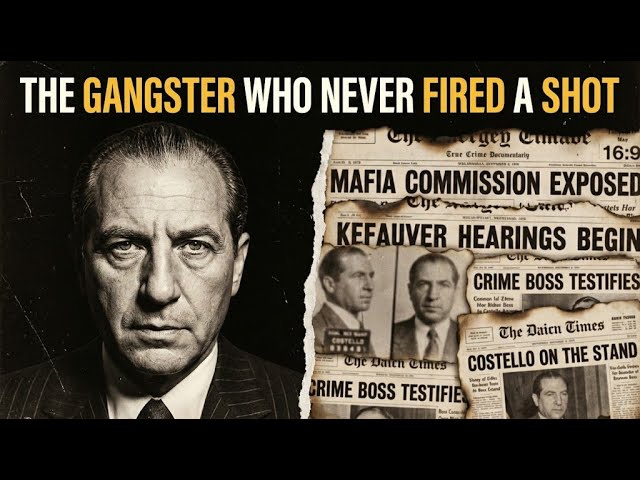
In 1951, 20 million Americans sat glued to their televisions, watching the manicured fingers of one man drum against a wooden table. It was the most-watched drama in history, but the star wasn't an actor—he was the CEO of the American Underworld.
But while the public expected a bloodthirsty killer, they found a diplomat. Frank Costello didn't rule with a Thompson submachine gun; he ruled with a 3 AM phone call and a network of corrupted judges that made him truly untouchable.
This is the untold story of Frank Costello, the "Prime Minister of the Underworld." From the tenements of East Harlem to the Waldorf Towers, we explore how one man transformed neighborhood gangs into a corporate empire and became the real-life inspiration for Don Vito Corleone.
No textbook covers the moment the mob stopped fighting the system and simply became the system. We reveal the secret deals between Tammany Hall and the Commission that defined New York for half a century.
Real power isn't the kind that comes from fear or bullets. It's the kind that comes from being indispensable.
⚠️ HISTORICAL DISCLAIMER: This documentary reconstructs events from historical records, court documents, oral histories, and investigative journalism. Some dialogue and scenes are dramatized based on documented accounts. Sources listed below.
📚 Sources & Further Reading:
→ The Five Families (Selwyn Raab)
https://www.amazon.com/Five-Families-Rise-Decline-Resurgence/dp/0312361815
→ Uncle Frank: The Biography of Frank Costello (Leonard Katz)
→ The Kefauver Committee Hearings (National Archives)
https://www.archives.gov/legislative/features/kefauver
Show More Show Less View Video Transcript
0:00
In 1951, America discovered the most dangerous gangster in history had never
0:05
fired a shot. The Keover Committee had been investigating organized crime for 18
0:13
months. Senator Ests Keover had dragged mob bosses from 14 cities into televised
0:20
hearings that 20 million Americans watched like a serialized drama. They'd
0:25
seen killers, seen enforcers, seen men who wore violence like cheaper men wear
0:31
cologne. But on March 14th, 1951, they saw something that terrified them
0:38
more than any of that. They saw Frank Costello's hands, not his face.
0:43
Costello's lawyer demanded the cameras point down. So for 2 days, 20 million
0:50
Americans watched a pair of manicured hands, watched them grip the table edge,
0:56
watched fingers drum during accusations, watched them ball into fists when
1:01
prosecutors mentioned names Costello wouldn't confirm or deny. And those
1:07
hands told a story more dangerous than any confession. They belonged to a man
1:13
who'd never killed anyone, never fired a shot in anger, never needed to. Because
1:19
Frank Costello had built something the other mobsters couldn't comprehend. He'd
1:24
built an empire where the deadliest weapon wasn't a Thompson's submachine gun. It was a phone call at 3:00 a.m.
1:32
This is a documentary about power. real power. Not the kind that comes from fear
1:39
or muscle or bullets in the street. The kind that comes from knowing which judge
1:44
needs money for his daughter's wedding. Which senator has a gambling problem,
1:50
which police captain likes showgirl a little too young. Frank Costello was
1:55
called the prime minister of the underworld, but that title unersells what he actually accomplished. He didn't
2:03
rule the underworld. He connected it to the world above, made them inseparable,
2:09
made it so you couldn't tell where the mob ended and the government began. And when Hollywood needed to create the most
2:16
iconic gangster in cinema history, they didn't look to Al Capone's bloody reign.
2:22
They didn't study John Goty's flashy violence. They studied Frank Costello's
2:28
quiet hands. Some dialogue and scenes in this documentary are reconstructed from
2:34
historical records, court testimony, FBI surveillance reports, and documented
2:41
accounts. Where exact conversations weren't recorded, we've created
2:47
dramatically accurate representations based on verified sources and
2:52
established historical patterns. Now, here's what most people miss about
2:57
Costello's story. He wasn't born into this world. Wasn't raised in Sicily
3:03
learning old country codes. Frank Costello was born Francesco Castiglia in
3:09
1891 in Calabria, Italy. His family brought him to East Harlem when he was
3:15
four. He grew up in the same tenementss as thousands of other Italian kids,
3:22
worked the same degrading jobs, faced the same discrimination that kept
3:27
Italians locked in the lowest rungs of American society. The difference was
3:33
what he decided to do about it. By age 21, Francesco Castiglia had changed his
3:40
name to Frank Costello. The Irish ran New York politics. Irish names opened
3:46
doors Italian ones didn't. It was his first lesson in the real nature of
3:51
power. Identity is negotiable. Reputation is currency and the rules
3:57
that govern society are just agreements made by people who got there first. So
4:03
he'd make new agreements. His early years were standard issue crime, petty
4:08
theft, smalltime gambling, a gun charge in 1915 that put him in prison for a
4:15
year. When he got out, he was smarter. He'd learned that getting arrested was
4:20
for suckers, that real criminals didn't get their hands dirty. They got other
4:26
people's hands dirty. Then came 1920 prohibition. The Volstead Act banned
4:33
alcohol across the entire United States. Politicians called it a moral victory.
4:40
Reformers called it progress. Frank Costello called it the opportunity of
4:45
the century. Here's what prohibition actually did. It took a legal product
4:50
that every adult in America wanted, made it illegal, then acted surprised when
4:56
criminals stepped in to provide it. It was the single greatest gift the
5:01
government ever gave organized crime. Overnight, neighborhood gangs became
5:06
international smuggling operations. Street thugs became millionaires, but
5:12
most of them stayed thugs. Frank Costello became something else. While
5:17
other bootleggers fought territorial wars that left bodies stacked in alley, Costello was making phone calls,
5:25
building relationships, he understood something most gangsters never figure out. Violence is expensive. It draws
5:33
attention, gets people arrested, gets people killed. But corruption,
5:39
corruption is sustainable. Pay a cop to look the other way, he looks the other way forever. Pay a judge to fix a case.
5:47
Suddenly you own that judge for life because now he's dirty. Now he needs you
5:53
as much as you need him. That's not extortion. That's partnership. Costello
5:59
built a network that stretched from coast guard captains to city aldermen.
6:04
He imported whiskey from Europe and Canada through channels so protected
6:10
that his shipments moved with less interference than legal cargo. His booze
6:16
flowed into speak easys from Manhattan to Miami. And every bottle generated
6:21
profit that got split not just with criminals but with cops, judges, politicians. He wasn't fighting the
6:29
system, he was becoming it. Pay attention to what happens next. It's
6:34
easy to miss. In 1929, Frank Costello walked into a meeting
6:39
that would change organized crime forever. The location was Atlantic City.
6:46
The occasion was unprecedented. Every major crime figure in America had been
6:51
summoned. Al Capone from Chicago, Lucky Luchano from New York, Mayor Lansky,
6:58
Bugsy Selil, Enoch Nucky Johnson. They called it the Atlantic City Conference.
7:05
History calls it the moment the mob became the mafia. The old mustache pets,
7:10
the Sicilian bosses who'd run Italian crime for decades. They operated on old
7:15
world rules, blood oaths, ethnic loyalty, tribal vendettas. You were born
7:22
into a family. You died for that family. The idea of working with Jews or Irish
7:28
wasn't just unthinkable. It was sacrilege. But Costello had been working
7:34
with Jews and Irish for years. Mayor Lansky was his closest friend and
7:40
business partner. Together they'd built operations that made more money than any
7:46
pure Sicilian operation ever dreamed of. The Atlantic City Conference was where
7:52
that new model went national. Lucky Luchano stood up in that room and
7:58
proposed something revolutionary. Forget the old families. Forget ethnic
8:03
divisions, organize crime like American business, create territories, establish
8:10
commissions, run it like a corporation where the product was illegal, but the structure was pure capitalism. The old
8:17
bosses called it an insult to tradition. Frank Costello called it the future. And
8:23
years later, one name would appear in the margins of this transformation.
8:28
Veto Genov. Within 2 years, the old bosses were dead. Salvata Maranzano, the
8:36
self-proclaimed boss of bosses, murdered in his office by killers Luchano sent.
8:42
Joe Maseria shot to death in a Canai Island restaurant while Luchano was
8:47
conveniently in the bathroom. The Castle War ended. The commission era began.
8:54
Five families would control New York. Luchano's family, Mangano's family,
9:01
Prophesi family, Gaglano's family, Banano's family. Each with defined
9:07
territories, each with representation on the commission. Disputes settled by
9:13
votes, not bullets in theory. But here's where Frank Costello's genius separated
9:19
him from everyone else at that table. While Lucky Luchano ran the biggest
9:24
family and Mayor Lansky ran the numbers, Frank Costello ran the connections. He
9:31
didn't want to be boss of bosses. That title got Moranzano killed. He wanted
9:36
something safer, something sustainable. He wanted to be indispensable.
9:42
So, while other mobsters were consolidating criminal operations, Costello was consolidating political
9:49
power. He'd already established relationships with Tamony Hall, the
9:55
political machine that controlled New York Democratic politics. Now he
10:00
expanded systematically. Judges, union leaders, police captains, city
10:05
councilmen. His method was consistent. Find the pressure point. Apply the
10:11
solution. Create the dependency. A politician needs campaign funds.
10:17
Costello provides them. Now that politician owes favors. A judge has
10:22
gambling debts. Costello clears them. Now that judge rules the right way. A
10:29
police captain wants his son in a good union job. Costello makes a call. Now
10:34
that captain's raids always miss Costello's operations. It wasn't bribery. It was investment. By the mid
10:42
1930s, Frank Costello had New York wired so thoroughly that other mob families
10:49
had to go through him to fix their own problems. Got arrested. Costello knew
10:55
which judge to call. Need a union contract. Costello knew which official
11:00
to pressure. Want a liquor license for your front business? Costello's people
11:06
approved it. He became the switchboard operator for the entire underworld.
11:11
Mayor Lansky once said that Frank Costello could pick up the phone and talk to the mayor, the governor, or any
11:18
judge in New York, and they'd take his call. Because by then, the line between
11:25
legitimate politics and organized crime wasn't just blurred. It didn't exist.
11:31
When prohibition ended in 1933, most bootleggers went broke overnight.
11:37
The product they'd killed for was suddenly legal again. Their empires collapsed. They went back to being
11:44
street thugs or they went to prison or they went into the ground. Frank Costello got richer because he'd never
11:51
put all his money in one business. While other mobsters were building breweries and warehouses, Costello was
11:58
diversifying slot machines, gambling operations,
12:03
nightclubs, real estate. He had income streams that would survive any single
12:09
law change, and he had the political protection to operate them openly. His
12:15
slot machine empire alone was bringing in millions annually. He'd placed them
12:21
in candy stores, drug stores, bus stations across New York. The Tam Hall
12:28
politicians he'd spent years cultivating made sure the cops never bothered them.
12:33
When reform Mayor Fiorello Lagardia declared war on slots in 1934,
12:40
smashing them with sledgehammers for news reel cameras, Costello didn't fight
12:45
back. He moved the operation to New Orleans. One phone called to Senator
12:51
Huie Long. One arrangement with the Louisiana political machine. Every slot
12:57
machine Lagardia destroyed in New York got replaced with two new ones in
13:02
Louisiana. The revenue didn't just continue, it doubled. That's the
13:07
difference between a gangster and what Frank Costello had become. Gangsters
13:12
fight. Politicians negotiate. Costello had evolved past criminality into
13:19
something more dangerous. He'd become infrastructure. By 1937,
13:25
Lucky Luchano was in prison, railroaded by prosecutor Thomas Dwey on
13:30
prostitution charges that were probably exaggerated, possibly fabricated, but
13:36
definitely effective. The man who'd organized the commission, who'd modernized the mob, who'd killed his way
13:43
to the top, was now doing 30 to 50 years. His family needed a new boss. The
13:50
obvious choice would have been Veto Genov's Luchano's under boss. Ruthless,
13:56
ambitious, connected to every crew. But Genov had fled to Italy in 1937 to avoid
14:04
a murder charge. He'd spend the next years smoozing with Mussolini while his
14:09
enemies thought he was in exile. He was actually waiting. So the family turned
14:15
to Frank Costello, the politician, the fixer, the man who'd never killed anyone
14:21
but knew everyone worth knowing. He didn't want the position. Being boss
14:26
meant being a target, meant taking the heat when things went wrong. Meant prosecutors built their careers on your
14:33
name. But Lucky Luchano asked from prison. And you didn't say no to Lucky.
14:40
Frank Costello became acting boss of what would eventually be called the Genovese family, the richest, most
14:47
powerful crime organization in America. And he ran it exactly the way he'd run
14:53
everything else. Like a business, a quiet business, no flashy hits, no
14:59
public wars, no newspaper headlines. When problems arose, Costello solved
15:06
them with phone calls and cash payments and favors called in. He expanded
15:11
gambling operations into Cuba, working with Mayor Lansky to turn Havana into an
15:17
offshore casino empire. He invested in legitimate businesses, buying into
15:23
restaurants, hotels, nightclubs. The money got cleaner, the operation got
15:29
quieter, and Frank Costello became exactly what he'd always wanted to be,
15:35
invisible. Except he wasn't invisible to everyone. The FBI had a file on him 3 in
15:42
thick. Jay Edgar Hoover called him the most dangerous criminal in America, not
15:48
because of violence, because of influence. Hoover understood that a gangster who controlled judges was more
15:55
dangerous than a gangster who controlled killers. You can arrest killers, but
16:00
judges decide if the arrest sticks. And through the 1940s, as World War II raged
16:08
and America transformed, Frank Costello's power only grew. He helped
16:13
the Navy during the war using his dock connections to prevent sabotage and
16:18
strikes. He helped politicians get elected, then helped them stay elected.
16:24
He solved problems for people who made laws and enforced laws and interpreted
16:30
laws. He became the man you called when the system couldn't help you or when you
16:35
were the system and needed help. By 1950, Frank Costello was 60 years old.
16:43
legitimate businesses, enormous wealth, political connections that reached into
16:48
the highest levels of New York government. He'd survived prohibition,
16:54
survived the commission wars, survived two decades as acting boss without ever
16:59
facing serious prison time. He'd done what almost no gangster ever does. He'd
17:05
gotten old and he'd gotten comfortable. That's when Senator Ests Keover
17:11
announced his committee, the special committee to investigate crime in interstate commerce. 14 cities, months
17:19
of hearings, television cameras bringing mob testimony into American living rooms
17:25
for the first time. Frank Costello's lawyer told him to refuse the subpoena,
17:31
fight it in court, delay, obstruct. But Costello made a different calculation.
17:38
He'd spent 30 years building a reputation as a legitimate businessman who happened to know people. Refusing to
17:45
testify would destroy that image, make him look guilty, make him look like
17:50
every other hood who took the fifth. So on March 14th, 1951, Frank Costello
17:58
walked into the federal courthouse in Manhattan, sat down at the witness table, adjusted his tie, and 20 million
18:06
Americans watched his hands grip the table. They didn't know it yet, but they were watching the blueprint. The
18:13
template, the original model for every fictional mob boss that would come after. The Godfather hadn't been written
18:20
yet, wouldn't be published for 18 more years. Mario Puzo was still a struggling
18:27
writer. Francis Ford Capola was 12 years old, but both of them would study these
18:34
hearings. Study Frank Costello's calm demeanor. His refusal to show fear. His
18:41
careful answers that revealed nothing and admitted less. The way he commanded
18:46
respect without threatening anyone. The way power looked when it didn't need to prove itself. For 2 days, Costello
18:54
sparred with Keover. Admitted knowing gangsters, but claimed they were just friends. Admitted making money, but
19:02
claimed it was all legitimate. Admitted influence, but denied corruption. He
19:07
never cracked, never shouted, never lost control. And when it was over, when he
19:13
walked out of that courthouse, Frank Costello had done something impossible.
19:18
He'd testified before a Senate crime committee on national television and
19:24
come out looking more respectable than the senators questioning him. But victories have costs and exposures have
19:31
consequences because sitting in a cell watching those hearings was Veto
19:37
Genoves. The man who'd fled to Italy 14 years earlier. The man who'd come back to
19:44
America after the war. the man who believed he, not Frank Costello, should
19:49
be running the family. And watching Costello's face on every television screen in America, Genov saw an
19:57
opportunity. When you're that visible, you're vulnerable. When you're that powerful, you're a target. When you're
20:04
that comfortable, you forget that someone's always waiting to take what you built. The Kefover hearings ended.
20:12
Frank Costello went back to business. The slot machines kept printing money.
20:18
The judges kept ruling the right way. The politicians kept taking his calls.
20:23
Everything looked the same. But something fundamental had shifted. Frank
20:29
Costello had spent three decades building power through invisibility.
20:34
Now he was the most famous mobster in America. His face was known. His name
20:39
was in every newspaper. His influence was public knowledge. And in the world
20:45
Frank Costello had built, being famous was the same as being finished. Veto
20:51
Genovese came back to America in 1945 with a plan and a grudge. The plan was
20:58
simple. Take back the family. Lucky Luchano had built the family that should
21:03
have been his when Luchano went to prison. The family Frank Costello had
21:09
been keeping warm. The grudge was personal. While Genov had been in Italy
21:14
playing Mussolini's favorite American gangster, Costello had transformed the
21:20
organization, made it richer, made it quieter, made it so legitimatook that half the family's
21:27
income came from businesses that barely broke the law. Genov hated every second
21:33
of it because Veto Genov was old school. He believed in blood, believed in fear,
21:41
believed that respect came from the barrel of a gun, and loyalty came from terror. He'd killed his first man at 20,
21:49
had personally executed dozens more. Murder wasn't just business to go, it
21:56
was communication. and watching Frank Costello testify on national television,
22:02
watching him dodge questions with lawyer tricks and political sophistication.
22:07
Genov saw everything he despised about the new mob. Costello had turned them
22:13
into businessmen. Genov wanted to turn them back into killers, but he was smart
22:18
enough to wait, patient enough to build support. Because you don't move against
22:23
the acting boss of the most powerful family in America without preparation.
22:29
You gather allies, undermine authority, create the conditions where removing him
22:35
looks like necessity instead of ambition. Veto Genov spent the late
22:41
1940s doing exactly that. He whispered to Karpos that Costello was weak, too
22:48
political, too willing to negotiate when real men would fight. He pointed to
22:53
Costello's gambling operations, his slot machines, his nightclub investments, and
23:00
called them beneath the dignity of Kosa Nostra. Real gangsters didn't count
23:05
coins from onearmed bandits. Real gangsters controlled unions, docks,
23:11
construction industries where you could squeeze millions and break anyone who resisted. Slowly, carefully, Genoves
23:20
built a faction. Younger guys who resented Costello's style. Old-timers
23:25
who missed the days when a boss ruled through fear. Ambitious soldiers who saw
23:31
Costello's political approach as weakness they could exploit. By 1951,
23:37
the family was splitting. Not openly, not yet, but in the way men choose sides
23:43
when they sense a coming war. Then the keover hearings made everything worse.
23:49
Because while Costello had performed brilliantly under questioning, had maintained his dignity, and revealed
23:56
nothing prosecutable, the exposure itself was a problem. Every cop in
24:02
America now knew his face. Every prosecutor wanted to be the one who
24:07
finally nailed him. Every reform politician could campaign on cleaning up
24:12
corruption by going after Frank Costello. The invisibility that had
24:17
protected him for 30 years was gone, and Genov made sure everyone in the family
24:24
noticed. In late 1951, Frank Costello got word that Genov was
24:31
making moves, challenging his decisions, countermanding his orders. Treating
24:37
acting boss like it was a temporary title that had expired, Costello called
24:42
a meeting, just the two of them, neutral location. They met at a restaurant
24:48
Costello owned in Manhattan, private room, no one else present. two men who'd
24:54
known each other for 30 years, who'd worked together under Lucky Luchano,
24:59
who'd built the Commission era together, now sitting across a table trying to
25:05
decide if they were going to war. According to later testimony from men who heard both versions, the
25:11
conversation went like this. Costello spoke first, calm, measured, the way he
25:17
always spoke. Veto, I've been hearing things. Hearing you got concerns about how the family is being run. You want to
25:24
talk about it, we talk, you and me, right now. Genov leaned back, smiled the
25:30
way predators smile at prey. Frank, you've done good work. No one saying otherwise, but times change. The
25:38
commission needs strength, not politicians. The commission needs money,
25:43
Costello said, which we have more of than any other family. because of those
25:48
politicians you don't like. Money from slot machines. Genoves made it sound
25:54
like an insult. Money from gambling. We should control industries, unions, real
26:00
power. We control judges, Costello said quietly. We control cops. We control
26:07
city hall. That's not real power. It's weak power. Genevies leaned forward.
26:13
Now, power that disappears the second they decide to turn on you. I saw what
26:18
happened at those hearings. Frank, saw you dancing for senators, answering their questions like you work for them.
26:26
I didn't answer anything. You showed up. Genevies let that sit for a moment. A
26:32
boss doesn't show up when the government calls. A boss makes them come to him or
26:38
makes them too scared to call at all. Costello studied Genov's across the
26:44
table, seeing something he'd missed before. This wasn't about strategy or
26:49
philosophy or the right way to run a family. This was about Veto Genov's
26:54
needing to be the most feared man in the room. And you can't be the most feared man in the room when Frank Costello's in
27:01
it being respected. So, what do you want? Costello asked. I want what's
27:07
mine? Genov said. what Lucky promised me before they sent him away. I want to run
27:14
this family the way it should be run. Costello could have fought right there. Could have called in favors. Reminded
27:21
Genoves that the commission had approved Costello as acting boss that Lucky
27:27
Luchano still sent word from Italy supporting Costello's leadership.
27:32
Instead, he made a different calculation. You want it? Costello said
27:37
you can have it. Genov actually looked surprised. He'd been prepared for resistance, threats, maybe violence, not
27:45
surrender. Just like that, Genov asked. Just like that, Costello said. You want
27:52
the headaches, the exposure, the prosecutors crawling up your ass every
27:57
time someone gets killed. Take it. I'll step back. Keep my operations. Keep my
28:03
cruise. But you want the title? It's yours. It was the smartest thing Frank
28:08
Costello ever said and the most dangerous because he just given Veto
28:14
Genov's exactly what he wanted while making it worthless. Here's what
28:19
Costello understood that Genov's didn't. The title boss only matters if people
28:25
obey you. Frank Costello had spent 30 years building loyalty through favors
28:31
and profit and making people rich. Every caro in the family owed him. Every
28:37
soldier had gotten wealthy under his system. Veto Genov had spent 30 years
28:43
building fear and fear is expensive to maintain. So, Genov became boss in name,
28:51
started giving orders, started making moves and discovered that half the
28:56
family still went to Frank Costello when they needed something done because
29:01
Costello still controlled the judges, still controlled the politicians, still
29:08
controlled the infrastructure that kept everyone out of prison and kept the money flowing. Being boss meant Genovese
29:15
got the respect. But Frank Costello kept the power and that split, that
29:21
fundamental division would poison the family for the next decade. But before
29:27
we go further, there's something that happened 20 years earlier that explains
29:32
why Costello's system worked at all. Something about how he built the alliance that made him untouchable.
29:39
1931, Frank Costello and Mayor Lansky were sitting in a Brooklyn warehouse counting
29:46
money from a bootlegging run. They'd been partners for almost 10 years by then. Costello providing the political
29:54
protection, Lansky providing the organizational genius. They'd made each
30:00
other rich, but more than that, they'd made each other safe. A knock on the
30:06
door. One of Costello's men brought in a young guy, mid20s, fresh off the boat
30:12
from Sicily. His name was Charlie Luchano, though everyone called him
30:17
Lucky. Lucky Luchano had a problem. The old mustache Pets, the Sicilian bosses
30:24
who ran Italian crime in New York, they were killing each other over territory
30:29
and pride and insults from decades ago. Blood feuds that made no sense to anyone
30:35
under 40. Maranzano and Maseria had the city divided and every week someone got
30:42
killed over which side you were supposed to be on. Lucky wanted out of that system. Wanted to build something new,
30:49
but he needed help. He looked at Costello, then at Lansky, one Italian,
30:55
one Jew, working together, making more money than any pure Sicilian operation.
31:01
How do you do it? Lucky asked. Costello looked at Lansky. Lansky looked at
31:07
Costello. They both smiled. We don't care where the money comes from, Lansky
31:12
said. We care that it comes. The old bosses, Costello added. They'd rather be
31:18
pure and poor than mixed and rich. We'd rather be rich. Lucky Luchano sat down.
31:25
I want to kill them. Both of them, Maranzano and Maseria. End this war.
31:31
Build something that works like what you've got. Most people would have called that insane. The old bosses had
31:38
armies, had decades of loyalty, had killed everyone who challenged them
31:43
before. But Frank Costello had learned something in his 20 years of crime. The
31:49
most dangerous moment is when everyone thinks you're crazy because that's when they are not watching closely enough.
31:56
You kill them. Costello said, "You're going to need protection, political
32:02
protection, because every cop in New York will be looking for whoever did it,
32:07
and you'll need structure." Lansky added, "Can't just create a power vacuum. Need something to replace them
32:14
with." Lucky Luchano leaned forward. "That's why I'm here." Over the next 3
32:21
hours, they planned it. Not the murders themselves. Lucky had killers for that.
32:26
But the system that would come after the commission. Five families instead of
32:31
two. Territories negotiated, not fought over. Disputes settled by votes among
32:37
equals. And most importantly, the alliance, Italian and Jewish gangsters
32:43
working together, sharing operations, splitting profits. The thing the old
32:48
bosses said was impossible. the thing Costello and Lansky had been doing for
32:54
years. By September 1931, both old bosses were dead. Joe Maseria shot in a
33:01
Canai Island restaurant. Salvata Moranzano stabbed and shot in his own
33:07
office. The Castillame war was over. The commission era began. And at the center
33:13
of it was the alliance Frank Costello had helped build. Luchano's family
33:19
handling Italian operations. Lansky's organization handling Jewish operations.
33:26
Costello serving as the bridge between both worlds and the political world above them. It was the blueprint, the
33:34
model, the family structure that would last decades. Not a family based on
33:39
blood, a family based on profit. Take a breath. Because from here on, the story
33:45
only gets darker. By 1954, Veto Genov was officially boss. Frank Costello was
33:53
officially retired. Officially in reality, Costello was still running
33:58
gambling operations that brought in millions, still had the political connections, still got calls from Karpos
34:06
asking advice. Genov was boss in title. Costello was boss in everything that
34:13
mattered. and Genov couldn't stand it. So he started making moves, aggressive
34:19
moves. He pushed into Union rackets using violence Costello would have
34:25
avoided sanctioned hits that brought police attention. Started acting like
34:30
the kind of boss who proved power through fear instead of profit. The money started getting complicated. The
34:38
heat started rising. And Frank Costello, watching from his supposed retirement,
34:44
saw his life's work being dismantled by a man who thought the old ways were better. In 1956,
34:52
Costello made a decision. He went to the commission, formerly complained that
34:57
Genov was mismanaging the family, damaging operations, bringing
35:03
unnecessary attention. It was the political move, the smart move, the kind
35:09
of thing Frank Costello had done a hundred times. But this time it didn't work because the commission had changed.
35:17
Carlo Gambino, who' taken over the Mangano family, sided with Genoves. So
35:23
did the other bosses. They were tired of Costello's political style. Tired of
35:29
feeling like businessmen instead of gangsters. They voted to support Genov's
35:34
as the legitimate boss. Told Costello to accept it and step back. Really step
35:40
back this time. Frank Costello walked out of that meeting knowing something had shifted. The world he'd built, the
35:48
system he'd created, it was being replaced. The new generation wanted
35:53
blood and territory, and the old Sicilian ways. Everything he'd evolved
35:59
past, they were evolving back into. That's when he should have disappeared, taken his money, moved to Florida, lived
36:07
quietly on his wealth, and died of old age. But Frank Costello had one flaw,
36:13
one blind spot that would nearly kill him. He couldn't let go. Because men
36:18
like Frank Costello, don't build empires to abandon them. Don't spend 40 years
36:25
creating systems just to watch someone else dismantle them. Even when logic
36:30
says walk away, pride says fight. And pride is what gets everyone killed
36:36
eventually. May 2nd, 1957. Frank Costello was living in the
36:42
majestic apartments on Central Park West. Expensive building, dorman,
36:48
security, the kind of place where wealthy legitimate businessmen lived,
36:54
which is what Frank Costello insisted he was. He'd spent the evening at the Monsenor restaurant on West 56th Street.
37:02
Dinner with friends, drinks, normal night for a 66-year-old
37:08
retired man who happened to have made his money in gambling. Around 11 p.m.,
37:13
his driver dropped him at the Majestic. Costello walked through the lobby,
37:18
nodded to the doorman, headed for the elevator. Behind him, the building door
37:23
opened. A man walked in. large guy, dark coat, hat pulled low. The doorman later
37:31
said he didn't think anything of it, just another resident coming home late. Frank Costello pressed the elevator
37:38
button, heard footsteps behind him, started to turn. The man raised a gun
37:43
and said one word. Frank Costello turned fully, recognized the voice, maybe
37:50
recognized the situation definitely. The gun fired, one shot. The sound cracked
37:57
through the marble lobby like thunder. Frank Costello dropped. The shooter ran
38:02
out the door into a car waiting on Central Park West. Gone in seconds. The
38:08
doorman rushed over. Found Frank Costello on the marble floor. Blood
38:13
streaming from his head, eyes open, still conscious, still alive. The bullet
38:19
had grazed his skull, entered above his right ear, traveled under the skin,
38:24
exited behind his ear one inch different, and it would have blown his brains across the lobby. Instead, it
38:32
gave him the worst headache of his life and a message impossible to misunderstand.
38:37
Veto Genov had tried to kill him. The shooter was Vincent the chin gigant. A
38:44
Genovese soldier built like a boxer, brain like a calculator. He'd been
38:50
ordered to eliminate Frank Costello. Make it look like a robbery. Remove the
38:55
last obstacle to Genovis's complete control. He'd failed, but only
39:00
technically. Because lying on that marble floor, bleeding from a gunshot wound to the head, Frank Costello had a
39:08
choice. The same choice every mob target has when they survive an attempt. Fight
39:14
back or disappear. The police came. Ambulance took him to Roosevelt
39:19
Hospital. Detectives stood by his bed asking who shot him, asking if he knew
39:25
why, asking if he wanted protection. Frank Costello, head wrapped in
39:30
bandages, blood pressure stabilizing, looked at them with the same calm he'd
39:36
shown the Keover Committee. I didn't see nothing. He said, "Don't know nothing.
39:42
Must have been a robbery." The cops knew it was a lie. Costello knew they knew.
39:47
But that's not what mattered. What mattered was the message Frank Costello was sending back to Veto Genov. You
39:54
tried to kill me. You failed. And I'm not cooperating with the cops. I'm still
40:00
playing by the rules. Still handling this the family way. But the rules had
40:05
changed. and Frank Costello lying in that hospital bed finally understood
40:11
what Veto Genov had been trying to tell him all along. There was no room for
40:16
both of them anymore. One week later, Frank Costello called a meeting. Not
40:21
with Genoves, with the commission. Every boss, neutral location. He walked in
40:28
with his head still bandaged, sat down at the table, looked at Carlo Gambino,
40:34
Tommy Lukis, Joe Banano, the men who'd built the commission alongside him and
40:39
Lucky Luchano. I'm done, Costello said. No one asked what he meant. They knew.
40:46
I'm stepping back from everything. Operations, territory, cruise, veto
40:51
wants it all. He can have it. I'll keep my personal business, but I'm out of family leadership. Carlo Gambino spoke
40:59
carefully. Frank, you don't have to do this. We can settle. I'm 66 years old,
41:05
Costello interrupted. I've been doing this for 40 years. I'm tired and I'm
41:11
done getting shot at. He stood up, adjusted his jacket, looked at each boss
41:16
in turn. I built this thing with Lucky, he said quietly. built it to last, to
41:23
make money without making bodies. But that's not what you guys want anymore. So take it, run it your way, just leave
41:29
me alone. He walked out, didn't wait for a vote, didn't wait for approval. Frank
41:35
Costello had just done what almost no mob boss in history ever manages. He
41:40
quit, and somehow, impossibly, Veto Genov let him. Maybe because Costello
41:47
had humiliated himself in front of the commission. Maybe because Genov finally
41:53
had everything he wanted. Maybe because even Veto Genov understood that killing
41:59
Frank Costello after he'd publicly retired would bring heat nobody needed.
42:06
Or maybe because Genov knew something Costello hadn't figured out yet. the
42:12
empire Costello had built couldn't survive without him. The political connections, the judicial fixes, the
42:20
systematic corruption, all of it depended on relationships Frank Costello
42:26
had spent decades cultivating. Veto Genov could kill people, but he
42:32
couldn't replace what Costello was. Within 2 years, the Genov's family was
42:38
in chaos. Veto's violent approach brought federal attention. His lack of
42:44
political protection meant arrests stuck. His leadership style bred resentment and fear instead of loyalty
42:51
and profit. In 1959, Veto Genov got arrested on heroine
42:58
trafficking charges. Sentenced to 15 years, he'd die in prison in 1969,
43:05
still claiming the family was his. Frank Costello lived until 1973,
43:11
died of a heart attack at 82, spent his final years managing legitimate real
43:17
estate investments and gambling on golf courses in Florida. He never went back
43:23
to crime, never returned to power, never even attended mob functions. He'd walked
43:29
away, and walking away had saved his life. But here's what most people miss
43:34
about the Costello Genov's war. It wasn't just two men fighting over one
43:40
family. It was two philosophies fighting over the future of organized crime.
43:45
Costello believed crime should evolve, become quieter, more legitimate, more
43:52
sustainable. Power through corruption instead of violence. Genevies believed
43:57
crime should stay true to its roots. Power through fear. Respect through
44:02
blood. The old Sicilian ways. Costello's way made more money. Genovves's way felt
44:09
more like tradition. And when those two visions collided, tradition won, not
44:15
because it was better, because it was louder. The families went back to violence, back to public hits, back to
44:22
the kind of spectacular mob war that makes headlines and history books and
44:28
eventually brings down the entire system. The Gallow Wars, the Columbbo
44:33
shooting, the Castellano murder, every spectacular hit that came after, every
44:40
boss who died in the street, they were all following Genovves's model. None of
44:45
them lasted as long as Frank Costello. Because Frank Costello understood
44:51
something that every other mob boss had to learn the hard way. The moment you
44:56
become famous is the moment you start dying. Stay quiet. You can operate
45:01
forever. Make noise and eventually someone louder comes along. Violence
45:07
attracts violence. Blood demands blood. And the only way to survive is to be the
45:13
one who doesn't need violence to prove power. But there was one person who understood this lesson better than
45:20
anyone. One person who watched Frank Costello's rise and fall and took notes.
45:26
who studied the way power could look quiet but run deep. A struggling writer
45:32
named Mario Puzo, who'd spend the 1960s researching organized crime, who'd
45:39
interview former mobsters and read FBI reports and study the Keover hearings,
45:45
who'd create a character named Veto Corleó. And that character, that
45:50
fictional boss, he'd combine everything Frank Costello was with everything he
45:55
could have been. The political sophistication, the quiet power, the refusal to sell
46:02
drugs, the focus on respect over fear. Don Corleó was Frank Costello with
46:08
better PR and a Hollywood ending. But we're getting ahead of ourselves right
46:14
now. In 1957, Frank Costello was just a retired gangster with a bullet scar and a
46:22
decision to stay retired. The question was whether the world would let him and
46:27
whether the empire he'd built would survive without him or whether Veto Genovves's vision, blood and territory
46:36
and traditional power would erase everything Costello had created. The
46:41
answer would take another decade to arrive. And it would come from the most unexpected place. Not from the mob, not
46:49
from the FBI, not from politicians or prosecutors, from Hollywood. Frank
46:56
Costello's retirement didn't look like most mob retirements, no witness
47:01
protection, no fleeing the country, no looking over his shoulder every time he
47:06
left the house. He bought an apartment in the Waldorf Towers, played golf at
47:12
exclusive country clubs, invested in oil wells and real estate developments, ate
47:19
dinner at the finest restaurants in Manhattan, where judges and businessmen
47:24
would stop by his table to say hello to anyone watching. He looked like exactly
47:30
what he'd always claimed to be, a successful businessman who'd made his money in gambling and moved into
47:37
legitimate ventures. The FBI knew better. They watched him for another 16
47:43
years, followed him to golf courses and restaurants and business meetings, built
47:49
files documenting every person he met with, every phone call they could trace,
47:55
every investment he made. They never arrested him for anything significant
48:00
again. Because Frank Costello had finally learned the lesson that takes most criminals a lifetime to figure out.
48:08
The best way to beat law enforcement isn't to hide from them. It's to become
48:13
boring. No drama means no headlines. No headlines means no political pressure.
48:20
No political pressure means prosecutors focus on easier targets. And there were
48:26
plenty of easier targets because while Frank Costello was playing golf in
48:32
Florida, the mob was tearing itself apart. Veto Genoviza's imprisonment in
48:38
1959 created a power vacuum. Different factions within the family started
48:46
fighting for control. Carlo Gambino was consolidating his own family, making
48:52
moves that would eventually make him the most powerful boss in New York. The Prophesy family was dealing with the
48:59
Gallow brothers rebellion. Joey Gallow thought he deserved more respect, more
49:05
territory, more money. When he didn't get it, he started a war that would last
49:10
years and kill dozens. Joe Banano was planning his own power play, trying to
49:17
eliminate other commission members and take over multiple families. When that
49:22
plot got exposed in 1964, it triggered the Banano War. More bodies, more
49:28
attention, more FBI resources. The 1960s were chaos, public hits, newspaper
49:36
headlines, congressional hearings. Everything Frank Costello had spent 40
49:42
years trying to avoid, the new generation was doing openly. And from
49:47
his retirement, Costello watched it all fall apart. The system he'd built with
49:52
Lucky Luchano. The commission structure designed to prevent exactly this kind of
49:58
internal warfare, it was failing. Not because the structure was flawed,
50:04
because the men running it had forgotten why it existed. The commission was supposed to make crime sustainable,
50:11
profitable, safe. It was supposed to replace blood feuds with business
50:16
decisions, replace territory wars with negotiated agreements. But the new
50:22
bosses didn't want sustainability. They wanted respect. and respect in
50:28
their minds came from violence. So they got violence and with violence came
50:34
exposure and with exposure came the beginning of the end. Here's what
50:39
happened while Frank Costello was playing golf. In 1963,
50:44
Joe Valache became the first made member of the mafia to publicly testify about
50:49
its structure. He sat before the Mlelen committee and explained the commission,
50:56
named the five families, described initiation rituals, and organizational
51:02
hierarchy, everything the mob had kept secret for 30 years. Valache put on
51:08
national television, "The FBI finally had confirmation of what they'd
51:13
suspected. Organized crime wasn't just individual gangs. It was a nationwide
51:20
criminal conspiracy with formal structure and leadership. That testimony
51:25
changed everything because now prosecutors could use RICO statutes,
51:31
racketeer, influenced and corrupt organizations act. Instead of charging
51:37
individual crimes, they could charge participation in a criminal enterprise.
51:43
Being a member became the crime. Frank Costello had retired just in time.
51:49
Because the legal landscape he'd navigated so successfully, it was disappearing. The political connections
51:57
that had protected him for decades, they couldn't protect against federal conspiracy charges. The world was
52:05
changing and the mob wasn't changing with it. But Costello's influence was
52:10
spreading in a different direction, one he never could have predicted. In 1965,
52:17
a writer named Mario Puzo was broke. 45 years old, published two literary novels
52:24
that got good reviews and sold almost nothing. Living in a house he couldn't
52:29
afford with a family he could barely feed. His publisher asked if he had any
52:34
other ideas, something commercial, something that would actually sell. Puo
52:41
thought about the stories he'd grown up with. Italian gangsters in New York. The
52:46
mob guys his mother had warned him about the ke over hearings he'd watched on
52:51
television as a young man. He thought about Frank Costello's hands gripping that table. The way Costello had
52:59
commanded respect without threatening anyone, the quiet power. And he started
53:05
writing a book about a mafia family. Not the real mob. Too violent, too messy,
53:11
too self-destructive. A fictional mob, one that operated the way Frank Costello had operated, with
53:19
intelligence, with strategy, with political connections and business sense, and a code of honor that actually
53:26
meant something. He called it The Godfather. The book came out in 1969,
53:32
became an instant bestseller, spent 67 weeks on the New York Times bestseller
53:39
list, sold millions of copies, and at the center of it was Don Veto Corleon, a
53:46
character who felt more real than the actual mobsters making headlines because
53:51
Don Corleó was everything the mob pretended to be. Honorable, strategic,
53:57
family focused, a man who used violence reluctantly and politics expertly, who
54:04
commanded loyalty through respect rather than fear. Don Corleó was Frank
54:10
Costello's idealized reflection. Puo later admitted he'd based the character
54:15
on multiple real mobsters, but the core, the political sophistication, the quiet
54:22
authority, the refusal to deal drugs because it brought too much heat, that
54:28
was pure Costello. And when Francis Ford Capola adapted the book into a film in
54:34
1972, when Marlon Brando brought Don Corleó to life with that raspy voice and
54:41
calculating stare, they weren't just creating cinema history. They were
54:46
resurrecting Frank Costello as myth. The movie made seven times what it cost to
54:52
produce. One best picture launched a franchise that would define how America
54:58
thought about organized crime for the next 50 years. And the irony is perfect.
55:04
Frank Costello had spent his entire life trying to stay out of the spotlight,
55:10
trying to be invisible, trying to operate in the shadows where real power lives. Then Hollywood turned him into
55:17
the most famous gangster in cinema. Not by using his name, by using his method.
55:24
Now, here's where the pattern invites investigation. Frank Costello wasn't the
55:30
only mobster who understood that respectability was a weapon. That legitimacy was more valuable than
55:37
reputation, that the goal wasn't to be feared, it was to be necessary. Mayor
55:43
Lansky figured it out. built a gambling empire that stretched from Las Vegas to
55:49
Havana, invested in legitimate businesses, became so essential to so
55:55
many operations that prosecuting him meant destabilizing entire industries.
56:01
The FBI investigated Lansky for decades. Never got a conviction that stuck. He
56:08
died in 1983 in Miami Beach. Comfortable, free, relatively peaceful.
56:14
Same pattern. Carlo Gambino figured it out. Ran his family for 20 years without
56:20
ever spending significant time in prison. Kept a low profile. Avoided
56:26
public hits. Focused on business. He died of a heart attack in 1976. In his
56:32
own bed, natural causes, still the boss. Same pattern. And this repeated across
56:38
decades, different cities, different families, different names. But the
56:44
mobsters who survived longest, who died outside prison, who actually enjoyed
56:49
their wealth, they all followed the Costello blueprint. Stay quiet. Avoid
56:55
violence when possible. Build political connections. Make yourself valuable to
57:00
people in power. And when things get too hot, know when to step back. The ones
57:06
who ignored that pattern, the ones who thought violence and publicity proved power. Albert Anastasia, shot to death
57:14
in a barber shop in 1957. Joe Colombo, shot at an Italian American
57:21
rally in 1971, survived but brain damaged, died in 78,
57:27
never having recovered. Carmine Galante, shot to death in a restaurant in 1979.
57:34
Paul Castellano, shot to death outside Spark Steakhouse in 1985.
57:41
John Goti died in prison in 2002 after spending his final decade in supermax
57:48
isolation. Every boss who made themselves famous ended up dead or
57:53
imprisoned. Every boss who stayed quiet lived longer and richer. The evidence
57:59
doesn't prove anything definitive, but the pattern raises questions about what
58:05
power actually looks like. Is it the man on the news being arrested in front of
58:10
cameras, or the man you've never heard of who dies peacefully in Florida? But
58:16
there's another layer to Costello's influence that gets overlooked. The political corruption he normalized
58:23
didn't end when he retired. It metastasized the system he'd built where criminals
58:30
and politicians and judges were all interconnected, where you couldn't tell where legitimate government ended and
58:37
organized crime began. That became standard practice, not just in New York.
58:43
Everywhere Chicago had the outfit working with city hall for decades. Las
58:49
Vegas was literally built on mob money with government approval. New Orleans,
58:55
Kansas City, Detroit, Los Angeles. Every major city had the same structure.
59:01
Criminal organizations providing money and muscle to politicians. Politicians
59:07
providing protection and contracts to criminals. Frank Costello didn't invent
59:13
corruption, but he perfected it, systematized it, turned it from
59:18
occasional bribery into permanent infrastructure. and that infrastructure
59:23
outlasted him. In 1978, 5 years after Costello died, the FBI
59:30
launched Operation Cold Water, undercover investigation into political
59:35
corruption in New York. They found judges on mob payrolls, police captains
59:41
protecting criminal operations, city officials approving contracts for mob
59:47
connected businesses. the same system Costello had built 40 years earlier.
59:53
Still running, still functional. They made arrests, got convictions, cleaned
59:59
up one layer of corruption. But the system itself that survived because it
1:00:05
wasn't about individuals. It was about incentives. Politicians need money.
1:00:10
Criminals have money. Politicians have power. Criminals need power. The
1:00:16
exchange is logical, inevitable, almost natural. Frank Costello just understood
1:00:22
it before anyone else. He saw that crime doesn't happen in opposition to
1:00:28
legitimate society. It happens intertwined with it. And the criminals
1:00:33
who thrive aren't the ones fighting the system. They are the ones becoming part of it. By 1970, Frank Costello was 79
1:00:42
years old, living quietly, seeing old friends, occasionally following news
1:00:48
about the mob wars with the detached interest of someone watching a game he used to play. The FBI still had agents
1:00:56
checking on him periodically, making sure he wasn't quietly running operations,
1:01:03
making sure retirement was real. It was because Frank Costello had gotten what
1:01:09
most criminals never get, an ending. An actual end to his criminal career that
1:01:15
didn't involve prison or death or betrayal. He'd walked away and the world
1:01:21
had let him. In February 1973, Frank Costello had a heart attack at his
1:01:27
apartment in the Waldorf Towers. He was 82. His wife called an ambulance. They
1:01:33
got him to the hospital. He died that afternoon peacefully. No violence, no
1:01:40
drama, just an old man's heart giving out. The funeral was small. Family and a
1:01:46
few old friends, no mob spectacle, no news cameras, no federal agents taking
1:01:53
photographs of attendees, just a quiet burial for a man who'd spent his life
1:01:58
proving that the quietest criminals live the longest. The New York Times obituary
1:02:03
called him a reputed organized crime figure. Mentioned the Keover hearings,
1:02:10
mentioned the assassination attempt, mentioned his friendship with Lucky Luchano. It was six paragraphs buried on
1:02:19
page 43. for a man who'd controlled New York for 30 years, who'd built the
1:02:25
blueprint for modern organized crime, who'd inspired the most iconic gangster
1:02:30
in cinema history. It was almost insulting and it was exactly what Frank
1:02:36
Costello would have wanted because the biggest score isn't the one everyone
1:02:42
talks about. It's the one nobody notices until after you're gone. Frank Costello
1:02:48
died wealthy, died free, died surrounded by family in a luxury apartment. Compare
1:02:55
that to his contemporaries. Lucky Luchano died in exile in Italy, never
1:03:01
allowed to return to America. Veto Genov died in prison, still fighting for
1:03:08
control he'd never have again. Mayor Lansky died under federal investigation.
1:03:14
His money frozen, his empire dismantled. The only one who got a clean ending was
1:03:20
the one who'd quit before the ending was forced on him. That's the lesson Hollywood never quite captured. The
1:03:27
Godfather shows the tragedy of the criminal life, the violence, the family
1:03:32
destruction, the inevitable downfall. But Frank Costello's actual life showed
1:03:38
something else. That if you're smart enough, disciplined enough, willing to walk away at the right moment, you can
1:03:45
beat the inevitable, you can win. Not the Hollywood version of winning, the
1:03:51
real version. Where you die old and comfortable, and the only people who remember your name are historians and
1:03:59
FBI agents. But here's what happened after Costello died. That reveals his
1:04:04
real legacy. The Genovese's family continued without him. Had a succession
1:04:10
of bosses. Philip Lombardo, Frank Terry, Antony Seno, Vincent Gigant, the same
1:04:18
man who'd shot Costello in 57, now running the family he'd tried to kill
1:04:24
for. And every single one of them tried to operate the Costello way. low
1:04:29
profile, political connections, business focus. They'd watched what happened to
1:04:35
the bosses who went the other direction. Watched Goti's celebrity status bring
1:04:40
down the Gambino family. Watched public violence trigger Rico prosecutions. So
1:04:47
they tried to be invisible, tried to be boring, tried to follow the blueprint
1:04:52
Costello had created. Some succeeded better than others. Vincent Gigant
1:04:58
famously wandered around Greenwich Village in a bathrobe pretending to be mentally ill. The Oddfather act was
1:05:06
designed to avoid prosecution by seeming incompetent to stand trial. It was pure
1:05:12
Costello strategy. Make yourself look harmless. Make yourself look crazy.
1:05:18
Anything except dangerous. It worked for years until it didn't. Gigant got
1:05:24
convicted in 97. died in prison in 2005.
1:05:29
Because here's the thing about the Costello method. It only works if the world cooperates. If prosecutors are
1:05:36
willing to focus on easier targets, if the FBI has bigger priorities, if
1:05:43
politicians still need criminal money. But by the 1990s, the world had changed.
1:05:50
RICO made being a member the crime. Surveillance technology made privacy
1:05:55
impossible. Federal prosecutors built entire careers on mob cases. The
1:06:01
conditions that had allowed Frank Costello to thrive. They were gone. So
1:06:06
the method that had worked for him stopped working for everyone else. Not because the strategy was wrong, because
1:06:14
the game had changed. And that reveals the deepest truth about Frank Costello's
1:06:20
legacy. He wasn't just successful because he was smart. He was successful
1:06:26
because he operated in a specific moment in history. A window from prohibition to
1:06:32
the early 1960s when organized crime was powerful enough to matter, but law
1:06:39
enforcement wasn't sophisticated enough to stop it. When political corruption
1:06:44
was standard practice, not prosecutable offense. When surveillance meant
1:06:50
following someone in a car, not accessing their GPS data, when being
1:06:55
quiet actually meant being invisible. That window closed. And when it did,
1:07:01
every mob boss who tried to be the next Frank Costello discovered they were 50
1:07:07
years too late. But Hollywood Hollywood never closed that window because The
1:07:13
Godfather wasn't documenting reality. It was creating mythology. And mythology
1:07:20
doesn't need to be true. It needs to feel true. Don Corleó felt true. Felt
1:07:26
like what the mob should be. Honorable, strategic, tragic, but noble. And
1:07:32
millions of people who would never meet an actual mobster who would never see the real violence and betrayal and
1:07:39
self-destruction. They believed it. They believed in the myth Frank Costello had
1:07:45
lived. Even though Costello himself knew it was mostly performance, The Godfather
1:07:51
Part Two came out in 1974, a year after Costello died, expanded the
1:07:57
mythology, showed Veto Corleó's rise to power through intelligence and strategy,
1:08:04
not just violence. The Godfather part 3 came out in 1990, showed Michael Corleó
1:08:11
trying to go legitimate, trying to separate the family from crime, trying
1:08:16
to do what Frank Costello had actually done and failing because Hollywood needs
1:08:22
tragedy. Frank Costello had succeeded, had gone legitimate, had retired
1:08:28
peacefully, had died free. But that's not a satisfying story. not for cinema,
1:08:34
not for the audience that wants to see pride punished and crime defeated and justice served. So Hollywood took
1:08:42
Costello's method and gave it Michael Corleó's ending and in doing so created
1:08:48
the most influential mob mythology in history. Today you ask anyone to name a
1:08:54
famous mobster, half will say Al Capone. The other half will say Don Corleon. One
1:09:01
was real. One was fiction based on someone real and the fictional one is
1:09:06
more famous. That's Frank Costello's ultimate legacy. Not the political
1:09:11
corruption, not the gambling empire, not even the violence he avoided. His legacy
1:09:18
is that he became the template, the model, the blueprint that every fictional mob boss from Tony Soprano to
1:09:25
every crime drama character is based on. The intelligent gangster, the strategic
1:09:32
criminal, the man who uses politics and psychology instead of bullets. Frank
1:09:38
Costello created that archetype, not intentionally, not by design, but by
1:09:44
living it and surviving it and proving it was possible. Even if it was only
1:09:49
possible once, even if the window closed behind him, even if no one could ever do
1:09:55
it again, he did it. and Hollywood immortalized it. And now we arrive at
1:10:01
the question that matters. Was Frank Costello a criminal who corrupted the
1:10:06
system? Or a businessman who understood the system was already corrupt? Was he
1:10:11
the disease or just the symptom? Did he create political corruption in New York?
1:10:17
Or did he just monetize what was already there? Because here's what the evidence shows. Before Costello, Tamonn Hall was
1:10:26
already taking bribes. Police were already protecting illegal operations.
1:10:32
Judges were already fixing cases. Costello didn't invent any of that. He
1:10:38
just industrialized it, systematized it, made it more efficient and more
1:10:43
profitable for everyone involved. Some would call that evil. Taking a broken
1:10:49
system and making it worse. Others would call it inevitable, recognizing reality
1:10:55
and adapting to it. The truth is probably both and neither. Frank
1:11:00
Costello was a product of his time. Italian immigrant in a society that
1:11:06
discriminated against Italians. Poor kid in a system rigged for the rich.
1:11:12
Criminal in an economy that created criminals. He looked at the rules and saw they were designed to keep people
1:11:19
like him powerless. So he changed the rules not by fighting the system by
1:11:25
becoming essential to it by making himself so valuable to the people in
1:11:30
power that they needed him as much as he needed them. That's not heroic but it's
1:11:35
not simple villain either. It's survival elevated to an art form. And when
1:11:41
Hollywood tried to capture that complexity, they created Don Corleó, a
1:11:47
character who's simultaneously monster and family man, criminal and businessman, villain and hero. Just like
1:11:55
Frank Costello was, except Don Corolleone got the tragic ending, the
1:12:00
mythological punishment for pride and power. Frank Costello got the quiet
1:12:05
ending the historical reality of a smart man who knew when to quit. So which
1:12:11
story is true? Both. And that's what makes this fascinating. The real Frank
1:12:17
Costello proved crime could be sustainable if you were disciplined enough. The fictional Don Corleó proved
1:12:24
crime destroys everything it touches. One is history, one is mythology. And
1:12:31
America believed the mythology while living in the history. Because the system Frank Costello built, that
1:12:38
intertwining of crime and politics and business, it never went away. It just
1:12:43
got better at hiding, got quieter, more sophisticated,
1:12:48
more legal looking. The mobsters got replaced by corporate executives. The
1:12:54
bribes got replaced by campaign contributions. The fixed court cases got
1:13:00
replaced by lobbying. Different names, same structure. Frank Costello didn't
1:13:06
create that, but he showed how it works. Showed that the real power isn't in
1:13:11
violence or territory or fear. It's in making yourself necessary in becoming
1:13:17
infrastructure. And once you're infrastructure, you're permanent until you're not. The year is 2024. Frank
1:13:26
Costello has been dead for 51 years. The mob he helped build has been decimated
1:13:32
by RICO prosecutions. The five families still technically exist, but they are
1:13:38
shadows of what they were. Most of the bosses are in prison or dead. The
1:13:43
younger generation doesn't want to join. Why risk life in prison for a criminal
1:13:49
organization when you can make more money legally in finance or tech? The
1:13:55
American mafia is dying. Everyone agrees on that. But Frank Costello's influence,
1:14:01
that's never been stronger because something strange happened in the decades after his death. The method he
1:14:09
pioneered, corruption disguised as business. Crime integrated into
1:14:14
legitimate systems, power exercised through connections instead of violence
1:14:20
that didn't disappear when the mob declined. It evolved. got legal, got
1:14:25
corporate. Today, corporations spend billions on lobbying. That's just
1:14:31
systematic political influence. Paying for access, paying for favorable
1:14:36
legislation, paying for the right people to be in the right positions. That's the
1:14:42
Costello method with lawyers instead of bagmen. Today, industries are regulated
1:14:48
by people who used to work in those industries. Pharmaceutical executives
1:14:53
become health regulators. Bank executives become treasury officials.
1:14:59
Defense contractors become Pentagon advisers. That's the revolving door, the
1:15:05
blurred line between government and private interest. That's the Costello structure with business cards instead of
1:15:13
code names. Today, prosecutions get dropped because the right people know
1:15:18
the right judges. Settlements get reached before trials. Consequences get
1:15:24
negotiated behind closed doors. That's the fixed system. Just more
1:15:29
sophisticated than a bribe in an envelope. Frank Costello showed how it
1:15:35
works. Showed that sustainable power doesn't come from breaking the system.
1:15:40
It comes from becoming part of the system. From making yourself so integrated that removing you would
1:15:46
damage the structure itself. The mob tried to copy that and failed because
1:15:52
they stayed criminals. But legitimate industries, they succeeded because they
1:15:58
never had to hide. Now stop. Rewind that in your mind because it matters. This
1:16:04
isn't saying corporations are the mafia. They are not. One is legal, one isn't.
1:16:10
One operates in boardrooms. One operated in back rooms. But the structure Frank
1:16:16
Costello built, the intertwining of private power and public authority, the
1:16:21
systematic use of influence, the cultivation of dependencies, that
1:16:27
structure is everywhere now. And most people don't even see it as corruption anymore. They see it as how things work.
1:16:35
That's the ultimate victory. When your method becomes so normalized that it
1:16:40
stops being scandalous. Frank Costello died before he could see it, but he'd
1:16:46
built the proof of concept. And Hollywood made sure everyone understood the lesson, even if they didn't realize
1:16:53
what they were learning. The Godfather wasn't really about the mafia. Not deep
1:16:58
down, it was about power, how it's acquired, how it's maintained, how it
1:17:03
corrupts, how it seduces. And every character who watched that film and thought, "I understand how power works
1:17:11
now." They were learning from Frank Costello's playbook. Even the ones who became executives, politicians, lawyers,
1:17:20
regulators, especially them, because the film showed that power isn't loud, isn't
1:17:26
flashy, isn't the biggest guy in the room making threats. Power is the quiet
1:17:32
conversation, the favor granted, the obligation created, the network built
1:17:38
over decades. That lesson transcended crime became universal. And Frank
1:17:44
Costello, who never wanted fame, who spent his life trying to be invisible,
1:17:49
became the invisible teacher of a generation through fiction, through a
1:17:55
character who wasn't even named after him. That's the strangest kind of immortality. But there's one more layer
1:18:01
to this story. One final question that puts everything in a different light.
1:18:07
What if Frank Costello wasn't the smartest gangster in history? What if he was just the luckiest? Because timing
1:18:14
matters. Frank Costello operated in a specific window. Prohibition created
1:18:21
opportunity. The depression created desperation. World War II created chaos. The 1950s
1:18:30
created complacency. He threaded a needle that only existed for about 40
1:18:35
years. Before that, crime was too disorganized to build empires. After
1:18:41
that, law enforcement was too sophisticated to allow them. Costello
1:18:47
happened to be the right age with the right skills in the right place at exactly the right time. 5 years earlier,
1:18:54
he'd have been just another bootleger. 5 years later, he'd have been caught in RICO prosecutions like everyone else.
1:19:02
The window opened. He walked through, the window closed. That's not genius.
1:19:08
That's fortune. But here's the counterargument. Lots of criminals had the same window, same opportunity, same
1:19:17
timing. Most ended up dead or in prison. Frank Costello ended up playing golf in
1:19:24
Florida. So maybe it wasn't just luck. Maybe it was recognizing the opportunity, adapting to changes,
1:19:31
knowing when to push and when to retreat, understanding that the goal wasn't to win every battle. The goal was
1:19:38
to survive every battle. And that kind of strategic discipline, that kind of
1:19:43
long-term thinking, that's incredibly rare in crime or anywhere else. Most
1:19:49
people optimize for the short term. Maximum profit now. Maximum power now.
1:19:56
Maximum respect now. Frank Costello. Optimized for longevity. And longevity
1:20:02
means knowing when enough is enough. When to stop expanding, when to stop fighting, when to walk away. Veto
1:20:10
Genov's never learned that. Kept fighting for control until the day he died in prison. John Goti never learned
1:20:18
that. kept courting publicity until it destroyed him. Most bosses never learn
1:20:23
it because the personality that makes you willing to become a crime boss. The
1:20:29
ego, the ambition, the need for dominance, that same personality makes
1:20:34
it almost impossible to quit. Frank Costello quit. That's either wisdom or
1:20:40
weakness, depending on how you define winning. If winning means dying with the
1:20:46
most power, Costello lost. He gave it up, walked away, let someone else have
1:20:51
the title. If winning means dying free and comfortable, Costello won, lived to
1:20:57
82, kept his wealth, avoided prison, two different definitions, two different
1:21:04
outcomes. And the fascinating thing is that Hollywood chose to tell the story
1:21:09
where winning like Costello did is impossible. Where Michael Corleion tries to go legitimate and fails. Where the
1:21:17
family business always pulls you back. Where there's no escape. Because that's
1:21:22
the morality tale audiences want. Crime doesn't pay. Power corrupts. You can't
1:21:28
escape your sins. But Frank Costello's actual life proved the opposite. Crime
1:21:34
can pay. Power is negotiable. You can escape if you're smart enough. That's
1:21:40
not a satisfying story morally, but it's true historically. And that tension
1:21:46
between the myth Hollywood created and the reality Costello lived, that reveals
1:21:52
something about what we want to believe versus what actually happens. We want to believe crime doesn't pay. Want to
1:21:59
believe justice eventually catches everyone. want to believe the system works. But Frank Costello's life and the
1:22:08
lives of the mobsters who followed his blueprint, they suggest something more
1:22:13
complicated. The system works for people who understand the system. Justice
1:22:18
catches people who are visible. Crime doesn't pay when you're reckless. But crime paid very well for Frank Costello
1:22:27
because he understood the system, stayed invisible, and was never reckless.
1:22:32
That's an uncomfortable truth. So, we told ourselves the Godfather story
1:22:37
instead. And maybe that's fine. Maybe societies need myths more than they need
1:22:43
accuracy. Need to believe in karma and consequences and eventual justice, even
1:22:50
when the evidence suggests otherwise. In 2008, 35 years after Costello died, the
1:22:57
FBI released files on organized crime figures under Freedom of Information
1:23:03
requests. Thousands of pages, surveillance reports, wiretaps,
1:23:09
investigations. The Frank Costello file was enormous. decades of documentation, every meeting
1:23:17
he took, every call they traced, every business they investigated. And at the
1:23:23
end of all that surveillance, all that investigation, all those resources, the
1:23:28
conclusion was simple. Frank Costello had run one of the most powerful criminal organizations in American
1:23:36
history, had corrupted judges and politicians across New York, had made
1:23:42
hundreds of millions in illegal operations, and they'd never been able to prove enough to put him away for any
1:23:48
significant time. The system hadn't failed. Costello had just understood it
1:23:55
better than the people trying to catch him. That file sits in the National Archives now, available to researchers.
1:24:03
A monument to a criminal who beat the system by becoming part of it. And every
1:24:08
year, fewer people look at it, because the real Frank Costello isn't as
1:24:13
interesting as Don Corleion. The myth is better than the man. Maybe that's the
1:24:19
final irony. Frank Costello spent his life trying to be invisible, trying to
1:24:25
operate in the shadows, trying to be forgotten. He succeeded. Most people
1:24:30
have never heard of him, but the version of him that became Don Corleó, that's
1:24:36
immortal. So, in a way, Frank Costello got exactly what he wanted. His real
1:24:42
identity forgotten, his method preserved, his influence spreading through culture without anyone knowing
1:24:49
the source. And in another way, he got the opposite. Because Don Corleó's story
1:24:55
ends in tragedy, in failure, in everything Costello avoided. Two
1:25:00
legacies, two stories, two different truths. The historical Frank Costello
1:25:06
who won. The fictional Veto Corleó who lost. Both based on the same blueprint,
1:25:12
both teaching the same lessons about power, but only one ending is satisfying
1:25:18
to audiences, and it's not the true one. That tells you something about truth,
1:25:24
about justice, about what we're willing to believe versus what actually happens.
1:25:30
Frank Costello proved that smart criminals can win, can retire peacefully, can die free. And America
1:25:39
responded by creating a mythology where that's impossible, where crime always
1:25:44
destroys you, where power always corrupts, where escape is never an option. We needed that story. Even if it
1:25:52
wasn't true, even if the evidence sitting in the National Archives proves otherwise, because societies are built
1:26:00
on myths, on shared beliefs about how the world works, about how it should
1:26:05
work. And the myth that crime doesn't pay is more valuable than the truth that
1:26:11
sometimes it does. So we told ourselves the Godfather story and we believed it.
1:26:17
And Frank Costello became a footnote, a name historians mention, a file in the
1:26:23
archives while Don Corleó became eternal. And that silence said
1:26:29
everything. The most dangerous gangster in American history isn't the one you
1:26:34
remember. It's the one you forgot. The one who taught everyone how power works,
1:26:40
then disappeared before anyone realized what they'd learned. The one who became
1:26:45
the blueprint without becoming the legend. Frank Costello built an empire.
1:26:50
Hollywood built a mythology. And somewhere between the two, the truth got buried. Not by prosecutors, not by
1:26:58
enemies, not by time, by success. The quietest kind. The kind that doesn't
1:27:04
leave bodies or headlines or dramatic endings. Just wealth and freedom and a
1:27:10
peaceful death that nobody noticed. Until decades later when researchers
1:27:15
started asking why the fictional version was so much more famous than the real
1:27:20
one and discovered that maybe that was the plan all along. Because the best
1:27:26
criminals aren't the ones whose names you know. They are the ones whose methods you use without realizing where
1:27:33
they came from. Frank Costello proved something that still matters today. That
1:27:39
the most effective corruption doesn't look like corruption. It looks like business. Looks like politics. Looks
1:27:47
like how things have always worked. And once it looks normal, it becomes invisible. And once it's invisible, it's
1:27:55
permanent. That's the legacy. Not the gambling empire, not the political
1:28:00
connections, not even the influence on Hollywood. The legacy is the normalization,
1:28:06
the proof that systematic corruption can look indistinguishable from legitimate
1:28:12
society. That's what Frank Costello taught. That's what Don Corleó
1:28:17
dramatized. That's what became American culture. And 50 years after Costello
1:28:23
died, that lesson is everywhere. In every industry, in every system of
1:28:29
power, different names, different methods, different levels of legality,
1:28:34
same structure. So, was Frank Costello a criminal who corrupted the system or a
1:28:40
businessman who revealed the system was already corrupt? Was he the disease or
1:28:45
the symptom, the cause or the effect? The evidence raises questions that
1:28:51
deserve answers. The pattern invites investigation. The legacy demands examination. But the
1:28:59
conclusion, that's not for a documentary to decide. That's for you to decide.
1:29:05
Because the question isn't really about Frank Costello. It's about power. how it
1:29:10
works, how it hides, how it perpetuates, and whether the difference between a
1:29:15
gangster and an executive is morality or just legality. Whether the difference
1:29:21
between corruption and business is ethics or just terminology, whether the
1:29:26
system Frank Costello exploited has been reformed or just legitimized. Those
1:29:32
aren't historical questions. Those are present-day questions. And the answer
1:29:38
matters because if Frank Costello's method is still being used just with
1:29:43
different names and different industries, then understanding how he did it isn't just history. It's a map of
1:29:50
how power still operates. And maps are only useful if you know how to read
1:29:56
them. Frank Costello left one behind. Written in political connections and
1:30:02
judicial fixes and systematic influence. Hollywood translated it into cinema,
1:30:08
into mythology, into lessons about power that a generation absorbed. And now it's
1:30:14
everywhere. In every system where private interest and public authority blur together, where influence is
1:30:22
currency, where access is power. The question is whether you see it, whether
1:30:28
you recognize the pattern, whether the blueprint Frank Costello created is
1:30:33
visible to you now, or whether it's become so normal, so integrated, so much
1:30:39
a part of how things work that it's invisible. The same way Frank Costello
1:30:44
wanted to be invisible, the same way the most effective power always is. So
1:30:50
here's the final question. The one that matters. Was Frank Costello the smartest
1:30:56
gangster in American history? Or was he just the first to understand that the
1:31:01
real crime isn't breaking the law, it's making the law work for you. Comment one
1:31:06
word, gangster or businessman. The line between them is thinner than you think.
1:31:13
Frank Costello lived on that line for 50 years. And when he died, he left behind
1:31:19
a question nobody's answered yet. Where does crime end and commerce begin? This
1:31:26
documentary explored one man's answer, but the question is still open. And if
1:31:32
you want to understand how power works in America, if you want to see the systems that shape politics and business
1:31:39
and justice, there's another story you need to hear. Subscribe, hit the bell.
1:31:46
We go deeper every week. The most dangerous gangster isn't the one holding
1:31:51
the gun.
#Online Video
#Social Issues & Advocacy