live_tv
Livestream Starting Soon
00
Hours
:
00
Minutes
:
00
Seconds
Up next in 10


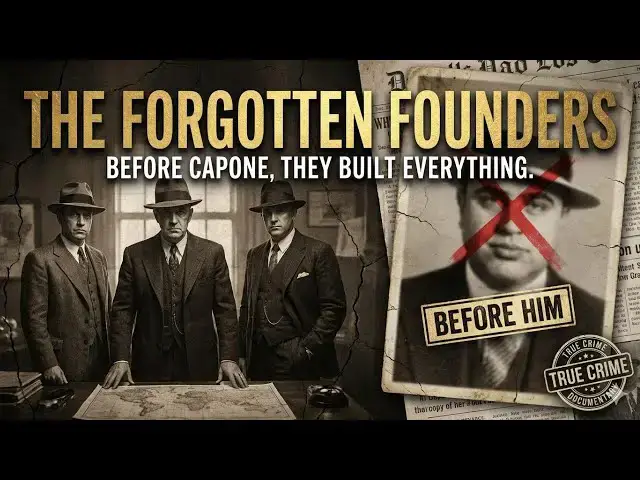
Forget everything you think you know about Mafia origins—the true founders built their empire thirty years before Prohibition, and their names have been deliberately erased from history.
This documentary exposes the forgotten architects who created organized crime's foundational structures between 1869 and 1920. We're investigating the men who established the first American crime families, wrote the rules that still govern the underworld, and built systems that made everything from Capone to the Five Families possible.
You'll discover how Charles Matranga created labor racketeering on the New Orleans waterfront—and survived America's largest mass lynching. The truth behind Giuseppe Morello's organizational genius that invented family hierarchy. Why Ignazio "The Wolf" Lupo's Black Hand terror campaign created the code of silence that still protects criminals today. How a Sicilian don named Cascio Ferro crossed the Atlantic to teach American criminals about political corruption. And the real story of Salvatore D'Aquila, the first Boss of Bosses whose systems became the Five Families structure.
This investigation draws from the earliest federal investigations, Italian immigration records, police archives from New Orleans to New York, and fragmentary testimony from witnesses to the Mafia's birth. Every founder examined. Every origin exposed.
For the complete cinematic history of organized crime, explore our 100-episode master series on the main channel, Global Mafia Universe. Link in description.
Which founding father do you think deserves more recognition? Drop your pick below.
0:00 The Founders History Forgot
1:25 Why These Names Were Erased
3:15 Charles Matranga: The First American Godfather
6:30 Giuseppe Morello: Creator of Family Structure
9:15 Ignazio Lupo: The Wolf Who Built Terror
12:30 Don Vito Cascio Ferro: The Old World Connection
16:00 Salvatore D'Aquila: The First Boss of Bosses
19:30 The Legacy That Outlasted Fame
Show More Show Less View Video Transcript
0:00
April 14th, 1903.
0:02
A barrel washed up on the shore of the
0:04
East River near 11th Street in
0:06
Manhattan. Inside, folded in half with
0:09
his throat slashed and 17 stab wounds
0:11
across his torso, lay Benadeetto
0:14
Medonia. His ears had been cut off, his
0:17
genitals had been mutilated, and carved
0:19
into his chest was a symbol that New
0:21
York police had never seen before. This
0:24
wasn't a murder. This was a message
0:26
written in blood by men whose names have
0:28
been deliberately erased from history.
0:30
Here's what every mafia documentary gets
0:32
wrong. They start the story in the wrong
0:34
decade. They focus on faces that came
0:36
later. Alapone didn't invent organized
0:39
crime. Lucky Luciano didn't create the
0:41
commission out of nothing. These famous
0:43
names built on foundations laid by men
0:46
who operated 30 years earlier. Men who
0:48
established the codes. Men who drew the
0:51
territorial lines. men who created the
0:54
organizational structures that made
0:56
everything that followed possible. The
0:58
true architects of American organized
1:00
crime arrived on boats from Sicily
1:02
between 1880 and 1,95.
1:05
They carried with them traditions forged
1:07
over centuries of resistance to foreign
1:09
occupation. They possessed
1:11
organizational knowledge that European
1:13
law enforcement had failed to penetrate,
1:15
and they built an empire worth over $50
1:17
million by 1910. Decades before
1:20
Prohibition supposedly gave birth to the
1:22
American Mafia. Why don't we know their
1:24
names? Because anonymity was their
1:27
greatest weapon. These founders
1:28
understood something that later
1:30
generations forgot. Fame attracts
1:33
attention. Headlines invite
1:35
investigation. The men who truly built
1:37
the mafia preferred shadows to
1:39
spotlights. They created systems
1:41
designed to outlast individual
1:42
participants. They wrote rules that
1:44
still govern organized crime today.
1:46
Consider what they accomplished without
1:48
the advantages later. Mobsters enjoyed
1:52
no prohibition windfall, no national
1:55
wire services, no Las Vegas casinos,
1:58
just raw organizational genius applied
2:01
to extortion, counterfeiting, murder for
2:04
hire, and territorial control. They
2:07
generated fortunes that would be worth
2:09
billions today. They corrupted police
2:11
forces from New Orleans to New York.
2:14
They established diplomatic
2:15
relationships between criminal
2:17
organizations that persist into the
2:19
present. The figures we're about to
2:21
examine aren't famous. You won't find
2:23
movies about them. Documentary series
2:26
ignore their existence.
2:28
But without them, there would be no
2:30
Capone, no Luciana, no Genovius, or
2:33
Gambino. The empire they built became
2:36
the template for organized crime
2:38
worldwide.
2:39
Who were these shadow architects? What
2:41
methods did they develop? How did their
2:44
innovations shape the criminal
2:45
organizations that followed? Today,
2:47
we're opening the vault. These are the
2:49
secrets they thought were buried
2:50
forever. What you're about to hear comes
2:52
from the earliest federal investigations
2:55
into organized crime. Files that predate
2:57
the FBI's official acknowledgement that
3:00
the mafia existed. It comes from Italian
3:02
government records tracking known
3:04
criminals who immigrated to America. It
3:07
comes from police archives in New
3:09
Orleans, New York, and Chicago that
3:12
document crimes nobody thought to
3:14
connect. And it comes from the
3:15
fragmented testimony of men who
3:17
witnessed the birth of an empire. Five
3:20
founding fathers.
3:22
Five men who built the infrastructure
3:24
that organized crime still uses today.
3:27
Five pioneers whose names should be
3:29
spoken alongside the famous bosses who
3:31
inherited what they created. Each one
3:33
contributed something essential to the
3:36
mafia's operating system. Each one paid
3:38
a price for their innovation. These
3:40
weren't lucky criminals who stumbled
3:42
into success. They were strategic
3:44
thinkers who applied oldw world
3:46
knowledge to new world opportunities.
3:48
They created the first American crime
3:50
families. They established the first
3:52
territorial agreements. They developed
3:54
the first systematic approaches to
3:56
corruption, extortion, and murder.
3:59
Everything that followed was iteration
4:01
on their original design. The history of
4:03
organized crime has been rewritten to
4:06
start in the 1920s. Today, we're
4:09
restoring the chapters that came before.
4:12
First up, the man who drew blood before
4:14
anyone knew what was coming. New
4:16
Orleans, 1869.
4:19
A ship from Polarmo docked at the busy
4:21
port, disgorgging passengers who had
4:23
paid their life savings for passage to
4:25
America. Among them walked men whose
4:27
names appeared on no passenger manifest,
4:29
whose faces matched no official
4:31
photograph, whose pockets contained
4:33
letters of introduction to countrymen
4:35
already established in the city's
4:37
produce markets. The Sicilian mafia had
4:39
arrived on American soil, and Charles
4:42
Matanga was about to build its first
4:45
kingdom. The New Orleans waterfront in
4:47
the 1870s represented the largest point
4:49
of entry for goods flowing into the
4:53
American heartland. fruit, particularly
4:55
bananas and citrus, arrived by the
4:57
shipload from Central America and the
4:59
Caribbean. Whoever controlled the docks
5:02
controlled millions of dollars in
5:03
commerce. The Sicilians, who settled
5:05
around the French market, understood
5:07
this immediately. Charles Matanga
5:10
arrived in New Orleans around 1880,
5:12
joining a community of Sicilian
5:14
immigrants had already begun organizing.
5:16
The existing structure was loose, more
5:19
village association than criminal
5:21
enterprise. Matanga saw the potential
5:23
for something more systematic. He had
5:25
connections to Palmo's established
5:27
criminal networks. He possessed the
5:29
organizational knowledge they had
5:30
refined over generations. And he had the
5:33
ruthlessness to eliminate anyone who
5:35
stood in his way. By 1885, Matanga had
5:38
consolidated control over significant
5:40
portions of the waterfront Stephodor
5:42
operations. His method was elegant.
5:46
He placed his men in positions that
5:48
controlled the loading and unloading of
5:50
specific cargo. Ships that employed his
5:52
workers received efficient service.
5:54
Ships that didn't experienced mysterious
5:56
delays, damaged goods, and workers who
5:59
refused to handle their cargo. The
6:01
choice was simple. Pay Matranga or watch
6:04
your business collapse. Here's what the
6:07
history books minimize about Matranga's
6:09
operation. He didn't just run a
6:11
waterfront racket. He created the
6:13
template for labor racketeering that
6:15
would dominate organized crime for the
6:17
next century. Control the workers. Tax
6:20
the employers.
6:22
Use violence selectively to demonstrate
6:24
consequences. Provide genuine services
6:27
that make your presence seem beneficial
6:29
rather than parasitic. Matranga system
6:31
generated over $200,000 annually by
6:34
1890.
6:36
In today's money, that exceeds $5
6:38
million. All from a single port. The
6:41
Hennessy assassination of 1890 revealed
6:43
both the power and the vulnerability of
6:46
the early mafia. Police chief David
6:48
Hennessy had been investigating the
6:50
Matongus and their rivals, the
6:53
Provenzano faction. On October 15th,
6:56
1890, assassins ambushed Hennessy near
6:58
his home, firing multiple shotgun
7:01
blasts. He died.
7:05
The next day, the investigation that
7:07
followed led to the arrest of 19
7:09
Sicilians connected to the Matranga
7:11
organization. What happened next shaped
7:14
American organized crime forever. The
7:16
trial ended in a quiddles and hung
7:18
juries despite seemingly strong
7:20
evidence. The American public, convinced
7:23
of Italian guilt, responded with fury.
7:26
On March 14th, 1891, a mob of several
7:29
thousands stormed the Orleans Parish
7:31
prison and lynched 11 of the defendants.
7:34
The incident became an international
7:36
crisis, temporarily straining relations
7:38
between the United States and Italy.
7:40
Matranga himself avoided the mob. He was
7:43
released before the lynching and
7:45
immediately resumed operations,
7:47
understanding that survival required
7:49
adaptation. The New Orleans mafia
7:51
learned to operate more quietly, to
7:53
corrupt more systematically, and to
7:56
avoid the public confrontations that
7:58
invited vigilante response. These
8:00
lessons flow to every other American
8:02
city where Sicilians were establishing
8:04
operations. But that's nothing compared
8:07
to what comes next. Coming in at number
8:09
four, the architect of American mafia
8:13
structure. Jeppe Mel arrived in New York
8:15
in 1892 with a deformed right hand that
8:18
would earn him the nickname the clutch
8:19
hand. What he lacked in physical
8:22
perfection, he compensated for with
8:24
organizational genius. Within a decade,
8:27
he would create the first true American
8:29
mafia family, establishing the
8:31
hierarchical structure that still
8:33
defines organized crime. Mel came from
8:35
Corleong, Sicily, a town whose name
8:38
would later become synonymous with
8:39
fictional mafia power. His family had
8:42
deep connections to the Sicilian
8:43
criminal underworld. When he arrived in
8:45
East Harlem, he immediately began
8:47
organizing the scattered Sicilian
8:49
criminals into something more coherent.
8:51
His vision was revolutionary.
8:54
A single organization with clear
8:56
leadership, defined territories,
8:58
systematic revenue collection, and
9:00
coordinated enforcement. The Mel
9:02
family's primary business was
9:04
counterfeiting. They produced fake
9:06
American currency of remarkable quality.
9:09
Using engravers brought from Italy and
9:11
distribution networks extending across
9:13
the eastern United States. Secret
9:15
Service investigations estimated that by
9:17
1900, the Mel operation had printed over
9:20
$500,000 in counterfeit bills. The real
9:23
value exceeded that as the bills
9:26
circulated multiple times before
9:28
detection. His organizational
9:29
innovations went far beyond printing
9:32
fake money. Mel established the first
9:34
recorded system of what later
9:36
generations would call crews. Each crew
9:38
controlled specific territory and
9:40
criminal activities. Each crew answered
9:42
to captains who reported the Mel. Each
9:45
crew contributed regular payments to the
9:47
family's central treasury. The structure
9:49
allowed expansion without losing
9:51
control. Here's the hidden truth about
9:53
Mel's influence. He didn't just build
9:56
one family. He established the model
9:58
that all five New York families would
10:00
eventually adopt. The hierarchical
10:02
structure, the territorial divisions,
10:05
the rules governing violence between
10:07
members, the system of tribute and
10:11
kickbacks. Every element that later
10:13
historians ends attribute to Luciano or
10:15
Marenzano originated in Mel's East
10:18
Harlem operations. The Barro murder of
10:20
1903 that opened our story connected
10:23
directly to Mela's organization.
10:25
Benadetto Monia was a counterfeitter who
10:27
had either cheated or informed on the
10:29
family. His mutilated body in the barrel
10:32
served as a message to anyone
10:33
considering similar betrayal. The
10:35
investigation that followed, led by
10:37
Detective Jeppe, became the first
10:39
serious American law enforcement effort
10:41
against organized crime. Mel faced
10:43
federal prosecution for counterfeiting
10:45
in 1910 and received a 25-year sentence.
10:49
His imprisonment didn't destroy his
10:51
organization. Instead, it demonstrated
10:53
the durability of his structural
10:55
innovations. The family continued
10:57
operating under new leadership,
10:59
maintaining the systems Mel had
11:01
established. He emerged from prison in
11:03
1920 and was murdered in 1930, but his
11:06
creation outlived him by generations.
11:08
The deeper you go, the darker it gets.
11:11
Number three takes us to the man who
11:13
brought oldworld methods to new world
11:15
opportunities. Ignazio Lupau walked the
11:18
streets of East Harlem like a predator
11:20
surveying territory. Tall, handsome, and
11:23
absolutely ruthless. He earned the
11:26
nickname the wolf, not from associates
11:28
trying to flatter him, but from victims
11:30
who recognized what he was. His
11:32
partnership with Jeppe Mel created the
11:35
most effective criminal enterprise
11:36
America had yet seen. Lup arrived in New
11:39
York in 1898, already carrying a murder
11:42
warrant from Sicily. He had killed a
11:44
business rival in Polmo and fled before
11:46
authorities could arrest him. This
11:48
willingness to use lethal violence as a
11:50
business tool would define his American
11:52
career. Within months of arrival, he had
11:55
established himself as Mela's primary
11:57
enforcer and business partner. Their
12:00
collaboration combined complimentary
12:02
skills. Mel possessed organizational
12:05
vision and political connections. Lup
12:07
brought operational intensity and a
12:09
talent for intimidation that made
12:11
resistance seem pointless. Together,
12:14
they expanded beyond counterfeiting into
12:16
what they called the Blackhand, a
12:18
systematic extortion operation that
12:20
terrorized Italian immigrant communities
12:22
from New York to Chicago. The Blackhand
12:25
method was psychologically
12:26
sophisticated. Victims received letters
12:29
demanding payment, often decorated with
12:31
crude drawings of skulls, daggers, or
12:35
black handprints. The letters promised
12:37
violence against the victim and their
12:38
family if payment wasn't made. Unlike
12:41
random criminal threats, blackhand
12:43
demands came with demonstrated
12:45
consequences. When targets refused to
12:47
pay, they suffered bombings, beatings,
12:50
or worse. Word spread quickly through
12:52
immigrant communities. Pay or face
12:55
destruction. Here's what nobody tells
12:57
you about Lupo's reign of terror. The
13:00
Black Hand generated more than extortion
13:02
payments. It created a climate of fear
13:05
that made all other criminal operations
13:07
easier. Witnesses didn't testify because
13:09
they feared blackhand retaliation.
13:12
Victims didn't report crimes because
13:14
they knew what happened to those who
13:15
talked to police. Lup's campaign of
13:17
terror became the foundation for the
13:19
code of silence that still protects
13:21
organized crime. His legitimate business
13:23
fronts demonstrated criminal
13:25
sophistication. Lup operated a wholesale
13:28
grocery business, an importing company,
13:30
and real estate operations throughout
13:32
East Harlem. These enterprises provided
13:35
moneyaundering capabilities, employment
13:37
for criminal associates, and social
13:39
standing in the community. The model of
13:41
using legitimate businesses to support
13:43
and disguise criminal activity became
13:46
standard organized crime practice. Lup's
13:48
downfall came through the same
13:50
counterfeiting operations that had made
13:52
him wealthy. Federal prosecution in 1910
13:55
sent him to prison alongside Mela.
13:57
Unlike his partner, Lup struggled to
14:00
maintain influence from behind bars. He
14:02
served multiple sentences, including a
14:04
30-year term at Atlanta Federal
14:06
Penitentiary. He died in 1947,
14:10
largely forgotten, having outlived his
14:12
power by decades. And this is where
14:14
things get truly dangerous, landing at
14:17
number two, the bridge between worlds
14:19
that made everything possible. Donvito
14:21
Casio understood something that purely
14:24
American criminals couldn't grasp. The
14:26
Sicilian mafia's power came not from
14:29
violence alone, but from its integration
14:31
into society. Robbery and extortion were
14:34
crude tools. True criminal power came
14:37
from becoming necessary, from providing
14:39
services that legitimate institutions
14:41
couldn't or wouldn't provide. Casio was
14:44
already a legend in Sicily when he
14:46
arrived in New York in 1901.
14:49
He had built a criminal network across
14:52
western Sicily that controlled
14:54
everything from livestock theft to
14:56
political corruption. His arrival in
14:58
America was partly flight from Italian
15:01
law enforcement pressure, partly
15:03
reconnaissance mission to explore new
15:05
world opportunities. What he discovered
15:07
would reshape organized crime on two
15:10
continents. He spent 3 years moving
15:12
through Italian immigrant communities
15:13
from New York to New Orleans. He met
15:16
with established criminal figures. He
15:18
observed their operations. He analyzed
15:21
their strengths and weaknesses. And he
15:23
identified the crucial innovation that
15:25
American Sicilians had not yet fully
15:27
developed. Systematic political
15:29
corruption as criminal infrastructure.
15:31
His contribution to American organized
15:33
crime was conceptual rather than
15:35
operational. Casio Pharaoh taught that
15:38
every successful criminal organization
15:40
needed relationships with legitimate
15:42
power. Police captains should be on
15:45
payroll. Judges should receive
15:47
contributions. Politicians should
15:49
understand who their real constituents
15:51
were. This wasn't bribery in the crude
15:54
sense. It was the creation of symbiotic
15:56
relationships where criminal and
15:58
legitimate worlds served each other's
16:00
interests. Here's the hidden truth about
16:03
Casio Pharaoh's American period. He
16:05
helped organize the fragmented Sicilian
16:08
criminal groups into something
16:09
resembling a coordinated network. Before
16:12
his intervention, each gang operated
16:15
independently, often violently competing
16:17
for territory. Casio promoted the idea
16:20
of territorial agreements, peaceful
16:22
resolution of disputes, and collective
16:25
action against shared threats. These
16:27
concepts would later be formalized as
16:29
the commission, but their origins trace
16:31
to a Sicilian dome walking the streets
16:33
of early 20th century New York. His most
16:36
lasting innovation was what Sicilians
16:38
called Pizui Novanta, roughly translated
16:40
as the wet beak. Instead of demanding
16:42
large payments that ruined businesses,
16:45
criminals should take small percentages
16:47
that allowed businesses to prosper while
16:49
providing steady income. A thriving
16:51
victim pays taxes forever. A ruined
16:54
victim pays nothing. This philosophical
16:56
shift transformed organized crime from
16:59
parasetism to something resembling
17:01
twisted partnership. Casio Pharaoh
17:03
returned to Sicily in 1904, but his
17:06
American influence persisted through the
17:08
networks he had cultivated. He
17:09
maintained correspondence with American
17:11
criminal figures for decades. Young men
17:14
seeking to establish themselves in
17:15
America sought his blessing and letters
17:18
of introduction. The bridge he built
17:19
between old world and new world criminal
17:22
traditions remained standing long after
17:24
he ceased traveling. What comes next?
17:27
Even the FBI couldn't believe it.
17:32
Dquila arrived in New York around 1906,
17:36
settling in Brooklyn, where a growing
17:38
Sicilian community offered opportunities
17:40
for ambitious criminals. Unlike Mel and
17:43
Lup, who operated primarily in
17:45
Manhattan, Dquila built his power base
17:48
in the outer burrows. His territorial
17:50
vision was expansive. He saw Brooklyn,
17:53
Queens, and the Bronx's Virgin Territory
17:56
where a patient operator could build
17:58
without constantly fighting established
18:00
powers. His rise coincided with Mel and
18:03
Lup's imprisonment. With the dominant
18:05
Manhattan organization temporarily
18:07
headless, Dquila moved to fill the power
18:10
vacuum. He didn't challenge the Mel
18:12
family directly. Instead, he positioned
18:14
himself as a mediator between competing
18:16
factions, a neutral power who could
18:19
resolve disputes fairly. This diplomatic
18:21
approach allowed him to accumulate
18:23
influence without accumulating enemies.
18:26
By 1914, Dquila commanded the largest
18:29
Italian criminal organization in New
18:30
York. His operations spanned gambling,
18:34
lone saring, labor racketeering, and
18:36
extortion across multiple burrows. More
18:39
importantly, he had established
18:40
relationships with other criminal groups
18:42
that acknowledged his seniority. When
18:44
disputes arose between families, the
18:46
akila mediat when major decisions
18:48
affected multiple organizations, Dquila
18:51
convened meetings. The position of boss
18:53
of bosses existed because Dquila made it
18:55
exist. Here's what the historical record
18:58
has buried about Dquila's achievement.
19:00
He created the territorial system that
19:02
prevented constant warfare between
19:04
criminal organizations. Each family
19:06
received defined territory where they
19:08
operated with minimal interference.
19:10
Expansion required negotiation, not
19:13
conquest. Violence between families
19:15
required approval from the boss of
19:17
bosses. This structure dramatically
19:19
reduced the costly conflicts that had
19:21
plagued earlier criminal operations. His
19:23
organizational chart placed him at top a
19:25
network that would evolve into the
19:27
Gambino crime family. Below him, under
19:30
bosses managed day-to-day operations.
19:32
Captains supervised crews handling
19:34
specific territories and activities.
19:36
Soldiers performed the actual criminal
19:39
work. Associates, not yet fully
19:41
inducted, proved their worth before
19:43
receiving membership. This hierarchy
19:46
became universal in American organized
19:48
crime. The rules he codified governed
19:50
criminal behavior for generations.
19:52
Members couldn't harm other members
19:54
without permission.
19:56
Disputes required mediation before
19:58
violence. Business opportunities in
20:01
another family's territory required
20:03
negotiation. Informing to law
20:05
enforcement meant death. These weren't
20:07
suggestions. They were laws enforced as
20:10
rigorously as any government statute.
20:12
Dquila srain ended on October 10th, 1928
20:16
when assassins shot him 14 times outside
20:19
a Brooklyn medical office. His killers
20:21
were never identified, though rising
20:23
powers, including Joe Miseria, benefited
20:25
from his removal. The murder
20:27
demonstrated the limits of even the most
20:29
powerful position. But the systems
20:31
Dquila had built survived him. The five
20:34
family structure, the territorial
20:36
agreements,
20:38
the rules of membership and conduct, all
20:40
of it persisted, adapted, and continues
20:43
operating into the present. What these
20:46
five founders revealed together is a
20:48
creation story that contradicts
20:50
everything we've been taught about
20:51
organized crime. The mafia didn't emerge
20:53
from prohibition's sudden wealth. It
20:56
didn't coales spontaneously when
20:58
Sicilian immigrants needed protection.
21:00
It was deliberately constructed by men
21:02
who applied centuries of European
21:04
criminal knowledge to American
21:05
opportunities. The pattern across their
21:07
careers reveals something remarkable.
21:10
Each founder contributed a specific
21:12
innovation that became permanent
21:13
infrastructure. Matunga created labor
21:16
racketeering.
21:18
Mel established family structure. Lup
21:20
perfected intimidation as systemic
21:23
policy. Casio Pharaoh introduced
21:25
political corruption as criminal
21:27
strategy. Dquila built the interf family
21:30
governance system. Together they created
21:32
an operating system for crime that has
21:34
survived every attempt to destroy it.
21:36
Their methods proved more durable than
21:38
any individual career.
21:40
Mel spent decades in prison. Lup died in
21:43
obscurity. Matanga faded after the New
21:47
Orleans crisis. Casio was eventually
21:50
imprisoned by Mussolini. Dquila was
21:52
assassinated by rising powers. Yet every
21:54
system they created outlasted their
21:56
personal involvement. The organizations
21:59
they built still function. The rules
22:01
they wrote still govern. The structures
22:03
they designed still shape organized
22:06
crime worldwide. Some mysteries remain
22:10
unsolved. How much wealth did these
22:12
founders actually accumulate? Records
22:15
from the period are fragmentaryary.
22:18
Who ordered Dquila s murder? The
22:20
question has never been definitively
22:22
answered. What happened to the fortunes
22:24
built by men who left no documented
22:26
estates? The money trail disappears into
22:29
legitimate businesses, real estate
22:31
holdings, and family enterprises that
22:33
still exist today. The vault has been
22:36
opened. The first fathers have been
22:38
named. But their greatest achievement
22:40
wasn't the money they made or the
22:41
organizations they built. It was the
22:43
template they created. Every crime
22:45
family that followed walked past these
22:47
men carved. Every criminal code honors
22:50
rules these men wrote. Every territorial
22:52
agreement reflects systems these men
22:55
designed. Al Capone became famous. These
22:58
men became permanent. If you want the
23:01
full cinematic story of the groups
23:03
behind these secrets, check out our 100
23:06
episode master series on our main
23:08
channel, Global Mafia Universe. The link
23:11
is in the description. Go deep.